Artwork
Farfurie de formă aplatizată, cu muchia buzei puternic concavă spre exterior și decorată cu onduleuri mari. Piesa este modelată la roata olarului, angobată pe față și decorată, prin pictare cu pensula, cu motive decorative vegetale stilizare (flori și frunze), dispuse central, într-un registru decorativ încadrat într-un cerc albastru, și patru grupuri de flori cu frunze, amplasate pe buza farfuriei. Cromatica: alb, verde, albastru, siena arsă. Pe față farfuria este smălțuită cu un smalț transparent.
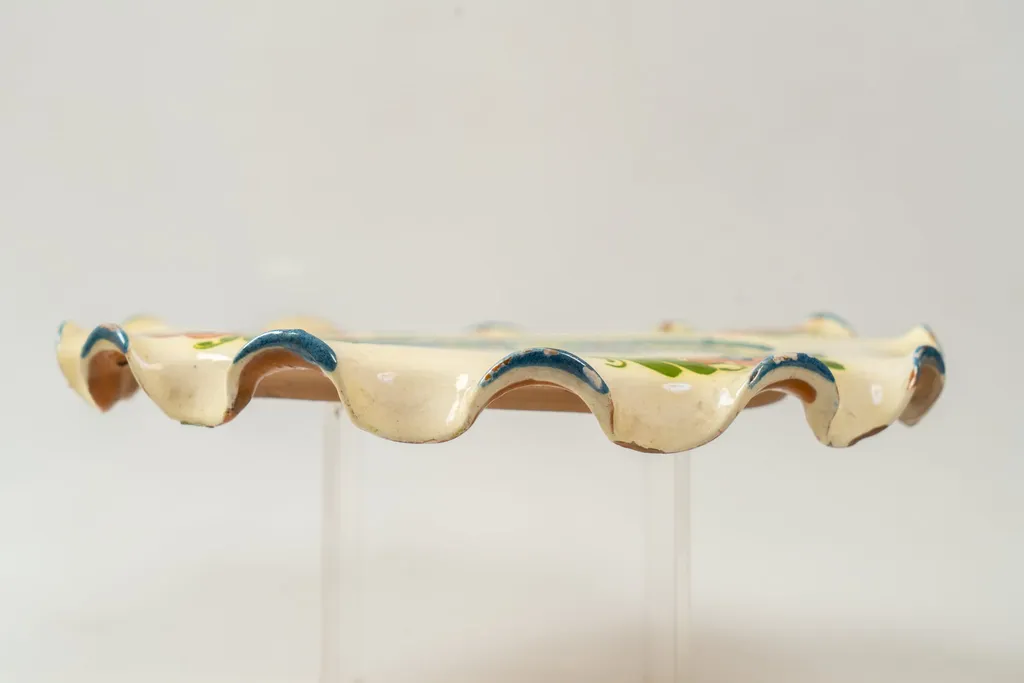
Farfurie de formă aplatizată, cu muchia buzei puternic concavă spre exterior și decorată cu onduleuri mari. Piesa este modelată la roata olarului, angobată pe față și decorată, prin pictare cu pensula, cu motive decorative vegetale stilizare (flori și frunze), dispuse central, într-un registru decorativ încadrat într-un cerc albastru, și patru grupuri de flori cu frunze, amplasate pe buza farfuriei. Cromatica: alb, verde, albastru, siena arsă. Pe față farfuria este smălțuită cu un smalț transparent. is a print by Unknown. It dates from 1850 and is held in the collection of the Ethnographical Museum of Transylvania. This shallow ceramic plate features a broadly curved, concave rim with a pronounced groove along its outer edge.
About this work
Overview
Crafted on a potter’s wheel, it is coated in a transparent glaze over an applied slip, creating a soft, off-white surface.
This shallow ceramic plate features a broadly curved, concave rim with a pronounced groove along its outer edge. Crafted on a potter’s wheel, it is coated in a transparent glaze over an applied slip, creating a soft, off-white surface. The decoration is limited to the interior, where stylized floral motifs are painted in a loose, freehand manner, contrasting with the precision of the vessel’s form.
Subject & Meaning
The decoration centers on simplified botanical elements—flowers and leaves—arranged in a circular band just inside the rim. Four additional floral clusters are placed along the upper edge, suggesting a rhythmic, non-symmetrical composition. The motifs lack naturalistic detail, indicating a symbolic or ornamental intent rather than a literal representation of flora, common in regional folk pottery traditions.
Technique & Style
The plate was thrown on a wheel and coated with a white slip before being painted with brushes using pigments in green, blue, and burnt sienna. The floral patterns are applied with a sketchy, uneven hand, and the enclosing blue circle appears irregularly drawn, not mechanically traced. The glaze is thin and uneven, revealing subtle variations in the clay body beneath, emphasizing its handmade character.
History & Provenance
This piece belongs to a tradition of utilitarian ceramics produced in Eastern Europe during the late 19th or early 20th century. Its form and decoration align with regional pottery workshops where functional wares were adorned with locally familiar motifs. No specific origin or maker is recorded, but similar examples are held in ethnographic collections across Romania and Moldova.
Context
Such plates were likely used in domestic settings for serving food, their decoration serving both aesthetic and cultural purposes. The restrained palette and simplified motifs reflect a vernacular approach to ornamentation, distinct from urban or industrial ceramics. The emphasis on hand-painted flora suggests a connection to rural life and seasonal cycles, common themes in folk material culture.
Legacy
This type of pottery represents a continuity of pre-industrial craft practices in Eastern Europe. Though mass-produced ceramics later replaced such wares, examples like this remain in ethnographic museums as records of local techniques and visual language. Their informal aesthetics continue to inform contemporary ceramic artists interested in handmade traditions and imperfection as expressive values.
Artist & collection
Museum
Ethnographical Museum of Transylvania
Continue through works from the same source collection.
 Domestic Scene
 Giacomo and Cardinal Marco, investing Andrea, Abbot of San Zeno, with his Benefice
 The Nymph of Fontainebleau
 Portrait of a Woman
 Madonna and Child with Saints in the Enclosed Garden
 Venus and Minerva
 Family Group of Four on Sofa
 Wall painting from Room H of the Villa of P. Fannius Synistor at Boscoreale
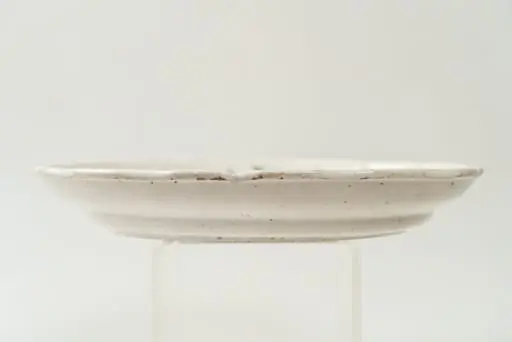 Farfurie de formă aplatizată, cu marginea lată, răsfrântă, ușor concavă spre interior și muchie ușor ondulată. Decorul, dispus pe un fond alb, prin pictare, este format din motive florale fin stilizate (flori și frunze), dispuse central, pe fundul farfuriei, și pe buza acesteia. Cromatica decorului: alb, verde, brun, galben-ocru, albastru.
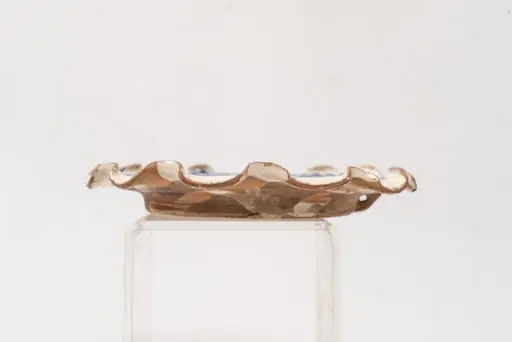 Farfurie de formă semi-adâncă, cu buză lată, evazată și muchia buzei puternic ondulată (onduleuri înalte). Farfuria este angobată pe fața interioară cu un strat de humă albă, peste care este pictat cu cornul și cu pensula decorul monocromatic, format dintr-un motiv floral și motive fitomorfe stilizate: o floare de lalea cu frunze (două tipuri de frunze) și vrejuri, înscrisă în două cercuri albastre, ce formează registrul decorativ central, de pe fundul farfuriei. Buza acesteia este decorată cu un șir continuu de linii dispuse în formă de V, înșiruite de-a lungul unei linii circulare, sugerând un șir de frunze duble. Cromatica: alb, albastru. Farfuria este acoperită pe fața decorată cu un strat de smalț transparent.
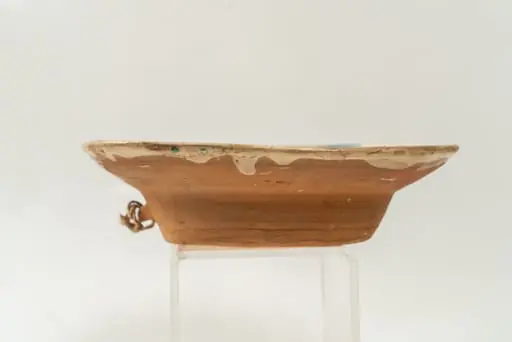 Farfurie adâncă, cu corp mic și buză lată, evazată; piesa este modelată la roata olarului și angobată cu humă albă pe fața interioară. Decorul este realizat prin pictare cu pensula și se compune din motive decorative florale și vegetale stilizate, dispuse central, pe fundul vasului (o floare albastră cu frunze verzi) și pe buza farfuriei (4 flori albastre alternate cu 4 grupuri de frunze). Fața decorată a farfuriei este acoperită cu un strat de smalț transparent. Cromatica: alb, albastru, verde.
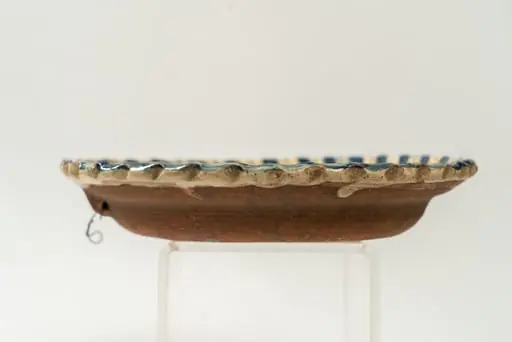 Farfurie adâncă, cu corp scund și buză lată, răsfrântă și muchie ondulată (mici alveole). Central, pe fundul farfuriei, este atașată o farfurioară mai mică, cu diametrul de 7 cm și înălțimea de 1 cm, care servea, probabil, pe lângă rolul său decorativ, pentru a ține lumânarea la coliva morților. Piesa este modelată la roata olarului, angobată cu humă albă pe fața interioară a acesteia. Decorul, bogat, este realizat prin pictare cu cornul și cu pensula și constă în motive decorative vegetale stilizate (frunze) și geometrice (linii, puncte, linii spiralate, linie vălurită, motivul colțului de lup), dispuse pe întreaga suprafață a farfuriei. Cromatica decorului: alb, albastru. Farfuria este smălțuită pe interior, cu smalț transparent.
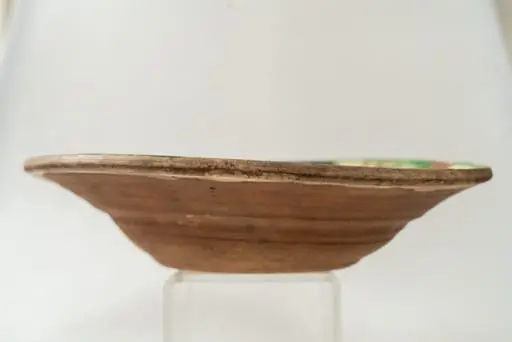 Farfurie mare, de formă adâncă, cu buză răsfrântă. Piesa este modelată la roată, angobată cu humă albă pe fața interioară. Decorul este realizat prin pictare cu pensula, cu smalțuri colorate (verde și maro) și prin sgrafitare. Motivele decorative sunt florale și vegetale stilizate (flori cu frunze) dispuse pe fundul farfuriei (o floare) și patru flori intercalate de patru elemente decorative vegetale (frunze) sugerând motivul inimii, dispuse pe buza farfuriei. Bordura interioară a farfuriei este marcată de o linie groasă sub formă de cerc, de culoare verde. Pe fața interioară a farfuriei este aplicat un strat de smalț transparent.
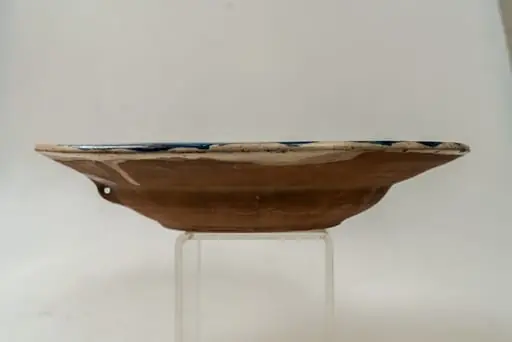 Farfurie mare, adâncă, cu corp scund și buză lată, răsfrântă. Piesa este modelată la roata olarului, angobată cu humă albă pe fața interioară a acesteia. Decorul este unul bogat, realizat prin pictare cu pensula, cu linii groase, și constă în motive decorative florale și vegetale stilizate (flori și frunze), dispuse pe toată suprafața farfuriei. Cromatica decorului: alb, albastru. Farfuria este smălțuită pe interior, cu smalț transparent.
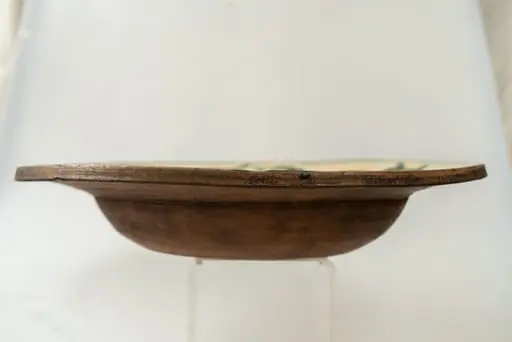 Farfurie mare, de formă adâncă, cu buză lată, răsfrântă. Piesa este modelată la roată, angobată cu humă albă pe fața interioară. Decorul este realizat prin pictare cu pensula și prin sgrafitare și este format din motive decorative florale și vegetale stilizate, dispuse pe fundul farfuriei, într-un registru central (o floare cu patru petale, înconjurată de alte patru flori cu frunze, dispuse diametral opus) și pe buza farfuriei (cinci grupuri de flori și frunze, ca cele de pe fundul farfuriei). Bordura interioară a farfuriei și muchia buzei sunt marcate de linii sub formă de cerc, de culoare verde. Pe buza farfuriei este marcat, prin sgrafitare, anul realizării piesei "1731", încadrat într-un registru decorativ sub formă de inimă. Fața interioară a farfuriei este acoperită cu un smalț transparent. Cromatica: alb, galben, verde.
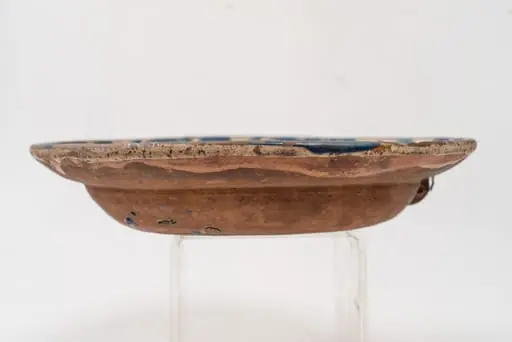 Farfurie adâncă, cu buza evazată și muchia ușor ridicată. Farfuria este angobată pe fața interioară cu un strat de humă albă, peste care este pictat cu cornul și cu pensula decorul monocromatic, format din motive florale și fitomorfe stilizate (tulpină cu cinci flori, din care patru sunt lalele, și frunze, reprezentate pe centrul farfuriei și un șir continuu format din elemente vegetale, ce decorează buza acesteia). Muchia buzei este marcată cu o dungă de culoare albastră. La baza tulpinii cu flori apare pictat cu pensula anul fabricării piesei: 1785. Cromatica: alb, albastru. Farfuria este acoperită pe fața decorată cu un strat de smalț transparent.
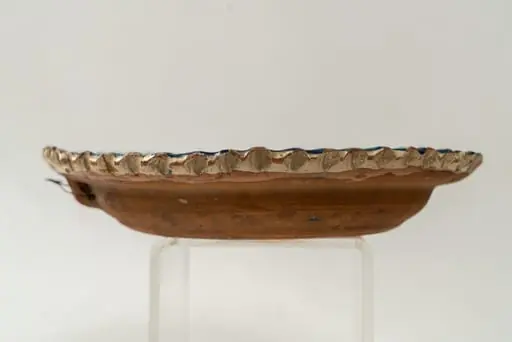 Farfurie semi-adâncă, cu corp scund și buză lată, răsfrântă, ușor concavă spre interior și muchie ondulată (mici alveole). Piesa este modelată la roata olarului, angobată cu humă albă pe fața interioară. Decorul monocromatic, bogat, este realizat prin pictare cu cornul și cu pensula: zona centrală a farfuriei este decorată cu motive florale stilizate - o floare centrală, încadrată într-o linie sub formă de spirală peste care au fost așternute puncte groase; pe exteriorul acestei linii au fost pictate alte flori. Întreg acest registru central este încadrat într-un cerc format dintr-o linie vălurită. Buza farfuriei este decorată cu motive geometrice, într-un registru continuu: linii mici, groase, așezate în formă de V, intercalate de șiruri de puncte mici, sugerând un decor vegetal (frunze). Bordura interioară a farfuriei este marcată de o linie subțire sub formă de cerc iar muchia buzei de o dungă albastră. Cromatica decorului: alb, albastru. Farfuria este smălțuită pe interior cu smalț transparent.
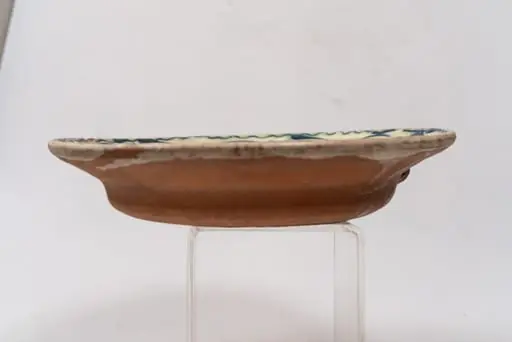 Farfurie semi-adâncă cu buza evazată și muchia rotunjită; este angobată pe suprafața interioară cu un strat de humă albă, peste care este pictat cu cornul decorul monocromatic format din motive florale stilizate și geometrice: centrul farfuriei conține un buchet format din două flori de lalea decorate cu puncte și două flori cu frunze rotunde; la baza acestui buchet este înscris anul confecționării piesei, 1782. Buza farfuriei este decorată cu un șir continuu format din linii în formă de S și grupuri de linii albastre paralele. Suprafața ornamentată a farfuriei este acoperită cu un strat de smalț transparent. Cromatica: alb, albastru.
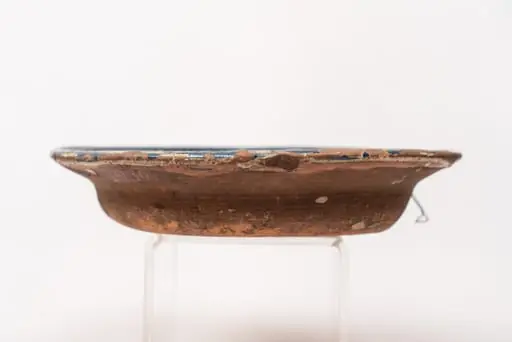 Farfurie semi-adâncă, cu buza răsfrântă; piesa este modelată la roata olarului și angobată cu humă albă pe fața interioară. Decorul monocromatic este realizat prin pictare cu cornul și cu pensula și se compune din motive florale și vegetale stilizate (o tulpină cu două flori de lalea și o floare centrală cu zece petale și frunze, pictate în zona centrală a farfuriei) și motive geometrice (grupuri de linii crescătoare și descrescătoare, șiruri de puncte, linii sub formă de spirală mică, linii hașurate). Câte o linie groasă albastră marchează muchia buzei și bordura interioară a farfuriei. Cromatica: alb, albastru. Fața ornamentată a farfuriei este acoperită cu un start de smalț transparent.