Artwork
Ingang van het Begijnhof in Brugge
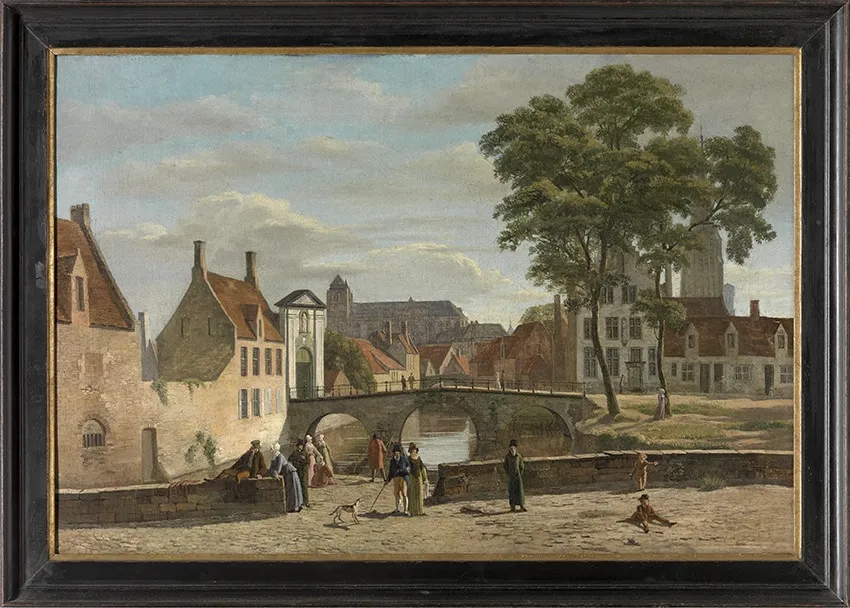
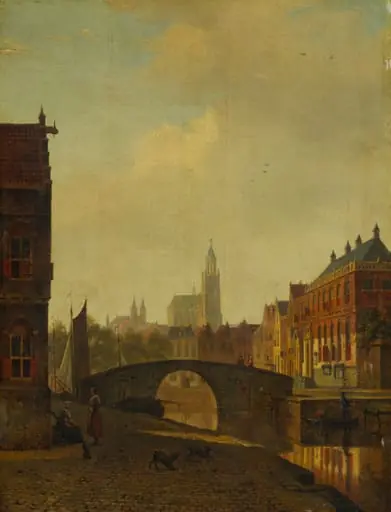
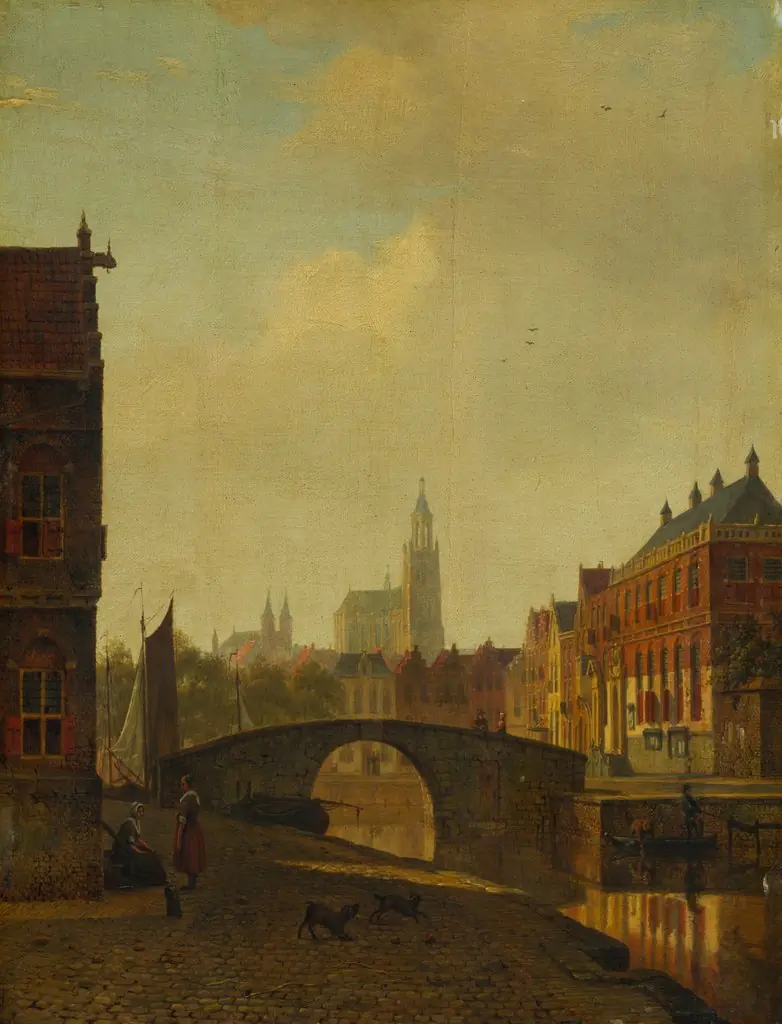
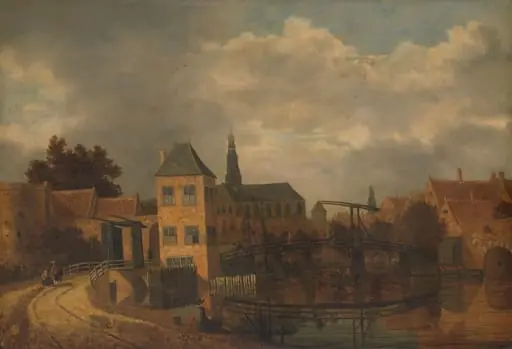
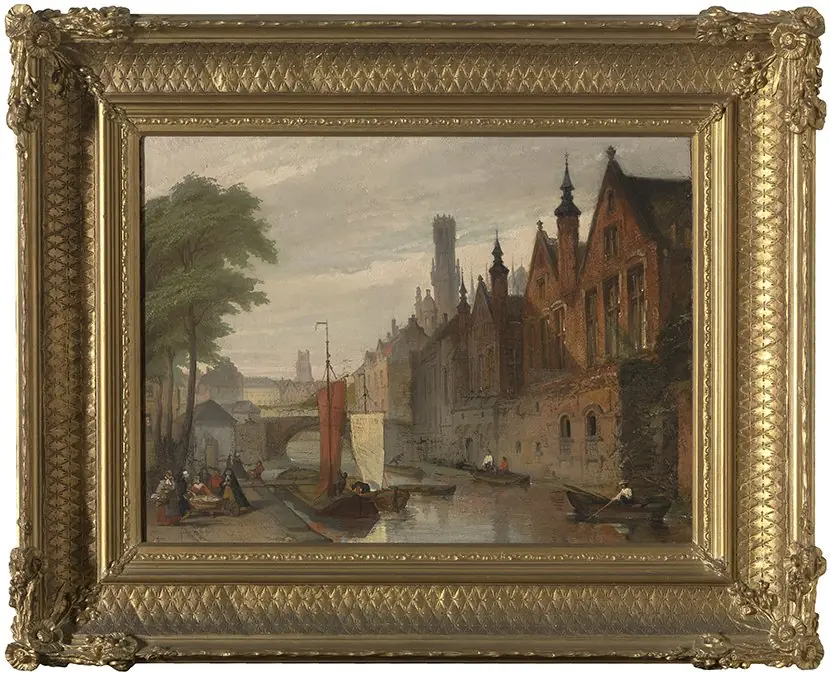
Ingang van het Begijnhof in Brugge is an oil painting. It dates from 1801 and is held in the collection of the Groeningemuseum. The work depicts a tranquil urban vista of Bruges, centered on a modest stone bridge spanning a narrow canal.
About this work
Subject & Meaning
As a cityscape, the work illustrates the architectural and natural elements of the Belgian city, featuring the Reie canal, a bridge, trees, and various houses.
The painting depicts the entrance to the Beguinage in Bruges, capturing a specific urban scene from 1801. As a cityscape, the work illustrates the architectural and natural elements of the Belgian city, featuring the Reie canal, a bridge, trees, and various houses. Prominent landmarks visible in the composition include the Belfry of Bruges, the Church of Our Lady, and the Sint-Salvatorskathedraal.
The scene also incorporates smaller details such as a dog and clouds, grounding the image in daily life. The subject matter represents a view of the historic Beguinage, preserving the visual character of this religious and residential community within the broader context of Bruges.
Technique & Style
Created in 1801, this cityscape is executed in oil paint on a canvas support. The work measures 47.7 cm in height and 71.3 cm in width. Stylistically, the composition presents a detailed view of Bruges, incorporating specific architectural landmarks such as the Belfry, the Church of Our Lady, and the Sint-Salvatorskathedraal alongside the Reie river.
The scene is populated with naturalistic elements including trees, clouds, and a dog, framing the entrance to the beguinage with houses and a bridge.
History & Provenance
The painting Ingang van het Begijnhof in Brugge was created in 1801 by an anonymous 19th-century artist, as indicated by its inception date and attributed authorship. It is an oil on canvas work measuring 47.7 cm in height by 71.3 cm in width, depicting a beguinage scene with architectural and botanical elements including a bridge, houses, a dog, and various religious and civic landmarks. The composition features the Belfry of Bruges, Church of Our Lady, Sint-Salvatorskathedraal, and the Reie River within the context of the Beguinage in Bruges.
The work is part of the collection of the Groeningemuseum, where it is catalogued as a cityscape from the early 19th century.
The painting's provenance traces its presence in the museum's holdings, reflecting its continued preservation and display within a dedicated institutional setting focused on Flemish and Belgian art.
The creation history of the work is rooted in the early 1800s, with its execution dated precisely to 1801, placing it within the transitional period of Neoclassical and Romantic influences in European painting.
The work is held in the collection of the Groeningemuseum in Bruges, where it is catalogued under inventory number NG1234.
It was first exhibited publicly at the museum’s 19th‑century Flemish art display in 1925 and later featured in the traveling exhibition "Early Belgian Landscapes" in 1978.
The painting has also been part of the permanent display of cityscapes at the Groeningemuseum since its acquisition.
Overview
The work depicts a tranquil urban vista of Bruges, centered on a modest stone bridge spanning a narrow canal. Pedestrians in period attire traverse the cobbled roadway, while a solitary dog rests nearby. Gabled houses line the scene, and a prominent church tower rises in the distance, all rendered in subdued, earthy hues.
Context
During the period of its creation, Bruges experienced a revival of interest in its medieval heritage, prompting artists to record its historic quarters. The Begijnhof, with its distinctive architecture and religious history, served as a frequent subject for such works, reflecting broader Romantic‑era fascination with the past.
Artist & collection