Artwork
Leaf from a Beatus Manuscript: the Angel of the Church of Sardis with Saint John
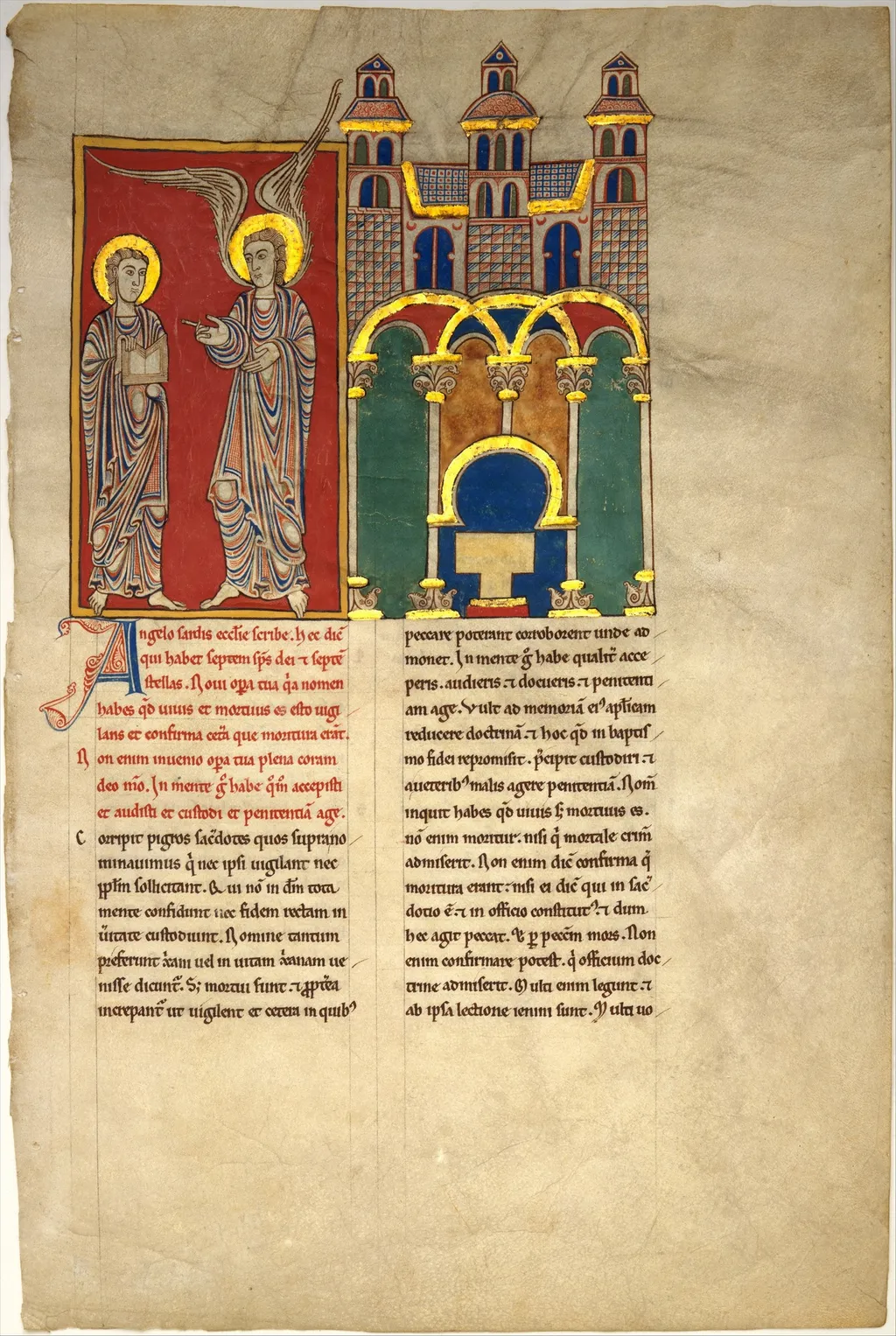
Leaf from a Beatus Manuscript: the Angel of the Church of Sardis with Saint John is an unspecified painting. It dates from 1190 and is held in the collection of the Metropolitan Museum of Art.
About this work
History & Provenance
Created in 1190, this anonymous religious painting depicts the Angel of the Church of Sardis alongside Saint John the Evangelist.
Created in 1190, this anonymous religious painting depicts the Angel of the Church of Sardis alongside Saint John the Evangelist. The work, classified as a leaf from a Beatus Manuscript, measures 44.4 cm in height and 30 cm in width. While the specific commissioning patron and original manuscript context are not detailed in the available records, the piece is firmly dated to the late twelfth century.
It is currently held within the collection of the Metropolitan Museum of Art, cataloged as an anonymous painting. The leaf represents a fragment of a larger illuminated manuscript tradition, preserving the iconography of the Apocalypse commentary attributed to Beatus of Liébana.
Overview
This artwork is a single page extracted from a Beatus Manuscript, a medieval illuminated codex containing commentaries on the Apocalypse of Saint John. The vibrant painting depicts Saint John alongside the Angel of the Church of Sardis. Characterized by its distinctive medieval aesthetic, the leaf combines figural representation with architectural elements and accompanying text, illustrating a key biblical narrative. Its rich colors and detailed imagery are typical of the period's devotional art.
Subject & Meaning
The illustration presents two haloed figures against a striking red ground: Saint John, identifiable by the book he holds, and the Angel of the Church of Sardis. The angel gestures towards Saint John, likely conveying a divine message or revelation from the Book of Revelation. This scene is part of the larger narrative within Beatus manuscripts, which visually interpreted the apocalyptic visions, guiding medieval readers through complex theological texts.
Technique & Style
The painting employs a vivid palette, featuring figures in robes striped with blue and red, set against a bold red background. To the right, an elaborate architectural structure, rendered in shades of green, yellow, red, and blue, includes arches, towers, and a prominent doorway. This stylized representation, along with the black and red text column at the lower left, exemplifies the decorative and narrative approach common in medieval illuminated manuscripts, emphasizing clarity and symbolic color.
Artist & collection

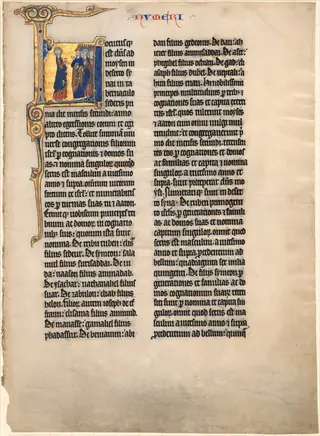 Moses Counting the Children of Israel
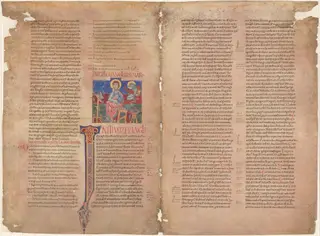 Saint Mark
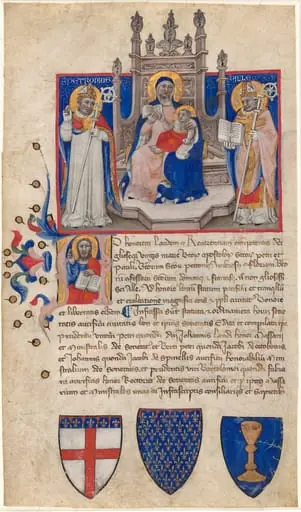 Madonna and Child Enthroned between Saints Petronius and Alle (Eligius); Christ in the Initial A
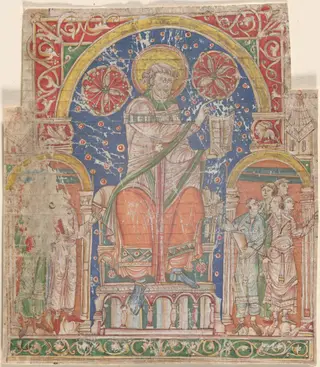 Saint Augustine
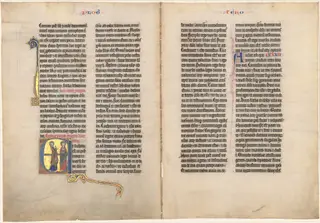 Joshua before the Lord
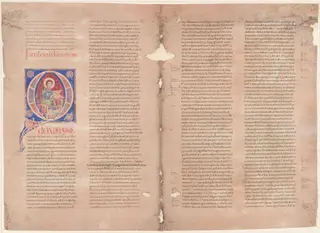 Saint Luke
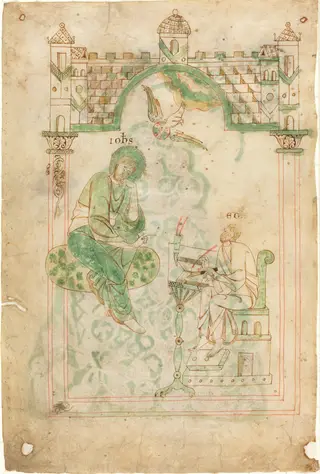 Saint John Dictating to the Venerable Bede
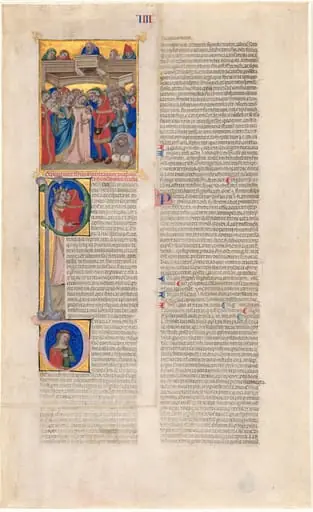 The Marriage; the Kiss of the Bride (initial P); the Bride Abandoned (initial D)
 Four Scenes from the First Book of Samuel