Artwork
Portrait of Empress Maria Feodorovna, Wife of Emperor Paul I
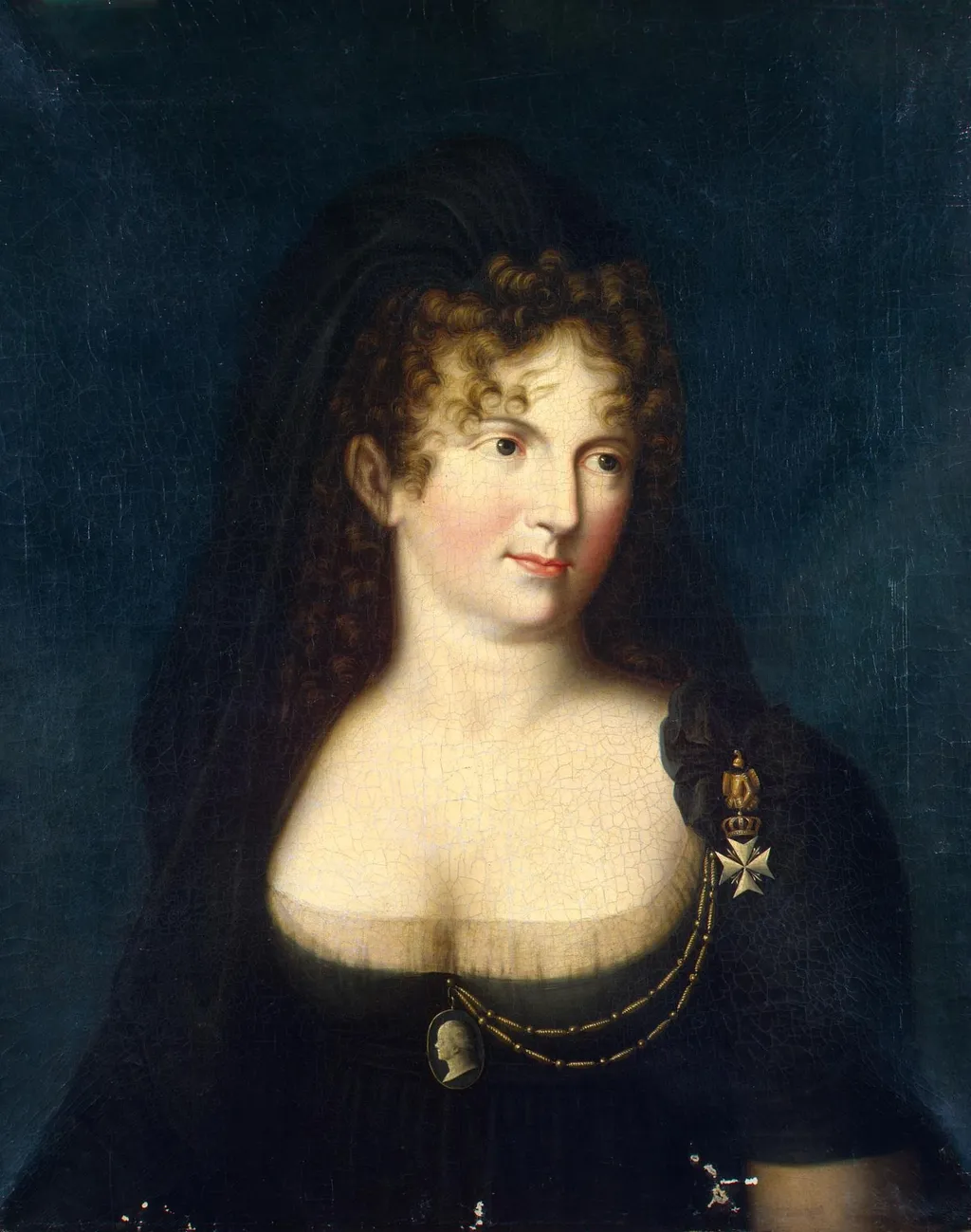
Portrait of Empress Maria Feodorovna, Wife of Emperor Paul I is an oil painting. It dates from 1825 and is held in the collection of the Hermitage Museum. The oil painting depicts Empress Maria Feodorovna, consort of Emperor Paul I, presented in a solemn pose.
About this work
Subject & Meaning
These elements serve as symbolic markers of her status, religious affiliation, and personal history within the Russian imperial court.
The painting depicts Sophie Dorothee of Württemberg, also known as Empress Maria Feodorovna, the wife of Emperor Paul I. Created in 1825, the work portrays the empress in a mourning dress, reflecting a period of grief. Her iconography includes specific regalia: a medallion and the insignia of the Order of Saint John of Jerusalem. These elements serve as symbolic markers of her status, religious affiliation, and personal history within the Russian imperial court.
The composition emphasizes her role as a widowed empress through the somber attire and the inclusion of these distinct honors.
Technique & Style
Oil paint on canvas creates a formal portrait emphasizing quiet dignity through muted tones and precise brushwork. The composition features a medallion and mourning dress rendered with careful handling that conveys restrained elegance. The painting measures 75 cm by 60 cm and was executed in Russia in 1825.
The work demonstrates formal balance and restrained palette characteristic of early 19th-century Russian court portraiture, with attention to material texture and surface finish.
History & Provenance
The portrait was produced in 1825 in Russia, executed in oil on canvas, and depicts Maria Feodorovna (born Sophie Dorothee of Württemberg) in mourning dress with a medallion and the Order of Saint John of Jerusalem. It is attributed to an anonymous painter working in the manner of Gerhard von Kugelgen. The work entered the collection of the Hermitage Museum, where it remains held. It was subsequently featured in the exhibition "Jewels! The Glitter of the Russian Court."
The portrait is held in the collection of the State Hermitage Museum in Saint Petersburg.
Its inventory record corresponds to Hermitage accession number ЭРЖ-3639. The painting was included in the exhibition Jewels! The Glitter of the Russian Court, organized in Russia, where it was shown as part of the display.
Overview
The oil painting depicts Empress Maria Feodorovna, consort of Emperor Paul I, presented in a solemn pose. She wears a black mourning dress complemented by a veil, a gold necklace bearing a medallion, and a decorative brooch on her left shoulder. The backdrop is a deep blue, enhancing the work’s restrained palette and the dignified expression of the sitter.
Context
The portrait aligns with late 18th‑century Russian court portraiture, where mourning dress and symbolic jewelry were commonly used to convey personal loss and dynastic continuity. The inclusion of a portrait medallion reflects the era’s practice of embedding familial connections within formal representations.
Artist & collection

 Madame Roland
 Laulajatar ja näyttelijätär Beata Charlotta Eckerman
 Portrait of Maria Mancini Colonna (1639-1715)
 Portrait of Katarzyna Lessel
 Portrait of Mme de Staël
 Elizabeth Charlotte of the Palatinate, Duchess of Orléans
 Portret de femeie
 Portrait of Johanna Ferdinanda van Collen, Wife of Salomon Rendorp
 Portrait of Karolina née Sapieha 1.v.Potocka 2.v.Sołtyk
 Louise-Marie-Adélaïde de Bourbon-Penthièvre, Duchess of Orléans