Artwork
Rooster
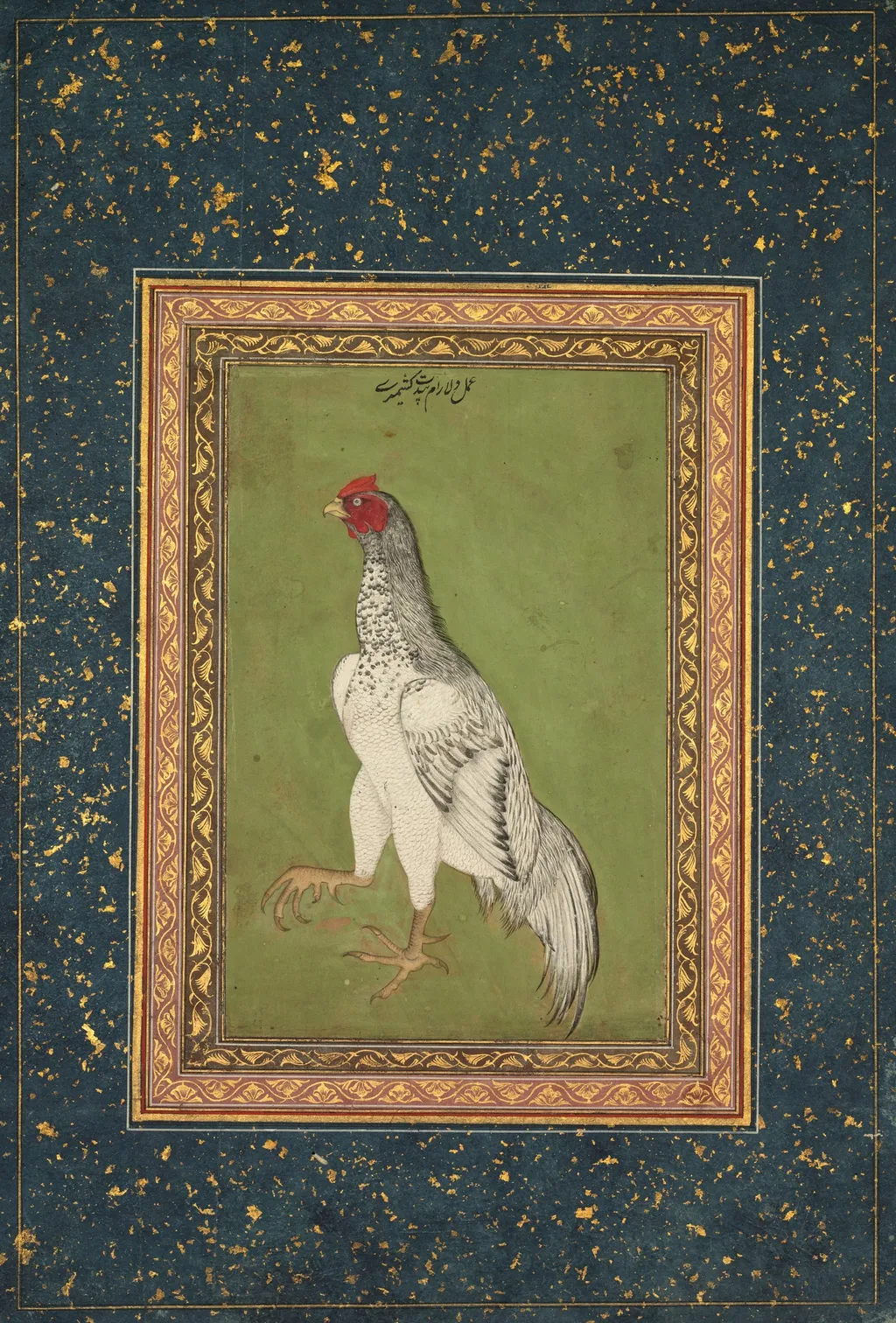
Rooster is an unspecified painting. It dates from 1620 and is held in the collection of the Cleveland Museum of Art.
About this work
Technique & Style
Its formal qualities include a restrained palette and precise attention to anatomical detail, reflecting the stylistic conventions of Mughal miniature painting.
Executed in oil on canvas, the work depicts a rooster rendered with delicate brushwork that emphasizes the bird's plumage and posture. The painting is part of the Cleveland Museum of Art collection and was created in the Mughal Empire during 1620. Its formal qualities include a restrained palette and precise attention to anatomical detail, reflecting the stylistic conventions of Mughal miniature painting.
History & Provenance
The painting was created in 1620 within the Mughal Empire and entered the collection of the Cleveland Museum of Art, where it has remained since its acquisition. Its provenance traces a continuous ownership chain from its original commission to its present location, reflecting consistent custodianship within the museum’s holdings.
The painting is part of the Cleveland Museum of Art's collection, recorded under accession number 1944.501, and has been exhibited there as part of its permanent display. It was created in 1620 within the Mughal Empire and entered the museum's holdings in the early 20th century, reflecting its long-standing presence in the institution's collection.
Legacy
The painting Rooster has been cited as an early example of naturalistic animal portraiture that influenced later Mughal court artists, and its presence in the Cleveland Museum of Art has reinforced scholarly discussions of 17th-century Indian art. The work’s attribution to an unknown artist has remained stable in museum records, and its provenance as a piece created in the Mughal Empire continues to inform exhibitions on South Asian painting.
Overview
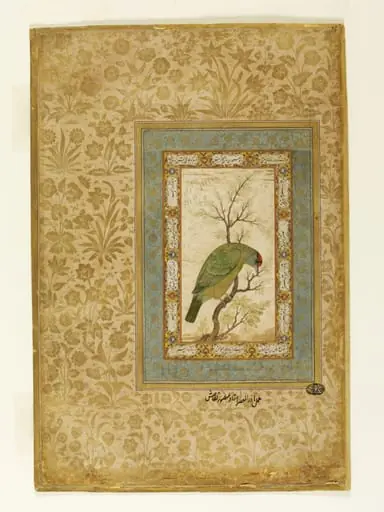
The work depicts a solitary rooster positioned against a deep green field. The bird’s plumage combines white feathers marked with black speckles, a vivid red comb, and an elongated tail. Its gaze is directed slightly leftward, conveying alertness. A decorative border frames the composition, featuring gold motifs and Arabic calligraphy.
Subject & Meaning
The central figure is a domestic rooster, a common symbol of vigilance and territorial pride in many cultures. The inclusion of Arabic script within the ornamental frame suggests a possible link to Islamic artistic traditions, where such motifs often accompany depictions of everyday life.
Context
The combination of a naturalistic animal portrait with decorative Islamic elements reflects a cross‑cultural aesthetic that was common in regions where Persian, Ottoman, or Mughal influences merged with local artistic practices. Such works often served both decorative and didactic purposes.
Artist & collection

- Rooster
 Untitled
 Falcon on a Perch
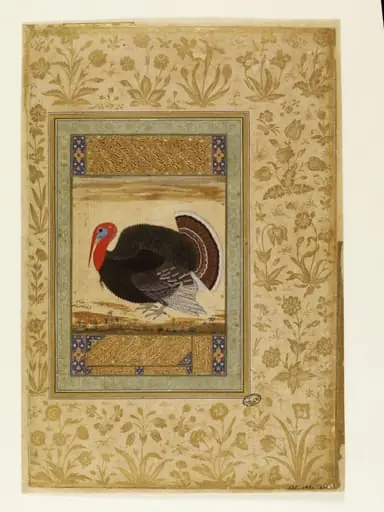 Untitled
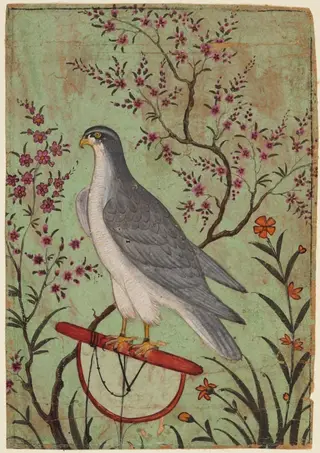 Falcon on a Perch
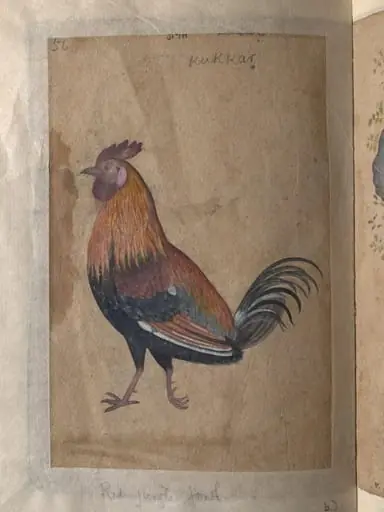 Depictions of a Coppersmith and a Red jungle-fowl of Northern India
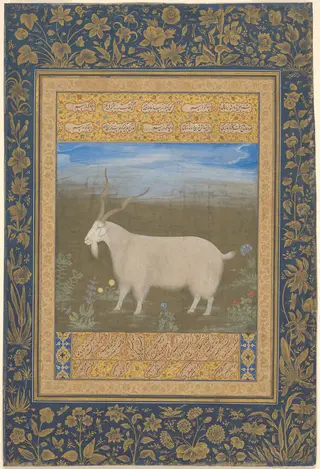 Portrait of a Ladakhi Mountain Goat
 Akbar and Jahangir Examine a Ghir Falcon while Prince Khusrau Stands Behind
 Akbar and Jahangir Examine a Ghir Falcon while Prince Khusrau Stands Behind
 Untitled
 Falcon
 Taurus, from a "Mandi Astrology Series"