Artwork
Green Heron, Night Heron, Young Heron, and Great White Heron
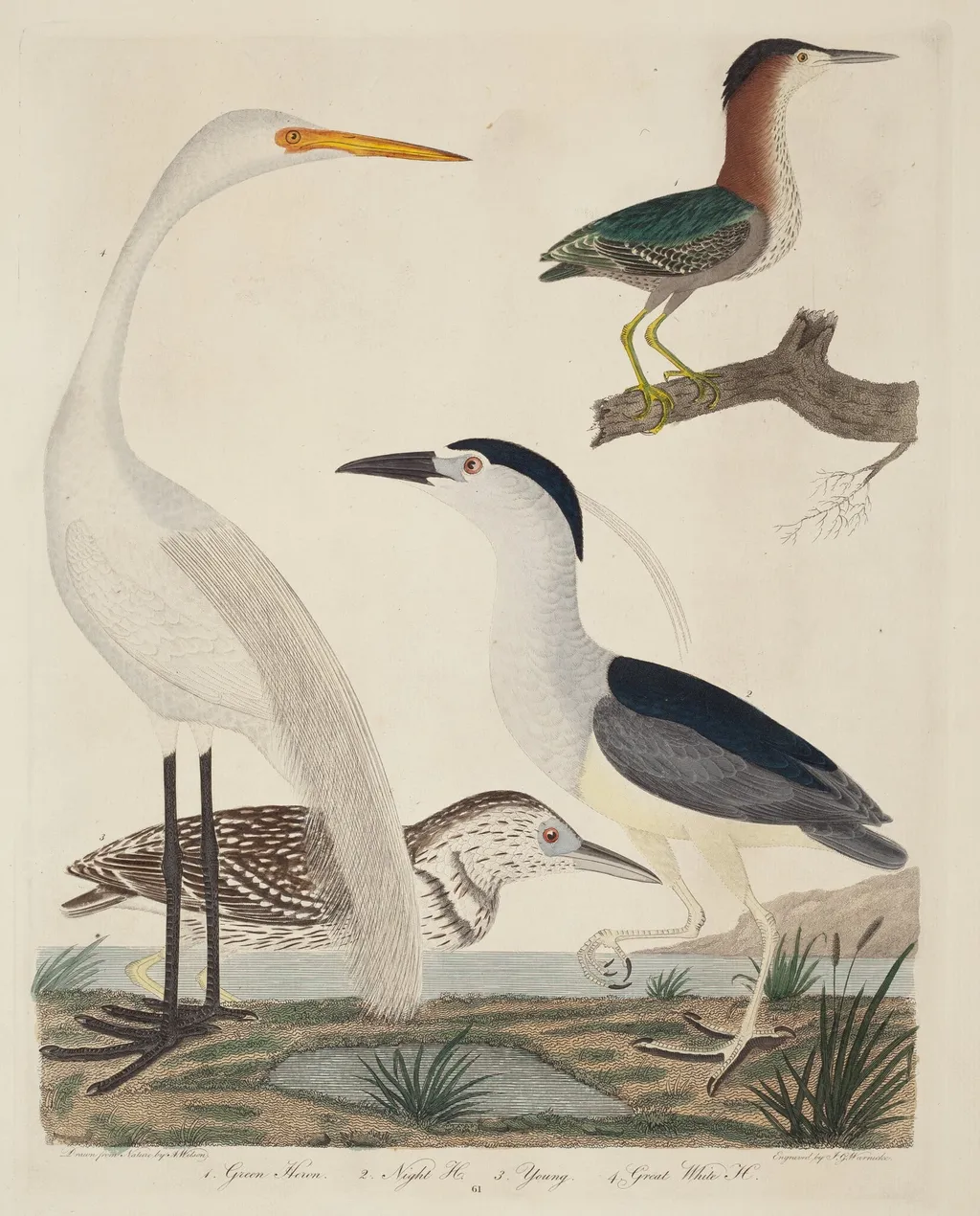
Green Heron, Night Heron, Young Heron, and Great White Heron is an ink print by the Romanticist artist John G. Warnicke. It dates from 1811 and is held in the collection of the National Gallery of Art. Created in 1811 by John G.
- Inscription
- Inscribed:lower left in plate: Drawn from Nature by A.Wilson; lower right in plate: Engraved by J.G. Warnicke; across bottom in plate: 1. Green Heron. 2. Night H. 3. Young. 4. Great White H.; lower center in plate: 61; by later hand, lower right in graphite: 40_
About this work
Overview
The work combines etching and engraving techniques on wove paper, with delicate hand-applied pigments enhancing the plumage of each bird.
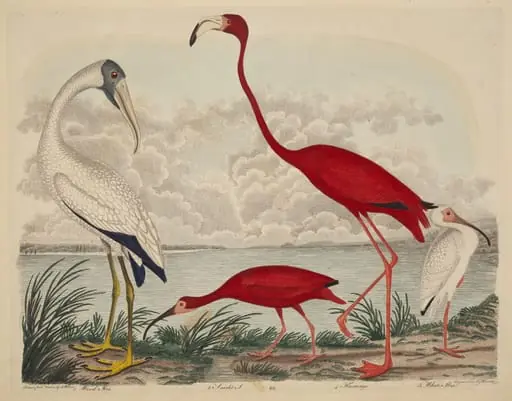
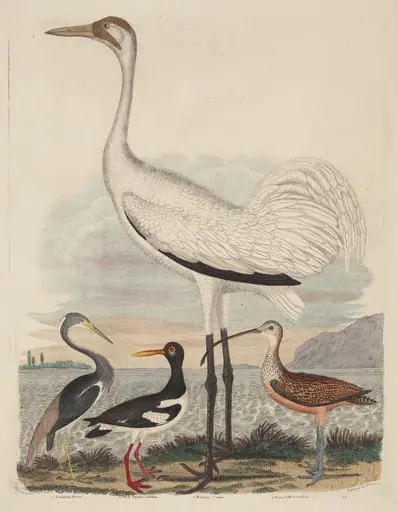
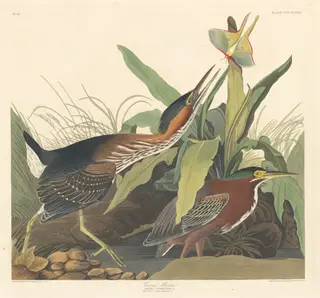
Created in 1811 by John G. Warnicke, this hand-colored engraving depicts four species of herons in a marshland setting. The work combines etching and engraving techniques on wove paper, with delicate hand-applied pigments enhancing the plumage of each bird. The composition presents the birds in naturalistic poses, arranged to emphasize their distinct forms and sizes, reflecting a scientific interest in avian identification.
Subject & Meaning
The four herons, Green, Night, Young, and Great White, are rendered with taxonomic precision, each labeled beneath the image to aid recognition. Their placement in a wetland environment with reeds and shallow water suggests an ecological context rather than a purely decorative one. The work functions as a visual record, intended to document physical characteristics for study, likely for ornithological or educational use in the early 19th century.
Technique & Style
Warnicke employed fine-line etching and engraving to define the birds' anatomy, capturing the texture of feathers and the length of their necks with precision. Hand coloring was applied subtly in muted tones of green, pink, and yellow to distinguish species without overwhelming the line work. The background, rendered with lighter strokes, provides depth without distraction, maintaining focus on the birds’ form and detail.
History & Provenance
Produced in 1811, the print likely originated as part of a broader effort to catalog North American bird species during a period of growing natural history interest. While specific ownership records are sparse, its technical quality and labeling suggest it was intended for institutional or scholarly use, possibly linked to early American naturalists or collectors of ornithological illustrations.
Context
This print emerged during a time when detailed natural history illustrations were vital for scientific communication, before photography. Similar works by Audubon and Wilson were emerging, but Warnicke’s focus on regional herons reflects a localized, methodical approach. The inclusion of a juvenile specimen indicates attention to developmental variation, aligning with contemporary efforts to understand species beyond superficial traits.
Legacy
Though less widely known than contemporaries, Warnicke’s print contributes to the foundation of American ornithological illustration. Its accuracy and restrained aesthetic offer insight into pre-Audubon efforts to document avian life with scientific rigor. The work remains a quiet but valuable artifact of early 19th-century natural history, valued for its fidelity over dramatic flair.
Own this work as a print
Artist & collection