Artwork
Untitled
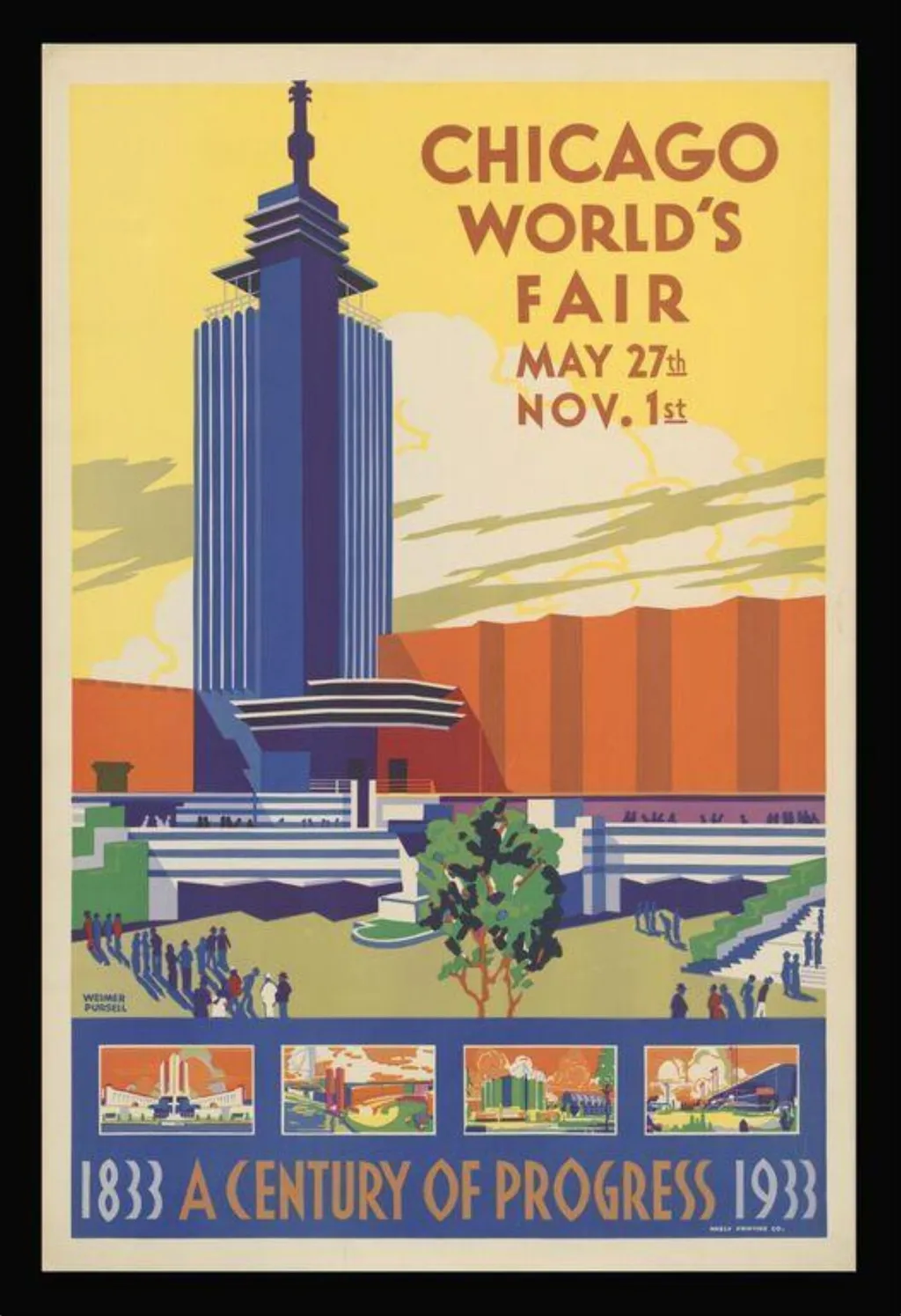
Untitled is a poster by Weimer Pursell. It dates from 1933 and is held in the collection of the Victoria and Albert Museum.
About this work
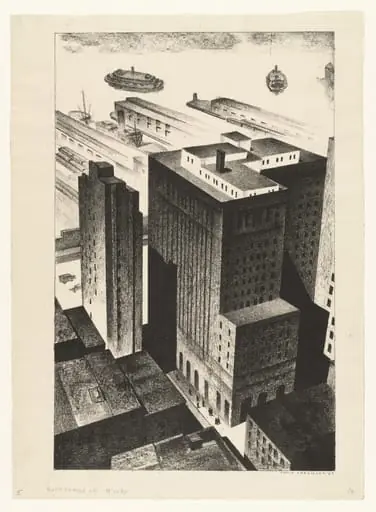
This 1933 poster by Weimer Pursell shows a big fair building in Chicago.
This 1933 poster by Weimer Pursell shows a big fair building in Chicago. It was made for the Century of Progress fair in 1933-34. The fair wanted to show science and technology could help America.
Right after the Great Depression hit, Chicago needed hope. The fair’s buildings used new building tricks. They were fast to put up and looked huge.
See more posters from this fair at the Victoria and Albert Museum.
Overview
Created in 1933 for the Century of Progress International Exposition in Chicago, this poster by Weimer Pursell promoted the fair’s emphasis on modernity and industrial innovation. Designed to attract visitors during the Great Depression, it highlighted the fair’s architectural achievements as symbols of progress. The poster’s composition centers on the Hall of Science, flanked by four other key pavilions, all rendered in clean, geometric lines to reflect the era’s faith in technological advancement.
Subject & Meaning
The poster foregrounds the Hall of Science, the fair’s dominant structure, designed by Paul Cret, as an emblem of scientific ambition. Its skyscraper-inspired form signaled a break from historical revivalism, embracing verticality and industrial materials. The four supporting buildings, Federal, Electrical, Travel and Transport, and Agricultural, collectively illustrated the breadth of American innovation, framing architecture not as ornament but as a vehicle for societal renewal.
Technique & Style
Pursell employed a simplified, poster-style aesthetic with bold outlines and flat color fields, typical of 1930s graphic design. The buildings are arranged with precise alignment, emphasizing symmetry and order. Minimal shading and absence of human figures direct focus to form and structure, reinforcing the fair’s message: progress is embodied in engineered space, not human narrative.
History & Provenance
Commissioned by the fair’s organizers, the poster was part of a broader visual campaign to draw public interest and investment. Produced during the fair’s opening year, it was distributed widely across the Midwest. Original prints are held in institutional collections, including the Victoria and Albert Museum, where they serve as records of Depression-era public relations and design culture.
Context
The 1933–34 Chicago World’s Fair emerged amid economic hardship, positioning technology and industry as antidotes to despair. Unlike earlier expositions that celebrated historical achievement, this fair prioritized the future, prefabricated structures, steel frames, and streamlined forms demonstrated efficiency and modernity. Architecture became propaganda: buildings were not just exhibits but proof that America could rebuild through innovation.
Legacy
The poster reflects a pivotal moment in American design, where graphic communication aligned with industrial modernism. While the fair’s structures were temporary, the visual language of the poster influenced subsequent advertising and public architecture campaigns. Its emphasis on form over ornament helped cement the aesthetic values of the Machine Age in the public imagination.
Artist & collection
Artist
Poster art from the 1930s often sold travel dreams on trains and ships. Weimer Pursell’s 1933 Untitled poster shows a streamlined ocean liner slicing through waves in bold Art Deco blues and silvers, promising speed and…