Artwork
Ilves
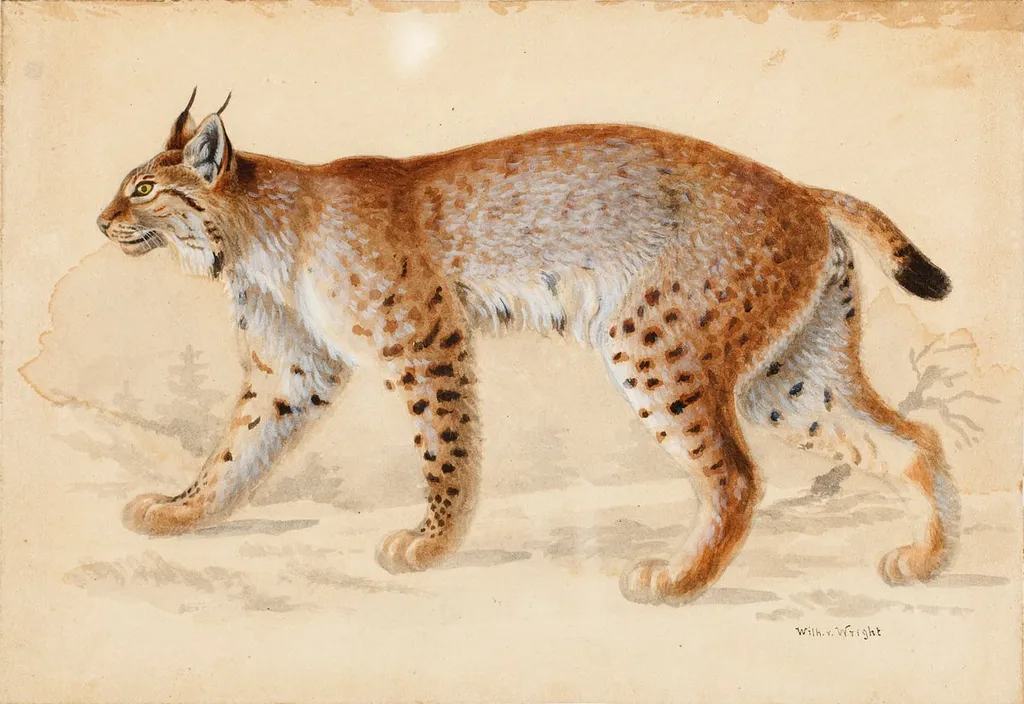
Ilves is an unspecified work on paper by the Naturalist artist Wilhelm von Wright. It dates from 1858 and is held in the collection of the Finnish National Gallery.
About this work
Overview
Ilves, executed around 1858, is a watercolor work by Swedish naturalist‑artist Wilhelm von Wright. The composition presents a solitary lynx traversing a pale, sandy terrain, rendered with a light, atmospheric touch that emphasizes the animal’s integration within its environment.
Subject & Meaning
The central figure is a lynx, its coat depicted in muted browns and whites, ears erect, and tail short with subtle dark markings. The creature’s alert gaze and poised stance suggest a moment of quiet vigilance, reflecting the artist’s interest in the natural behavior of Nordic wildlife.
Technique & Style
Von Wright employed watercolor glazing to achieve a soft, layered effect, allowing colors to remain loose and natural. The brushwork captures the texture of the fur through gentle strokes, while the background’s minimal tonal range reinforces the sense of open, windswept landscape typical of mid‑nineteenth‑century Scandinavian illustration.
History & Provenance
Created circa 1858, Ilves belongs to a period when von Wright produced numerous studies of Scandinavian fauna for scientific and educational purposes. The work has been retained within collections focusing on natural history illustration, illustrating the artist’s dual role as both painter and documentarian of the region’s wildlife.
Artist & collection