Artist
Movement
Fête Galante School
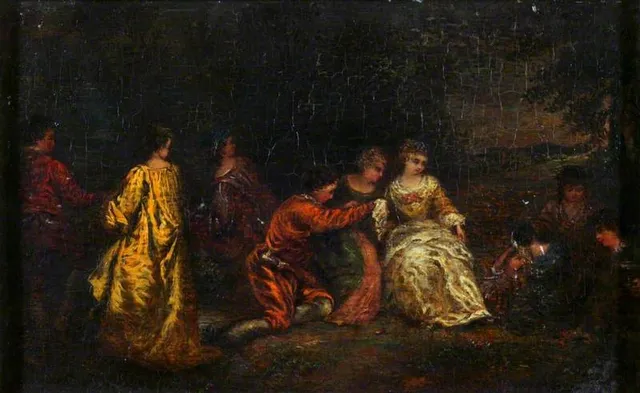
Fête Galante School is an art movement of the 1710–1760 period. The gallery holds 2 works in this movement, including works by Jean Étienne Le Bel. Browse Fête Galante School paintings, portraits, pictures and artworks from the world's public-domain museum collections.
The fête galante—literally a "courtship party" or "gallant celebration"—was an 18th-century French painting genre invented around the work of Jean-Antoine Watteau (1684–1721). When Watteau, born in Valenciennes near the Flemish border, sought admission to the Académie Royale de Peinture et de Sculpture in Paris, the institution found no existing category for his idylls of elegant figures at leisure. Rather than reject him, in 1717 the Académie coined a new one, registering his reception piece, the *Pilgrimage to Cythera* (Louvre), as a *peinture des fêtes galantes*. The genre grew out of the older *fête champêtre*, or rustic outdoor feast, but refined it: where the pastoral tradition mingled peasants and patricians, Watteau's parks are peopled by aristocrats and players in silk and masquerade costume, drifting through an Arcadia of his own imagining.
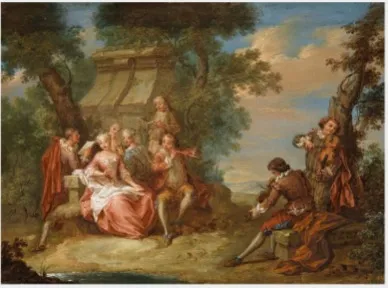
Visually, the fête galante is defined by small-scale figures dispersed across dreamy, twilit parkland, often shaded by feathery trees and punctuated by mossy statuary. Watteau worked from life through chalk drawings—frequently in *trois crayons* (red, black, and white)—then assembled his figures into shimmering compositions of fluid brushwork and silvery, iridescent color. The mood is the genre's signature: flirtation, music-making, dance, and theatrical play unfold in a register of gentle melancholy, a sense that pleasure is fleeting and love already tinged with regret. The recurring figure of the wistful clown, as in his *Pierrot* (formerly *Gilles*), distills this bittersweet undertone.
The principal practitioners after Watteau were his only formal pupil, Jean-Baptiste Pater, and his close associate Nicolas Lancret—both trained alongside him under Claude Gillot—who carried the formula forward with brighter palettes and more recognizable settings. François Boucher absorbed its themes into a more frankly sensuous, mythological key. Canonical works include the Louvre and Berlin versions of the Cythera subject and Watteau's late masterpiece *L'Enseigne de Gersaint*; our own catalogue holds a *Fête champêtre* attributed to Watteau, alongside later variations on the theme such as Jean Étienne Le Bel's *Fête Champêtre – Music*.
As the cornerstone of French Rococo, the fête galante shaped a generation of decorative painting before the moralizing earnestness of Greuze and the austerity of Neoclassicism eclipsed it; by the Revolution it was dismissed as frivolous. The 19th century rehabilitated it: the Goncourt brothers and Baudelaire championed Watteau, and Paul Verlaine borrowed the genre's very name for his 1869 poetry collection *Fêtes galantes*, securing its place as one of art history's most poignant visions of pleasure.
Key artists
Works
Frequently asked questions
What is Fête Galante School?
Fête Galante School is an art movement. An 18th-century French genre invented around Watteau, depicting elegant figures at leisure in dreamy parkland.
Who are the key Fête Galante School artists?
Key Fête Galante School artists in the collection include Jean Étienne Le Bel.
When did Fête Galante School take place?
Fête Galante School dates from 1710–1760.
Where can I see Fête Galante School works?
Fête Galante School works in the collection are held by Victoria and Albert Museum and National Gallery of Ireland.