Movement
Laren School
Laren School is an art movement. The gallery holds 2 works in this movement, including works by Albert Neuhuys and Jacob Simon Hendrik Kever. Browse Laren School paintings, portraits, pictures and artworks from the world's public-domain museum collections.
The Laren School (Larense School) was a Dutch art colony that flourished in the village of Laren, in the rural Het Gooi region near Hilversum, from the 1870s into the early twentieth century. It arose as a direct offshoot of the Hague School. As industrial expansion and urban sprawl encroached on the meadows around The Hague, painters went in search of unspoiled countryside, much as their predecessors had gathered earlier at Oosterbeek. The elder statesman Jozef Israëls is credited with discovering Laren's quiet farmland and heath, and the village's transformation into a thriving colony was hastened in 1882 when a railway line connected it to Amsterdam, making the area newly accessible to artists, dealers, and collectors.
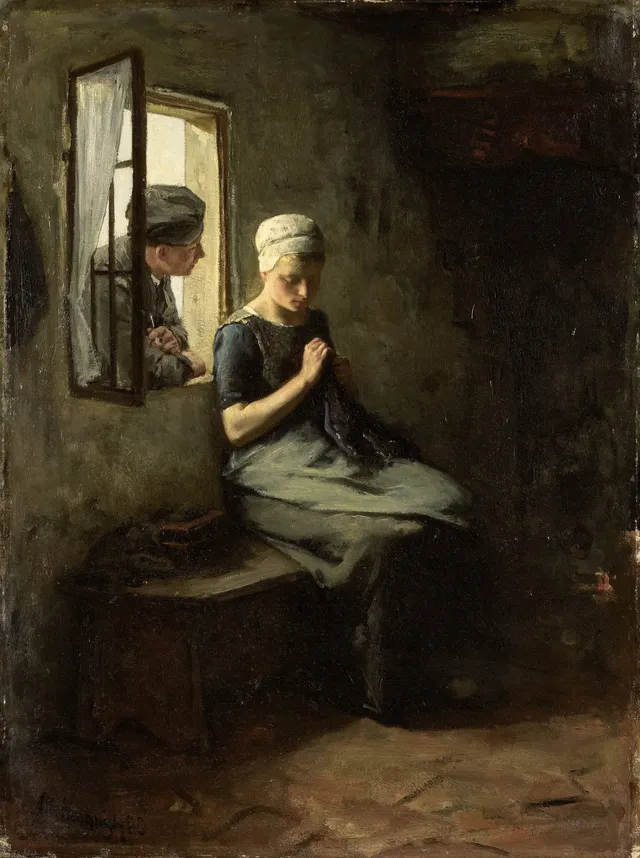
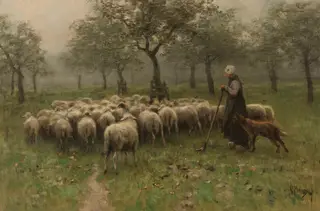
The school took shape when Albert Neuhuys settled in Laren in 1883 and Anton Mauve followed in 1885; the two are generally regarded as its founders. Their subjects continued the Hague School's preoccupation with humble rural life: dim farmhouse interiors, peasant families at the hearth, weavers and spinners at their looms, and flocks moving across open heath. Neuhuys, who rented a flax barn to draw spinners at work, became one of the colony's defining genre painters, while Mauve excelled at tonal landscapes of shepherds and sheep — his late canvas The Return of the Flock, Laren is among the period's best-known images.
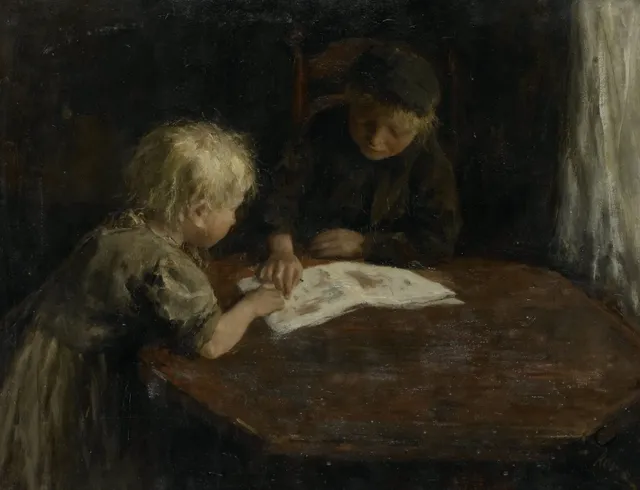
Stylistically, the first generation worked in the Hague School's muted, atmospheric realism, but a second wave around the turn of the century — including George Hendrik Breitner, Willem de Zwart, and Willem Bastiaan Tholen — consciously absorbed Impressionism, brightening the palette toward gold, red, and blue and loosening the brushwork. The colony is thus counted as a significant chapter in Dutch Impressionism. Among the genre specialists was Jacob Simon Hendrik (Hein) Kever, whose tender domestic scenes, such as Children with a Picture-book, exemplify the school's intimate treatment of family life.
The colony's legacy was institutionalized when the American painter-collector William Henry Singer built a villa in Laren in 1911, the nucleus of the present-day Singer Laren museum. The region became so identified with Mauve that it was nicknamed "Mauve land" even in the United States, and the artistic ferment Laren fostered helped shape later modernists, among them Piet Mondriaan and Jan Sluijters.
Key artists
Works
Groups & collectives
Frequently asked questions
What is Laren School?
Laren School is an art movement. A group of Dutch painters based in the village of Laren in North Holland from the 1880s onward, closely related to the Hague School.
Who are the key Laren School artists?
Key Laren School artists in the collection include Albert Neuhuys and Jacob Simon Hendrik Kever.
Where can I see Laren School works?
Laren School works in the collection are held by Rijksmuseum.