Movement
Peredvizhniki
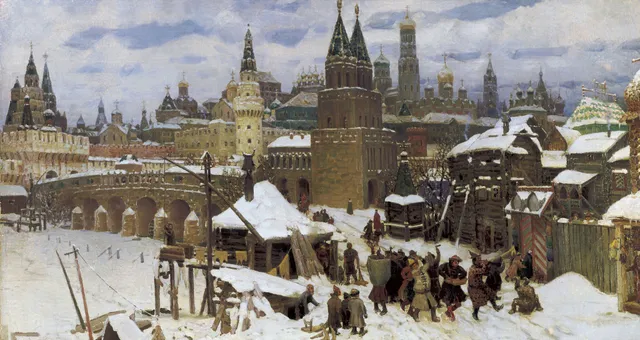
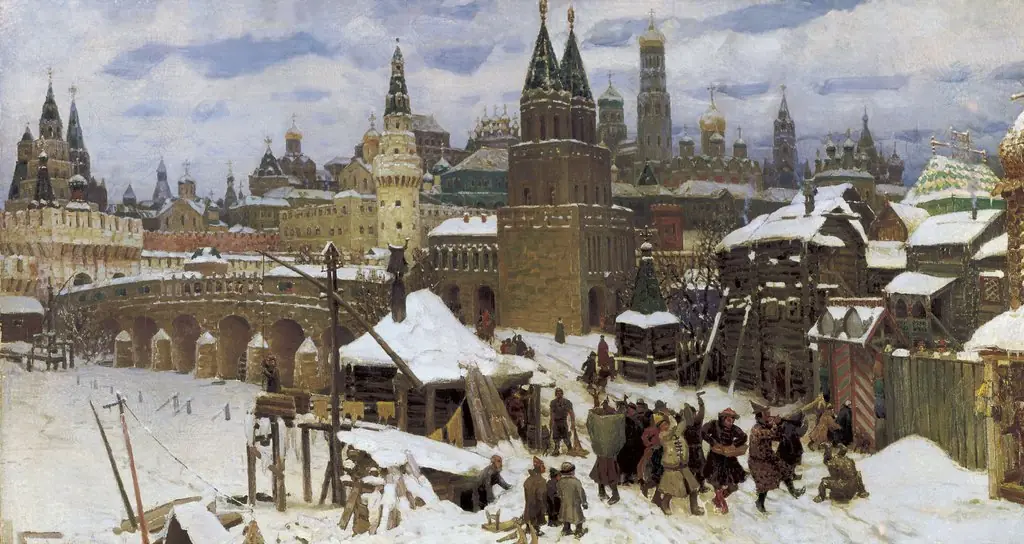
Peredvizhniki is an art movement dating from 1860. The gallery holds 4 works in this movement, including works by Konstantin Savitsky. Browse Peredvizhniki paintings, portraits, pictures and artworks from the world's public-domain museum collections.
The Peredvizhniki—literally "the Wanderers" or "Itinerants"—were the dominant force in Russian realist painting in the second half of the nineteenth century. Their roots lie in the "Revolt of the Fourteen" of 1863, when fourteen graduating students walked out of the Imperial Academy of Arts in St. Petersburg, refusing to compete for the Gold Medal on a prescribed mythological theme. Led by Ivan Kramskoi, they first formed an independent artists' cooperative (the Artel), and in 1870 reorganised as the Society for Travelling Art Exhibitions (Tovarishchestvo peredvizhnykh khudozhestvennykh vystavok). Their guiding conviction, sharpened by the radical critic Vladimir Stasov—who in 1882 proclaimed "nationality and realism" the society's twin principles—was that art should abandon academic idealism, depict contemporary Russian life truthfully, and reach audiences far beyond the capitals.
The society's defining innovation was organisational as much as aesthetic: rather than exhibit only in St. Petersburg and Moscow, members sent their canvases on circuit. Between 1870 and 1923 the Peredvizhniki mounted forty-eight travelling exhibitions, carrying paintings to provincial cities including Kyiv, Kharkiv, Odesa, Kazan, Saratov, and Riga. Visually, the work favours sober, legible realism over academic polish—muted tonalities, attentive observation of peasant faces and provincial settings, and an unsentimental social conscience. Genre scenes of hardship, religious processions, and prison convoys sit alongside an equally important strand of national landscape painting.
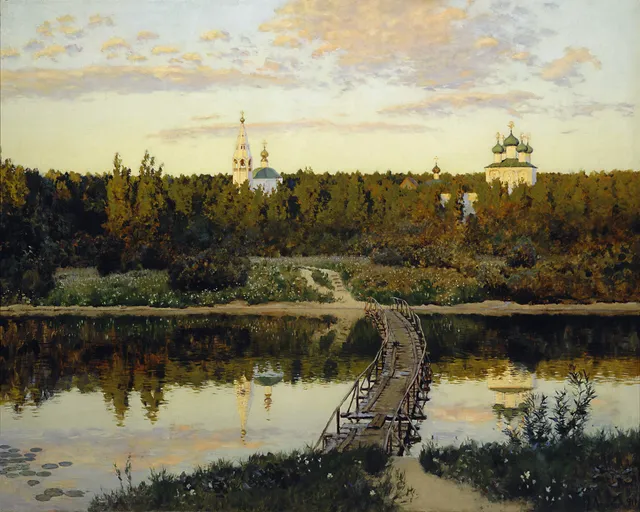
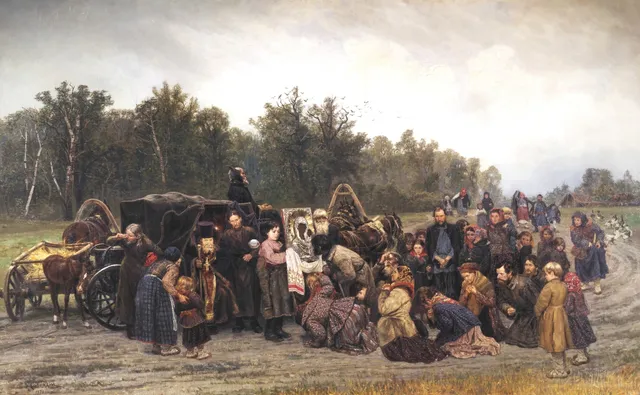
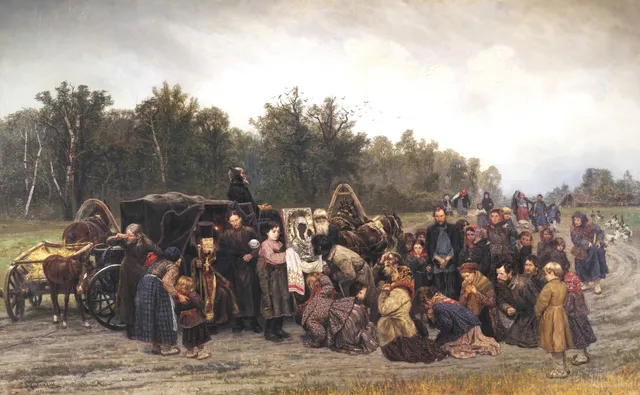
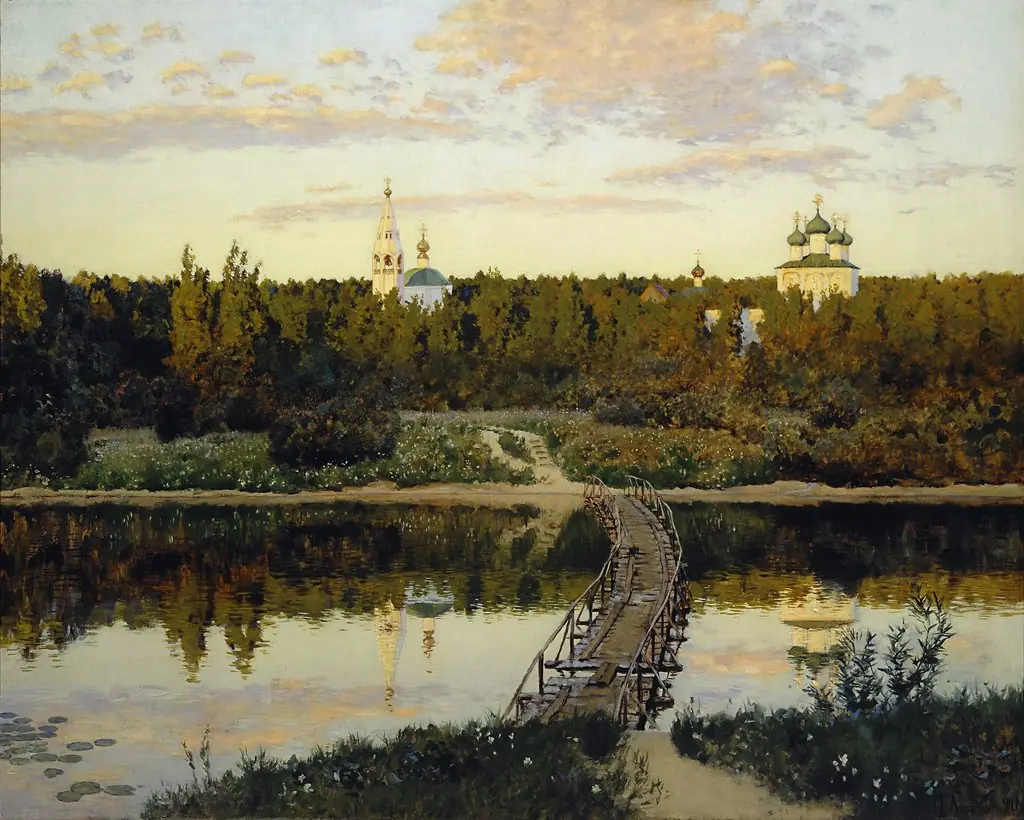
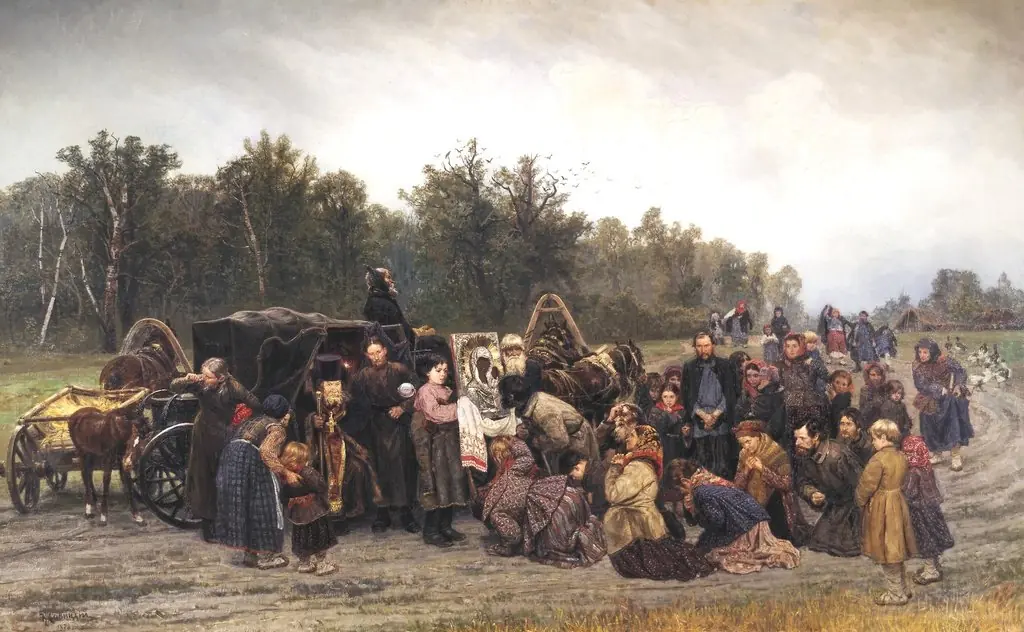
Its canonical figures span both registers. Ilya Repin, the movement's giant, produced its most famous image, *Barge Haulers on the Volga* (1870–73, State Russian Museum), as well as *Ivan the Terrible and His Son Ivan*. Vasily Surikov painted monumental historical dramas such as *Boyarina Morozova* and *The Morning of the Streltsy Execution*, while Kramskoi contributed searching portraits and *Christ in the Desert*. In landscape, Ivan Shishkin—the "tsar of the forest"—and Alexei Savrasov pioneered a distinctly Russian "mood landscape" later perfected by Isaac Levitan, whose contemplative *A Quiet Monastery* exemplifies the lyrical tendency. Konstantin Savitsky, represented here by *Welcoming the Icon*, was among the genre painters chronicling communal rural ritual.
The Peredvizhniki effectively created a national school independent of the state, shaped a generation of collectors (notably Pavel Tretyakov), and supplied the moral and stylistic foundation for early Soviet Socialist Realism. Though eventually eclipsed by the avant-garde of the World of Art and the Russian modernists, their insistence on civic relevance left a permanent mark on Russian visual culture.
Key artists
Works
Frequently asked questions
What is Peredvizhniki?
Peredvizhniki is an art movement. The 'Wanderers,' a group of 19th-century Russian realists who broke from the academy to take art to the people.
Who are the key Peredvizhniki artists?
Key Peredvizhniki artists in the collection include Konstantin Savitsky.
When did Peredvizhniki take place?
Peredvizhniki dates from around 1860.
Where can I see Peredvizhniki works?
Peredvizhniki works in the collection are held by Tretyakov Gallery, Yaroslavl Art Museum and Victoria and Albert Museum.