Movement
Romanesque art in Catalonia
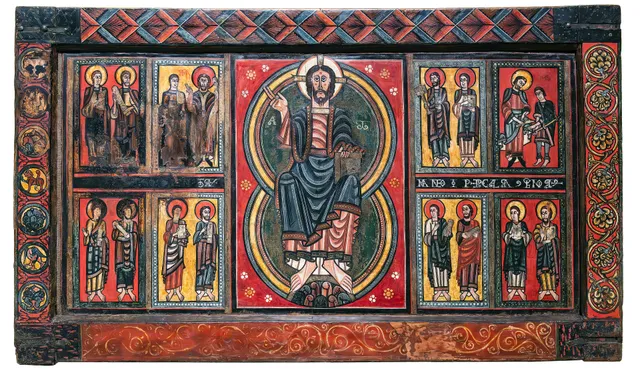
Romanesque art in Catalonia is an art movement dating from 1000. The gallery holds 1 work in this movement. Browse Romanesque art in Catalonia paintings, portraits, pictures and artworks from the world's public-domain museum collections.
Romanesque art in Catalonia represents one of the richest and best-preserved bodies of medieval art in Europe, flourishing across the 11th and 12th centuries. It emerged in a confident, expanding society: the Catalan counties, nominally tied to the Frankish world but increasingly autonomous, grew wealthy through the repopulation of frontier lands and trade, funding a vast campaign of church building. The new architecture arrived from northern Italy in the form of the Lombard Romanesque style—built in finely worked ashlar, austerely decorated, and marked by slender, freestanding bell towers. Nowhere is this purer than in the Vall de Boí in the Pyrenean district of Alta Ribagorça, whose ensemble of churches—including Sant Climent and Santa Maria de Taüll and Sant Joan de Boí—was inscribed as a UNESCO World Heritage Site in 2000.
The style's defining achievement, however, was painting. Catalan churches were unusual for the richness of their interiors, where apses were covered in fresco and altars dressed with painted wooden frontals. The aesthetic is emphatically anti-naturalistic: monumental, frontal figures rendered in firm contour lines, flat fields of saturated colour, ornamental exuberance, and a tendency toward geometric abstraction. The governing image was the Christ in Majesty (Maiestas Domini), enthroned within an almond-shaped mandorla and flanked by the symbols of the Evangelists.
The masterpiece of the school is the apse of Sant Climent de Taüll, whose church was consecrated on 10 December 1123. Its Christ in Majesty, holding a book inscribed "Ego sum lux mundi" ("I am the light of the world"), is the work of the anonymous Master of Taüll, regarded as the greatest mural painter of 12th-century Catalonia. The murals were detached and transferred to Barcelona between 1919 and 1923; today the National Museum of Art of Catalonia (MNAC) holds the world's foremost collection of Romanesque painting, including the apses of Sant Quirze de Pedret by the Master of Pedret, the Batlló Majesty, and altar frontals from Avià and La Seu d'Urgell.
The painted altar frontal is a form essentially unique to the Catalan territories, produced between the 10th and 12th centuries by workshops associated with La Seu d'Urgell, Ripoll, and Vic. The frontal from Ix, from the church of Sant Martí at La Guingueta d'Ix in the Cerdanya, dates to the mid-12th century and is closely related to the La Seu d'Urgell frontal, sharing its treatment of Christ and its palette. These panels were the embryos from which the later Gothic altarpiece would grow, making Catalan Romanesque a foundational chapter in the art of the western Mediterranean.
Works
Frequently asked questions
What is Romanesque art in Catalonia?
Romanesque art in Catalonia is an art movement. The Romanesque painting tradition of Catalonia (roughly 1100–1200), one of the best preserved in Europe.
When did Romanesque art in Catalonia take place?
Romanesque art in Catalonia dates from around 1000.
Where can I see Romanesque art in Catalonia works?
Romanesque art in Catalonia works in the collection are held by Museu Nacional d'Art de Catalunya.