Art Museum
Dulwich Picture Gallery

Image: Wikimedia Commons.
Dulwich Picture Gallery is an art museum in Dulwich, United Kingdom.
About Dulwich Picture Gallery
Dulwich Picture Gallery is an art gallery in Dulwich, south London, and the oldest public art gallery in England. Opened in 1817 to a design by Regency architect Sir John Soane, it became a landmark in museum architecture through its innovative use of natural light.
Originally part of the College of God's Gift, the charitable foundation established by Edward Alleyn in the early 17th century, the gallery became an independent charitable trust in 1994. Its collection, formed through the purchases of its founders and expanded by later bequests, ranks among Britain’s finest holdings of Old Master paintings, especially strong in French, Italian, and Spanish Baroque art and in British portraiture from the Tudor era to the 19th century.
Dulwich Picture Gallery by the numbers
- Founded
- 1811
Plan your visit
Dulwich Picture Gallery
Moments held at Dulwich Picture Gallery
Overview
Dulwich Picture Gallery is an art gallery in Dulwich, south London, and the oldest public art gallery in England. Opened in 1817 to a design by Regency architect Sir John Soane, it became a landmark in museum architecture through its innovative use of natural light. Originally part of the College of God's Gift, the charitable foundation established by Edward Alleyn in the early 17th century, the gallery became an independent charitable trust in 1994. Its collection, formed through the purchases of its founders and expanded by later bequests, ranks among Britain's finest holdings of Old Master paintings, especially strong in French, Italian, and Spanish Baroque art and in British portraiture from the Tudor era to the 19th century.
Founding & history
The gallery's origins trace back to Edward Alleyn (1566-1626), an Elizabethan actor and entrepreneur whose commercial interests in the Rose and Fortune Theatres enabled him to acquire the Manor of Dulwich in 1605. He founded the College of God's Gift, a school for boys with adjacent almshouses for the local poor. Alleyn bequeathed to the college a collection including portraits of English kings and queens, and in 1686 the actor William Cartwright (1606-1686) added a further 239 pictures, of which 80 remain identifiable at Dulwich today. The collection attracted few additions during the 18th century, and visitors proved largely unimpressed; Horace Walpole famously described seeing 'a hundred mouldy portraits among apostles sibyls and kings of England'. The collection's transformation began with Sir Francis Bourgeois (1753-1811), an Anglo-Swiss painter, and his business partner Noël Desenfans (1744-1807), a French art dealer. In 1790, King Stanisław August Poniatowski of the Polish, Lithuanian Commonwealth commissioned them to assemble a national collection to encourage fine arts in Poland. After five years of European travel and acquisition, the partitions of Poland left them without a buyer. Attempts to sell to the Tsar of Russia and the British Government failed, and they resorted to selling minor pieces to fund further purchases of greater importance. Following Desenfans' death in 1807, Bourgeois inherited the collection and, on the advice of actor John Philip Kemble, bequeathed it to the College of God's Gift. His will instructed that a gallery be built in Dulwich to Soane's design, providing £2,000 for construction, with a further £4,000 contributed by Desenfans' widow. The gallery opened to Royal Academy of Arts students in 1815, with the public opening delayed until 1817 due to heating system problems. It quickly became popular among London art students and copyists, frequented by figures including John Constable, J.M.W. Turner, and Vincent van Gogh. Charles Dickens mentioned it in The Pickwick Papers. A major addition came in 1835 when William Linley, brother of composer Thomas Linley the Younger, bequeathed his family portrait collection. The gallery suffered significant damage from a German V1 explosion on 12 July 1944; the mausoleum was particularly affected, with bones reportedly scattered across the lawn. Austin Vernon and Partners undertook restoration, and the gallery reopened on 27 April 1953 in the presence of the Queen Mother. In 1995, following substantial reorganization of the Alleyn's College foundation, the gallery was reconstituted as an independent charity. The gallery has experienced notable thefts. On 31 December 1966, eight paintings were stolen, including three Rembrandts, three Rubens, a Gerrit Dou, and an Adam Elsheimer, then valued at £3 million. All were recovered within days after an investigation led by Detective Superintendent Charles Hewett. Rembrandt's Portrait of Jacob de Gheyn III (1632) holds the Guinness World Record as the most frequently stolen artwork, taken four times and last recovered in 1986 from a left-luggage office in West Germany.
Collection scope
The collection of Bourgeois and Desenfans remains the core of the museum's holdings, though supplemented by further donations and acquisitions. The gallery's strengths lie in European art of the 17th and 18th centuries, with particular depth in French, Italian, and Spanish Baroque painting and in British portraiture spanning from the Tudor period to the 19th century. The holdings include significant numbers of works by major masters: twelve paintings by Rubens, four by Rembrandt, five by Van Dyck, and two by Raphael, among others. This concentration reflects the collecting priorities of Bourgeois and Desenfans during their European purchasing campaigns of the 1790s, as well as the subsequent development of the collection through targeted bequests such as the Linley family portraits.
Notable holdings
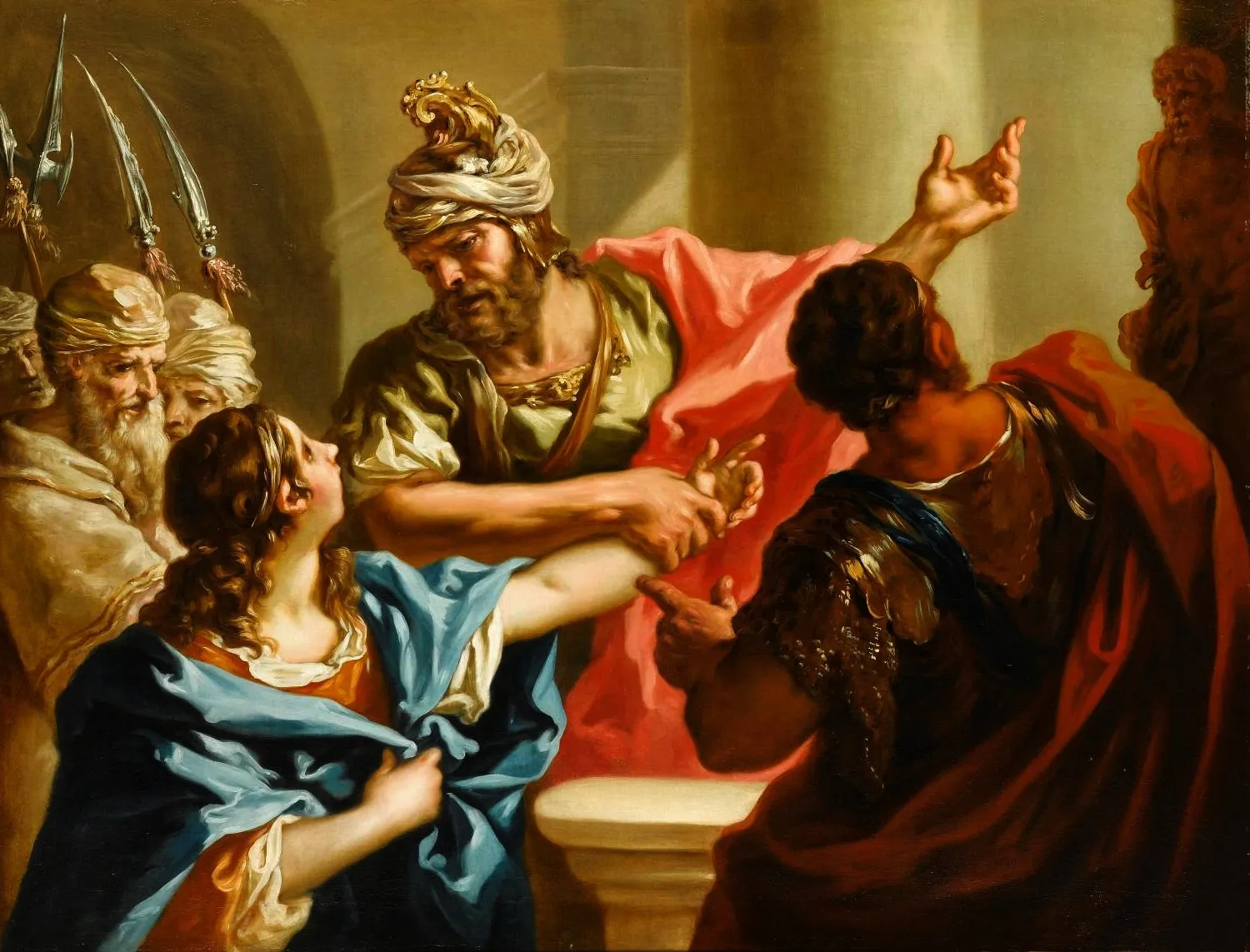
Among the gallery's most significant works are two paintings by Raphael: Saint Francis and Saint Anthony of Padua, dating from approximately 1503-1505. The Baroque holdings include three paintings by Rembrandt, among them the small early Portrait of Jacob de Gheyn III (1632), notable for its repeated thefts. The Rubens collection encompasses twelve canvases, including three that were stolen in 1966: Three Nymphs with a Cornucopia, St. Barbara, and The Three Graces. Other major works include Antoon van Dyck's Emanuele Filiberto of Savoy (1624), Guido Reni's Saint Sebastian (1630-1635), Bartolomé Esteban Murillo's Girl with Flowers (1665-1670), and Giovanni Battista Tiepolo's Joseph Receiving Pharaoh's Ring (1733-1735), Diana, Apollo and Nymphs (c. 1750), and Virtue and Nobility Putting Ignorance to Flight (c. 1743). The collection also includes Canaletto's Walton Bridge (1754). The 1966 theft also involved Gerrit Dou's A Lady Playing on the Clavicord and Adam Elsheimer's Susannah and the Elders.
Building & site
Sir John Soane designed the gallery as the first purpose-built museum building in the world, constructed in exposed brick with a configuration of interconnected rooms illuminated from above. Soane's architectural solution, featuring skylights arranged to provide indirect natural light that fully reveals oil paintings, became foundational to subsequent museum design. Philip Johnson later observed that 'Soane taught us how to present paintings.' The exterior is articulated by pilasters suggesting classical order without fully committing to it, representing an early attempt to transcend strict neoclassicism in Soane's personal architectural language.
At the building's central axis, Soane placed a mausoleum containing the sarcophagi of the three founders: Francis Bourgeois, Noël Desenfans, and Margaret Desenfans. The gallery and its mausoleum are listed Grade II* on the National Heritage List for England.
Charles Barry Jr. converted the almshouses along the west side into exhibition space in 1880, and an eastern extension followed designs by E.S. Hall between 1908 and 1938. The 1944 bomb damage necessitated substantial reconstruction. In 1999, Anglo-American architect Rick Mather (born 1937) designed a modern extension incorporating a café, education rooms, a lecture theatre, and a new entrance with ticketing facilities.
Visiting
Dulwich Picture Gallery is located in Dulwich, in the London Borough of Southwark, on Gallery Road adjacent to the surviving buildings of the original College of God's Gift and its chapel. The gallery operates as an independent charitable trust, having separated from the Alleyn's College foundation in 1994. Its website is https://www.dulwichpicturegallery.org.uk/. The institution continues its original educational mission, maintaining its role as a public art museum while hosting temporary exhibitions and educational programs in addition to displaying its permanent collection of Old Master paintings.
Museums near Dulwich Picture Gallery
- Art Museum Tate Britain City of Westminster, United Kingdom
- Art Museum Tate Modern London Borough of Southwark, United Kingdom
- Art Museum National Gallery City of Westminster, United Kingdom
- Gallery Matthiesen Gallery London, United Kingdom
- Art Museum Victoria and Albert Museum Royal Borough of Kensington and Chelsea, United Kingdom
- Art Museum National Portrait Gallery City of Westminster, United Kingdom