Art Museum
Leighton House

Image: Wikimedia Commons.
Leighton House is an art museum in Royal Borough of Kensington and Chelsea, United Kingdom.
About Leighton House
Leighton House is an historic house in the Holland Park area of the Royal Borough of Kensington and Chelsea in west London. The building was the home of wealthy Victorian painter, and President of the Royal Academy, Frederic Leighton (1830–1896), notable for the popular Flaming June painting. Leighton commissioned George Aitchison to build him a combined home and studio, to which later was added a qa'a (or "Arab Hall") which incorporated tiles and other elements purchased in the Near East during Leighton's travels. The resulting building, completed between 1866 and 1895 on the privately owned Ilchester Estate, is now Grade II* listed. It is noted for its elaborate Orientalist and aesthetic interiors, and is open to the public as both an historic house and an art museum.
Leighton House by the numbers
- Founded
- 1929
Plan your visit
Leighton House
- Website
- www.rbkc.gov.uk
Overview
Leighton House is a historic house museum in the Holland Park area of the Royal Borough of Kensington and Chelsea in west London. It was the home and studio of Frederic Leighton (1830-1896), Victorian painter, sculptor, and President of the Royal Academy, best known for the popular painting Flaming June. The house is celebrated for its elaborate Orientalist and aesthetic interiors, particularly the Arab Hall, and has been open to the public since 1929. Now Grade II* listed, it operates as both an historic house and an art museum under the management of the Royal Borough of Kensington and Chelsea.
Founding & history
The house originated from Leighton's commission to architect George Aitchison, whom he had met in Rome in the early 1850s. Aitchison, though from a family of architects specialised in shipyards, warehouses, and railway architecture, had never before designed a house. Leighton secured a lease on land on the privately owned Ilchester Estate in April 1866, and building commenced shortly thereafter. The project extended over 30 years and grew to encompass not merely the building but the entire design and interior decoration. The initial house at 2 Holland Park Road (later renumbered 12) was ready for occupation by the end of 1866 at a cost of £4,500. Extensions followed: to the east in 1869-70, the domed Arab Hall in 1877-79, a winter studio in 1889, and finally a top-lit picture gallery in 1895. After Leighton's death in 1896 without direct heirs, the contents were sold at Christie's within a week, leaving the house virtually emptied. At least one thousand of his drawings were acquired by the Fine Art Society. Towards the end of the 1890s, Emilie Barrington, a former neighbour, and the newly formed Leighton House Committee began collecting and repurchasing former exhibits and acquiring period furnishings. The property passed to the Royal Borough of Kensington and Chelsea in 1927. Mrs Henry Perrin funded additional gallery space, and the Perrin Galleries, designed by Halsey Ricardo, opened in 1929 in memory of her daughter Muriel Ida Perrin, an artist and sculptor who had trained at the Royal College of Art and worked for the Aircraft Manufacturing Company during the First World War. The house has been open to the public since that year. Neglected in subsequent decades, with some rooms converted to flats, the house gradually deteriorated. The Society of the Friends of Leighton House formed in 1969 with poet and architectural enthusiast John Betjeman as president. Curator Stephen Jones's appointment in 1982 initiated comprehensive restoration under architect Ian Grant, restoring the house's fin-de-siècle atmosphere. The museum received the European Union Prize for Cultural Heritage / Europa Nostra Award in 2012. In 2008 the architectural firm BDP was commissioned to design a comprehensive renovation and reinterpretation. After fourteen years of planning and construction, the project added a new staircase tower, lift, climate control, remodelling and extension of the Perrin Wing, function and archive rooms, a museum shop, and the De Morgan Café. Financed by the Friends of Leighton House and the National Heritage Lottery Fund, the museum reopened on 15 October 2022. A further 2022 addition was an extension with a lift and staircase tower featuring an 11-metre high wall painting, Oneness, by Iranian artist Shahrzad Ghaffari.
Collection scope
The museum's collection has been rebuilt through donations and repurchases after Leighton's original collection was dispersed. It now holds 700 drawings from Leighton's original stock of over 1,000, as well as 81 oil paintings by Leighton himself. The collection emphasises Pre-Raphaelite and Victorian art, with works by John Everett Millais, Edward Burne-Jones, Albert Moore, Lawrence Alma-Tadema, and George Frederic Watts. The holdings also include five albums and sketchbooks of drawings and watercolours, 27 watercolours, 54 prints of Leighton's works, 14 items of personal material including documents, personal mementos, embroideries, enamels and caricatures, and several small-scale sculptures. The interior has been refurnished with original period pieces and replicas based on historical models.
Notable holdings
Among the most notable oil paintings by Leighton in the collection are The Death of Brunelleschi (1852), Charles Edward Perugini (1855), A Noble Lady of Venice (c. 1865), Hercules Wrestling with Death for the Body of Alcestes (1869-1871), Clytemnestra from the Battlements of Argos Watches for the Beacon Fires Which Are to Announce the Return of Agamemnon (c. 1874), Professor Giovanni Costa (1878), The Countess of Brownlow (c. 1878-79), The Vestal (c. 1882-83), Alexandra Sutherland Orr (née Leighton) (1890), and And the sea gave up the dead which were in it (c. 1891-92). Sculptures include Athlete Strangling a Python (1874) and Needless Alarms (1887). Works by other artists include Antonio Rossellino's carved and coloured relief Madonna of the Candelabra, which had been in Leighton's collection, was sold after his death, and was re-acquired by the museum in 2006. Also present are G. F. Watts's portrait of Frederic Leighton, Luke Fildes's still life and study for The Widower, and Sir Alfred Gilbert's original sketch model for Eros. A painting of a Doge from the workshop of Domenico Tintoretto, which once dominated the entrance area, has been returned to the house. In 2016 Leighton's famous painting Flaming June was loaned to the museum and displayed in the studio where it was created.
Building & site
The building is constructed of red Suffolk brick with Caen Stone dressings in a restrained Classical style. Aitchison's first phase was only three windows wide. The main first-floor studio faced north, originally measuring 45 by 25 feet (approximately 13.7 by 7.6 metres), with a large central window for painting light, a gallery at the east end, and a separate staircase for models. The architectural centrepiece is the two-storey Arab Hall (qa'a), built in 1877-79 to house Leighton's collection of tiles gathered during travels in the Middle East. Aitchison and Walter Crane based the design on the palace of La Zisa in Palermo. The hall incorporates 17th-century tiles, carved wooden lattice-work windows from Damascus of the same period, large 16th-century Turkish tiles, and a wooden alcove with inset 14th-century tiles on the west wall. Victorian contributions include capitals of the smaller columns by Sir Joseph Boehm after Aitchison's designs, gilded bird-shaped capitals of the large columns by Randolph Caldecot, a mosaic frieze designed by Walter Crane, marble work by George P. White, elaborate decorative paintwork on the domed ceiling, a small central fountain, and passage tiles by William De Morgan. Leighton himself designed the garden, which was expanded north and east through purchases in 1868 and 1870. It consists of a central lawn with Victorian flower beds, trees, shrubs, flower borders, and a pergola now planted with roses. The garden was restored in 1997 according to the only surviving garden plan from 1896, and a white marble fountain basin was discovered, restored, and installed during later restoration work.
Visiting
Leighton House is located at 12 Holland Park Road in the Royal Borough of Kensington and Chelsea, west London, near Holland Park. It is run by Kensington and Chelsea Borough Council. The museum is open daily except Tuesdays. In 1958 the London County Council commemorated Leighton with a blue plaque. The museum is a companion museum to 18 Stafford Terrace, another Victorian artist's home in Kensington.
In 2009 Nicholas Paget-Brown launched the Cultural Placemaking initiative as part of the council's Arts and Culture Policy, building on the work of Opera Holland Park and Leighton House Museum to encourage developers to consider the council's creative and artistic ambitions. Following the major £8 million refurbishment and the 2022 reopening, the museum continues to serve as a venue for exhibitions and diverse cultural events.
Museums near Leighton House
- Art Museum Victoria and Albert Museum Royal Borough of Kensington and Chelsea, United Kingdom
- Art Museum Schorr Collection City of Westminster, United Kingdom
- Art Museum National Gallery City of Westminster, United Kingdom
- Gallery Matthiesen Gallery London, United Kingdom
- Art Museum Tate Britain City of Westminster, United Kingdom
- Art Museum National Portrait Gallery City of Westminster, United Kingdom




What's on
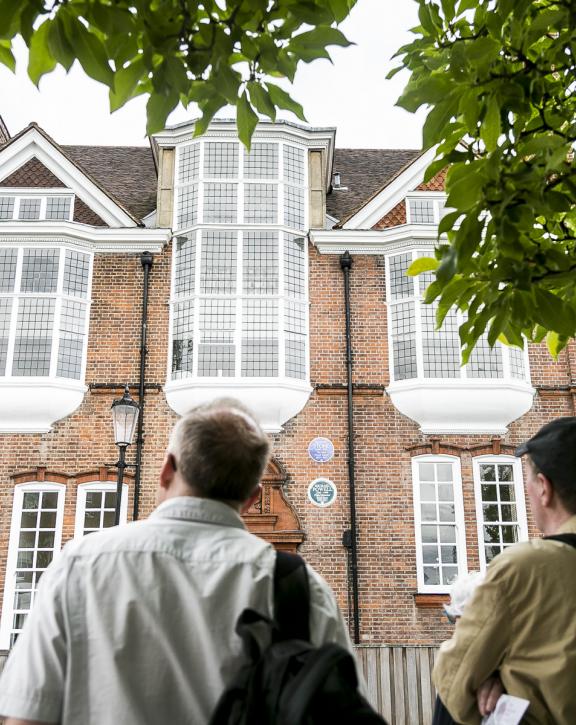
Artists Houses Free Walking Tours
From 7 Jun 2026
Skip to main content Buy Tickets Donate Search (optional) Search Menu Close Main navigation Home The De Morgan Café at Leighton House Visit us About the museums Leighton House…
Current page 1
From 7 Jun 2026
Skip to main content Buy Tickets Donate Search (optional) Search Menu Close Main navigation Home The De Morgan Café at Leighton House Visit us About the museums Leighton House…