Art Museum
Museum of the Ara Pacis
Museum of the Ara Pacis is an art museum in Rome, Italy.
About Museum of the Ara Pacis
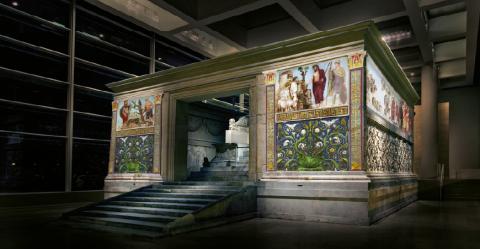
The Museum of the Ara Pacis (Italian: Museo dell'Ara Pacis) belongs to the Sistema dei Musei in Comune of Rome (Italy); it houses the Ara Pacis of Augustus, an ancient monument that was initially inaugurated on 30 January 9 B.C.
Museum of the Ara Pacis by the numbers
- Founded
- 2006
- Visitors / year
- 190,220
- Collection
- 1,001 objects
Plan your visit
Museum of the Ara Pacis
- Website
- www.arapacis.it
- Get Tickets
- Book on Tiqets
We may earn a commission from ticket bookings, at no extra cost to you.
Overview
The Museum of the Ara Pacis (Museo dell'Ara Pacis) is an archaeological museum in Rome, Italy, located on the Lungotevere in Augusta. It belongs to the Sistema dei Musei in Comune of Rome, the municipal museum system of the Italian capital. The museum's sole and defining purpose is to house and display the Ara Pacis Augustae, the Altar of Peace commissioned by the Roman Senate to honor the emperor Augustus and inaugurated on 30 January 9 B.C. The current building, designed by American architect Richard Meier, opened in 2006 and represents the first major architectural and urban intervention in Rome's historic centre since the Fascist era. The museum matters not only as a protective shelter for one of antiquity's most significant monuments but also as a flashpoint in debates about contemporary architecture's relationship to historical urban fabric.
Founding & history
The museum's history is inseparable from the modern history of the Ara Pacis itself. From 1938, the altar was enclosed within a glass-and-concrete pavilion designed by Vittorio Ballio Morpurgo, erected during Mussolini's reconfiguration of Piazza Augusto Imperatore. This earlier structure, known as the "teca del Morpurgo," stood for nearly seven decades. In 1996, then-mayor Francesco Rutelli commissioned Richard Meier to design a new museum without holding an architectural competition; the decision followed a meeting between the two at Davos. Demolition of Morpurgo's building proceeded, and construction began in September 2000. The new museum opened on 21 April 2006, the Natale di Roma, after seven years of work. Cost estimates escalated significantly during construction: Italia Nostra estimated final costs at 16.8 million euros against an initial projection of 5.9 million. The building has since been targeted by political and physical attacks. On the night of 31 May 2009, vandals defaced the white exterior wall with green and red paint and placed a toilet bowl at its base. On 12 December 2009, Earth First! activists dyed the museum fountain green and hung a banner reading "Earth First! Act Now" on the Via Tomacelli side during the Copenhagen Climate Summit; museum staff removed both within minutes. In November 2013, heavy rainfall overwhelmed the roof, causing water to leak into the gallery and requiring staff to use buckets to protect the altar. Political threats to the building's existence emerged in April 2008 when newly elected mayor Gianni Alemanno announced his intention to remove Meier's structure, though he later acknowledged this was not an administrative priority.
Collection scope
The museum's collection is unitary and monumental: it consists exclusively of the Ara Pacis Augustae and its surrounding interpretive apparatus. Unlike encyclopedic museums, the institution does not assemble diverse holdings but rather concentrates all resources on the presentation, conservation, and contextualization of this single ancient altar. The scope is thus archaeological and didactic, with temporary exhibitions occasionally supplementing the permanent display to broaden historical understanding. Visitor numbers have fluctuated in response to these temporary programming choices. In 2014, the museum recorded 307,668 visitors, an increase of 18.67 percent over 2013, partly attributed to popular exhibitions such as "Impressionisti" and "Cartier Bresson." The following year, attendance dropped by 29.23 percent to 217,730, which was linked to more specialized shows like "E42" and "Nutrire l'impero." A gradual recovery brought numbers to 241,609 in 2016 and 287,936 in 2017, before declining again to 216,806 in 2018 and 203,586 in 2019, the latter figure still above the 189,254 visitors recorded in 2012.
Notable holdings
The sole holding of the museum is the Ara Pacis Augustae, the Altar of Peace inaugurated on 30 January 9 B.C. This marble altar, commissioned by the Roman Senate to honor Augustus's return from campaigns in Gaul and Spain, is celebrated for its elaborate friezes depicting the imperial family, Roman religious ceremony, and vegetal motifs symbolizing the peace and prosperity of the Augustan age. The monument's relocation to its current site and its enclosure within successively protective structures, from Morpurgo's 1938 pavilion to Meier's 2006 building, reflect evolving twentieth and twenty-first century attitudes toward conservation, display, and urban integration of ancient monuments. No other works are held in the museum's permanent collection.
Building & site
Richard Meier's museum is constructed of steel, travertine, glass, and plaster, embodying the rigidly geometric forms and plain surfaces characteristic of modernist architecture. The building sits elevated beside the Mausoleum of Augustus, with extensive glazing and skylights designed to provide uniform lighting conditions for viewing the altar. The white color throughout is a signature of Meier's practice. Travertine panels on portions of the exterior resulted from a design modification: aluminum surfaces were originally planned, but Meier revised the scheme amid criticism of the building's visual impact on the surrounding historic landscape, particularly its relationship to the Mausoleum of Augustus. The structure was initially conceived to include a pedestrian underpass connecting the museum directly to the Tiber River, though this element was never constructed. The building's siting within Piazza Augusto Imperatore places it within a deliberately composed Fascist-era urban ensemble, making its modernist intervention especially conspicuous.
Visiting
The Museum of the Ara Pacis is located on the Lungotevere in Augusta in central Rome, within the Capitoline municipal museum system. It is owned and operated by the Comune di Roma. The museum's present role extends beyond simple monument preservation to encompass temporary exhibitions and public programming, though attendance figures suggest its success remains tied to the popular appeal of these ancillary offerings. Access is governed by the standard operational protocols of Rome's municipal museums. The official website, www.arapacis.it, provides current visiting information.
Museums near Museum of the Ara Pacis
- Art Museum Vatican Museums Vatican City, Vatican City
- Art Museum Capitoline Museums Rome, Italy
- Art Museum Pinacoteca Vaticana Vatican City, Vatican City
- Art Museum Galleria Borghese Roma Capitale, Italy
- Art Museum National Gallery of Umbria Perugia, Italy
- Art Museum Palace of Caserta Caserta, Italy


What's on

Robert Mapplethorpe. Le forme della bellezza - VIDEO LIS | Derrick Cross
From 28 May 2026

MUSEO DELLA REPUBBLICA ROMANA E DELLA MEMORIA GARIBALDINA
From 26 Jun 2023

Robert Mapplethorpe. Le forme della bellezza
From 7 Jun 2026
Collezioni prestigiose che spaziano dalla preistoria all’arte moderna e contemporanea, dai tesori del museo pubblico più antico al mondo ai progetti di valorizzazione del…
We may earn a commission from ticket bookings, at no extra cost to you.