The paintings of Arnold Böcklin reach us now mostly as weather. We meet them as moods: a green-black island floating on flat water, a violinist who turns out to be a skeleton, a stretch of sea that registers as grief before it registers as anything. That softening is a modern habit. The Swiss and German viewers who stood in front of these canvases in the 1870s and 1880s did not stop at mood. They read signs, and they expected those signs to carry definite freight.
Here is the position this essay defends: Böcklin's pictures were built to be read as much as felt, and their first audiences treated them as iconographic statements with specific referents rather than open invitations to reverie. Recovering how those viewers looked returns a precision that the later cult of "Böcklin atmosphere" sanded down. Some of the evidence is simply material. Artifact World Gallery holds thirty-six works by Böcklin across fourteen venues, all by the one hand, spanning roughly 1852 to 1901, and even that modest census shows a painter who circled a fixed vocabulary of motifs: the threshold, the tomb, the sea-beast, the sacred grove. Over half a century he sharpened their legibility rather than dissolving it.
What a Basel painter learned to make legible
Böcklin was born in Basel in 1827 and trained at the Düsseldorf Kunstakademie, chiefly in the landscape class of Johann Wilhelm Schirmer, before repeated stretches in Italy reorganized his sense of what a landscape was for (J. Paul Getty Museum). Schirmer's discipline mattered. It taught Böcklin that a landscape could be staged, that rock and tree and water were not transcription but grammar. What Italy added was personnel. The Roman campagna, the cypress, the antique tomb by the road gave him a cast of characters that a German-speaking public already half-knew from its schoolroom Latin and its philhellenism.
The Italian years left a residue that never washed out. The flat noon light of the campagna, its pines and crumbling stone, became the standing scenery of his imagination, and when he turned to a northern subject he still lit it like the south. That tension between a German subject and a Mediterranean light is part of why the pictures feel staged rather than observed. The world they show is assembled from more than one place at once, and Böcklin left the seam visible. A view this composed is a view that wants to be construed.
By the 1870s he had stopped painting scenery and started painting situations. A grove is not a grove; it is a precinct. A figure at the water is not staffage; it is a passenger. This is the crucial shift for the question of meaning, because it means the early viewer was never asked to admire a view. He was asked to identify a subject, place it against a story he knew, and feel the gap between the two. The pictures reward iconographic reading because they were composed as iconography.
Die Toteninsel: a memorial before it was a mystery
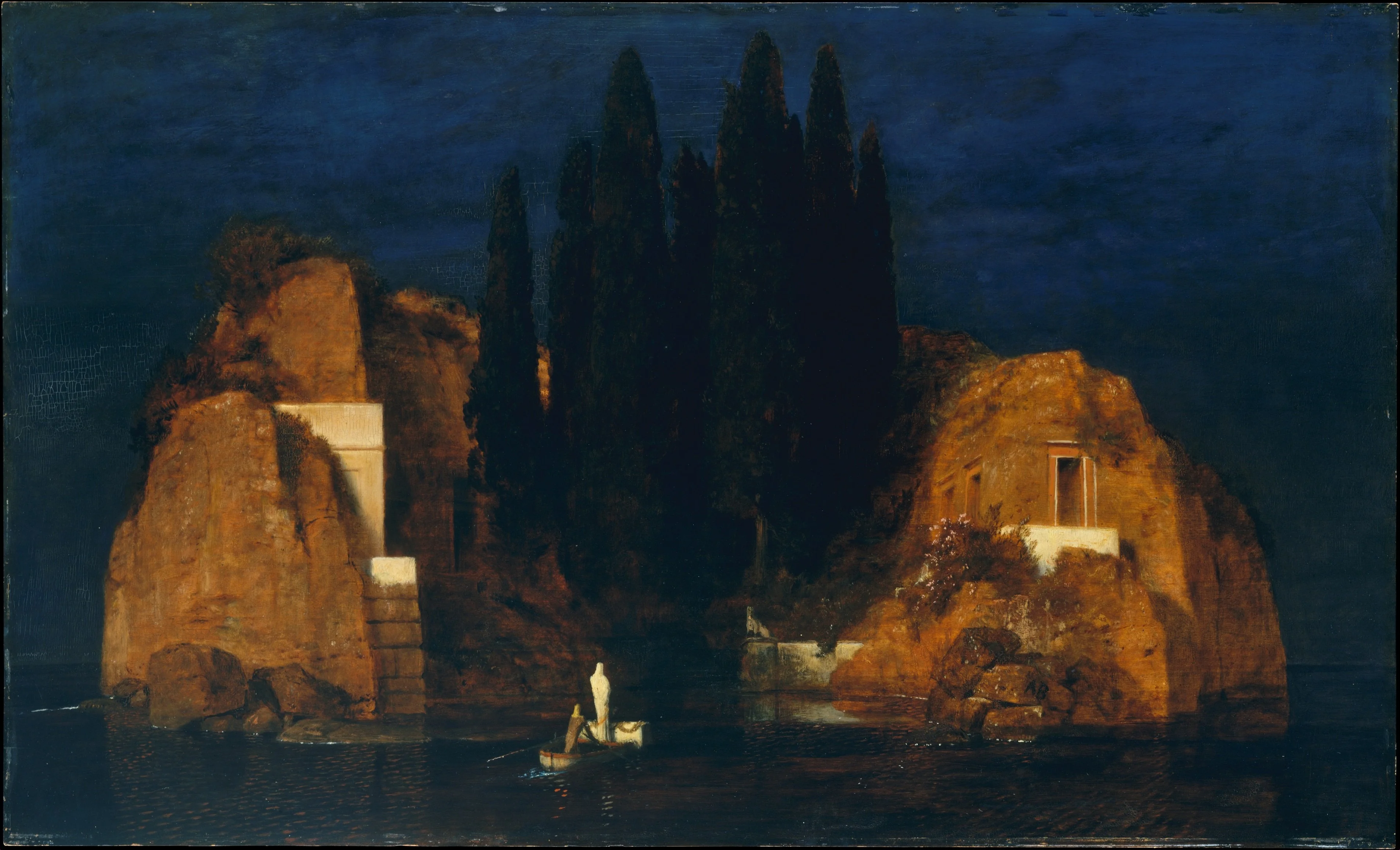
Look hard at the Isle of the Dead. A wall of pale rock curves toward us like the inside of a crater, and into that basin a dense stand of cypress rises, black and vertical, packed so tight it reads as a single dark body. The rock faces are not blank. Small rectangular openings have been cut into them, doorways and burial chambers, so the island declares itself a necropolis before you have named a thing in it. A rowboat slides in from the right across water so still it holds no ripple. An oarsman sits with his back to us. Ahead of him a figure stands wrapped head to foot in white, facing the cypresses, and on the boat's floor, just in front of that figure, lies a long white form draped in cloth. The light is low and even, the kind that belongs to no hour. Everything is arranged so the eye arrives at the standing white figure and stops, the way a held breath stops.
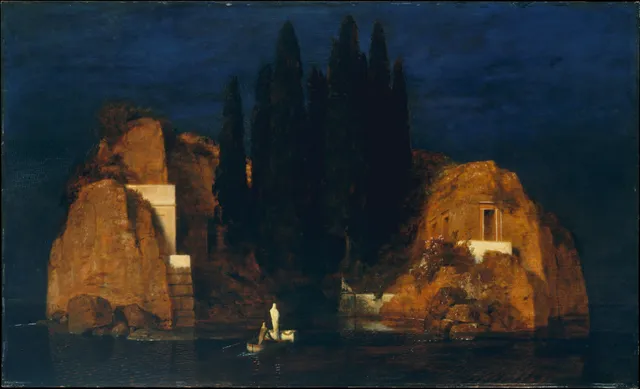
For the first owner the picture was not a riddle but an answer. The version now in the Metropolitan Museum was commissioned in 1880 by the recently widowed Marie Berna as a memorial to her late husband, and the draped coffin and the shrouded figure in the boat were added at her request (The Metropolitan Museum of Art). That commission is the whole interpretive key. The white passenger is the mourner; the draped form is the dead; the island is the place the dead is taken. The picture is a private rite, painted for a particular grief, with the iconography of the Roman tomb-island doing the consoling work that a Christian gravestone might have done for an earlier patron. The standing figure faces away from us because she is not ours to address.
Böcklin returned to the motif at least five times between 1880 and 1886, and the repetitions are not copies but revisions. Each autograph version of the Isle of the Dead adjusts the height of the cliffs, the density of the cypresses, the angle at which the boat enters, as if he were testing how much could change before the sign stopped reading. That a painter would rebuild the same composition five times tells you he thought of it as a fixed text to be refined, not a vague feeling to be chased. The motif had a job, and he kept tuning the instrument until it did that job cleanly.
What happened next is a parable about how meaning drifts. Böcklin never gave the work the name everyone now uses; the title was conferred on it by the dealer Fritz Gurlitt in 1883 (Wikipedia). Böcklin himself described an intention closer to a dream, a stillness so complete that a knock at the door would startle you. Gurlitt turned a memorial into a brand. Engravings of the composition went out across German-speaking Europe, and the picture that had answered one woman's loss became a universal emblem of death, hung in apartments and reproduced until it was nearly furniture. The early meaning was specific and commissioned. The mass meaning was atmospheric and free-floating. The drift from one to the other is the drift this essay wants to reverse.
The myth pictures and their classical alibi
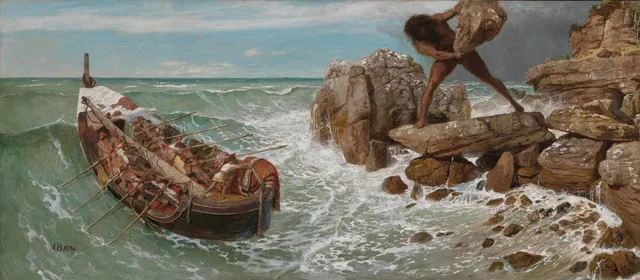
Böcklin's mythologies were never illustrations in the academic sense. Take Odysseus and Polyphemus. The episode from the Odyssey is reduced to its single violent instant: the ship driven low and fast across a sea that has hardened into a moving wall of cold spray, the oars biting, and on the cliff above, the blinded giant rearing back to hurl a boulder after the men who tricked him. The composition refuses the pretty middle distance. The water comes at you in slabs. A nineteenth-century viewer with a gymnasium education read this as Homer, yes, but he also read it as the sea itself turned vengeful, the giant a personification of a nature that does not forgive cunning. The classical subject was an alibi that licensed a frankly elemental terror.
The same alibi runs through his invented cult-sites. The National Gallery of Art holds his Sanctuary of Hercules of 1884, one of those idiosyncratic classical landscapes where an altar and a sacred precinct are staged in a setting that never existed (National Gallery of Art). For the first viewers these were not archaeological reconstructions. They were acts of cultural longing, the German philhellene dream of a paganism still warm, still attended. The meaning lay precisely in the fiction: a worshipper of the 1880s could stand before an altar that no real religion claimed and feel the pull of a continuity that history had cut. Böcklin gave educated Protestants a sacred place they were permitted to miss.
Death with a fiddle, and the legible self
The clearest proof that Böcklin trusted his viewers to read is his Self-Portrait with Death Playing the Fiddle, an oil of 1872 now in the Alte Nationalgalerie in Berlin, in which the painter pauses at his easel while a skeleton behind his shoulder draws a bow across a single string (Smarthistory). The telling detail is the artist's pose. He does not look at Death; he listens. His head is tilted, his eyes drift off the canvas, his brush is stilled. The whole memento mori tradition of the dance of death is folded into a single contemporary gesture: a working painter, in his own studio clothes, taking dictation from mortality. A viewer in 1872 needed no caption. The skeleton with the instrument was a four-hundred-year-old sign, and Böcklin's contribution was to make the man receiving it ordinary, modern, and at his trade.
Ruins, castles, and the German interior
Böcklin's architectural pictures carry their meaning in their masonry. In Ruin by the Sea the broken wall is not picturesque decay for its own sake; it is time made visible against the one element that does not age, the sea. The ruin says that human building is provisional and the water is not. In Landscape with Castle the fortified pile reads the other way, as the past still standing, still occupied, a national-romantic image of a Germanic interior where history has not yet fallen down. To the first audiences these were not neutral views. They were positions in a live argument about whether the old world endured or had already gone under, and a viewer could choose his mood by choosing his wall.
Naming mattered too. His Portrait of Gottfried Keller is not a generic head but a likeness of the great Swiss novelist, and to fix that particular face was to enroll Böcklin among the builders of a Swiss cultural nation, alongside the writer he painted. The allegories work the same way by inversion. Spring Awakening trades on the oldest seasonal sign there is, the return of growth read as the return of desire, and a nineteenth-century viewer met it with the same reflex that let him read a tomb-island or a fiddling skeleton. The vocabulary was shared. Böcklin's originality was in the pressure he put on words everyone already owned.
Works discussed in this article
How the first viewers actually saw him
We can partly reconstruct that first reading from the criticism. An illustrated appraisal of the painter by the Count de Soissons ran in the London monthly The Artist in August 1901, months after Böcklin's death, treating him already as a figure of settled importance whose subjects demanded interpretation rather than mere description (Internet Archive). The German-speaking public had arrived at the same conclusion a decade earlier, and the machinery of arrival was commercial. Böcklin's fame in the 1880s was amplified by Gurlitt, whose engravings of the Toteninsel did for the image what sheet music did for a song. Reproduction is what let a private memorial become a public sign, and it is why so many households felt they knew a painting almost none had seen in oil.
His reputation has always carried an objection inside it. To later eyes the literary subjects can look like a refusal of the modern, a painter still telling stories when painting had begun to be about paint. Look again at the Odysseus and Polyphemus: the charge is fair only if you grant its premise. Böcklin was not trying to dissolve the subject; he was trying to load it, and the load is the point. The quarrel over his worth is really a quarrel about whether a picture is allowed to mean something nameable, and his first audience answered yes without hesitating.
The corpus shape echoes that canonization. Thirty-six works spread across fourteen institutions is not the footprint of a forgotten provincial; it is the footprint of a painter the museums fought to hold once the prints had made the public hungry. The venue spread is itself a record of how thoroughly the first reading took, how completely a Basel painter of tombs and groves became an institution's idea of a master. When you set that distribution against the period criticism, the two agree: Böcklin was received not as a maker of pretty melancholy but as a painter of arguable subjects, the sort you stood in front of and decoded.
What we inherited, and what we mislaid
The twentieth century kept Böcklin but changed his use. Giorgio de Chirico and Max Ernst came to regard his enigmatic pictures as a precursor to their own work on the unconscious, and the surrealists read the Toteninsel as a dream-object, evidence that a painting could behave like the inside of a sleeping head (Smarthistory). That reading is true and also lossy. It keeps the strangeness and discards the referent. The closer inheritance ran through his own circle and pupils, among them the Swiss painter Albert Welti, who took the master's allegorical machinery and turned it toward a homelier, more domestic symbolism. Welti understood the grammar from the inside, which is exactly what the surrealists, borrowing the images whole, did not need to.
Welti's debt is the kind that proves the rule. He inherited not a style but a method, the habit of staging a thought as a place you could enter, and he carried it into quieter, more interior scenes than his teacher ever painted. The lineage that mattered was a lineage of legible meaning. What the next century borrowed from Böcklin was the surface strangeness; what his pupils kept was the underlying conviction that a picture is a sentence, and that a viewer can be trusted to parse it. The two inheritances barely speak to each other, and the gap between them is exactly the precision this essay set out to recover.
So the recovery worth making is not a defense of Böcklin against his admirers. It is a correction of focus. Read the Isle of the Dead as Marie Berna read it, as the place a particular husband was rowed to, and the picture sharpens from a generalized hush into a rite with an address. The next time the boat appears in one of the later versions, watch the white figure: it is still facing away, still carrying its dead toward the cut doorways in the rock, still expecting you to know whose funeral this is. Böcklin painted thresholds because he believed a viewer would walk up to them. The job he left us is to keep walking up.
Sources & further reading
- Island of the Dead, Arnold Böcklin (object record) — The Metropolitan Museum of Art
- Isle of the Dead (painting) — Wikipedia
- Arnold Böcklin, Self-Portrait with Death Playing the Fiddle — Smarthistory
- Arnold Böcklin (Swiss, 1827-1901) — The J. Paul Getty Museum
- Arnold Böcklin — National Gallery of Art
- Arnold Böcklin (artist overview) — Smarthistory
- Arnold Böcklin, The Artist: An Illustrated Monthly Record, Vol. 31 (1901) — Internet Archive
- Arnold Böcklin (biography) — Wikipedia