A passport, not a likeness
When Anders Zorn, the Swedish painter and etcher, set up his easel in a New York drawing room in the 1890s, the men and women who sat for him were not commissioning a likeness so much as a certificate. A Zorn portrait declared that the sitter had entered a particular caste: the transatlantic moneyed class that moved between Newport and Paris and the Riviera, that bought Old Masters by the crate and married its daughters into banking houses. The picture said arrival. That is the argument of this essay, and it is worth stating plainly before the brushwork seduces us into talking only about handling and light.
Zorn's iconography is a code of belonging, and it ran in two directions at once. To the American financier it murmured cosmopolitan status, the assurance that he now owned the same painter the European nobility did. To the Swedish public it announced something nearly opposite: rootedness, an unembarrassed national authenticity drawn from the lakes and farmyards of Dalarna. The watch chain across a banker's waistcoat and the bare back of a girl wading into a northern lake belong to the same artist and the same decade, and both were legible to their first viewers as signs. One meant you had climbed. The other meant you had never left home. Reading those signs the way Zorn's contemporaries read them tells us more than any account of his famous wet brush.
Our own holdings make the scale of his reach concrete. Artifact World Gallery keeps 109 works by Zorn, gathered from a dozen separate institutions and spanning roughly 1887 to 1919, which is to say the whole of his mature career under a single byline. That spread across so many venues is itself a piece of evidence. A painter whose output sits today in twelve collections at once was a painter whose pictures were treated, from the start, as trophies worth competing for.
The man the medals made
Zorn arrived at international fame young and decorated. At twenty-nine he was made a Chevalier de la Légion d'honneur at the Exposition Universelle in Paris in 1889, a state honour that did real work in the market: it told prospective sitters that the French republic had already vetted him (Wikipedia). The Getty's Union List of Artist Names files him with a triple trade, Swedish painter, etcher, and sculptor, 1860 to 1920, and that breadth matters. A buyer could own Zorn as an oil over the fireplace, as an etching in the print cabinet, and as a bronze on the desk, three price points and three intimacies of the same prestige.
He had not always been the bravura oil painter we picture. His early reputation was built on watercolor, and only by 1887 had he switched firmly to oils, the medium that would carry the grand portraits (Wikipedia). The timing is neat. The man who would spend the 1890s painting American millionaires had, just before, retooled himself into the very medium that signalled seriousness to those buyers. Watercolor was for amateurs and ladies' albums. Oil was for the salon wall and the boardroom. Zorn made the move at exactly the moment his clientele was forming.
The American portraits: a grammar of status
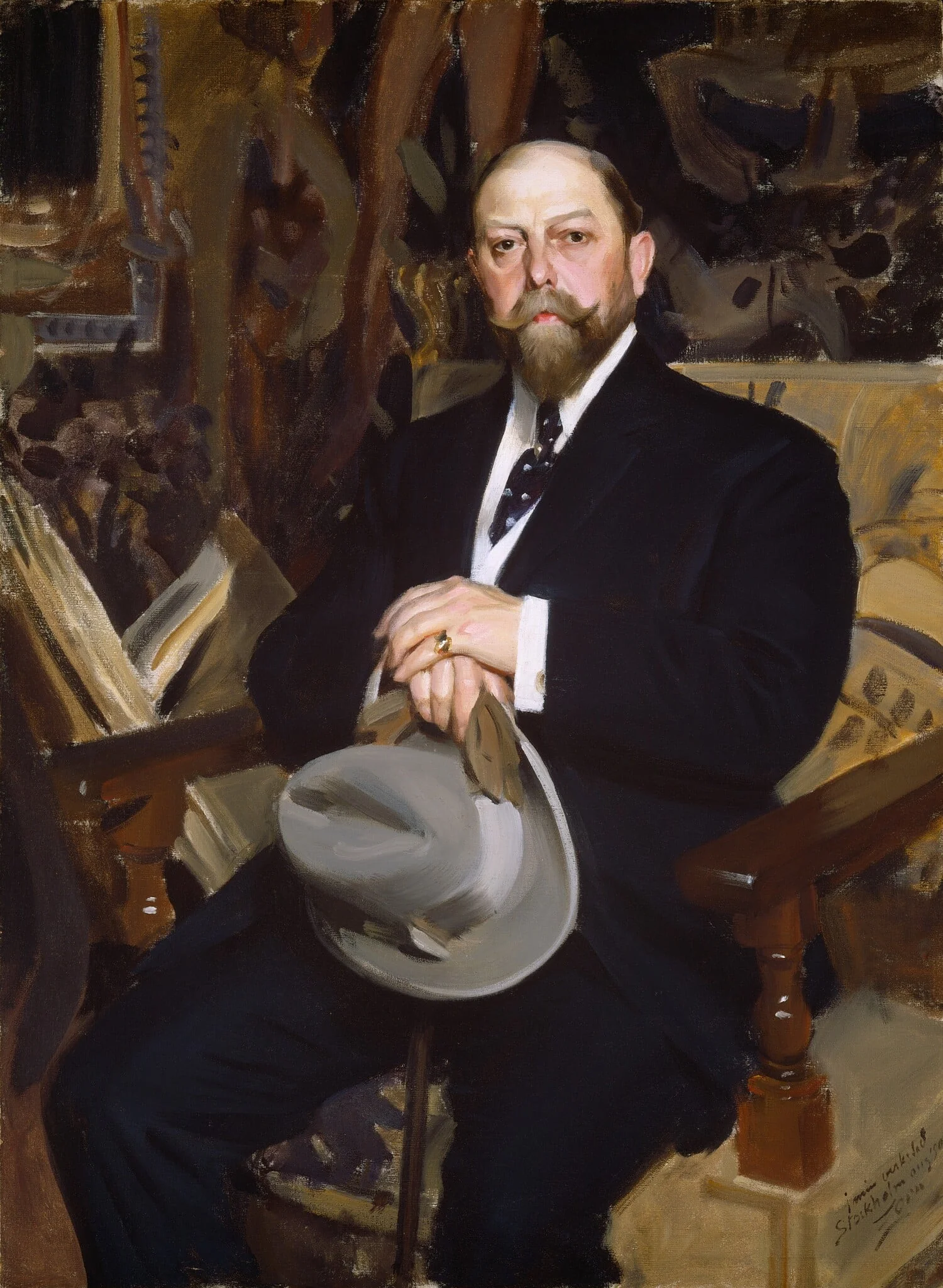
Look at the standing portrait of Hugo Reisinger, the German-American businessman and art patron, and you can watch the grammar work. The figure rises out of a ground that Zorn has barely described, a wash of warm shadow with no furniture and no view, so that nothing competes with the man himself. The dark formal suit is laid in with broad, confident strokes that dissolve at the edges into the background, almost the same value as the air around them. Then, where it counts, the paint tightens. The face and the white of the collar are built with quick, deliberate touches that snap into focus, and the gaze comes straight out at us, level and unhurried. Zorn spends his detail like a banker spends capital, all of it concentrated on the head and hands, the parts that read as character and command, and none of it wasted on the room.
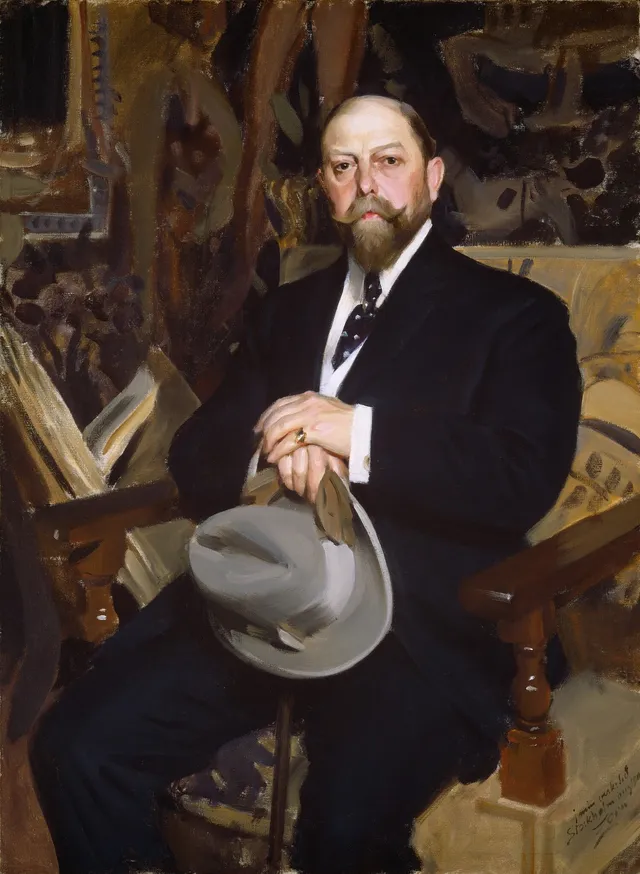
That is not a neutral way to paint a man. The emptied background was an iconographic choice, and Zorn's first viewers understood it. By stripping the sitter of setting, he made each portrait a study in self-possession rather than property. A lesser society painter would have crowded in the marble mantel and the heavy drapery to prove the wealth. Zorn implies the wealth and paints the confidence instead, which is the subtler and more flattering message. You do not need to show your house when your bearing already says you own several.
The same logic governs his women. The portrait of Mrs. John Crosby Brown, born Mary Elizabeth Adams and married into one of the great American banking families, is an image of matronly authority rather than youth or charm. Zorn gives her weight and stillness, a sitter who has nothing to prove and knows it. Set that against his Frieda Schiff, painted as a young woman before she became Mrs. Felix M. Warburg and joined the Kuhn, Loeb banking dynasty. Here the brush turns lighter and quicker, the picture trades gravity for the bloom of a girl on the threshold of a dynastic marriage. The iconography tracks the social function exactly: the established wife is painted as permanence, the marriageable daughter as promise.
Works discussed in this article
His male financiers carry their meaning in the same restrained vocabulary. The portrait of Edward R. Bacon presents a man whose dates, 1846 to 1915, place him squarely in the American railroad and finance generation, and Zorn paints him as that generation wished to be seen, sober, frontal, unsmiling, with the dignity of an institution. The Portrait of Martha Dana softens the register for a younger woman without ever losing the underlying claim that the sitter is somebody. Across these faces the message to the first viewer was consistent. You are looking at a person the European-honoured master found worth his hours, and that fact alone confers rank.
What the brushwork itself was saying
The handling that made Zorn famous was not only a technique. It was a message about modernity, and his sitters knew it. He worked, notoriously, from a severely limited palette, the so-called Zorn palette of lead white, yellow ochre, vermilion, and ivory black (Wikipedia). Four pigments, and from them the full warmth of flesh and the cool of a black coat. The restriction was a discipline that forced unity of tone, and it let him paint at speed, wet into wet, leaving each stroke visible. To a viewer in 1895 that open, unblended surface read as advanced, alla prima, alive. It signalled that the sitter had chosen a painter of the present, not a fussy academician polishing every eyelash.
The natural comparison is John Singer Sargent, Zorn's rival for the same Gilded Age commissions, and the comparison is instructive precisely because the two men competed for one clientele. Both built a face out of a few decisive strokes and let the costume blur. But where Sargent often gives his sitters a nervous elegance, a flicker of psychological tension, Zorn gives them solidity and ease. His Americans look settled in their good fortune. That difference was a selling point. A man who had just made his pile did not always want to look complicated. He wanted to look permanent.
The etcher's republic
If the oils sold status one canvas at a time, the etchings sold Zorn himself to a far wider public, and they carried a different iconography of modern life. The Metropolitan Museum holds his etching Omnibus of 1892, catalogued under the maker who was, in the museum's own formula, Swedish, born and died at Mora, 1860 to 1920 (The Met). The Omnibus subject, passengers jolting along inside a Paris public trolley, was a deliberate piece of contemporary urban observation. The painted version of the theme survives in major collections in Stockholm and Boston (Wikipedia). Here the sign points the other way from the society portrait. Instead of one important individual lifted out of any setting, we get anonymous moderns pressed together in the machinery of the city, light raking across a tired woman's face. To Zorn's first audience this was the iconography of the new century arriving: the crowd, the timetable, the democratic vehicle.
His prints also placed him in a lineage his buyers prized. Zorn worked the etched line with the loose, hatched freedom that everyone recognised as the inheritance of Rembrandt, the supreme painter-etcher of the portrait head. To own a Zorn etching was to own a modern descendant of that tradition, and the comparison was made constantly in the period press. The National Gallery of Art in Washington keeps a run of his prints, including his 1892 etched portrait of the French thinker Ernest Renan (National Gallery of Art). Renan was a celebrity of the European mind, and Zorn etching him is its own kind of social claim, the artist circulating among the famous and bringing their faces to the print-buying public.
He never abandoned the needle. Across his career the etchings return, again and again, to the weathered and capable working people he had grown up among, the fishermen, farmhands, and boatmen whose faces carried the same robust northern character as the dancers at Midsummer. The print collector who bought one of these heads was buying character, the dignity of labor caught in a few raking lines, rather than the rank a society portrait conferred. It is the same instinct that sent him out of the drawing room and back to Mora, and it explains why his graphic work feels of a piece with his Dalarna paintings even when the sitter is a stranger. The etched portrait of the laborer and the oil of the village dance come from one conviction, that the unglamorous north was worth the same serious looking he gave to a Fifth Avenue banker.
Durand-Ruel and the selling of authenticity
The machinery behind the reputation was first-rate. In 1906 the Galeries Durand-Ruel in Paris, the dealership that had championed the Impressionists, gave Zorn a one-man show of paintings, etchings, watercolors, and sculptures, open from the seventeenth of May to the sixteenth of June (period exhibition catalogue, Internet Archive). The choice of dealer is telling. Durand-Ruel sold the idea of the painter as an independent modern figure, and showing all four of Zorn's media together framed him as a complete artist rather than a portrait factory. The same gallery that taught Paris to value Camille Pissarro and his circle was now packaging the Swede for the same collectors.
And what did that public buy when it bought the Zorn who was not painting Americans? It bought Sweden. Stand in front of Midsummer Dance and the second half of his iconography opens up. Couples turn in the slow light of a northern midsummer night, the sky still pale long after midnight, a leaning pole and a red timber cottage anchoring the far edge of the green. The dancers are villagers in folk dress, not models, and Zorn paints the heavy reality of their movement, the swing of a skirt, the grip of a hand at a waist, the slight clumsiness of real bodies enjoying themselves. There is no allegory pinned to it. The meaning is the dance itself, the oldest festival of the Swedish year, light and fertility and continuity made visible.
To a Swedish viewer in the 1890s this was a portrait of the nation, painted by a man who had conquered Paris and chosen to come home to Mora and paint the people he grew up among. That biography was the whole point. The same hand that flattered New York bankers also recorded a farm dance at the solstice, and the second fact authenticated the first. Zorn was not a rootless international portraitist for hire. He had a homeland, a dialect, a village, and he kept painting it. His foreign success and his local loyalty propped each other up, which is why his countrymen could claim him as a national hero while his American sitters claimed him as a cosmopolitan prize.
Water, skin, and the freedom motif
Between the boardroom and the village dance lies the third of Zorn's great subjects, the bathing nude in open water, and it carries the clearest iconography of all. He painted women wading, swimming, drying themselves at the lake edge, their skin catching the broken light off the surface. The motif let him do what he loved technically, the play of reflected light across moving flesh, but to his first viewers it also read as a wholesome northern freedom, sensual without the perfumed decadence of the Parisian salon nude. The water is cold and real. The bodies are robust, not idealized. This was sold as health, as nature, as the unashamed body of the north.
It is worth saying that the line between liberation and consumption here is thin, and a modern eye sees the male artist's appetite where a contemporary saw only sunlight. But the period meaning was specific and it mattered to the pictures' reception. Zorn's nudes were respectable in a way a French academic Venus was not, because they wore the costume of the open air and the swimming hole rather than mythology. The figures of Paul Gauguin were busy carrying symbolist freight in the South Seas at the same moment, and the quieter domestic intimacies of Édouard Vuillard were unfolding in Paris interiors. Zorn went the opposite way, outdoors and into cold water, and his audience took the splash of it as something honest.
Reading Zorn the way his first viewers did
Put the three subjects together and the system is complete. The portrait certified rank. The etching circulated the artist's prestige and his eye for modern life at a price the merely comfortable could afford. The Dalarna scene and the lake nude supplied the authenticity that made the prestige feel earned rather than mercenary. A single decade of one man's work offered his audience a way to locate themselves, whether they were a New York banker wanting to be seen as permanent or a Stockholm patriot wanting to see the nation dance.
This is why the limited-palette bravura and the choice of subject cannot be separated when we ask what the pictures meant. The open stroke said now. The four pigments said discipline. The empty portrait background said command, the village dance said belonging, the cold lake said freedom. None of these were private flourishes. They were a shared language, and Zorn's contemporaries spoke it fluently, which is the real reason the work spread into a dozen collections within his own lifetime and stayed there.
The next time one of his late etched heads catches your eye, the weathered face of a fisherman or a farmhand built from a handful of lines, remember that the man who cut it had spent thirty years teaching two continents to read his marks. He died at Mora in 1920, in the village he kept painting, having sold the world both his sitters' grandeur and his own homecoming, and having made each one the proof of the other.
Sources & further reading
- Anders Zorn — Wikipedia
- Omnibus (etching, 1892) — The Metropolitan Museum of Art
- Exposition Anders Zorn, Galeries Durand-Ruel (1906), catalogue — Internet Archive
- Anders Zorn — National Gallery of Art
- Omnibus (painting) — Wikipedia
- Anders Zorn, ULAN ID 500002927 — Getty Research Institute (ULAN)