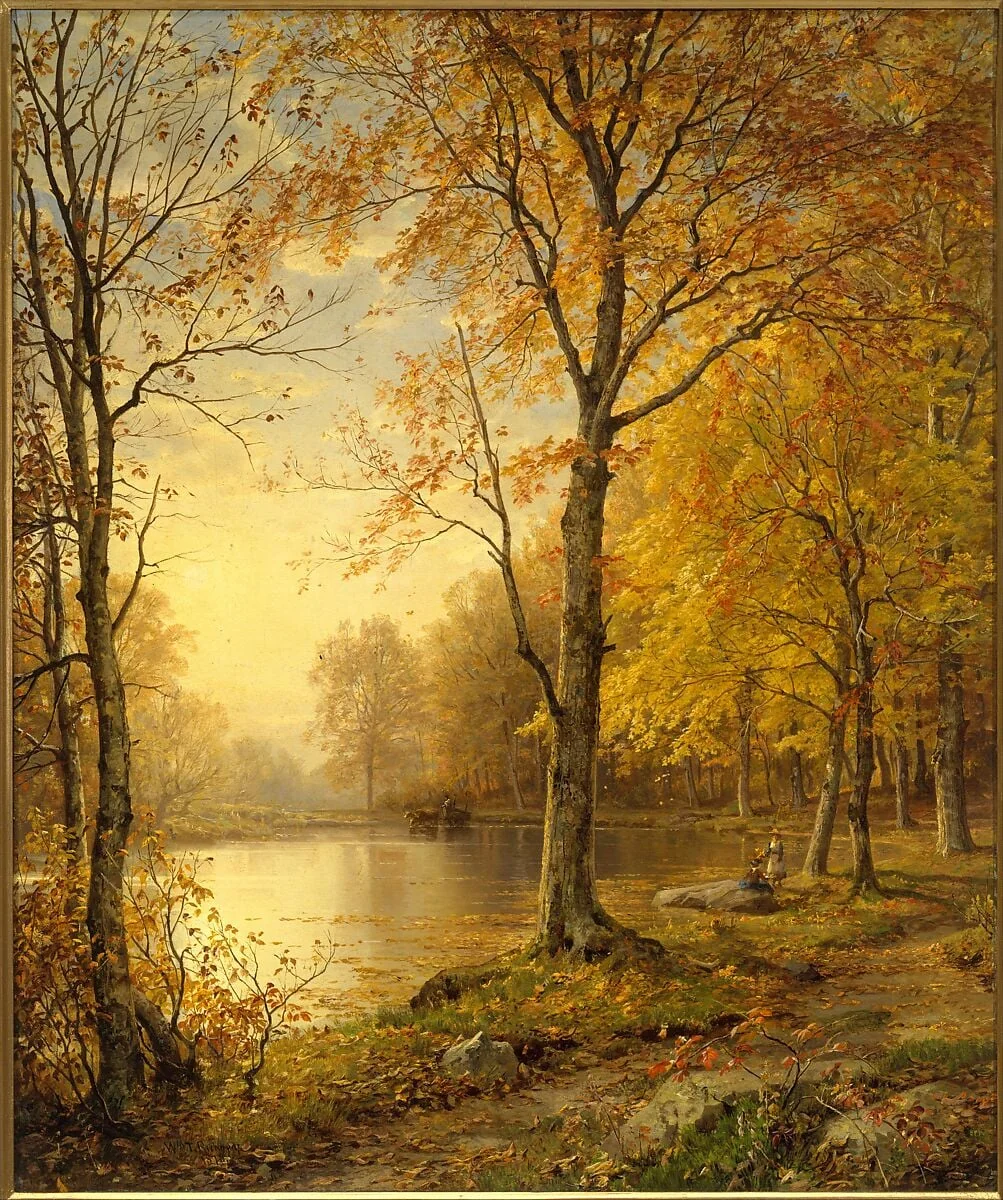
Most accounts of the painter William Trost Richards treat his obsessive fidelity to leaf, rock, and wave as a private vow, a moral position about looking that he kept for half a century. That is half the story. The other half is a ledger. Richards painted what a specific class of American buyers wanted to own, and when that demand shifted, so did his subjects. The forest interiors of the 1860s, built blade by blade, were a product calibrated to Ruskinian collectors who treated a landscape as evidence of careful seeing. The surf and headlands that took over after 1867 answered a different appetite. Read his work this way and the famous consistency of his method looks less like stubbornness and more like a craftsman tracking his market with great discipline.
The argument of this essay is simple and a little unromantic: who paid for a Richards is the best single guide to what a Richards looks like. His training began in trade, designing ornamental metalwork, and he never lost the trade habit of making a thing fit for a buyer. The patrons who mattered were not anonymous. A Baptist minister assembled the watercolors that would seed the first American drawings ever taken into a major museum. A New York dealer carried his name into the international market late in his life. Trace those names and the standard biography, born in Philadelphia, devoted to truth in nature, reorders itself around the people who underwrote the devotion.
The designer who learned to look
Richards was born in Philadelphia on November 14, 1833, and died in Newport, Rhode Island, on November 8, 1905, six days short of seventy-two. His early years were spent in commercial design, drawing patterns for ornamental metalwork and illustration while studying part-time, between roughly 1850 and 1855, with the German émigré painter Paul Weber. This matters more than it sounds. A designer of metalwork is paid for precision and legibility, for line that carries information. When Richards turned to landscape, he brought that discipline with him. He did not learn to paint loosely and then tighten up. He started tight, because tightness was what his first employers bought.
The decisive conversion came in 1858, when an exhibition of English Pre-Raphaelite paintings reached Philadelphia. According to the National Gallery of Art, Richards' landscape style turned markedly more meticulous in its wake, the kind of microscopic attention that asks a viewer to count the ferns. The Pre-Raphaelite Brotherhood had been founded in London a decade earlier, in 1848, as a revolt against academic idealism in favor of serious subjects treated with maximum realism, as the Tate sets out in its account of the movement. Richards did not need to cross the Atlantic to feel its pull. The doctrine of truth to nature arrived as imported pictures, and it found an American painter already primed by trade to take it literally.
In 1863 he made the allegiance formal, joining the Association for the Advancement of Truth in Art, the New York circle usually called the American Pre-Raphaelites. The group read John Ruskin and applied his fidelity-to-nature creed to native subjects, the Adirondacks instead of the Alps, a Pennsylvania woodlot instead of an English hedgerow. The same year produced the dense forest interior the National Gallery now dates to 1863, a picture in which the ground itself becomes the subject and the sky is barely admitted. This was not a young man hedging. It was a painter choosing a difficult, demonstrably effortful manner because effort was the thing his audience prized.
Truth to nature, and the men who bought it
The American Pre-Raphaelite moment was brief, and it was sustained by a small, identifiable readership of collectors and critics who believed a landscape ought to be morally instructive. To own one was to advertise a temperament: patient, devout, suspicious of flash. Richards supplied that temperament in oil and, increasingly, in watercolor. The watercolors are the tell. A Ruskinian collector wanted the artist's hand close to the paper, the record of looking made portable and intimate, and watercolor delivered exactly that. The medium was cheaper to acquire than a major oil, which widened the pool of buyers, and it suited the studious, almost botanical attention these patrons came to expect from him.
That last fact deserves to be stated plainly because it inverts the usual hierarchy. We tend to imagine that museums confer status on artists. Here the sequence ran the other way. A private buyer with a religious conviction about landscape assembled the works, and the institution followed his lead. The Met has recorded that its earliest American drawings were Richards', a distinction owed to Magoon's eye rather than to any curator's prospecting. Patronage did not merely pay Richards' bills. It wrote the first sentence of his canonical reputation.
Close looking: Indian Summer
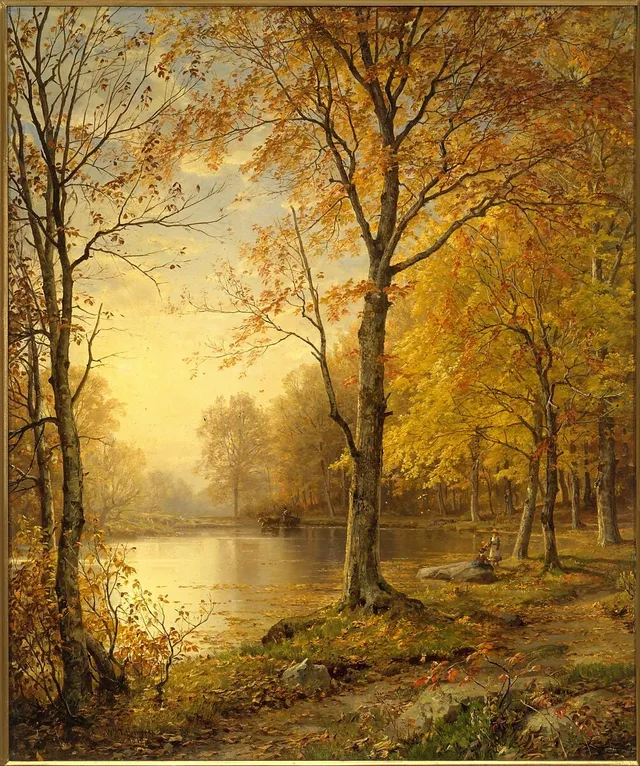
Stand in front of Indian Summer and you can watch Richards negotiate between two loyalties. The horizon sits low, pushed down so that warm autumn air fills most of the surface, and that air is the painting's real material. Near the bottom edge the grasses and the dry margin of the field are still given the old forensic attention, each clump legible, the kind of foreground a Ruskinian buyer would read like a page. Then the land recedes and Richards lets it go soft. Trees thin into a gold-brown vapor, the far line of woods dissolving into the same haze that flattens the light. He is doing two contradictory things at once, holding the foreground to the letter of truth to nature while permitting the distance to behave like atmosphere, like weather rather than fact.
The tension is the point. A strict Pre-Raphaelite refuses the dissolve, because the dissolve hides information. Richards keeps the discipline where the eye lands first and spends the rest of the canvas on a mood that no amount of counted leaves could produce. The picture is calmer than his forest interiors, less anxious to prove its labor. It reads as a painter who has learned that buyers will pay for feeling as readily as for fidelity, and who has found a way to sell both in one frame. The honesty of the detail vouches for the honesty of the haze.
From the forest floor to the surf line
After 1867 Richards turned decisively to the sea. The National Gallery dates the shift to marine subjects to that year, and it was not a whim. The dense, labor-heavy forest interiors had always been hard to sell at scale; they read as exercises, admired more than purchased. The coast offered something the woods could not: repeatable, recognizable, emotionally available scenes that a broad middle-class market wanted on its walls. A wave breaking on rock is legible to anyone. It does not require a Ruskin tract to be enjoyed. Richards, the former designer, understood the difference between a connoisseur's object and a popular one, and he moved toward the second without abandoning the craft that defined the first.
Look at the corpus and the pivot is visible as a spread of subjects. Surf on Rocks is the new product in its purest form, all heaving water and resistant stone, the patient detail now turned on foam instead of foliage. New Jersey Beach strips the drama out and sells the long, quiet horizontal of the shore, a format that suits a domestic room. Yet the mountains never fully left. Bouquet Valley, Adirondack Mountains and Lake Squam from Red Hill show him keeping the inland market warm even as the coast took over. He diversified rather than converted.
The most interesting works are the ones that try to have it both ways. Moonlight on Mount Lafayette, New Hampshire takes the precise White Mountain topography his earlier patrons loved and wraps it in a nocturnal mood closer to the sentiment-driven market he was now courting. It is the same maneuver as Indian Summer, in a colder key. The detail certifies the picture; the mood sells it. A painter with no eye on his buyers does not hedge this carefully.
The Magoon collection and the Metropolitan's first American drawings
Return to the minister, because the Magoon connection is where patronage and subject matter lock together. Magoon collected on paper, and Richards gave him watercolors that rewarded the medium's intimacy. One survives in the Metropolitan as a near-perfect specimen of the arrangement: a New Hampshire watercolor of 1874, executed in watercolor, gouache, and graphite on gray-green wove paper, and recorded as having come from Magoon's collection. The graphite under the wash is the designer's old habit again, the drawn armature beneath the color. A collector who prized the visible record of looking got exactly that, down to the pencil.
The institutional consequence was large out of proportion to the modest scale of the sheets. When the Metropolitan absorbed this material, it acquired its first American drawings, and they were Richards'. A century later the museum mounted a show drawn from its own holdings of his work. The lesson for anyone reading his career as a money story is that the most durable form of patronage is not the highest price paid in a single year. It is the buyer whose taste happens to align with where institutions are heading, so that a private cabinet becomes a public foundation. Magoon bought Richards because Richards painted the way Magoon believed landscape should be painted, and the Met inherited the consequence.
Works discussed in this article
Dealers, Knoedler, and the late market
By the last decades of his life Richards had moved beyond the closed circle of Ruskinian believers into the ordinary commercial art world, the world of dealers who sold to whoever would buy. The Getty Research Institute holds documentation on Richards within the records of M. Knoedler & Co., the major New York firm, which places him squarely inside the dealer system that organized the American market in the late nineteenth and early twentieth centuries. This is a quiet but telling fact. A painter handled by Knoedler is a painter being sold as inventory, his pictures priced, stocked, and moved like any other commodity on the wall.
It helps to situate that shift among his contemporaries, because the dealer-driven market was a continent-wide phenomenon, not a Richards eccentricity. The same machinery that stocked Knoedler's New York rooms carried European names across the Atlantic, the etchings of Félicien Rops, the portraits and still lifes of Henri Fantin-Latour, and the sculpture of Auguste Rodin. On the American side his rough peer was the Munich-trained Frank Duveneck, a generation's worth of painters whose reputations were increasingly set in dealers' showrooms rather than in artists' societies. Richards entered that system on his own terms, with a marine product the dealers could sell on sight.
What the ledger shows
A holdings count makes the spread concrete. Artifact World Gallery holds 42 works by Richards across 8 venues, all by his hand, with catalogue dates clustering across roughly a century from the early 1800s to 1903. The number tells you two things. First, the work is dispersed, scattered across many institutions rather than concentrated in one, which is the natural fate of an artist who sold steadily to private buyers and through dealers instead of being absorbed wholesale by a single museum. Second, the survival rate of his watercolors is what holds the distribution together, the portable, collectable sheets that buyers like Magoon acquired and then handed onward.
- The Ruskinian phase (1860s): forest interiors and microscopic detail, sold to a small circle of collectors who treated fidelity as a moral test.
- The marine pivot (after 1867): surf, headlands, and beaches, a broader product for a broader middle-class market.
- The dealer years (late career): Knoedler handling and a national market, the painter as inventory.
None of this diminishes the pictures. Indian Summer is a genuinely good painting, and its negotiation between counted grass and dissolving gold is the kind of problem only a serious artist sets himself. The point is that the problem was not posed in a vacuum. Richards solved it for people, for a minister who wanted looking made visible, for households that wanted the sea on the wall, for dealers who needed something that would sell before the season turned. The truth-to-nature creed gave him a method. His buyers gave him a reason to keep refining it for fifty years.
So the revisited question answers itself. We know who painted these works, a Philadelphia designer who taught himself to look with a draftsman's exactness. The harder and more revealing question is who paid, and the answer runs through a minister's cabinet, a coastal middle class, and a Fifth Avenue dealer's stockroom. Follow that money and the consistency people admire in Richards stops looking like a temperament. It looks like a working artist reading his audience, year after year, and giving them a sea they could believe in.
Sources & further reading
- William Trost Richards — Wikipedia
- William Trost Richards — National Gallery of Art
- Pre-Raphaelite (art term) — Tate
- Sundown at Centre Harbor, New Hampshire (1874) — Internet Archive (Metropolitan Museum of Art scan)
- William Trost Richards in the Metropolitan Museum of Art — The Metropolitan Museum of Art
- October (1863) — National Gallery of Art
- William Trost Richards: Hieroglyphs of Landscape — Internet Archive (McMullen Museum of Art, Boston College)
- M. Knoedler & Co. records (component) — Getty Research Institute