Artwork
Lake Squam from Red Hill
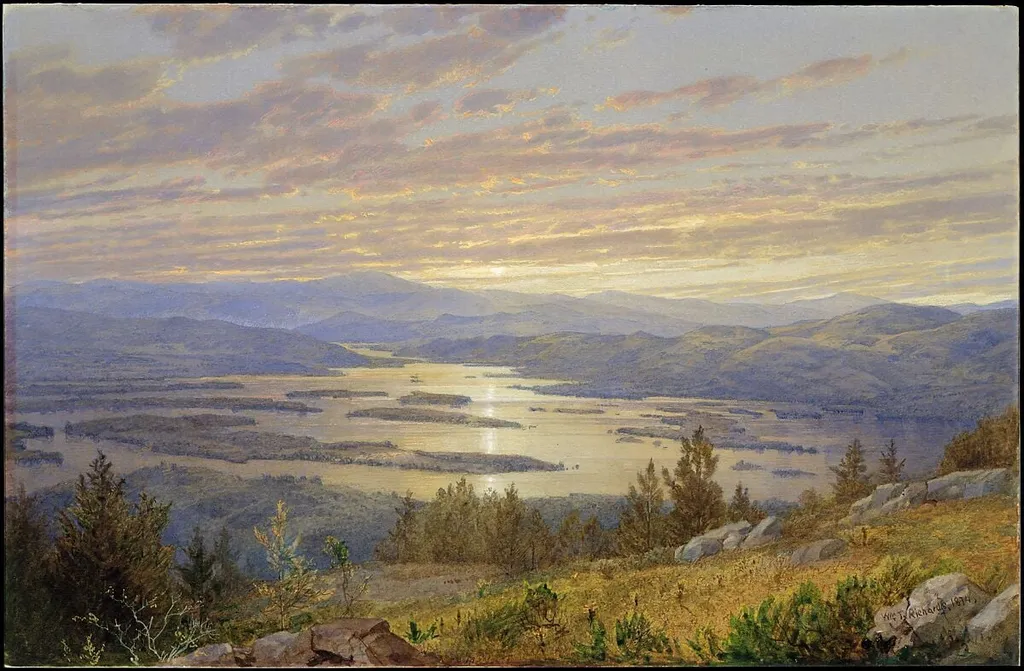
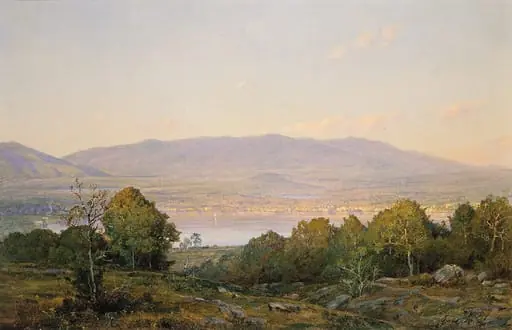
Lake Squam from Red Hill is a gouache work on paper by the Hudson River School artist William Trost Richards. It dates from 1874 and is held in the collection of the Metropolitan Museum of Art.
About this work
Subject & Meaning
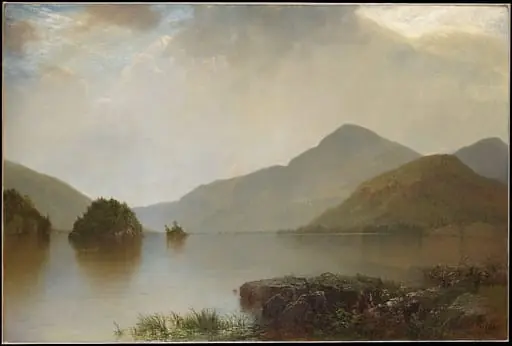
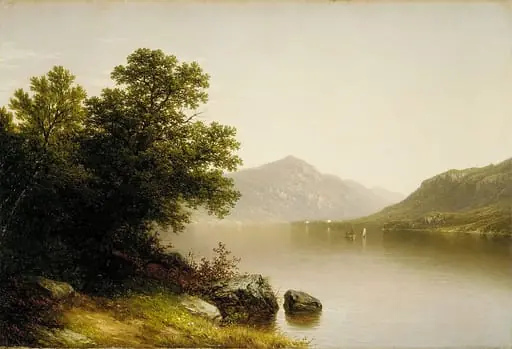
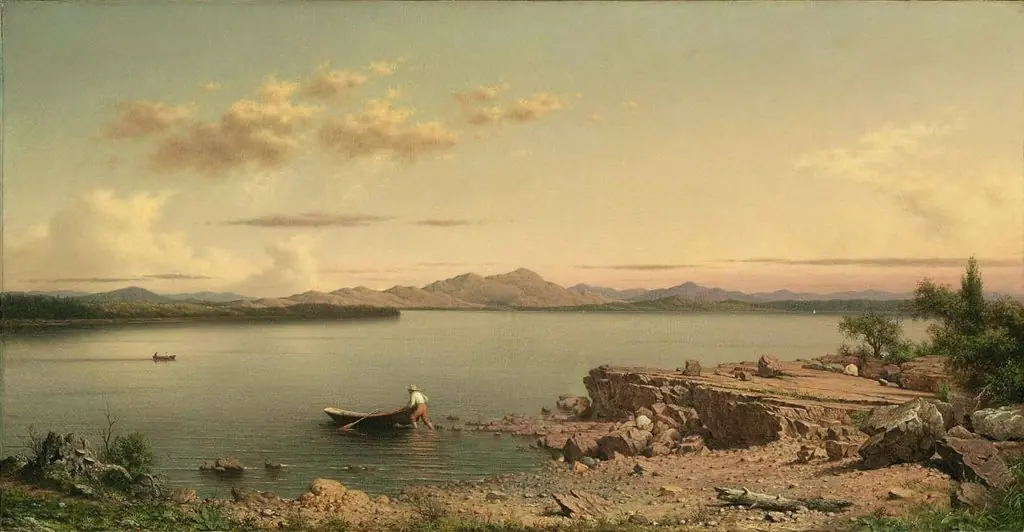
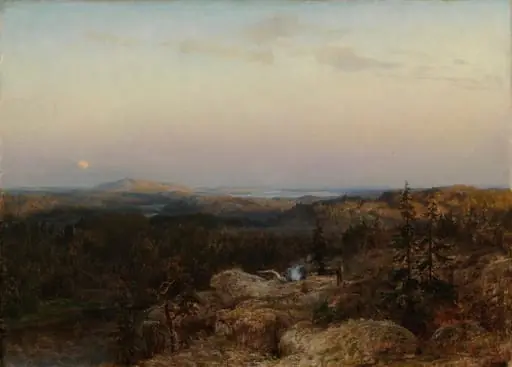
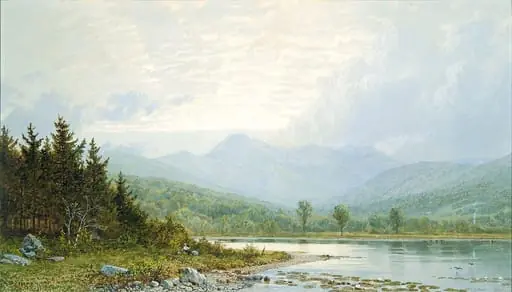
Lake Squam from Red Hill depicts the New Hampshire lake of the same name, rendered as a broad sheet of water encircled by wooded shores and set beneath an expansive sky. The composition gathers the natural elements of Squam Lake, open water, sky, drifting clouds, bordering trees, and grassy foreground, into a unified landscape view taken from the elevated vantage of Red Hill. Working in watercolor, gouache, and graphite, Richards recorded the topography of the region as a topographical study, presenting the lake itself as the central subject rather than as a backdrop for figures or narrative incident.
The painting thus functions as a direct transcription of place, celebrating the specific geography of Squam Lake and its surrounding terrain through careful observation of light, atmosphere, and the layered recession of land, water, and sky.
Technique & Style
The artist worked in a mixed-media technique combining watercolor and gouache, supplemented with graphite, on a sheet of light gray-green wove paper.
Lake Squam from Red Hill is a watercolor painting executed in 1874 by William Trost Richards. The artist worked in a mixed-media technique combining watercolor and gouache, supplemented with graphite, on a sheet of light gray-green wove paper. This combination of transparent and opaque water-based media, along with graphite underdrawing, allowed Richards to build up both atmospheric washes and crisper linear definition on the toned paper support.
The composition is a landscape format, measuring 22.5 by 34.5 centimeters, oriented horizontally. The depicted elements, Squam Lake, sky, clouds, trees, and grass, reflect Richards's characteristic handling of New Hampshire scenery through layered washes and refined draftsmanship, with the gray-green ground unifying the natural palette of sky, water, and foliage.
History & Provenance
The work was created in 1874 by William Trost Richards as a watercolor, gouache, and graphite composition on light gray-green wove paper. It depicts Squam Lake near Holderness, New Hampshire, from the vantage of Red Hill. The painting entered the collection of the Metropolitan Museum of Art, where it remains held as of documented records.
Technical and stylistic analysis aligns its production with Richards’s mature watercolor practice of the early 1870s, marked by precise graphite underdrawing and layered translucent washes.
Legacy
William Trost Richards’s 1874 watercolor Lake Squam from Red Hill, documented in both The American Wing classification and the Metropolitan Museum of Art collection, has come to symbolize the careful observation of New England scenery that characterized late‑19th‑century American landscape painting. Its inclusion in a major museum’s permanent holdings and its continued citation in studies of American scenery underscore a lasting reputation that influenced subsequent artists’ approaches to naturalistic representation. The work’s technical combination of watercolor, gouache, and graphite on gray‑green paper exemplifies the hybrid media practices of the period, contributing to its enduring scholarly interest.
Overview
Painted in 1874, Lake Squam from Red Hill is a watercolor, gouache, and graphite work by William Trost Richards, a prominent figure in the American landscape tradition. The composition captures a serene view of Lake Squam in New Hampshire, characterized by the artist's meticulous attention to natural detail and atmospheric light. Richards executed this piece on site rather than in a studio, a practice central to his later career shift toward precise, observational realism.
The scene features a calm body of water under a pale sky, with a single sailboat drifting near the shore. Tall pine trees frame the foreground, their sharp green needles contrasting with the soft luminosity of the water and sky. Richards achieved this effect by layering thin glazes of color, a technique that enhances the transparency and depth of the water while maintaining the structural integrity of the foliage.
This work exemplifies Richards' mature style, bridging the grandeur of the Hudson River School with a more intimate, scientific observation of nature. It reflects his dedication to capturing the specific conditions of a moment in time, moving away from the idealized compositions of his earlier career toward a more direct engagement with the American landscape.
Artist & collection