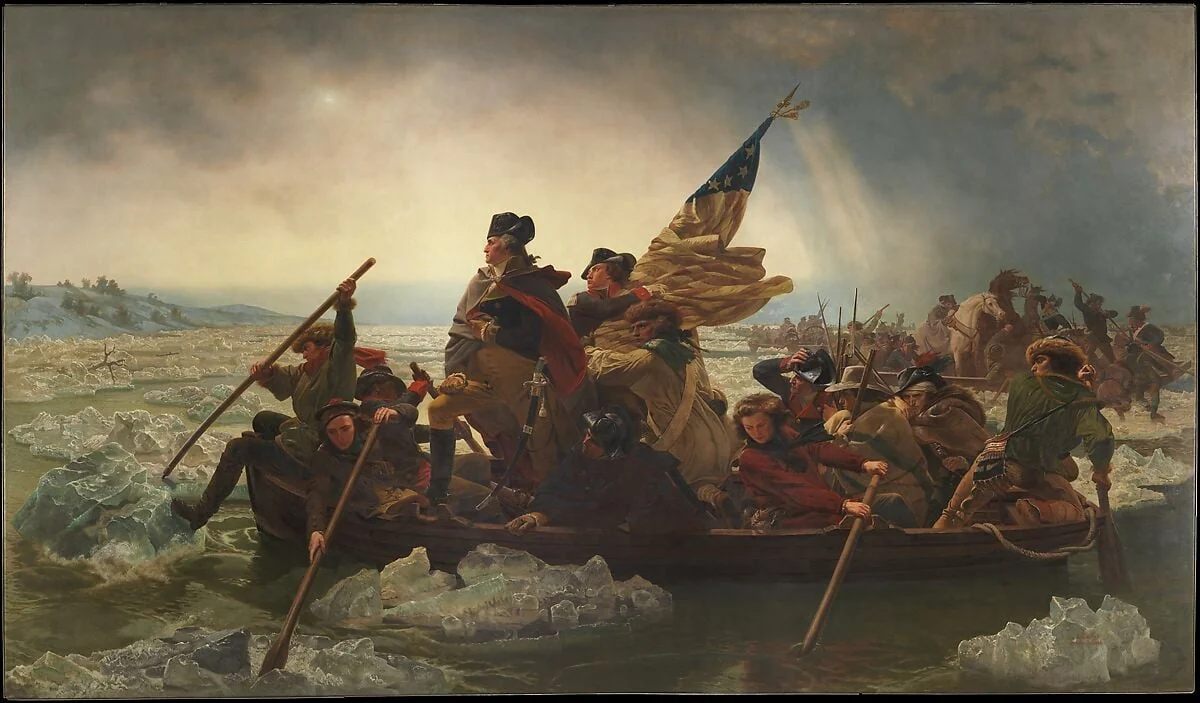
The painter Emanuel Leutze, the German-American history painter, built the most familiar picture of the American Revolution about four thousand miles from the river it shows, in a studio in Düsseldorf, using German training, German light, and money raised on a European art market. That single fact reframes everything the canvas seems to tell us. Washington Crossing the Delaware reads as a national confession of faith. Its origins belong to the international art trade.
Here is the argument this essay defends. Leutze's patriotism was a product made for export, and the people who paid for it were dealers, engraving publishers, and ticket-buying crowds rather than the republic it flatters. Ask who painted it and you get a German immigrant schooled in the Rhineland. Ask who paid for it and you find a speculative venture in which American history was the commodity and a European audience the first buyer. The two questions turn out to be one question, and the answer is commerce.
The man who painted it
Leutze was born on May 24, 1816, in Schwäbisch Gmünd, in the Kingdom of Württemberg, and he died on July 18, 1868, in Washington, D.C., according to the biographical record. Between those dates he lived a double life that the famous painting conceals. His family carried him to the United States while he was still a small boy, settling in Philadelphia, so his earliest American years were those of an immigrant child. The training that made him a painter, rather than merely a patriot, happened back in Germany.
He enrolled at the Kunstakademie Düsseldorf under its director, Schadow, and lasted only about a year. The academy's discipline did not suit him; the accounts describe an anti-academic temperament that pushed against the school's program. What actually shaped him was not the official curriculum but a colleague. Leutze took his cues from Karl Friedrich Lessing, the Düsseldorf painter whose charged historical canvases showed how a picture of the past could argue about the present. The sources are blunt about the debt: Leutze was mostly influenced by Lessing, not by the professors he walked away from.
That lineage matters for the question of who painted the crossing. The hand belonged to a man fluent in a German idiom of historical drama: high finish, theatrical lighting, a composition built to carry a moral the way a stage tableau does. Leutze did not coax American history painting out of native soil. He imported a Rhineland method and aimed it at an American subject, and he did so inside a Düsseldorf art economy that was already organized to sell pictures across the Atlantic. The young republic gave him his themes. Germany gave him the means to render them, and a ready market to recoup the cost.
Made on the Rhine, not on the Delaware
The image most Americans carry in their heads was assembled in a German studio. Leutze worked on two large versions of the composition. The first, begun in 1849, was later destroyed in an Allied bombing raid during the Second World War. The second, begun in 1850, is the canvas that crossed the Atlantic and went on public view in New York in October 1851, as Smarthistory documents. The Metropolitan Museum of Art, which holds that canvas today, dates it to 1851 and records it as oil on canvas, a single object roughly twelve feet high and twenty-one feet wide. The Met's catalog entry is the anchor for everything written about the work since.
There were more than two. The record counts three oil paintings by Leutze depicting Washington's crossing of the Delaware with the Continental Army in December 1776, as the Internet Archive's object record notes. A subject painted once is a statement. A subject painted three times, across two countries, is a production line. The multiplication is the first clue that we are looking at an enterprise and not only an inspiration.
Geography sharpens the point. Düsseldorf sits on the Rhine. The men, the boat, the ice, and the cold dawn were all fabricated in a studio on a European river, then shipped to a country whose audience would read the scene as its own founding moment. The Getty's authority file places the finished painting in Gallery 760 of the Metropolitan and ties it to the crossing on the night of December 25 to 26, 1776. Everything documentary about the picture confirms the same paradox. A German workshop manufactured the most American image there is.
Close looking: a monument in a rowboat
Stand in front of Washington Crossing the Delaware and the first thing it does is refuse physics. Washington stands upright in a small boat clogged with ice, one boot braced on the gunwale, his weight thrown forward toward a far bank we cannot see. Nobody stands like that in a rowboat caught in a winter current. Leutze knows it. He wants the impossibility, because the figure is not a man keeping his balance. It is a monument that happens to be wearing a uniform.
Around him the boat is a deliberately mixed crowd. An oarsman strains against a slab of floating ice. A figure in a Scottish bonnet bends to the work, another man at the bow reads as Black, a wounded soldier slumps, two figures dressed as farmers haul at their oars. The strong diagonal of the boat cuts across the horizontal of the river, and the great folded flag rises behind Washington's shoulder to close the composition the way a sail would. Leutze sets a cold dawn low on the horizon and lets it catch the ice in pale gold while the men stay in blue shadow, so the whole crossing appears lit from the future it is rowing toward.
Look longer and the picture keeps confessing its construction. The ice is closer to carpentry than to water, each floe a flat plane edged in white, set at angles that march the eye from the lower corner up to Washington's braced leg. The river gives back almost no reflection. Leutze wants no shimmer here, nothing that would soften the diagonal or dissolve the men into atmosphere the way the Impressionists later would. The faces held in shadow are individuated, each oarsman a separate type rather than a smear of crowd, while the one blaze of warm light falls on the general's profile and the metal at his chest. This is lighting used as an argument. The eye is told where the meaning sits before the mind has named a single figure.
The brushwork is where the German schooling shows. It tightens on the faces and the flag and loosens only in the churned water at the keel. Every element that has to be read is rendered to a high, legible finish, with nothing important left to accident. And the staging is openly false. The flag is the wrong flag for December 1776. The boat is far too small for the bodies crammed into it. The scene is built the way a Lessing history piece is built, for maximum readable feeling. That staging is precisely what made the picture sellable. A canvas this clear, this quotable, this easy to reproduce, was engineered to travel.
Who paid for it
No agency of the United States government commissioned Washington Crossing the Delaware. The republic did not order its own founding portrait. The financing of a great history canvas in the middle of the nineteenth century ran along a chain that had little to do with the state. An artist painted the large picture on speculation, then charged the public admission to come and see it, then sold engraved reproductions to everyone who could not buy the original. The painting was the loss leader. The crowd and the prints were the revenue.
The single-picture show was a recognized business by mid-century. A dealer or the artist would rent a hall, hang one enormous canvas, light it for effect, charge admission at the door, and sell engraved reproductions to the crowd it drew. The economics rewarded scale and legibility, which is exactly what Leutze delivered. A picture twelve feet high reads from across a packed room. A composition this clean survives the shrink to a print plate without losing its force. Every formal choice that looks like patriotic conviction also works as commercial sense, and the two never pull against each other. They are one decision seen from two sides.
Leutze's canvas fits that model exactly. The second version did not enter a museum on arrival. It went on view in New York in 1851 as a paid attraction, the kind of single-picture exhibition that drew lines around the block and made history painting pay. The picture's design supports the business at every level. Its clarity is reproduction-ready. Its emotional pitch is built for a ticketed audience that wants to feel something on the spot. The existence of three oil versions tells you the composition was treated as an asset to be worked more than once.
The Düsseldorf context closes the case. The school Leutze trained in was oriented toward export, and Americans were among its most reliable customers. A German-trained immigrant painting American subjects for American buyers was not an accident of biography. It was a market position. The patriotism on the surface of the canvas was, underneath, a transatlantic transaction, and the men who underwrote it were the dealers and publishers who understood that a nation will pay handsomely to be shown its best version of itself.
The history machine beyond Washington
The crossing overshadows a working painter who produced far more than one icon. Look at Columbus Before the Queen and you see the same instinct that drove the Delaware. Leutze repeatedly chose the hinge moment, the instant a decision tips an empire, and he staged it for an audience that already knew the ending. Columbus stands before Isabella with the New World still an argument rather than a fact. The pictorial logic is identical: a single charged exchange, lit and arranged so the viewer reads the stakes before reading the figures.
He kept circling the Revolution too. Mrs. Schuyler Burning Her Wheat Fields on the Approach of the British takes the founding war and hands it to a woman performing scorched-earth patriotism, setting fire to her own harvest rather than let it feed the enemy. It is a companion thesis to the crossing: sacrifice as the price of nationhood, told through a single resolute body in a charged landscape. The subject is American to the bone, the method is the one he carried over from the Rhineland, and the emotional pitch is again tuned for a viewer who will feel the choice before parsing the scene.
Leutze was also a portraitist of the artists around him, and that side of the work maps his network. The portraits of the landscape painter in Worthington Whittredge and of the painter in William Morris Hunt, along with the unnamed sitter in Portrait of a Gentleman, show a man embedded in the American art world of his century rather than standing outside it. He painted his peers the way a colleague does, with attention to the particular face rather than the public legend. The contrast with the crossing is instructive. The same hand that turned Washington into a monument could drop the theatrics entirely and simply study a friend.
It helps to set him beside his American contemporaries to see how unusual his position was. Genre painters such as William Sidney Mount worked the everyday life of the young republic, and a portrait dynasty such as the one represented by Rembrandt Peale supplied the founders' faces from inside the country. Leutze, by contrast, supplied the country's grand history from abroad. A later figure such as William Merritt Chase would again look to Europe for technique, and a landscapist like Samuel Colman would keep the transatlantic conversation running. Leutze was an early, decisive node in that long exchange.
What our archive holds
Our own holdings make the pattern legible. Artifact World Gallery catalogs thirty-one works by Leutze spread across five institutions, dating from roughly 1839 to 1865, the full working span from his early German years to the eve of his late American murals. That spread, concentrated in a handful of major collections rather than scattered widely, is itself a portrait of his career. A painter who built pictures for exhibition and reproduction ends up where the largest institutions are, because that is where the audience and the prestige accumulated. Five venues for thirty-one works is a tight cluster, and tight clusters are what a market-facing career leaves behind. The thirty-one works are not a random sample. They are the residue of a strategy.
Works discussed in this article
When the state finally paid
The patronage story has a final turn, and it reverses the one we started with. In the early 1860s Leutze painted a mural for a stairway of the United States Capitol, the panorama known as Westward the Course of Empire Takes Its Way, an image bound up with the ideology of Manifest Destiny. This time the patron was the American state itself, and the picture was painted into the wall rather than sold off it. The immigrant who had once exported American history from a German studio was now painting it, on commission, inside the building where the country governs itself.
The preparatory record survives. The National Gallery of Art holds drawings and studies by Leutze, including studies for the Washington crossing and for the Westward mural, and ranks him among the leading artists of the Düsseldorf school. Those sheets are the working evidence that both of his great public images were engineered rather than improvised, planned figure by figure before the paint went down. The arc from speculative export to government mural is the whole career in miniature. He learned to sell the past abroad, then was hired to install it at home.
So the patriotic icon turns out to have a price tag, several of them, and a foreign workshop. That does not cheapen the painting. It explains it. The clarity that lets a textbook crop it to a thumbnail, the staged heroism that lets a stamp reproduce it at the size of a fingernail, the readable drama that drew a paying crowd in 1851, are all the same set of decisions, made by a German immigrant who understood that an audience will buy its own myth if you paint it well enough to believe. The next time the crossing turns up on a coin or a classroom wall, remember it was a Düsseldorf export before it was an American memory.
Sources & further reading
- Washington Crossing the Delaware, Emanuel Leutze (1851) — The Metropolitan Museum of Art
- Emanuel Leutze, Washington Crossing the Delaware — Smarthistory
- Washington Crossing the Delaware (object record) — Internet Archive
- Emanuel Leutze — Wikipedia
- Westward the Course of Empire Takes Its Way — Wikipedia
- Emanuel Gottlieb Leutze (artist record and studies) — National Gallery of Art
- Washington Crossing the Delaware (CONA subject record) — Getty (CONA)