Look at almost any Gérôme and you are looking at two objects at once: the painting on the wall, and the engraving or photogravure that was always going to follow it. The career of the painter Jean Léon Gérôme, the most reproduced French artist of the Second Empire, makes the cleanest case in nineteenth-century art that the question of who paid for a picture answers the question of who painted it. His canvases were built to travel as prints, and the firm that held the plates shaped the supply at least as much as any Salon jury did. By 1880 his images had been pressed into so many parlors and print-shop windows around the world that he could plausibly be called the most famous living artist anywhere, a reach documented in the standard biographical record of his life.
The argument here is narrow and a little unfashionable. Gérôme's famous enamel smoothness, his archaeological props, his stagecraft of the arena and the bazaar, were not private obsessions held at arm's length from commerce. They were the painterly form of a distribution machine. A surface with no visible brushwork photographs cleanly and reproduces without loss. A scene that carries a single legible anecdote sells the print to a buyer who will never stand in front of the original. Gérôme understood this earlier and more completely than his rivals, and he organized his whole production around it. To read him as a reactionary who simply refused Impressionism is to miss the more interesting truth: he was the most modern artist of his generation in the one respect that the avant-garde pretended not to care about, which was the business of getting pictures in front of people.
The dealer in the family
The decisive fact of Gérôme's working life is not a teacher or a movement. It is a marriage. In 1863 he wed Marie Goupil, daughter of Adolphe Goupil, head of Goupil et Cie, the most aggressive art-publishing house of the century. Goupil did not merely sell paintings. The firm bought reproduction rights, commissioned engravings and later photogravures, and ran an international chain of branches that pushed those prints from Paris to The Hague to New York. A Gérôme original might fetch a serious price from one collector. The plate behind it earned for years. Once the painter and the publisher were family, the easel and the press became a single economic instrument, and the instrument had preferences. It wanted finish, clarity, and a subject a shopkeeper could name at a glance.
This is why complaints about Gérôme's lack of visible touch slightly miss their mark. The absence of brushwork was a feature. Impressionist handling, all broken color and weather, degrades badly in black-and-white reproduction, which was the only reproduction most nineteenth-century viewers ever saw. Gérôme's hard contours and even light survive the translation almost intact. He painted, in effect, for the engraver's burin and the camera's plate, and he was paid accordingly. The man who set the terms of payment was sitting at his own dinner table.
The Salon that made him, and the critic who paid in attention
Before the dealer there was a debut. Gérôme sent The Cock Fight to the Paris Salon of 1847, a tightly finished classical scene of a boy and a near-nude girl coaxing two birds to fight. It could have vanished into the crowd. Instead the influential critic Théophile Gautier championed it, and his review effectively launched the career, according to the same biographical record. The lesson Gérôme took from that morning was not lost on him. Critical attention is a currency, and a picture that gives the critic something specific to praise, a posture, an erotic frisson, a feat of finish, converts faster than one that asks for patient looking. The young painter of the so-called Néo-Grec set learned to design pictures that hand the reviewer a sentence. He would do it for fifty years.
Close looking: The Duel After the Masquerade
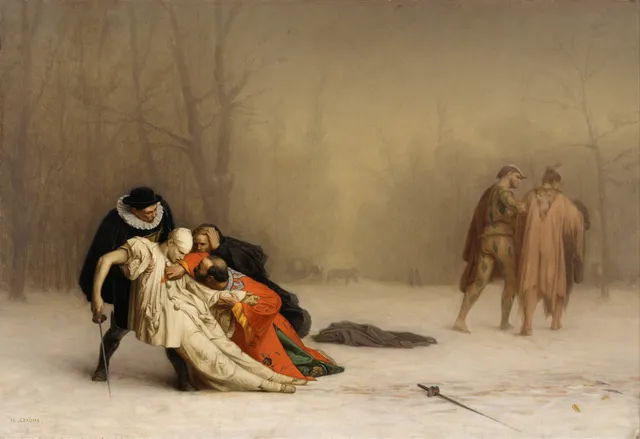
Stand in front of The Duel After the Masquerade and notice first how Gérôme withholds the duel itself. The swords are already down. In a grey dawn at the edge of a winter wood, a Pierrot in loose white silk folds backward, mortally hit, his powdered face tipped toward us while a companion in a black Domino catches him under the arms and a doctor in a red Native American costume probes the wound. The victor, a Harlequin in his diamond motley, walks off to the left with his head bowed and his hand pressed to his brow, the bravado of the costume contradicted by the slump of the shoulders. The snow is the trick of the picture. It drains the color out of everything except the carnival dress, so that the harlequin's lozenges and the doctor's scarlet read as obscene against the bare birches. Gérôme points the whole composition at a single moral irony: men in clown suits have just killed one of their own, and the morning does not care. The footprints leading back across the field are the only narrative the snow keeps, a trail from the carriage to the killing ground that Gérôme lets you reconstruct without a word of explanation.
That irony is exactly what makes the picture a perfect commodity. It is legible in one beat, it is faintly scandalous, and it survives reproduction because the design depends on silhouette and contrast rather than on paint quality. The composition was successful enough that Gérôme produced more than one autograph version of it, a habit he kept whenever an image sold, treating a winning design as a template to be re-supplied rather than a one-off. He did the same later with his Pygmalion subject, painting it from several angles, a practice the Metropolitan Museum documents in its catalog entry on the oil Pygmalion and Galatea of around 1890. The replica is not laziness. It is a manufacturer meeting demand.
The East as merchandise
Nowhere did supply and demand fuse more tightly than in Gérôme's Orientalist work, the strand for which he is now both celebrated and condemned. The Met's Heilbrunn survey of the field names him among the most celebrated of the Orientalist painters, and the celebration was commercial before it was critical. European and American buyers wanted the East rendered as a place of leisure, cruelty, and unguarded flesh, and Gérôme gave it to them with the conviction of a man who had actually traveled the Nile and sketched the architecture. The conviction is the problem. In his bath scenes and bazaars the careful tilework and brass lend the fantasy a documentary alibi it has not earned. He learned the grammar of that alibi on the ground, in the markets and mosques he drew on his Egyptian travels, and he spent the rest of his life deploying it in the studio at Paris, far from any of it.
Smarthistory makes this point sharply about his best-known example. Reading The Snake Charmer of around 1879, it shows that the faux-Arabic inscriptions on the back wall are illegible nonsense, so the painting wears the costume of ethnography while inventing its content. The mechanism is the same one driving the duel picture. The viewer is handed a scene that looks like reported fact and is in truth a stage set. You can watch the formula at work across his other Egyptian subjects too. In Cafe House, Cairo (Casting Bullets), the soldiers, the smoke, and the molten lead are arranged like a tableau vivant, every object placed for the buyer's reading rather than for the indifference of real life. The National Gallery of Art preserves the quieter, more topographical side of this output in its panel View of Medinet El-Fayoum of about 1868 to 1870, where the same precise hand is turned to landscape.
The students who paid him back in influence
If the dealer set the terms of the market, the atelier set the terms of Gérôme's afterlife. As a teacher at the École des Beaux-Arts he ran one of the busiest studios in Europe, and his roster reads like a map of where late-century painting was actually going. His students included Mary Cassatt and Thomas Eakins, along with Edwin Lord Weeks and the Ottoman painter and archaeologist Osman Hamdi Bey, a spread confirmed in the standard biographical record. The irony is heavy and worth stating plainly. Cassatt would help carry Impressionism into American collections, the very movement Gérôme spent his last decades fighting, and Eakins would take his teacher's clinical drawing and turn it toward a grave native realism that owed Paris nothing in spirit.
Around Gérôme, in the same Goupil-fed economy of high finish, worked a painter who beat him at his own glittering game, the Spaniard Mariano Fortuny Marsal, whose dazzling small pictures commanded sensational prices through the same dealer network. And the generation that came of age in his shadow, painters such as Gustave Caillebotte, Julian Alden Weir, and Odilon Redon, defined themselves partly by what they refused in him. To work against Gérôme you first had to reckon with how completely he had won the marketplace. His influence was strongest, in the end, as the thing his pupils pushed away from.
The sculptor, and the painter as a brand
A brand wants extensions. In his sixties Gérôme reached for sculpture, and he did it in the most market-aware way imaginable. His public debut as a sculptor was a large bronze gladiator standing with his foot on a fallen opponent, shown at the Universal Exhibition of 1878 and lifted directly from the figures of his 1872 painting Pollice Verso, again per the biographical record. He took his single most reproduced image and rebuilt it in three dimensions, so the same intellectual property could be sold as a painting, an engraving, and now an object. The Getty Museum holds a photograph from 1877 that shows the painter in his studio beside the towering model for that group, a picture of a celebrity at work that was itself a piece of publicity, documented in the museum's collection. He later pushed further, making polychrome marbles and painting the same sculpted figures back into oils so the two media advertised each other.
What the archive shows
Set the lifetime fame against the holdings and the shape of the market comes into focus. Artifact World Gallery holds fifty-six works by Gérôme drawn from twenty-one separate collections, with cataloged dates running from roughly 1804 to 1902, a spread that already tells you he was the kind of painter institutions competed to own rather than a name confined to one city or one bequest. That dispersal across twenty-one venues is the residue of the Goupil strategy working as designed. A painter engineered for wide distribution ends up, a century later, widely distributed in the world's museums. The print machine seeded the demand, and the demand placed the originals everywhere.
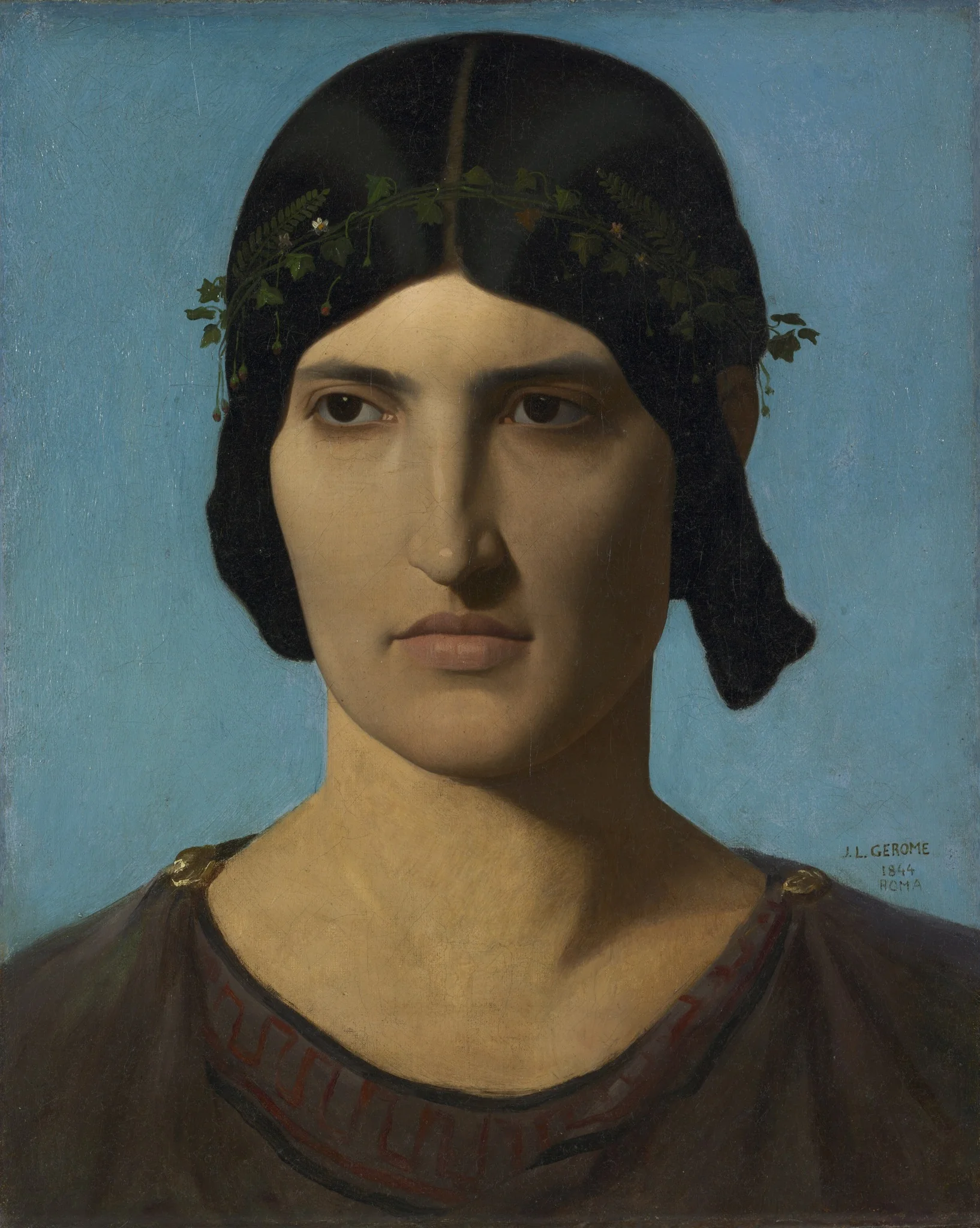
The corpus also preserves the quieter Gérôme that the spectacle tends to bury. Head of an Italian Woman is a study, not a salable anecdote, and the difference shows in the paint. The face turns three-quarters into a soft light, the modeling of the cheek and the dark coil of hair done with a directness the finished exhibition pictures sand away. Beside it, Portrait of a Woman carries the same evidence of a painter who could observe a living sitter rather than stage a fiction. And then there is Lion on the Watch, where the animal painter steps forward, the great cat reduced to a low taut shape in the dusk, alert and patient. The dusk is doing the same work the snow did in the duel, pulling tone down until only the essential shape remains, except here there is no anecdote to sell, only an animal and the painter's patience with it. These are the works that remind you the market did not invent Gérôme's skill. It only decided which parts of it would be famous.
Works discussed in this article
What happened after his death in 1904 is the final proof of the thesis. The reputation collapsed almost overnight, because the modernist account of art history had no use for a painter whose virtues were finish and salability. For most of the twentieth century Gérôme was a punchline, the academic villain against whom the heroes of paint were measured. The rehabilitation, when it came, arrived through the same door the fame had: the market and the museum. Collectors of nineteenth-century academic art rediscovered him, prices climbed, major retrospectives followed, and scholars returned to ask harder questions about the politics of his Orientalism rather than simply sneering at his slickness. He had built his career to move through the world as image, and it was as image, copied and circulated and argued over, that he eventually came back. The retrospectives that resurrected him hung the spectacle pieces, the gladiators and the bath scenes, but the scholarship that followed kept circling the same uncomfortable seam between his eye and his sales ledger.
Which leaves the viewer with a useful discomfort. When you admire the snow in the duel or the menace of the watching lion, you are responding to a craft that was real and to a sales instinct that was just as real, and the two were never separable in him. Gérôme is the painter who lets you watch the nineteenth century turn a picture into a product without losing the picture. Stand close to the canvas and the honest study survives. Step back into the print shop and the merchandise takes over. He painted for both distances at once, and he was paid for both.
Sources & further reading
- Jean-Léon Gérôme — Wikipedia
- Jean-Léon Gérôme, The Snake Charmer — Smarthistory
- Pygmalion and Galatea (object record) — The Metropolitan Museum of Art
- [Jean-Léon Gérôme in his Studio with Large Model of "The Gladiators"] — The J. Paul Getty Museum
- View of Medinet El-Fayoum and the artist's record — National Gallery of Art
- Orientalism in Nineteenth-Century Art — The Metropolitan Museum of Art (Heilbrunn Timeline)
- Gérôme: The Life and Works of Jean Léon Gérôme (Fanny Field Hering, Cassell, 1892) — Internet Archive