To understand Albert Bierstadt's landscape painting, start not with the Rocky Mountains but with the apparatus he used to paint them. Bierstadt did not break with the Hudson River School over subject. Thomas Cole and Frederic Church had already taught American audiences to read a mountain as a moral fact. What Bierstadt changed was the way light enters a picture. The first generation treated the canvas as a window onto an even, distributed daylight in which every leaf got its fair share of sun. Bierstadt treated the canvas as a proscenium stage. He concentrated illumination into a single theatrical shaft, lit one zone of the composition as if a lamp hung above it, and consigned the rest to a graded, smoky shadow. That is the formal break, and it is the argument of this essay: one decision about where the light falls governs everything else in his art.
The claim worth defending is that Bierstadt's compositional staging, his split handling of paint, and the placement of his tiny human and animal figures are not three separate habits. They are consequences of the same staged-light premise, and that premise explains both halves of his strange career. It is why a New York buyer paid a fortune for a single canvas in 1865, and it is why the painters and critics who came after treated him as a fraud of feeling. Born in Solingen in 1830 and trained for three formative years in Düsseldorf, Bierstadt fused a German academy's hard finish to an American luminist's appetite for atmospheric glow. The seam between those two inheritances is visible in nearly every major work. Once you see the seam, you cannot unsee it, and the paintings become far more interesting than the postcards of national grandeur they are usually mistaken for.
A debut built on borrowed Swiss light
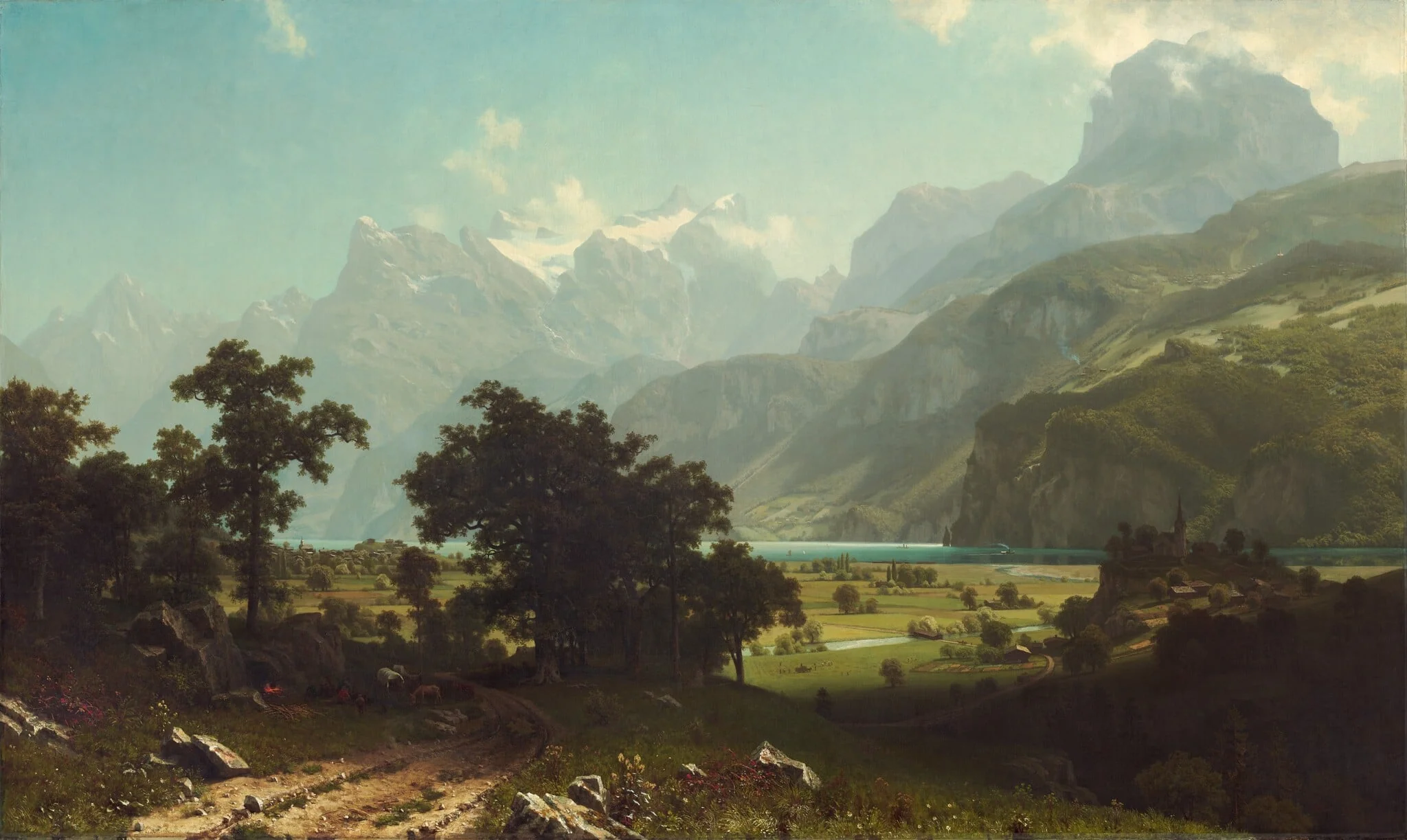
Before the West there were the Alps. Bierstadt announced himself to New York in the spring of 1858 by sending a large canvas, Lake Lucerne, to the annual exhibition of the National Academy of Design, and within weeks the academy elected him an honorary member (National Gallery of Art). This matters because the formal vocabulary that would later be sold as uniquely American was rehearsed first on a European subject. The picture then vanished. It sold at auction in 1882, dropped out of the record for more than a century, and surfaced in a Rhode Island farmhouse in 1990. The corpus carries that survivor, and it is the right place to watch the machine in its earliest tuned state.
Look closely at how Lake Lucerne is built. The foreground is a dark, stony shelf where a few figures gather near the water, painted small and incidental, scaled to make the cliffs behind them read as enormous. The eye is pulled across the flat plate of the lake toward a far wall of mountains, and the light does not lie evenly over that distance. It pools. A clearing in the weather lets a band of pale illumination strike the middle range of peaks while the nearer slopes stay in a cool, bruised shadow. Bierstadt is already separating the picture into a lit chamber and a shadowed frame around it. The water is handled with a glassy, almost enameled smoothness, so still that the mountains double in it, while the rocks at our feet carry a coarser, more loaded touch. That doubling of surface, slick distance against gritty foreground, is the technical signature he never abandoned. He worked it out on a Swiss lake and then spent forty years applying it to terrain no Eastern viewer had seen.
The stage and the single shaft of light
The full theatrical method arrives with the western survey pictures. After joining Frederick W. Lander's government expedition in 1859, Bierstadt produced his breakthrough, The Rocky Mountains, Lander's Peak (1863). The painting was bought in 1865 by the railway financier James McHenry for twenty-five thousand dollars, one of the highest sums an American picture had then commanded (The Metropolitan Museum of Art). People did not pay that for accurate geology. They paid for an experience the canvas manufactures.
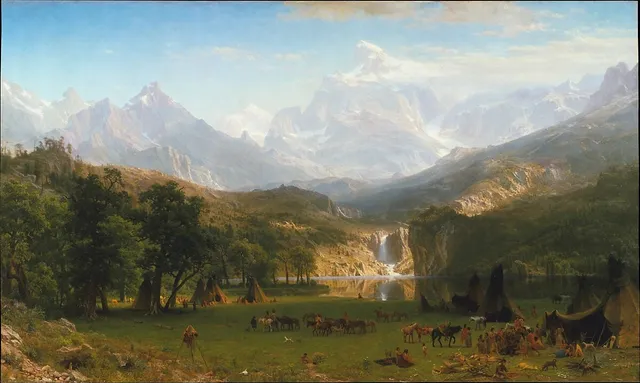
The composition is a set in three flats. Down in front, on a green valley floor, a Shoshone encampment goes about its day, the figures rendered just legibly enough to register as ethnographic detail and small enough to vanish under the landscape. Behind them a dark middle wall of forested rock rises and throws the valley into a held, even shade. Then, at the top, the snow peak catches a light that exists nowhere else in the picture. Bierstadt opens the clouds in exactly one place and lets a clean band of sun ignite the summit and the waterfall beneath it, so the mountain seems lit from within while the human world below sits in the cool of an afternoon that has not reached it. The light is not describing weather. It is directing the eye, the way a stage lamp tells an audience which actor to watch. Nothing in the real Wind River Range arranges itself this obligingly. He composited the view from field studies, raising and recentering the peak, deepening the foreground shadow, and reserving the brightest pigment for the one passage that had to carry the religious charge. The picture works as theater, and it is dishonest as cartography, and both facts come from the same lamp.
This is the break stated plainly. Church, in a canvas like his Andean scenes, distributes wonder across the whole surface and trusts the viewer to find it. Bierstadt refuses that trust. He decides for you. The luminist glow that other American painters used to dissolve a scene into quiet, Bierstadt weaponizes into a spotlight, and the Düsseldorf training supplies the crisp drawing that keeps the spotlit zone from going soft. The combination is the source of the overwhelming first impression his contemporaries described, and it is reproducible. He could do it on demand, at any scale, for any peak, which is precisely what made him an enterprise as much as an artist.
Two hands working one canvas
The handling of paint is where Bierstadt's method either convinces you or gives itself away, and it deserves more attention than his admirers and his detractors have usually paid it. He painted, in effect, with two hands. The distant passages, the lit peaks and the far sky, are laid in with thin, blended, nearly invisible brushwork, glazed to a porcelain finish that erases the trace of the maker. The near passages, the broken rock, the scrub, the foreground water's edge, are built up with a thicker, more various touch, drier, occasionally palette-knifed, where the marks stay visible as marks. The viewer's eye reads the smooth distance as ungraspable and pure, and the rough foreground as the place where a body could actually stand. The contrast manufactures depth and the feeling of access in a single gesture.
You can see the same split in Merced River, Yosemite Valley, where the water lies in long, smoothed reflective strokes that carry the cliff faces down into the river, while the bank vegetation is dabbed and scumbled with a much busier wrist. In Mount Corcoran, a Sierra subject he is thought to have partly invented and renamed to flatter a Washington collector, the lake holds the peak in a flawless mirror while the timber at the water's edge is given a rougher, darker, more material handling. The smoothness is doing ideological work. It tells you the mountain is beyond touch, eternal, while the foreground invites you in. That is a persuasive structure, and it is also a manipulation, and Bierstadt knew the difference. His field oil sketches, painted fast and direct on the spot, are looser and truer and far less staged than the exhibition machines he assembled from them in the studio. The finished pictures are constructions, and the construction is the art.
What the archive lets you watch
Artifact World Gallery holds 46 Bierstadt canvases distributed across ten venues, spanning roughly 1857 to 1898, by a single hand. That spread is small enough to read end to end and wide enough to test the thesis against the whole arc of a working life. Nancy K. Anderson's monograph calls Bierstadt the foremost recorder of the western landscape and the first painter with the technique and the talent to convey the scale of America's mountains (Anderson, Albert Bierstadt: Art and Enterprise). Run the corpus chronologically and you can see what that technique actually consisted of, and where it began to fail him. The staging device is fully present by 1863 and is still being deployed in the late Canadian and Sierra pictures of the 1880s and 1890s. It does not evolve. It repeats. The 1857 to 1898 span in this archive is, formally, less a development than a single invention applied and reapplied, which is both the secret of his productivity and the seed of his decline.
Set the late Canadian Rockies (Lake Louise) beside the early Lake Lucerne and the continuity is almost uncomfortable. Thirty years apart, on two continents, the same still mirror-lake, the same reserved shaft of light on the far peak, the same dark repoussoir of rock and timber holding the front of the picture. Bierstadt found a formula that reliably produced awe and he stopped interrogating it. The corpus makes that visible in a way a single masterpiece on a museum wall cannot, because the repetition is the data. When a painter solves the sublime once and then manufactures it for decades, you are looking at a method, not a vision, and the method is what this essay has been tracking.
The break that became a liability
The staged premise had a cost, and it came due in the 1880s. Bierstadt built his career travelling with government-sponsored surveys to document remote country for Eastern audiences, extending the Hudson River School's faith in landscape as national meaning (Smarthistory). The Met's own history of the period credits painters like Bierstadt with bringing the Rocky Mountains and Yosemite into a public attention that helped those places get set aside as national parks (The Metropolitan Museum of Art). That is a real civic achievement. But the same theatrical apparatus that drew crowds to a peak began to look, to a younger generation schooled on Barbizon restraint and incoming French Impressionism, like rhetoric. The tide had turned by the time he painted his last great machine.
Consider The Last of the Buffalo (about 1888), the work where the method overreaches and exposes itself. A mounted Plains hunter drives a lance into a charging bull at dead center, the foreground littered with bones and dying animals, the great herd thinning toward a luminous, dust-gold horizon. The staging is total. The light still pools on the distant plain, the foreground still carries the loaded, grisly detail, and the figures are arranged with the legibility of a tableau. The painting was meant for the 1889 Paris Exposition and was rejected by the American selection committee, whose members found this kind of grand machine an embarrassment beside the looser, more modern work they wanted to send. The rejection was a verdict on the whole formal system. By insisting on the proscenium, Bierstadt had made a picture that could only read as old-fashioned spectacle to eyes that now prized the unstaged glance. The very device that built him in 1863 buried him in 1889.
And yet the contemporary instinct to dismiss him is as lazy as the older instinct to worship him. The interesting position is the third one. Bierstadt is not a naive painter of national glory and not a mere salesman of fake sublimity. He is a painter who made an early, deliberate formal choice, to light the canvas like a stage, and then followed that choice with total consistency to its triumph and its dead end. Read him for the lighting decisions and the doubled paint surface, and he becomes a case study in what happens when a powerful method outlives the taste that rewarded it. The corpus, with its forty-six works running from the Alps to the Canadian Rockies, is the document of that single idea worked to exhaustion. He did not lose his touch. He kept his touch, and the world moved.
There is a useful contrast available in the same Düsseldorf lineage. The German history painter Karl Friedrich Lessing, whose work shaped the academy Bierstadt passed through, used dramatic light to charge a moralized European past. Bierstadt took that same trained instrument and aimed it at empty western space, where there was no narrative to carry, only scale. Stripped of story, the staging had to do all the emotional work by itself, which is why his light grew so insistent and why, when fashion turned against insistence, there was nothing underneath to fall back on. The break with the Hudson River School was a break toward pure effect, and pure effect is the most perishable thing a painter can build a career on.
Works discussed in this article
Sources & further reading
- The Rocky Mountains, Lander's Peak — The Metropolitan Museum of Art
- Lake Lucerne — National Gallery of Art
- America Comes of Age: 1876-1900 (Heilbrunn Timeline of Art History) — The Metropolitan Museum of Art
- Bierstadt, Valley of the Yosemite / Hetch Hetchy — Smarthistory
- Albert Bierstadt: Art and Enterprise (Nancy K. Anderson) — Internet Archive
- Albert Bierstadt — Wikipedia
- Albert Bierstadt (1830-1902), artist record — The J. Paul Getty Museum