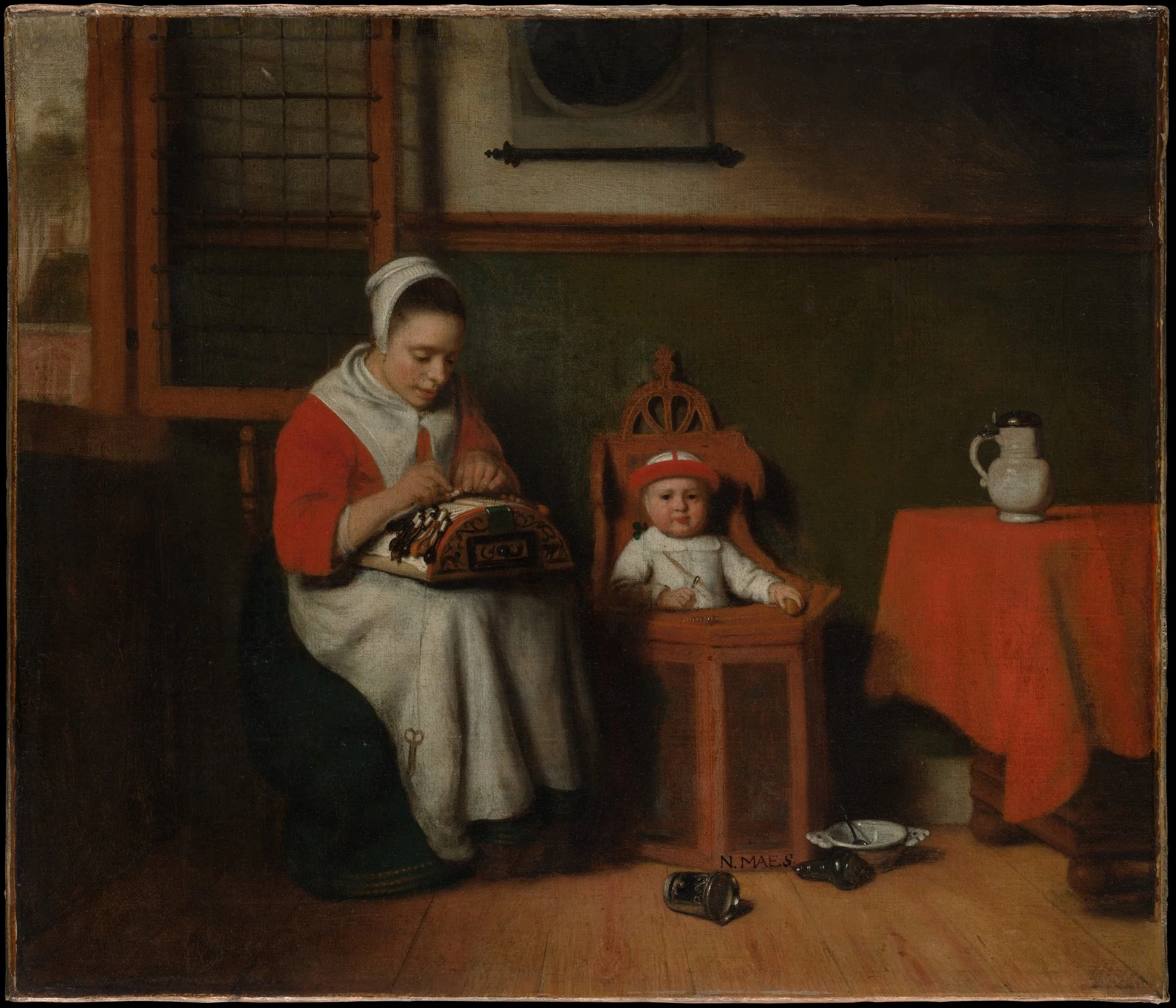
Nicolaes Maes spent close to forty years worrying at a single problem, and he refused to solve it the same way twice. The problem is easy to name and stubborn to paint: how do you make a viewer feel they have walked in a beat too soon, before the figure inside the frame has arranged herself for company? A woman bends over her lacework and does not look up. An old servant peels apples and lets the peel curl loose toward the floor. Each picture treats looking as a small trespass. Maes built a career on that trespass, and then, in his forties, he appeared to walk away from it. He did not. He took it into the sitting room.
The textbooks tell a tidy story of falling-off. Maes the inventive young genre painter, trained under Rembrandt, gives us a handful of unforgettable kitchen scenes in the mid-1650s, then turns to the lucrative grind of portraiture and never paints anything surprising again. That reading mistakes a change of key for a change of subject. The question stayed put. Maes always wanted to catch a person in the half-second before self-presentation, and when he moved from the scullery to the commissioned sitting room he was still chasing it, now in a public register where the stakes ran higher and the margin for error was thinner. The several answers he gave to that one question are the actual shape of his career, and the portraits belong inside it, not after it. Read the work this way and the late canvases stop looking like a retreat. They look like the same painter raising his voice.
An apprenticeship in withholding
Maes was born in Dordrecht in January 1634, the son of a prosperous merchant, and around 1648 he made the move to Amsterdam and entered the studio of Rembrandt, where he stayed for roughly five years before returning home, according to the standard biographical record. He was buried in Amsterdam at the close of 1693, which gives us a working life that runs almost the full breadth of the Dutch Golden Age. The Dordrecht he came back to around 1653 was a wealthy river town with a portrait market of its own, and within two or three years he was painting the pictures that made his name. He was barely past twenty when he found his subject, which is rare, and rarer still he kept it.
The most durable thing he took from his teacher had less to do with drawing than with the management of darkness. Rembrandt taught him to treat light as a scarce resource, something you spend on one or two things and deny to everything else. You can watch that lesson land in his early single-figure interiors, the young women set at a window or a sill, chin propped on a hand, the daylight allowed to reach a face and a sleeve and almost nothing else. The Rijksmuseum keeps one such panel, a girl leaning at a window that the museum catalogues under the nickname The Daydreamer. The room behind her is barely a room at all. Maes pools the light on the front of the body and lets everything past the shoulder go soft and brown, so that the figure reads as a warm shape pressed forward out of the dark. That instinct, to ration light so the eye has nowhere else to go, is the engine under everything that follows. He never lost it, even when his palette later turned bright and the shadows thinned out.
First answer: the picture as keyhole
Genre painting, in the plain definition the Tate still uses, means simply scenes of everyday life, and in the seventeenth-century Netherlands that mode sold in remarkable volume. The Metropolitan Museum's survey of the field notes that genre enjoyed enormous popularity in northern Europe, and especially in the Dutch Republic. Maes worked inside a crowded market, painting the same servants and sewing baskets a dozen rivals were painting in the same years. So his first answer to his own question had to be a formal one, something a buyer could feel before he could explain it. His answer was the keyhole. He composes the domestic scene so that the viewer is always slightly outside it, looking in past a doorframe or a curtain at someone who does not know she is being watched. The framing does the work that a caption would do in a lesser picture.
Look hard at The Lacemaker. The light comes from the left and finds the white of her cap first, then the pale cushion bristling with pins, then the taut diagonal of a single thread. Her eyes are down, locked on the exact point where two strands cross; the bobbins hang in a small weighted cascade that one finger keeps from tangling. Everything else gives way. The far wall is a brown nobody is meant to read, the table edge slides into the dark, and the only event in the room is the slow building of a pattern too fine to see from where we stand. Maes does something quietly aggressive here. He refuses us her face. We are granted the back of a bent neck and the geometry of concentrated hands, and we are made to understand that the picture would be exactly the same whether we were present or not. The absorption is total, and it is the absorption that makes us feel like intruders. A woman who looked up at us would be a different painting, a polite one.
That is the keyhole logic at full strength. He is not illustrating lacemaking. He is staging the difference between a person who is performing for an audience and a person who has forgotten there is one, and he hands the second to us as if it were contraband. The restricted light he learned in Amsterdam does the moral work: by darkening the room he removes every excuse our eye might have to wander, so that watching her becomes a deliberate act rather than a passing glance. We are not allowed to be casual about it. The composition makes our looking a decision, and a decision can be felt as a small guilt.
The same intelligence runs through Young Woman Peeling Apples, a humbler picture that rewards slow looking. A woman sits in the corner of a kitchen, knife turning, a long unbroken ribbon of peel falling away from the fruit. The whole event hangs on that ribbon. It tells us the action is mid-stream, that we caught it between the first cut and the last, and that nobody paused for us. Maes loved this kind of in-progress detail because it dates the moment. A finished plate of apples would be a still life; a peel still curling is a clock. He keeps the palette close and warm, the reds and browns banked like coals, and he lets the labour speak for the character. These women are defined by what their hands are doing, which is a kind of dignity he extends almost nowhere else in the period's kitchen scenes, where the help is so often there to be laughed at or moralized over. Maes declines both. He simply watches her work, and asks us to do the same.
Second answer: scripture brought down to the kitchen
Maes did not confine the eavesdrop to the kitchen. He carried it into biblical narrative, where the convention demanded grandeur and he supplied intimacy instead. Abraham Dismissing Hagar and Ishmael takes one of the hardest scenes in Genesis, the patriarch sending his servant and their son out into the wilderness, and refuses to inflate it. Abraham's gesture is the whole drama: an open hand that points the way out and, in the same motion, declines to meet the eyes of the woman he is banishing. He cannot look at her. Hagar's face is wet and turned down, caught in the act of wiping it, and the boy stands a little apart with the bundle that holds whatever they are allowed to take. There is no thunder in the sky, no chorus of angels crowding the margins. The cruelty is administrative. It happens at the scale of a doorway, between three people who will not survive the conversation as a family.
What Maes brings to scripture is the same thing he brought to the scullery, the sense that we are seeing a private moment that ought to have a door on it. He treats Abraham's reluctance as the subject. The averted face, the hand that does the cruel thing while the eyes refuse to authorize it, is exactly the small human tell that his genre pictures train us to notice. A grander painter would have given us the theology. Maes gives us the flinch. The biblical commission becomes one more occasion to ask his question, only now the trespass is on a man trying to keep his composure while doing something he cannot defend. The story is famous; the gesture is his.
Third answer: the sitter who forgets the painter
From the 1660s onward Maes dedicated himself almost exclusively to portraiture. This is the pivot the decline narrative hangs on, and on the surface it looks like surrender to the market. The dark interiors fall away. The palette brightens. He adopts a swagger drawn from Flemish portrait fashion, satins that catch the light and easy, slightly theatrical poses. A great deal of this work is, frankly, production. He ran a busy Amsterdam shop and answered demand, and demand wanted flattery delivered on schedule. But the best of the portraits keep faith with the old question, and that is what the decline story misses. He brought the keyhole into the room and pointed it at the patron.
Take the portrait of Admiral Jacob Binkes, the naval commander who died at sea in 1677. The conventions of a captain's portrait push toward bombast, and Maes accepts most of them, the confident turn of the body, the sheen of the sash. Yet he places the head so that the gaze drifts a few degrees off the viewer, as though the sitter were tracking something past our shoulder, a habit Maes uses again and again to keep a face from hardening into a mask. The trick is small and it is the whole game. A portrait that meets your eye is a performance. A portrait whose eyes have just slipped is a person, and Maes spent his youth learning precisely how to paint the second. The admiral is being commemorated, and yet for a moment he seems merely to be thinking, which is the harder thing to catch and the reason this canvas outlasts its occasion.
The two anonymous sitters in our archive, a Portrait of a Woman and a Portrait of a Lady, show the formula at its most polished and also its most automatic, the kind of competent, repeatable image that filled the studios of the next generation, including younger Amsterdam decorative hands such as Philip Tideman. Set them beside The Lacemaker and you can measure both what he gained and what he traded. He gained reach and a livelihood. He gave up the dark, the doorway, the deliberate withholding that made the early scenes feel stolen. The late work is the one question answered loudly, for a paying room, where the early work answered it in a whisper. Both are real Maes. Only one of them keeps a viewer standing in front of it after the sitter's name has been forgotten.
Works discussed in this article
Why the question outlived him
If the late portraits were the end of the matter, Maes would be a footnote to Rembrandt. He is more than that because his first answer, the keyhole, escaped his own studio. His innovations in arranging figures inside interior space had an important influence on the Delft painters, on Pieter de Hooch and on Johannes Vermeer in particular. Anyone who has stood in front of a Vermeer interior, with its doorway framing a second room and a figure caught mid-task, has met Maes's grammar at one remove. The composed depth, the woman absorbed in some small domestic labour, the viewer held just outside the threshold, were problems Maes worked out first, in Dordrecht, while he was still young. He did not have the patience, or perhaps the temperament, to spend a lifetime polishing a dozen perfect rooms the way Vermeer did. He moved on to the portrait trade. But the room was his idea before it was anyone else's masterpiece.
We owe much of what we know about his life to Arnold Houbraken, whose early-eighteenth-century lives of the Netherlandish painters remain the foundational source and can be read in full on the Internet Archive. Houbraken, who had a stake in the trade, told the story of the portrait turn as a shrewd commercial decision, and that framing has shadowed Maes ever since. It is worth resisting. A career is not a betrayal of its own beginnings simply because the customer changed. The same eye that found Hagar's wet face found the admiral's drifting gaze, and it was looking for the same thing in both.
So return, one last time, to the bent neck and the crossing threads. The lesson of Maes is that a painter can ask the right question early and spend decades giving it answers that look nothing alike. The keyhole scenes, the averted biblical hand, the captain whose eyes have just slipped past us, are all attempts to paint the instant before a face composes itself. The next time a Vermeer holds you at the edge of a sunlit room, you are standing in the doorway Maes built, watching someone who has not yet noticed you, and who never will.
Sources & further reading
- Nicolaes Maes — Wikipedia
- Genre Painting in Northern Europe (Heilbrunn Timeline of Art History) — The Metropolitan Museum of Art
- Genre painting (art term) — Tate
- Girl at a Window, known as The Daydreamer — Rijksmuseum
- De groote schouburgh der Nederlantsche konstschilders en schilderessen — Internet Archive (Arnold Houbraken)
- Nicolaes Maes (artist record) — The J. Paul Getty Museum