To stand in front of the paintings of François Boucher, the painter of the French Rococo, is to watch the eighteenth century argue with the century that built it. Boucher is usually filed under one word, Rococo, as if the word settled him. It does not. The more useful way to read him is as the most fluent voice in a long quarrel the new age was having with the old one. The quarrel was about purpose. Does painting exist to instruct and ennoble, as the academy of Louis XIV insisted, or to give pleasure and make that pleasure look like a serious accomplishment? Boucher did not answer by walking away from the gods, the goddesses, and the great mythological machines. He answered by moving them indoors, lowering the light, and turning the temperature up. He kept the grammar of the academy and changed only what the sentences were now allowed to say.
Here is the claim this essay defends. Boucher's whole career is the Rococo's running argument with the Grand Siècle, and he is its strongest advocate precisely because he was raised inside the doctrine he loosened. He learned history painting, the genre the academy ranked above every other, and he was good enough at it to be admitted to the Académie royale on its own terms. Then he spent four decades proving that the academy's grandest vocabulary, Venus and her doves, shepherds and their flutes, could be redirected toward intimacy, appetite, and ornament without surrendering an ounce of craft. The earlier generation held that a great picture must carry moral weight. Boucher's pictures answer that weight was never the only measure of seriousness, and that a surface built for delight can be as deliberately engineered as any sermon in paint. Read his career this way and the old charge of frivolity starts to look like a category error, a comedy being graded against the rubric written for tragedy.
A painter trained inside the doctrine he loosened
Boucher was born in Paris on 29 September 1703 and died there on 30 May 1770, so his life maps almost exactly onto the reign of the style he came to define (Wikipedia). He came up under François Lemoyne, a decorator of ceilings whose own ambitions still pointed toward the heroic manner of the previous reign. From Lemoyne, Boucher absorbed a fluent, light-filled handling of mythological bodies and a taste for the kind of upward-floating composition that fills a vault. He watched that grand manner work at close range before deciding the future of painting lay in smaller, warmer rooms. He was formally received into the academy on 24 November 1731, the institutional gate every serious painter had to pass, and he passed it as a history painter rather than as a maker of pleasant trifles.
This matters because the academy he entered was not a neutral body. It was the surviving apparatus of Charles Le Brun's seventeenth century, the establishment that had turned the taste of Louis XIV into rules. Le Brun's academy had codified a hierarchy of genres, with grand history painting at the summit and still life at the bottom, and it had argued, with Poussin as its patron saint, that drawing carried thought while color merely flattered the eye. The picture was meant to teach. It was meant to elevate. That was the predecessor. When people speak of Boucher's frivolity, they are usually measuring him against this older yardstick, which is exactly the measurement Boucher set out to question.
The quarrel restated: from the throne room to the alcove
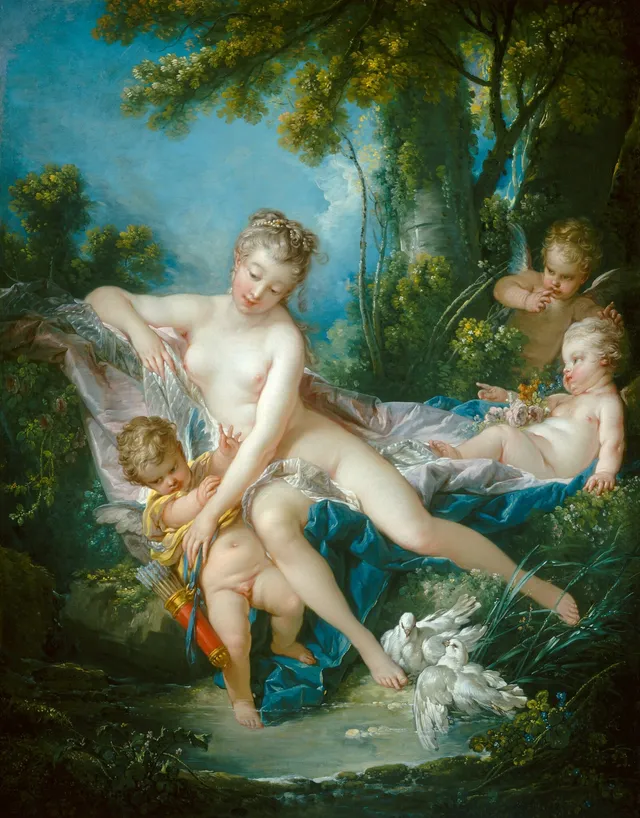
The Rococo did not abolish the academy's subjects. It rezoned them. The same mythological figures who had carried allegories of state under Le Brun were now asked to carry desire, leisure, and private feeling. Boucher is where you watch that rezoning happen most completely. Look at The Bath of Venus. Venus is still Venus, attended by doves and putti, draped in the cool blue and pearl-pink that became Boucher's signature register. But nothing in the picture wants to instruct you. The goddess is a study in soft contour and reflected light, posed for the pleasure of being seen rather than for the lesson she might teach. Set her beside what a state allegory was built to do, marshal its figures into an argument about power, and the gap is not one of skill but of intent. The old machinery of myth is still running, and it has been retuned to hum at the frequency of the bedroom rather than the council chamber.
You can read the same argument in his religious work, where the stakes are higher because the genre was even more freighted with doctrine. His Virgin and Child with the Young Saint John the Baptist and Angels keeps the iconography intact, yet the tenderness on offer is domestic. The holy figures are handled with the same plump, caressing line he gave his bathers, so the sacred scene reads as a warm family group lit from within. A seventeenth-century theorist would have wanted gravity and instruction. Boucher gives charm and proximity, and he gives them with total technical assurance, which is the point. He is not failing at the grand manner. He is choosing a different manner on purpose.
Close looking: Washerwomen
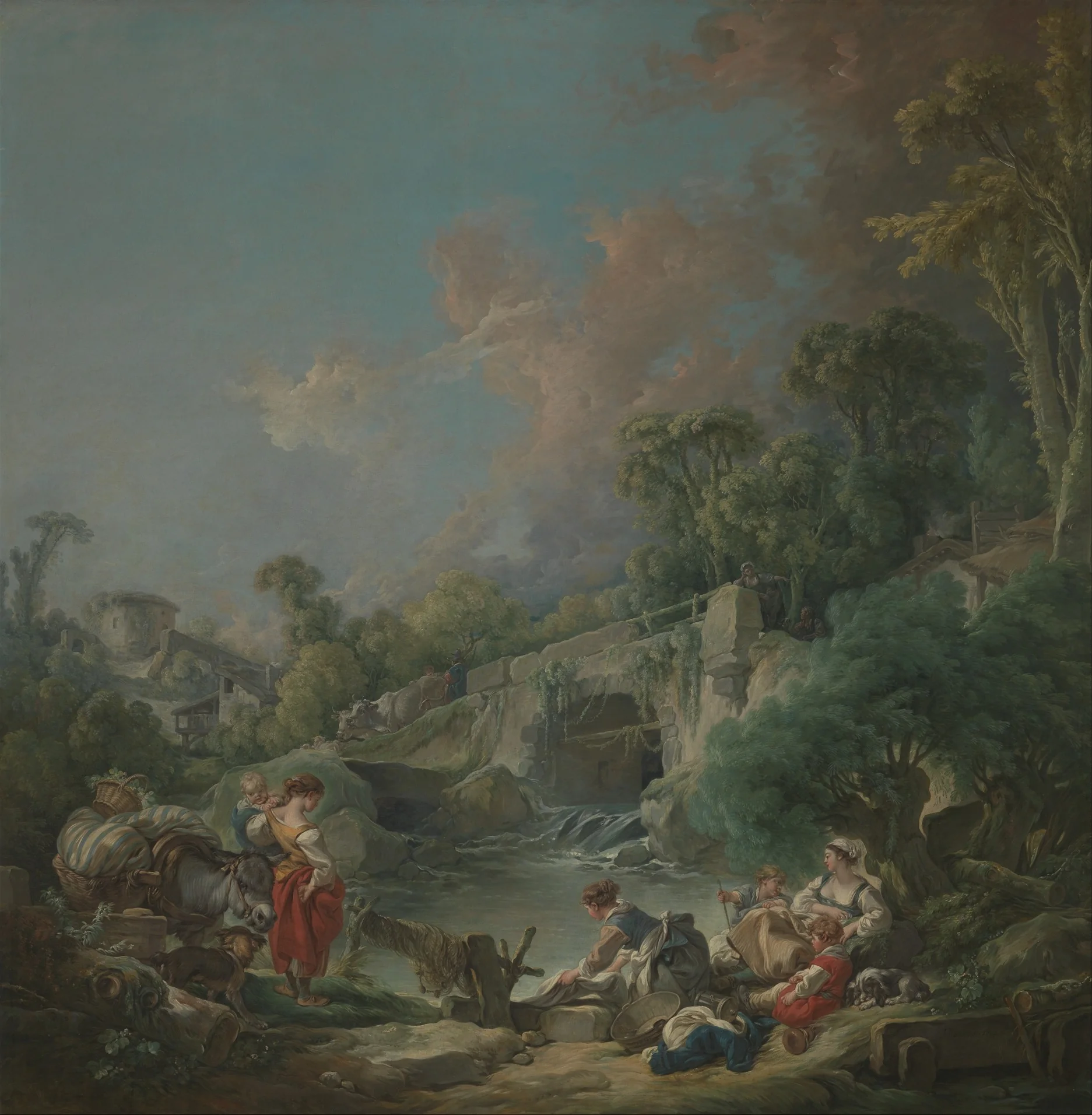
If you want to see the argument settled in a single canvas, go to Washerwomen. The subject could not be humbler. Women crouch at the edge of a stream, working laundry against the rocks, a task the academy would have placed near the bottom of its ladder of worth. Boucher treats it like a stage set for an idyll. The composition gathers at the lower left, where the figures bend over the water, and it opens diagonally toward a ruined arch and a screen of feathery trees that dissolve into a creamy, low afternoon sky. Follow that diagonal and the eye travels from a stooping figure in white, across the bright accent of the linen, out to a far bank where the paint thins to a single breath of grey-green. Nothing in the scene is dirty. The water is silvered, the linen is soft sculpture, and the landscape behind has been arranged into receding wings the way a designer arranges flats for an opera.
Point at the specifics. The light does not fall on the labor; it falls on the curve of a back, the fold of a skirt, the gloss of a copper vessel. The rustic architecture is picturesque rather than poor, a romantic prop with no working function. Boucher uses the brown of the foreground bank to push the eye up into the cooler blues and greens of the distance, so the painting breathes outward and never down toward the grime of the chore. Even the hands at work are softened, set at angles that flatter the wrist rather than show the strain in it. A real laundry day would be raw and tiring. This one is a pastoral, where peasant work has been promoted into something the salon could hang above a sofa. That promotion is the whole quarrel in miniature. The previous century would have asked what this scene teaches. Boucher answers that it teaches nothing, and that its refusal to teach is exactly what makes it modern.
The same engine drives his pastorals proper. Shepherd's Idyll dresses courtship in straw hats and crooks, and the flirtation is the subject, with the countryside reduced to a flattering backdrop. The flock is decorative. The lovers are the harvest. Boucher had absorbed the lesson of the fête galante, the open-air courtship scene the early Rococo had pioneered, and he industrialized it into a repeatable, sellable formula that decorated half the panelled rooms of fashionable Paris. The shepherd here tends nothing. He leans, he charms, he waits, and the sheep behind him are there to soften the corner of the design.
Pompadour and the machinery of taste
An argument needs a patron with the power to make it the house style, and Boucher found one. In 1749 he began teaching engraving and drawing to Jeanne-Antoinette Poisson, Madame de Pompadour, the mistress of Louis XV, and he became her favored painter (National Gallery of Art). Pompadour was not a passive sitter. She was an active director of taste at the heart of the court, and through her Boucher gained access to the very institutions the older doctrine controlled. Smarthistory reads his portraits of her as the defining images of the French Rococo and treats her as the most consequential patron of his career (Smarthistory). A patron who shaped the look of the reign chose, as her painter, the man arguing that pleasure could be governed as carefully as policy.
The clearest object of that alliance is The Toilette of Venus, painted in 1751 for Pompadour and originally set into the carved wood panelling of her Château de Bellevue; it later entered the Metropolitan Museum through the Bequest of William K. Vanderbilt in 1920 (The Met). Notice what that origin tells you. The painting was not made to hang as an isolated masterwork demanding contemplation. It was made to be architecture, fitted into a wall as part of an integrated decorative scheme. The Grand Siècle wanted the easel picture to function as a moral statement. The Rococo wanted it to function as an environment. Boucher's gods live in the woodwork, literally, because the new century wanted to be surrounded by them rather than lectured by them.
The argument was, in the end, won from inside. In 1765 Boucher was appointed to the two highest posts in the French art establishment, first painter to the king and director of the Royal Academy (The Met, Heilbrunn Timeline). The body Le Brun had built to enforce the grand manner was now led by the painter who had spent his life arguing with it. The Rococo had not stormed the academy from outside. It had risen through the ranks and taken the chair.
What the archive shows
Reach is part of how an argument wins, and the spread of Boucher's surviving output records exactly how far his version of painting traveled. Artifact World Gallery holds 155 works under Boucher's name across 31 venues, spanning roughly 1724 to 1770, which is to say across nearly his entire working life. Thirty-one venues is a wide net for a painter still sometimes caricatured as the pet decorator of a single apartment. Set that count against the standard art-historical view that he was the consummate insider of one court, and the picture sharpens. A painter whose work is now dispersed through dozens of separate institutions was not a niche talent serving a private taste. He was a brand, reproduced and collected and re-collected, and that volume is itself the evidence that the Rococo's case carried the day in the market long before later critics tried to reverse the verdict.
The pastoral pieces in that group reward a second look as a set. The Love Letter and The Interrupted Sleep run the same private narratives of flirtation through a countryside that exists only to flatter the figures inside it. One hands over a note; the other watches a doze become an opportunity. Read together, they show how thoroughly Boucher had converted the academy's serious genres into a repertory of charming, intimate episodes, each built to the same exacting standard the grand manner had reserved for kings and saints.
Works discussed in this article
The heirs, and the case for the defense
Every argument breeds the next one. Boucher's most gifted pupil, Jean Honoré Fragonard, carried the master's premise to its limit, pushing the loose, sparkling handling and the theme of private pleasure into pictures so spontaneous they seem painted in a single excited session. Where Boucher controlled, Fragonard let the brush run. Around them stood a whole generation working the same vein, from Charles André van Loo, the era's other reigning court painter, to the sculptor Augustin Pajou and the genre painter Martin Ferdinand Quadal. The reaction, when it came, was severe. A new generation of critics decided that Boucher's world was artificial and that French painting needed to recover gravity, civic purpose, and a stern moral line. The pendulum swung back toward exactly the values Le Brun's academy had championed, and Boucher's reputation fell with it. The argument the Rococo had won was, for a while, declared lost.
It was the nineteenth century that reopened the case in his favor. The brothers Edmond and Jules de Goncourt gave Boucher a full chapter in their study of eighteenth-century French painting, one of the founding works of period criticism, and their advocacy did much to restore him as a painter worth taking seriously rather than merely scolding (Internet Archive). They argued, in effect, that Boucher embodied the taste of his century so completely that to dismiss him was to misunderstand the age itself. That is the defense this essay endorses. Boucher is not the absence of seriousness in French painting. He is the moment French painting decided that pleasure was a legitimate thing to be serious about.
- The predecessor: Le Brun's academy, with its hierarchy of genres and its demand that painting instruct and ennoble.
- The argument: Boucher kept the academy's mythological and religious vocabulary but redirected it toward intimacy, pleasure, and integrated decoration.
- The proof of victory: His 1765 appointment to lead the very academy whose doctrine he had spent his life loosening.
Go back one last time to the women at the stream. The laundry is forever half-washed, the afternoon light will never quite fade, and the ruined arch behind them has no purpose but to look well. Boucher froze the most ordinary chore in France into something the court was happy to live inside. That refusal to let the picture do moral work is not a lapse in ambition. It is the ambition, stated plainly, and it is why the room he decorated still feels, two and a half centuries later, like a place you would want to walk into.
Sources & further reading
- François Boucher (1703-1770), Heilbrunn Timeline of Art History — The Metropolitan Museum of Art
- The Toilette of Venus (1751) — The Metropolitan Museum of Art
- François Boucher — Wikipedia
- François Boucher, artist biography — National Gallery of Art
- Boucher, Madame de Pompadour — Smarthistory
- French Eighteenth-Century Painters (L'art du dix-huitième siècle) — Edmond and Jules de Goncourt, via Internet Archive
- François Boucher (French, 1703-1770), collection person record — The J. Paul Getty Museum