Artwork
The Bath of Venus
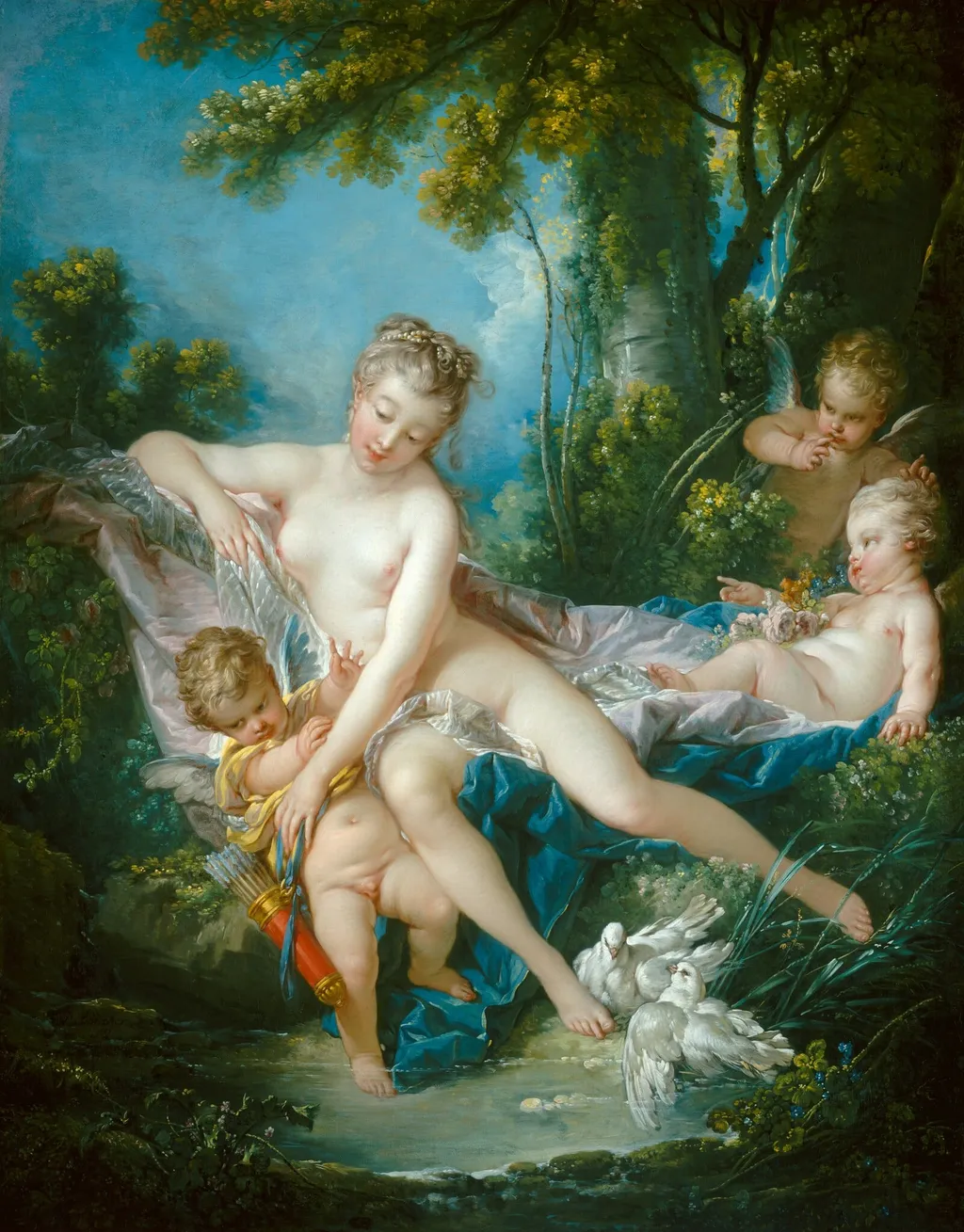
The Bath of Venus is an oil painting by the Rococo painting artist François Boucher. It dates from 1751 and is held in the collection of the National Gallery of Art.
- Inscription
- Inscribed:lower left in black paint: F Boucher / 1751
About this work
Subject & Meaning
The work reflects Enlightenment ideals that celebrated nature and the natural pursuit of pleasure, presenting the nude as an embodiment of beauty and grace.
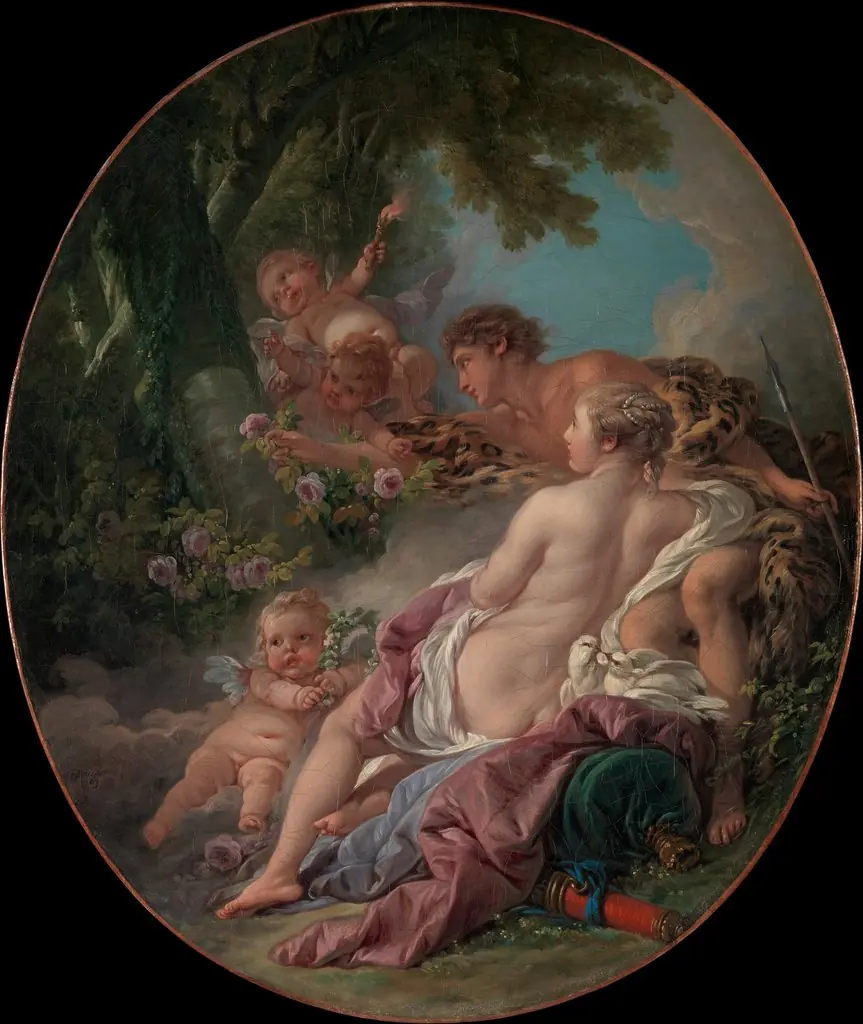
The painting shows Venus, the goddess of love, seated by a pond beside a tree, accompanied by two putti and two white doves, her traditional attribute. She is about to disarm Cupid, removing the arrows he uses to inspire love, while the scene is rendered in soft pastel tones under a dim, silvery light that enhances the sensual, seductive quality typical of French Rococo. The work reflects Enlightenment ideals that celebrated nature and the natural pursuit of pleasure, presenting the nude as an embodiment of beauty and grace.
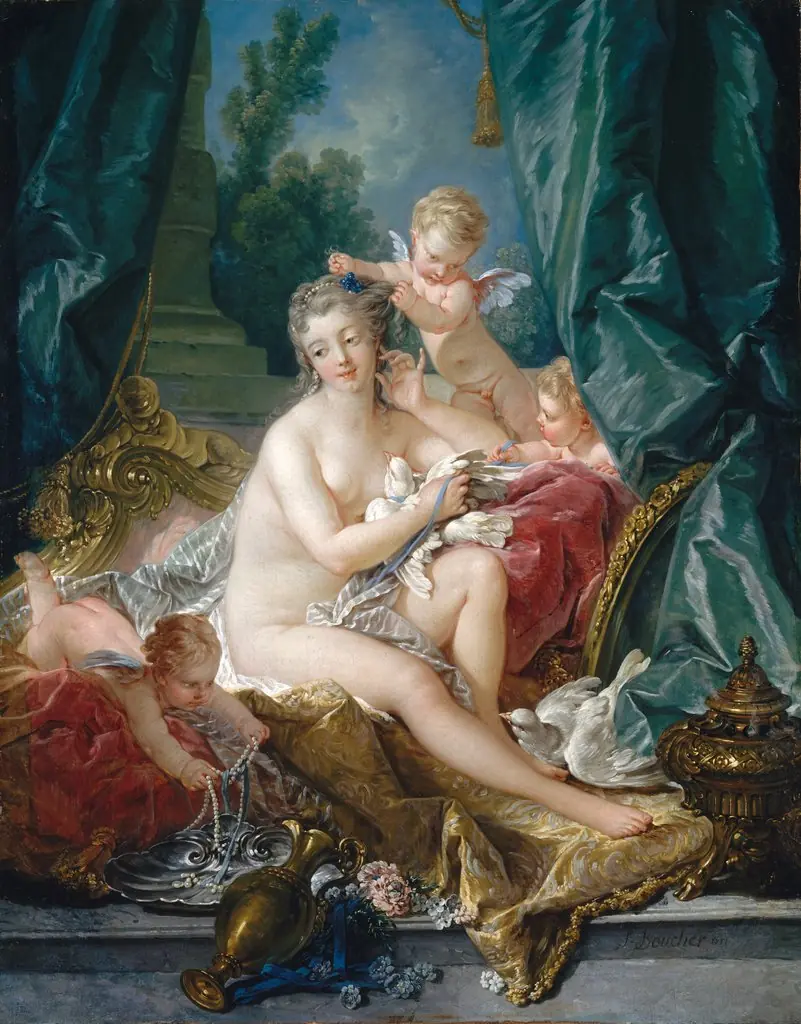
Commissioned by Madame de Pompadour for the appartement des bains at her Château de Bellevue, it forms a pendant to Boucher’s La Toilette de Vénus, pairing the acts of bathing and dressing as complementary stages of love’s preparation.
Technique & Style
The Bath of Venus is executed in oil on canvas, a medium confirmed by the artist’s record and by cataloguing data. The work is painted on a canvas support and was originally created with oil paint, as noted in the provenance and material specifications. In 1777 the painting was cleaned by the restorer Hoogstael, indicating documented handling during its early ownership.
Stylistically, Boucher rendered the mythological scene with soft pastel tones and a dim, silvery illumination that emphasizes the sensual, Rococo aesthetic; the composition places Venus beside a pond with doves, rendered in a delicate, technically skilled manner. The vertical format, measuring roughly 108 × 85 cm, further defines its visual presentation.
History & Provenance
François Boucher painted The Bath of Venus in 1751, executing it in oil on canvas as a commission from Jeanne Antoinette Poisson, marquise de Pompadour. The work was installed in the appartement des bains of her Château de Bellevue outside Paris. It was removed from that setting around 1757 and by 1764 had been moved to the ground-floor vestibule of her Parisian residence, the Hôtel d'Evreux.
Following Pompadour's death in 1764, the painting passed by inheritance to her brother, Abel François Poisson, marquis de Ménars et de Marigny, and was installed in the gallery of his residence on the rue St. Thomas du Louvre by 1777. After his death, it appeared in his estate sale in Paris in March–April 1782, where it was purchased by Jean Baptiste Pierre Le Brun. By 1884 the canvas was in the collection of Baron Alfred Charles de Rothschild at Halton House in Buckinghamshire.
It descended to Grace Elvina Hinds Duggan Curzon, marchioness of Curzon, at Kedleston Hall, and was sold at the American Art Association-Anderson Galleries in New York on 22 April 1932. Chester Dale subsequently acquired it in New York and gave it to the National Gallery of Art in 1943.
The Bath of Venus is presently housed in the National Gallery of Art, Washington, D.C., where it entered the collection as a gift from Chester Dale in 1943 (NGA accession unspecified in the sources). Its provenance traces back to a commission for Madame de Pompadour at Château de Bellevue, followed by successive owners including the Marquis de Marigny, Baron Alfred de Rothschild, and Grace Curzon before Dale’s acquisition. The work has been exhibited publicly, notably in the NGA’s exhibition “America Collects Eighteenth‑Century French Painting,” which highlighted American holdings of French rococo art.
Context
The Bath of Venus is regarded as a quintessential example of French Rococo painting, praised for its sensuality, soft pastel palette, and silvery light that highlight Boucher’s technical skill. Scholars situate the work within Enlightenment France’s reevaluation of nature and pleasure, noting how its depiction of Venus aligns with contemporary ideals of the nude. Commissioned by Madame de Pompadour for her Château de Bellevue, the painting formed a pendant to La Toilette de Vénus (now at the Metropolitan Museum of Art) and exemplifies the artist’s privileged position in her patronage network, where artists valued both prestige and reliable payment.
Its provenance, passing from Pompadour to the Rothschilds, Chester Dale, and finally the National Gallery of Art, and its inclusion in the exhibition America Collects Eighteenth‑Century French Painting further secure its place in art‑history discourse.
Overview
François Boucher's 1751 oil on canvas, The Bath of Venus, depicts a mythological moment. The painting features the goddess of love, Venus, in a tranquil setting, accompanied by Cupid. This work exemplifies the Rococo style prevalent in 18th-century France, showcasing the artist's characteristic elegance and attention to detail in its portrayal of classical themes.
Own this work as a print
Artist & collection

Artist
François Boucher was a French painter, draughtsman and etcher, who worked in the Rococo style.