Artwork
Washerwomen
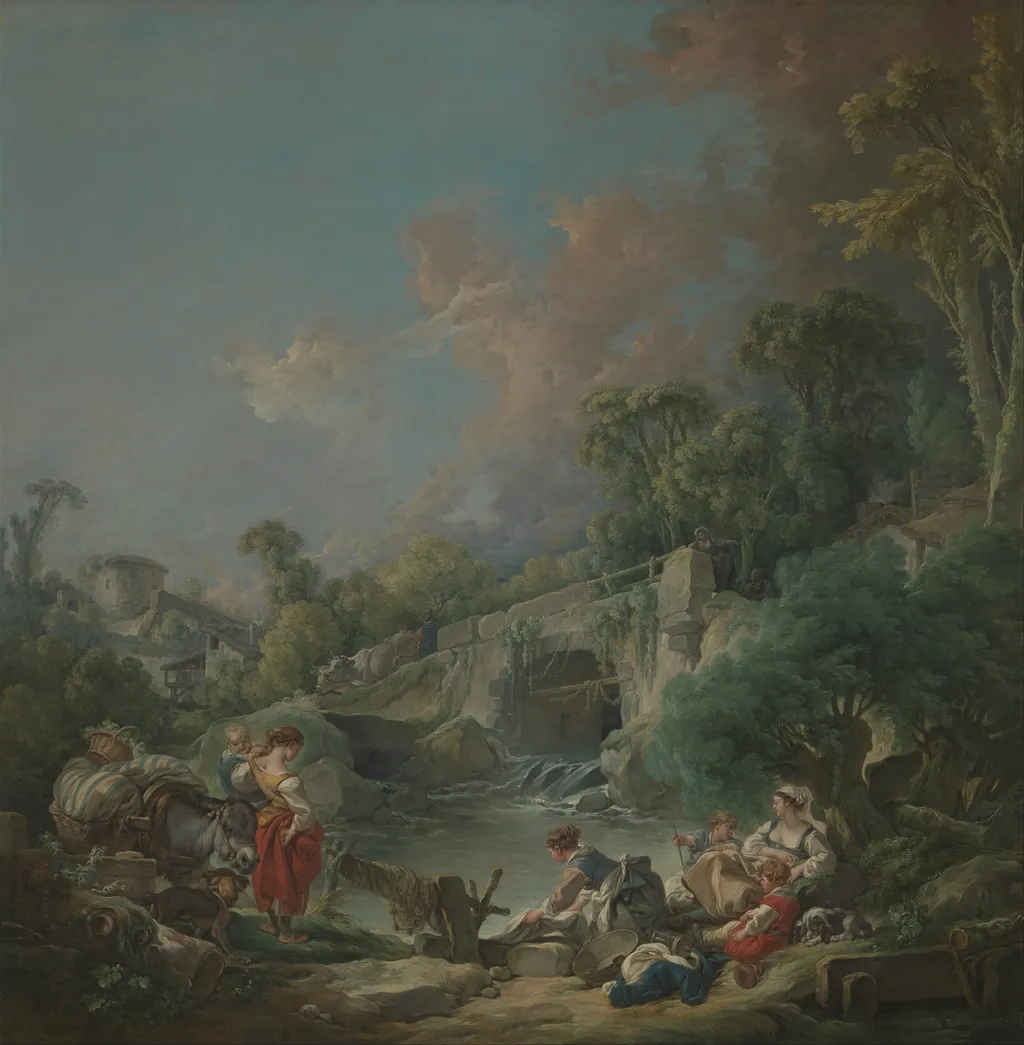
Washerwomen is an oil painting by the Rococo painting artist François Boucher. It dates from 1768 and is held in the collection of the Metropolitan Museum of Art.
About this work
In 1768, the sixty-five-year-old François Boucher produced a pair of monumental decorative canvases for Roslin d'Ivry's Château d'Hénonville, including Washerwomen, a pastoral scene nearly eight feet tall. Sir Joshua Reynolds visited his Paris studio that same year and almost certainly saw it. The painting now hangs in the Metropolitan Museum of Art.
Subject & Meaning
This composition aligns with Rococo tendencies to romanticize rural life, presenting humble work as harmonious and picturesque rather than arduous.
The painting presents a genre scene centered on washerwomen and their daily labor, set in a pastoral landscape. Depicted elements include women, infants, and children alongside laundry, buckets, and baskets, as well as a dog, donkey, oxen, and a net. The presence of a bridge, waterfall, and tree further situates the work in an idealized natural environment.
This composition aligns with Rococo tendencies to romanticize rural life, presenting humble work as harmonious and picturesque rather than arduous. The mix of workers, domestic animals, and children suggests a cyclical, communal view of labor and family within a tranquil setting.
Technique & Style
The painting is executed in oil on canvas, measuring approximately 241.3 by 236.2 cm, making it a large-scale work. The support is canvas, and the medium is oil paint, consistent with François Boucher's typical practice. While no detailed analysis of handling, condition, or brushwork is provided in the sources, the depicted subject, including trees, a bridge, women, children, animals, and laundry, indicates a pastoral genre scene.
The composition, with its varied figures and landscape elements, aligns with Boucher's Rococo style, though specific formal or stylistic qualities are not further described in the cited materials.
Overview
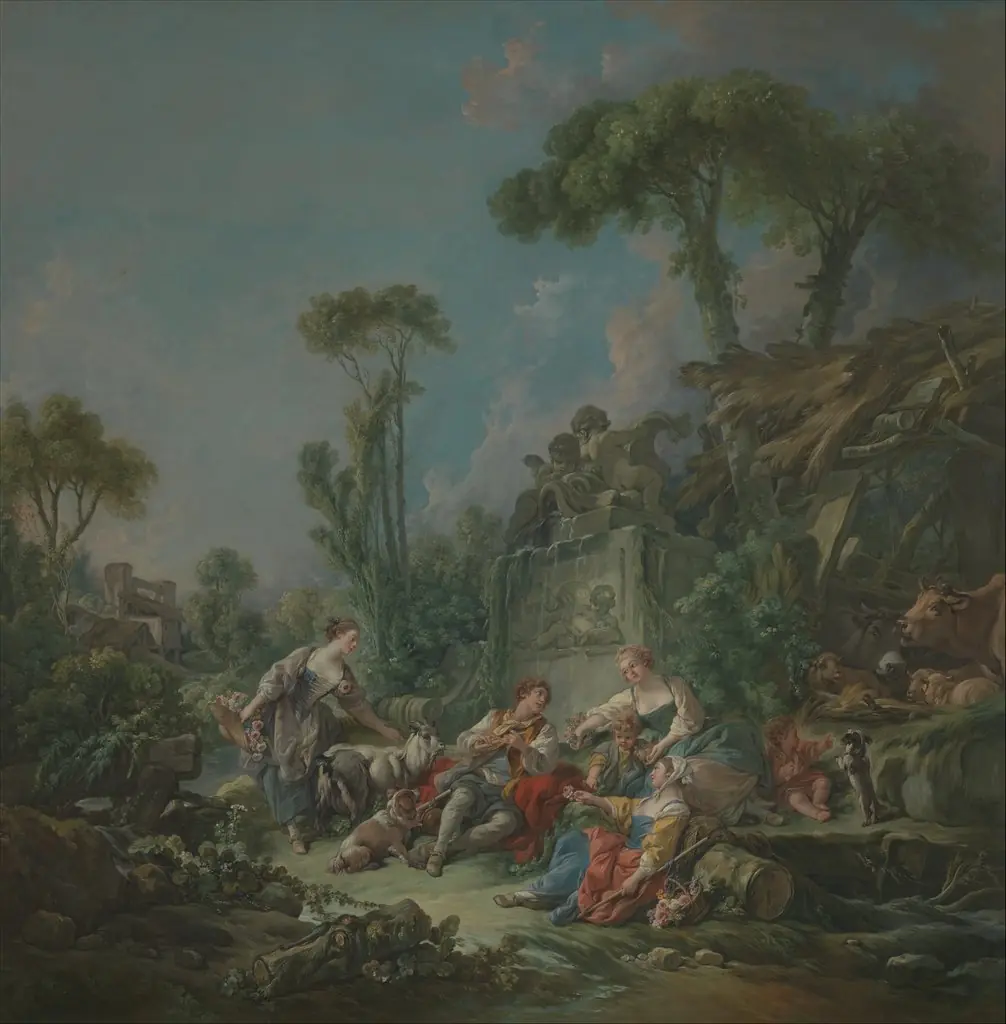
Created by François Boucher in 1768, Washerwomen is a large oil painting depicting laundresses in an idealized rural setting. This monumental canvas, measuring nearly eight feet tall, formed a decorative pair with Shepherd's Idyll. It represents a significant work from the artist's final years, showcasing his enduring engagement with pastoral themes and his characteristic Rococo aesthetic. The Metropolitan Museum of Art acquired the painting in 1953.
History & Provenance
Washerwomen was likely commissioned by Roslin d'Ivry for the Château d'Hénonville, his country estate near Beauvais, as a grand decorative piece. In 1768, the renowned English painter Sir Joshua Reynolds visited Boucher's Paris studio and reportedly admired these large pastoral works. The painting eventually entered the collection of The Metropolitan Museum of Art in 1953, a generous gift from Julia A. Berwind.
Own this work as a print
Artist & collection

Artist
François Boucher was a French painter, draughtsman and etcher, who worked in the Rococo style.


 Shepherds Resting by a Stream
 Arcadisch landschap met musicerende en dansende herders
 Rush Gatherers
 Rest on the Flight into Egypt
 Landscape with Water
 Diana and Her Nymphs
 Landschaft mit Herde
 Landscape
 Landscape with Figures
 Italian landscape
 Arcadisch landschap met linksvoor kinderen met een vogel en een hond
 Studied in the Mythology in Art course