Contemporary Abstract painting begins with a subtraction. Take away the apple, the kneeling saint, the bend of a river, and a question is left sitting on the bare canvas with nothing to lean on. Once a picture stops standing in for something you could point at out the window, what holds it together? That is the one question this essay circles. Abstraction never gave it a single answer. It produced a spiritual answer, a geometric answer, a bodily answer, and a coolly optical one, and the painters who offered them frequently had no use for each other's work. They were not collaborators refining a shared method. They were rivals defending incompatible accounts of what paint is for.
My claim is narrow, and I will carry it work by work. Abstraction is a problem before it is a style, and its hundred-year history reads as a set of rival solutions rather than a march toward one correct form. The body of work we keep under this heading proves the point by refusing to be tidy. It holds severe Irish geometry beside a loose French riverbank and a Danish storm sky, pictures that share almost nothing on the surface and everything underneath, because each answers the same dare: make a flat marked surface mean without borrowing from the visible world, or borrow only the parts you choose. The instinct of a survey is to smooth this into a single forward story. I want to do the opposite and keep the seams visible, because the seams are where the thinking happened.
The question, stated plainly
It helps to fix the terms. The Tate's working definition is blunt and useful: abstract art 'does not attempt to represent an accurate depiction of a visual reality but instead uses shapes, colours, forms and gestural marks to achieve its effect' (Tate). Read that twice and you notice it describes a method, not a look. Shapes and marks doing the work an apple or a face used to do. The trouble starts the moment you ask which shapes, doing what, toward what end, because there the agreement collapses. A grid and a poured skein of paint both satisfy the definition while sharing no premise about why a person should care. The word covers a method and hides a quarrel.
The birth was not one stroke of genius. Across roughly 1909 to 1913 a scatter of painters in Munich, Moscow, Paris and Prague pushed toward what they kept calling pure painting, each more or less on a separate track (Wikipedia). František Kupka hung Amorpha, Fugue in Two Colours at the 1912 Salon d'Automne in Paris, and the poet Guillaume Apollinaire, reaching for a label, called this strain Orphism, after Orpheus, music made visible. The name is a tell. From the start abstraction wanted to be the painting equivalent of music, a thing that moves you while pointing at nothing. That the breakthroughs happened in four cities at once, with little coordination, already says something. Abstraction was less a discovery than a pressure the whole period was under, and different studios cracked under it in different ways.
Answer one: paint as a spiritual instrument
The first answer was metaphysical. Wassily Kandinsky argued that color and line carry feeling the way a struck key carries a note, and that a painter could compose directly on the soul without routing the signal through recognizable things. He set this down in Concerning the Spiritual in Art, which reached English readers in 1914 through Constable in London. The book is half theory, half sermon, and its wager is enormous: that a yellow can sound like a trumpet, that a form can be a moral event. This is the answer most likely to curdle into mysticism, and plenty of weak abstraction since has hidden behind it. It also gave the whole project its nerve. Without the claim that a mark can be felt directly, the enterprise has no reason to exist. Strip the spiritual premise away and you are left with decoration, pattern that pleases and means nothing. Kandinsky's gamble was that the decoration could be made to ache.
Answer two: paint as built order
Where Kandinsky heard music, Kazimir Malevich and Piet Mondrian saw architecture. Tate names the two of them as the pioneers of pure abstraction between about 1910 and 1920, and they built the most disciplined rooms in the house. Both started from the planar grammar of Cubism and pushed past it until nothing recognizable survived. Malevich set a black square on white in 1915 and called it a beginning, a zero point, the ground cleared. Mondrian spent decades reducing the world to black scaffolding and three primaries locked at right angles. The answer here is severe and almost moral. The painting is a constructed fact, true to its own edges and beholden to nothing beyond them. It does not move you the way a sunset does. It convinces you the way a proof does. Notice how far this sits from Kandinsky. He wanted the mark to vibrate. They wanted it to stand still and be exactly itself, no overtones, no soul on the line. Two answers, less than a decade apart, that cannot both be the point of painting.
Answer three: paint as rhythm
In Ireland a third answer took shape, and our archive holds two strong examples of it. Mainie Harriet Jellett trained in Paris under Albert Gleizes, and she carried home his idea that a composition could be generated by rotating and shifting a few units across the surface, the way a fugue develops a single phrase. Look hard at A Composition - Sea Rhythm. The picture is built from arcing planes that overlap like the staggered crests of a swell, each one a translucent leaf of color laid over the next, so the eye reads depth and then loses it as the planes tip back into the flat. There is no horizon, no boat, no shoreline. The sea is present only as cadence, the rise and fall of those curved edges, the warmer ochres pushing up while the cooler blues settle back. Jellett does not picture the water. She rebuilds its motion as a closed system of shifting arcs, and the surface holds because the rhythm holds. Cover half the canvas with your hand and the other half still reads as a complete phrase, which is the test of a structure that was generated rather than copied.
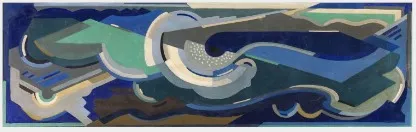
Set beside it, her An Abstract Composition reads as more frontal and more devotional, its segments fanning from a central spine like a Gothic window pressed onto a single pane. The arcs that rolled sideways in the sea picture here lift and converge, and the color sheds its weather to become something closer to lit glass. Jellett's quiet achievement is that she folded the spiritual answer and the geometric answer into one. The rigor is Gleizes; the feeling is closer to stained glass. When abstraction first reached Dublin in the 1920s the local press treated nonrepresentational painting as a foreign disease, which tells you how radical this looked outside Paris. The work outlasted the insults. Jellett gave the rhythmic answer its clearest Irish voice, and our two examples let you watch her tune it, the same method bent once toward the sea and once toward the altar.
Answer four: the gesture and the field
By the 1940s the centre of gravity crossed the Atlantic. Stella Paul's Heilbrunn essay for the Metropolitan Museum places Abstract Expressionism in New York in that decade and calls it the first American movement to gain genuine international influence (The Met). The movement split almost as soon as it cohered. Smarthistory draws the fault line plainly: on one side the gestural, kinetic Action Painting, on the other the broad, quiet expanse of Color Field (Smarthistory). Two answers again, under one roof, barely on speaking terms. The label that art history hands down as a single movement was, up close, a room full of people who agreed only on what they refused to paint.
The gesture wing treated the canvas as an arena and the finished picture as the residue of a performance. Jackson Pollock's poured and dripped paintings record the swing of an arm and the body's whole circuit around a canvas laid flat on the floor. The mark is an event you can almost reconstruct, the loop tightening where the wrist turned, thinning where the can ran dry. The field wing wanted the reverse: a color so large and even that it stops reading as a shape on a wall and begins to behave like an atmosphere you have stepped into. Mark Rothko's stacked rectangles depict nothing and perform nothing. They soak. One answer is a verb, the other a place. Both refuse the apple, and they refuse it for opposite reasons, the one to record an act, the other to dissolve the act entirely into a wash of presence.
What our shelf actually holds
Pull the drawer marked Contemporary Abstract in our own holdings and the plurality stops being theoretical. We keep 483 works under this heading, by 367 different hands, spread across 17 venues, with dates running from roughly 1850 to 2023. That spread is the argument in miniature. No single studio, decade, or country owns the label. A movement, in the textbook sense, has a center and a moment. This has neither. It is a lineage rather than a look, and the works gathered beneath it answer the founding question in voices that would never harmonize. The 173-year span alone should warn you off any clean origin story, because it reaches back past the famous 1912 breakthroughs and forward past everyone who claimed to end painting.
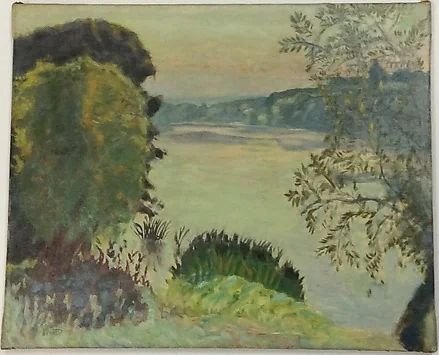
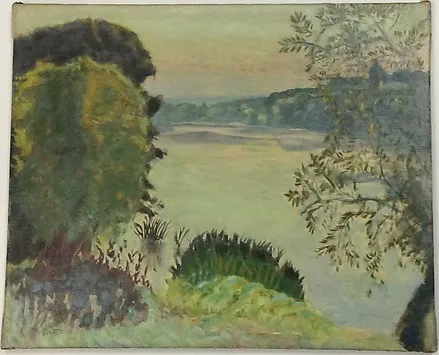
Pierre Bonnard's The Seine at Vernon is not abstract by any strict test, and that is exactly why it earns its place here. Stand close to it. The river is a band of broken greens and lilacs that will not resolve into water until you step back, and the far bank dissolves into dabs that describe foliage only by agreement. Bonnard keeps one foot in the world and lets the other float free. The picture is a held breath between depiction and pure surface, and it marks the threshold every abstractionist later crossed. Spend a minute with it and you understand that abstraction was not a door slammed on the visible. It was a door already standing ajar in the late nineteenth century, which is why our date range reaches back to 1850. The corpus, by filing Bonnard here at all, makes a quiet claim that the strict historians resist: the line between a loosened landscape and an abstract one is a matter of how far the marks have drifted from their job, not a wall.
Peter Rostrup Bøyesen does something similar with weather in Gathering Thunderstorm, Gilleleje, where the sky becomes a smeared mass of slate and bruised violet that means storm before it means cloud. The paint arrives as pressure first and as depiction second, the way real weather hits you before you have named it. The further out the corpus reaches, the looser its idea of the label gets. Béla Iványi-Grünwald gives us Thomas Touches Christ's Side, a frank religious narrative that has no business under an abstraction heading until you notice why the corpus filed it there. The handling is loosened to the edge of legibility, paint behaving as paint, the sacred scene barely holding its shape against the brush that wants to break it apart. The lesson is useful. Abstraction is a matter of degree, and the threshold sits wherever a painter stops serving the subject and starts serving the surface.
The lineage runs forward as well. Henri Matisse spent his last years cutting shapes straight from painted paper, abstraction by scissors, drawing with color instead of describing with it. The cut edge is its own kind of mark, clean where a brush would waver, and it gave him a way to keep the spiritual answer alive without a drop of mysticism. The Belgian Jan Fabre carried the impulse into materials a 1912 painter could not have imagined. Across our 17 venues the answers keep arriving in fresh dialects, none of them final, each one quietly contradicting the room next door. The count is not trivia. It is the shape of the claim. Spread 483 works by 367 hands across that many years and you cannot tell a single story without lying by omission.
Works discussed in this article
One question, several answers
So read this heading as an open argument rather than a closed movement. The spiritualists, the builders, the rhythmists and the gesturalists were not stages in one story. They were rival answers given at roughly the same time and never reconciled, and that is the strength of the category, not its weakness. A collection that forced them into a single tendency would be lying about what abstraction is. The question first asked aloud around 1912, whether a flat marked surface can mean without depicting, has no settled answer and was never going to get one. Each generation finds the old answers used up and reaches for a new one, which is why the date range keeps growing at the far end. Every painter who stretches a canvas today and declines to paint a thing you could name is still answering it. The next answer is already drying on a wall somewhere, set to contradict the last.
Sources & further reading
- Abstract art — Tate
- Abstract painting — Wikipedia
- Abstract Expressionism — The Metropolitan Museum of Art
- Abstract Expressionism, an introduction — Smarthistory
- Number 1, 1950 (Lavender Mist) — National Gallery of Art
- Concerning the Spiritual in Art — Internet Archive