Contemporary Realism is the name we give to representational painting made on the far side of abstraction, by artists who had watched the picture plane flatten and then chose to put solid, nameable things back onto it. The movement gathered force in the 1960s and early 1970s, after two generations had treated likeness as a settled, even embarrassing, question. Its painters did not paint as though Cézanne, Mondrian, and the New York School had never worked. They kept the modernist conviction that a canvas is first a designed flat surface and only second a window, and then they hung a chair, a body, a face, a museum interior on that surface anyway. The interesting break is not that they returned to the visible. It is how they returned.
That is the argument this essay defends: the formal signature of Contemporary Realism lives in three decisions, and all three carry the memory of abstraction. First, composition built as a flat design, with tilted tables, hard cropping, and frontal staging that refuses deep illusionistic space. Second, an even, weatherless light that describes form without dissolving it into atmosphere. Third, a handling of paint that suppresses the brush, polishing the surface until the touch of the hand almost disappears. Subject matter is the least of it. A realist of 1972 and an academic of 1872 might both paint a standing nude, but they organize the rectangle, the light, and the pigment by opposite rules. Look at the rules, not the motif, and the break comes into focus.
A realism that remembers abstraction
The vocabulary itself is recent. Contemporary realism is a worldwide tendency that came into existence around the 1960s and early 1970s, a label for post-1970 painters and sculptors whose work stays representational and whose stated object is to portray the real rather than the ideal, as the standard reference summaries put it (Wikipedia). The Tate frames the larger category more precisely. Its term for the same impulse is modern realism: painting or sculpture made since abstraction developed in modern art, which nonetheless continues to represent things in a realistic manner (Tate). That definition is doing more work than it looks. The qualifying clause, since abstraction developed, is the whole point. These are not painters innocent of flatness. They are painters who have absorbed it and decided to disagree with where it led.
The institutional moment can be dated. In the winter of 1970 the Whitney Museum of American Art ran a survey titled 22 Realists, on view from the tenth of February to the twenty-ninth of March, documenting in one room the resurgence of realist painting in the United States (Internet Archive). A major museum putting two dozen representational painters on its walls in 1970, at the height of Minimalism's authority, was a deliberate provocation. It announced that figuration was not a residue of the past but a live position with its own formal program. The painters in that orbit were not nostalgists. Many of them had trained as abstractionists and turned, mid-career, back toward the model and the room.
The tendency was never only American. In Canada the so-called Maritime Realists clustered around Mount Allison University in New Brunswick, where Alex Colville is counted the leading figure and where he taught a younger group that included Christopher Pratt, Mary Pratt, and Tom Forrestall (Wikipedia). Colville is the clarifying case for everything that follows, because no one mistakes his work for nineteenth-century academic painting. His pictures are built on hidden geometric armatures, painted in a dry, granular touch, lit by a light that seems to come from no particular hour. He paints a man and a horse, a woman at a window, a dog on a road, and the scene is legible to a child, yet the structure underneath is as calculated as a Mondrian. That is the contradiction the movement runs on.
Composition: the surface comes first
Start with how the rectangle is filled, because composition is where the inheritance from abstraction is hardest to disguise. The realist organizes the canvas as a design before it is a depiction. Alex Katz is the cleanest American demonstration. The National Gallery of Art keeps his early Folding Chair and reads it as a work where he was already blurring the boundary between abstraction and realism, letting a single ordinary object sit against a flat field so that the negative space is as composed as the thing itself (National Gallery of Art). Philip Pearlstein, another founder of the tendency, did the same to the human body. He cropped his nudes at the edge of the canvas as casually as a photographer crops a snapshot, cutting off a head or a foot, refusing the body the dignified completeness the academy demanded. The body becomes a set of volumes to be arranged, lit, and abutted against the frame. The frame is an active agent, not a neutral border.
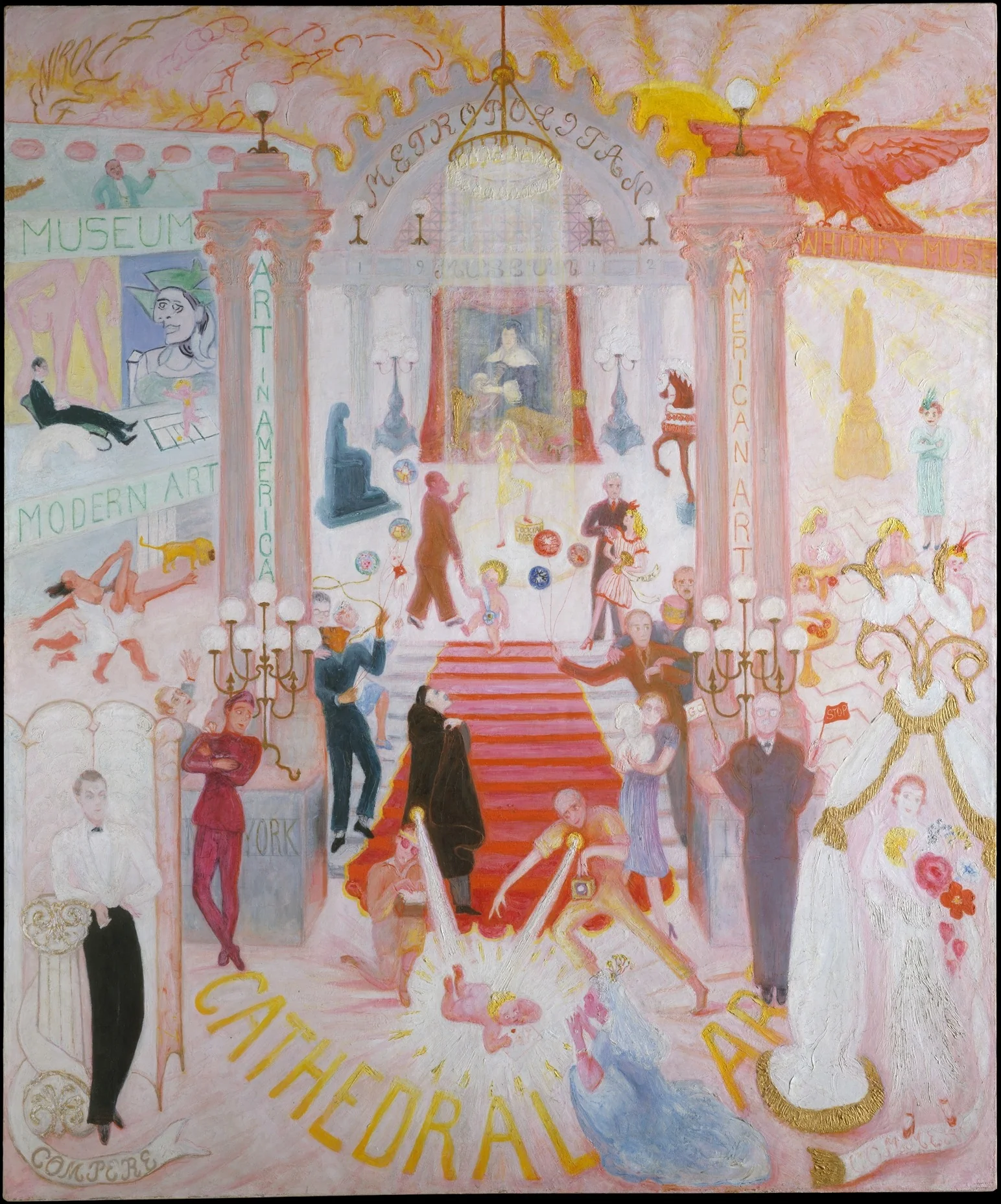
The corpus offers an unexpected ancestor for this kind of designed picture, and it is worth looking at closely. Florine Stettheimer's The Cathedrals of Art is a manifesto of surface-first composition decades before the term was coined.
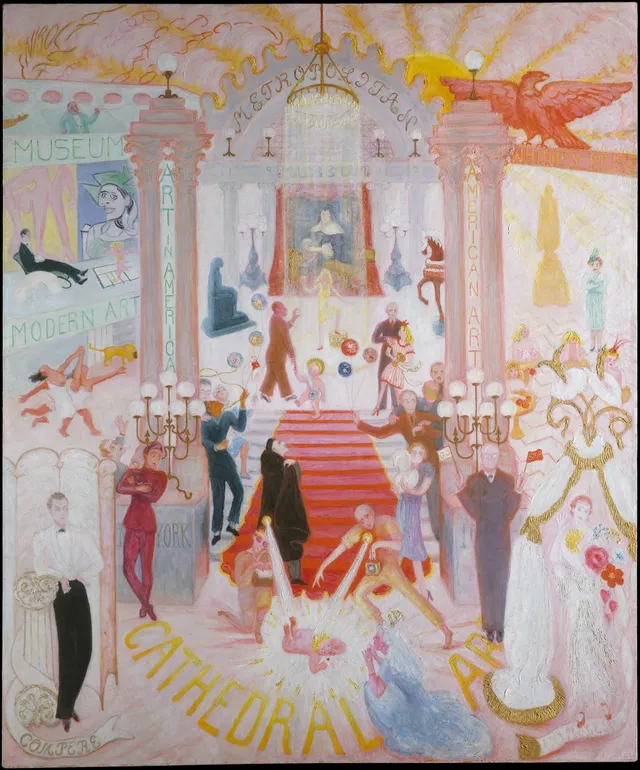
Look at what Stettheimer actually does on the canvas. She paints the New York art world as a theatrical interior, a grand staircase rising up the center, but she refuses to let the room recede the way a Renaissance perspective would carry you back into it. The floor tilts up toward us like a stage raked for the back rows. Figures of curators and critics are scattered across the height of the picture at roughly equal scale, so the eye reads them as a pattern of bright marks rather than as people standing at measurable distances. Red drapery frames the scene like a proscenium and pins the whole thing to the front plane. Gilt lettering, a baby on a pedestal, miniature paintings within the painting: each element sits flat and frontal, outlined, weightless. She has the descriptive precision of a realist and the spatial logic of a decorated screen. The picture is recognizable down to named institutions, and it is also, structurally, a flat field of incident. That double allegiance, exact likeness laid over a deliberately shallow stage, is precisely the compositional move the later realists would systematize.
The lesson generalizes. Where a Baroque painter pulls you into the canvas through a tunnel of diminishing scale, the realist holds you at the surface and lets the design do the talking. Tables tilt toward the viewer. Walls run parallel to the picture plane. Objects are stacked up the canvas rather than marched back into it. The space is shallow on purpose, a low relief you read rather than a room you enter. This is the most durable trace of abstraction in the movement, and it is why these pictures never look like waxworks. The geometry is modern even when the subject is a kitchen table.
Light without weather
The second decision is light. Impressionism had taught painting to chase the specific hour, the haze, the broken color of an actual afternoon. The contemporary realist mostly declines that gift. The characteristic light is even, frontal, and oddly hourless, a studio light or a noon without shadows that describes every form with the same clarity from foreground to back. It is light as information, not light as mood. Colville's roads and rooms have it; Pearlstein's studio nudes are flooded with it. The point is to keep every plane equally readable so the composition stays legible as a design. Atmosphere would soften the edges and the whole flat-surface argument would collapse into a blur. So the air is removed, and what remains is a strange, lucid, slightly airless clarity that no nineteenth-century realist would have recognized.
You can watch a painter reason about light in William Lönnberg's Self-Portrait, one of the more candid faces in this part of the archive. The light falls on the face as structure, modeling the planes of the brow and cheek into something almost carved, rather than flattering the sitter or building a romantic gloom around him. The background stays plain and close, pushing the head forward against a shallow ground. There is no theatrical chiaroscuro, no single dramatic source throwing half the face into darkness. The illumination is steady and analytical, the kind that lets you read the construction of a head the way you would read a diagram. A painter who lights himself like that is telling you he cares about how the thing is built, not how it feels to stand in the room with him.
The handling of paint
The third decision is the most physical: how the paint itself is laid down. Abstract Expressionism had made the visible gesture sacred, the loaded brush, the drip, the trace of the arm. The contemporary realists answered by suppressing the hand. The characteristic surface is smooth, tight, and anti-gestural, finished to a near-photographic evenness in which you cannot find the individual stroke. This is not timidity. It is a counter-argument in oil. If the gesture had become the whole content of painting, then a surface that erases the gesture and shows you a chair instead is a polemic. The realist hides the labor so that the depicted object, rather than the act of depicting, holds the eye. Smoothness is the rhetoric.
No work in the archive complicates this more sharply than Han van Meegeren's The foot washing. Van Meegeren is history's most successful forger, the man who painted fake Vermeers convincing enough to sell one to Hermann Göring and then had to prove his own guilt to escape a treason charge. His handling is the dark twin of the realist program. He suppresses the stroke so completely, and hardens the surface so thoroughly, that the paint pretends to be three centuries old. The smoothness here is not a polemic against gesture; it is a lie about authorship and date. Yet the formal effect is the same one the legitimate realists prize: a polished, impersonal finish in which the maker's hand goes silent and the depicted scene seems to exist on its own. The forger and the realist arrive at the same surface from opposite motives, which tells you how central that surface is to the whole idea of realism after abstraction.
Two further works in the archive mark the long road into this anti-gestural finish. Henricus Rol's Queen Juliana of the Netherlands in Her Coronation Robes shows the official, record-keeping strain of realism, where the paint serves the document and the brush is kept out of the way so the regalia can be counted. And the anonymous Still Life with a Poor Man's Meal of Porridge, Cheese, Herring and Pancakes reaches back to the Netherlandish tradition that taught European painting how to render a herring's skin and a cracked bowl with patient, self-effacing exactitude. The contemporary realist's smooth table is a descendant of that bowl. The faith that a humble object, painted plainly enough, is worth a viewer's full attention runs straight through.
What the archive holds
Set against the textbook timeline, the gallery's own holdings tell a revealing story. Artifact World Gallery holds 204 works tagged Contemporary Realism, drawn from 154 artists and spread across 27 venues, with dates running from roughly 1867 to 2022. That span is far wider than the movement's 1960s origin, and the gap is the most honest thing about the collection. It means the archive reads the movement backward through its lineage, gathering up the official portraits, the plain still lifes, and the surface-first interiors that taught later painters their grammar, then filing them under the label that grammar eventually earned. A spread across 27 venues, rather than one or two, also says something: this is a tendency curators recognize across many institutions, not a local school with a single home.
Works discussed in this article
Even a devotional panel like the anonymous Saint Catherine earns its place in this story by negative example. It is realism in the older sense, likeness in service of a sacred program, the figure idealized toward a type. Hold it beside Pearlstein's cropped, unidealized studio bodies and the modern break is obvious in a glance. The contemporary realist keeps the descriptive skill and throws out the idealization. The object is the real, not the ideal, and the difference is not subtle once you have trained your eye on the surface rather than the saint. Artists such as Albert Van Dyck and David Griffiths sit in the same archive as twentieth-century portraitists who keep the likeness and drop the halo.
Lineage: from Courbet to the present
The word realism carries an older charge, and the contemporary movement is a deliberate revival of it. The original Realism that these painters reach back to was forged in mid-nineteenth-century France and led by Gustave Courbet, who insisted on painting the ordinary, the laboring, and the unbeautiful at the scale the academy reserved for gods and kings (Smarthistory). That is the first Realism hub in the gallery's taxonomy, and the contemporary version is its grandchild. In between sat the twentieth century's first realist counter-current, the post-First-World-War return to order, which in Germany hardened into the cold, exacting Neue Sachlichkeit. The contemporary realists rhyme with that interwar coldness more than with Courbet's mud and labor. Their nearest sibling on the formal side is Photorealism, which pushed the suppressed brush and the all-over clarity to their logical end by copying the photograph outright. Contemporary realism stops short of that, keeping the model and the room in front of the painter, but it shares the same conviction that a cool, exact surface can carry as much weight as any gesture.
Where the break holds
The easy way to dismiss Contemporary Realism is to call it a retreat, painting that lost its nerve and crawled back to the figure. The pictures refuse that reading the moment you stop looking at what they show and start looking at how they show it. The tilted floor in Stettheimer, the analytical light on Lönnberg's face, the hand erased from van Meegeren's hardened surface: these are modernist decisions wearing representational clothes. The realist did not undo the twentieth century. He carried its lessons about the flat designed surface into a room with a chair in it and dared the surface and the chair to coexist. That dare is still open. Every painter now working from the model under an even light, building the canvas as a shallow design and polishing the brush out of sight, is testing the same proposition, that you can know everything abstraction proved and still want to paint the look of a real foot, a real bowl, a real face in the plain light of an ordinary afternoon.
Sources & further reading
- Contemporary realism — Wikipedia
- Modern realism (art term) — Tate
- 22 Realists (exhibition catalog, Feb 10, Mar 29, 1970) — Whitney Museum of American Art / Internet Archive
- Alex Katz, Folding Chair — National Gallery of Art
- A beginner's guide to Realism — Smarthistory
- Philip Pearlstein, Male and Female Models Sitting on the Floor — The Metropolitan Museum of Art