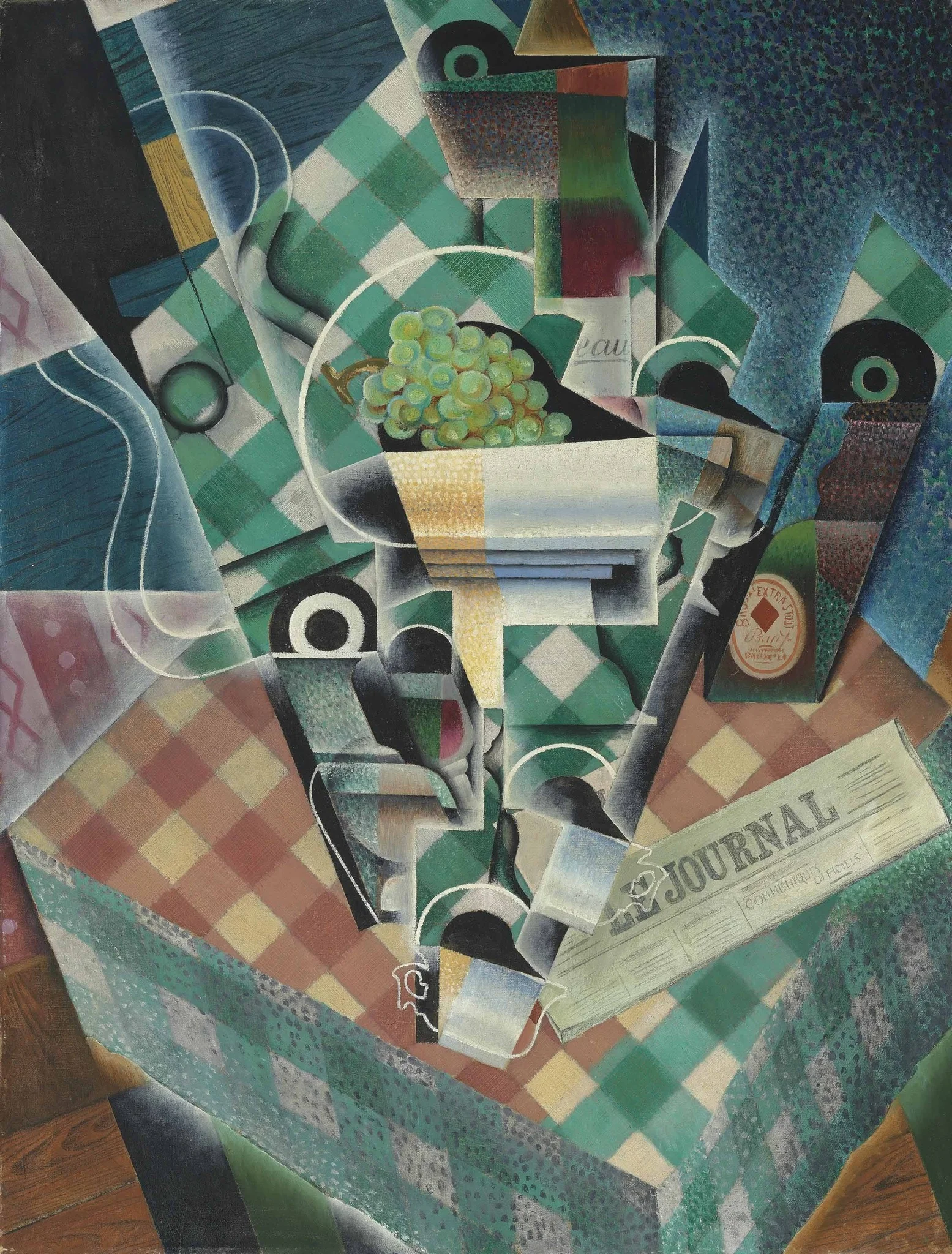
Synthetic Cubism began as a repair job on a problem its own inventors had created. By 1911 Picasso and Braque had taken the visible world apart so completely that their canvases risked becoming unreadable, a brown lattice of facets in which a bottle, a guitar, and a folded paper dissolved into the same restless shimmer. The next move was not a retreat toward realism. It was to build the object back up from flat parts, sign by sign, until a guitar could be recognized again without ever being copied. That reversal, from taking apart to putting together, is the entire argument of this essay, and the painter who states it most plainly is not Picasso but Juan Gris.
My claim is narrow, and I will carry it work by work. Synthetic Cubism is best understood not as the brighter, easier sequel to its analytic phase but as a constructive grammar, a way of assembling pictures out of flat signs, and Gris is the artist who made that grammar fully legible. Where Braque and Picasso improvised their way into it, Gris reasoned his way through. He started from the shape and arrived at the object, the reverse of the academic order, and he did it with a draughtsman's deliberateness that lets you watch the logic run. To test that reading, look hard at a single canvas, his Still Life with Checked Tablecloth, and let the rest of the movement arrange itself around what that one picture shows.
What the word "synthetic" actually changed
The standard chronology is tidy. Tate dates the synthetic phase from roughly 1912 to 1914 and describes it as a shift toward simpler shapes and brighter color after the dense monochrome of the analytic years (Tate, Synthetic Cubism). That is true as far as it goes, but the color is a symptom, not the cause. The real change was a change in how a painting was made, and it came in through the hands rather than the eye. Once you grasp that, the brighter palette stops looking like a mood and starts looking like a consequence. Flat parts want their own local color, not the smoky half-tones you need to fake a rounded surface.
The hinge was collage. In 1912 Picasso glued a strip of printed oilcloth, a machine-made image of chair caning, onto an oval canvas and ran a length of rope around its edge, producing what is usually counted as the first Cubist collage. Braque, working in the same months, pasted strips of imitation wood-grain wallpaper onto a drawing and invented the technique of papier collé (Tate, papier collé). The Metropolitan Museum puts the consequence cleanly: by introducing pasted, colored, and printed paper, the two painters swept away the last traces of three-dimensional illusionism that had survived in their analytic work (Met, Cubism). A pasted rectangle of newspaper does not pretend to recede into depth. It sits on the surface, flat, declaring that the picture is an object you build, not a window you look through.
Smarthistory marks the same threshold by its materials: beginning in 1912, cut newspaper, wallpaper, construction paper, cloth, even rope start to appear in the work of Picasso and Braque (Smarthistory, Synthetic Cubism). Once a scrap of Le Journal can stand in for a folded newspaper on a café table, the painter no longer has to model the thing in light and shade. A flat sign will do, and the viewer's mind supplies the rest. That economy is the synthetic method in miniature, and it scales from a glued fragment to an entire painted surface that behaves as if it were assembled from cut shapes. The pasted scrap is doing semantic work, not decorative work. It names the thing instead of describing it, and naming is cheaper and stranger than describing.
The method also found its first theorist almost at once. In 1913 the poet Guillaume Apollinaire published his Les peintres cubistes, the earliest sustained critical defense of the movement, written while the paint was still wet (Apollinaire, Les peintres cubistes). The point worth taking from it here is one of tempo. A practice that gets its champion in print within a year or two of its first collages is a practice that contemporaries already understood as a deliberate program, not a private studio habit. Synthetic Cubism arrived with its own argument attached.
There is a nice historical irony buried in the vocabulary. The label "Analytic Cubism" was not coined at the time by the men who made it. It was applied afterward by Gris himself, the very painter who would push the synthetic alternative furthest, and the synthetic mode stayed alive in Paris until about 1919, when Surrealism began to draw younger artists away (Cubism, overview). Gris, in other words, named the thing he was reacting against. He understood the two phases as a pair of opposed procedures, and his own paintings are the clearest demonstration of the difference.
Reading one table: Still Life with Checked Tablecloth
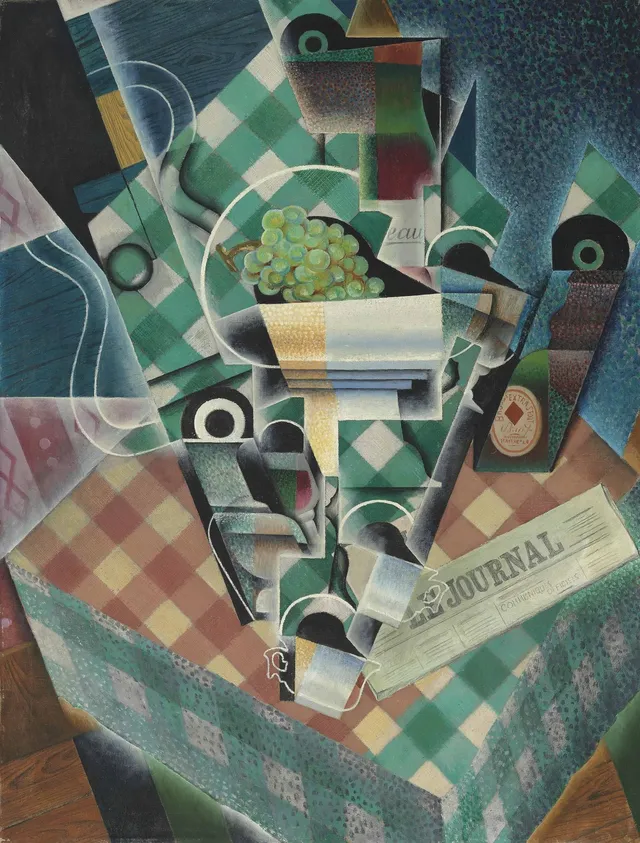
Start with the cloth, because Gris does. A checked tablecloth is already a grid, a ready-made coordinate system, and Gris seizes on that. The squares of the cloth are not just a depicted pattern lying obediently on a table. They become the measuring rule of the whole composition. Where the analytic painters had to invent a faceted scaffold and bury the objects inside it, Gris borrows his scaffold from the subject itself. The check runs across the surface as a flat plaid, then tips and narrows where the table edge turns, so that the same pattern reports both the design of the cloth and the geometry of the table it covers. One motif carries two jobs at once. That doubling is the synthetic idea made visible, and it is the kind of move you cannot stumble into. It has to be planned.
Now read the objects standing on it. They are not modeled in continuous light. Each is constructed from a few flat planes set edge to edge, a wedge of shadow-dark beside a wedge of light, the two halves of a glass or a carafe split down the middle and shifted, as if you were seeing it lit from the left and the right in the same instant. The fruit reads as fruit by its rounded silhouette and a single warm color, not by any careful gradation of tone. A folded sheet of paper sits as a pale rectangle, a flat sign for a flat thing. Nothing reaches back into a deep room. The depth that survives is shallow, a stack of overlapping cards rather than a stage. You feel the front of the table pressing toward you and almost no room behind it.
Look at how Gris keeps the eye honest about the surface. He lets the contour of an object align, just slightly, with a seam in the tablecloth grid, so that the boundary of the still life and the boundary of the cloth lock together for a moment and then come apart again. He breaks a single object into a lit zone and a dark zone divided by a clean straight edge, an edge that has nothing to do with anatomy and everything to do with the architecture of the picture. The result is a still life that you assemble as you watch it, the way you would assemble it from cut paper, except that Gris has painted the cut paper instead of pasting it. He took the lesson of the papier collé and carried it back into oil, which is precisely why his canvases read as the clearest sentences in the synthetic language. Where Picasso let the real newspaper do the talking, Gris reproduces the effect by hand, and in reproducing it he has to understand it completely.
This is the difference from the brown analytic grid worth naming flatly. The analytic still life asks: what is this object made of, seen from every side at once? Gris's synthetic still life asks: from how few flat parts can I rebuild this object so you still know it? The first question fractures. The second constructs. Set his Still Life with a Guitar or his Pears and Grapes on a Table beside the checked-cloth picture and the same procedure runs in each: a borrowed or invented grid, objects rebuilt from planes, a shallow space, color doing the work that modeling used to do. The guitar in particular is a perfect test object, all flat body and round hole, a shape that survives reduction to a few planes and still announces itself instantly. Gris is consistent across these canvases in a way that looks almost like a proof.
The method travels: Léger, Delaunay, Chagall, La Fresnaye
If the synthetic method were only Gris's private grammar it would be a footnote. Its importance is that it became portable. Once a painter accepts that an image can be built from flat, frankly artificial parts, the parts can be put to ends Gris never had in mind, and the corpus around him shows the range. Three painters in particular take the same construction kit in three directions, and a fourth shows how far it bends before it stops being Cubist at all.
Take Fernand Léger. He keeps the constructive logic and throws out the café table. Léger's planes harden into tubes, cylinders, and slabs, the vocabulary of a man who had seen artillery and liked machinery. In The Builders the human figure itself is assembled from the same prefabricated components as the girders the workmen climb, bodies and beams cut from one kit of parts. The synthetic premise, that a picture is built rather than observed, becomes literal: the painting is about building, and it is made the way a building is made, from standardized units bolted into place. Léger carried the grammar out of the still life and into the modern street, and he kept it there for the rest of his career.
Color is where Robert Delaunay pushed hardest. He took the flat synthetic plane and let pure color, rather than the depicted object, become the subject, a path that runs toward the color-driven abstraction sometimes filed under Orphism. His Stage Design for Cleopatra shows what the method does when it migrates to the theater: interlocking color shapes meant to be read at distance, under stage light, by an audience that will never inspect the brushwork. The flat assembled plane turns out to be a natural language for scenery, where illusionistic depth is supplied by the real depth of the stage and the painter is free to organize the backdrop as pure pattern. The grammar that began as a way to flatten a tabletop becomes a way to fill a proscenium.
Then there is the borrowing that resists the label. Marc Chagall passed through Paris in these years and took the faceting without the doctrine. In The Marketplace, Vitebsk the planes are unmistakably Cubist, the space tilted and segmented, but the purpose is memory rather than construction. Chagall uses the synthetic plane to hold a remembered town steady on the canvas, the way Gris uses it to hold a glass. That a grammar invented for bottles and guitars could be bent toward homesickness is the best evidence of how general it had become. Roger de La Fresnaye is the counter-case in the same archive, a painter who took the geometry and kept it gentle, fitting it to a more legible, more French sense of order. The method bends without breaking, and where it finally softens into ordinary description you can see exactly where its edge lies.
Works discussed in this article
What the archive shows
There is a way to feel the breadth of this without taking anyone's word for the textbook account. Artifact World Gallery holds 187 Synthetic Cubist works, spread across 44 venues and made by 48 different artists, with dates running from roughly 1910 to 1972. Two figures in that spread are worth pausing on. The artist count, 48, is large for a movement usually narrated as the private dialogue of two men. And the date range, more than half a century, blows past the neat 1912 to 1914 window that Tate and most surveys assign to it. Neither number is a rounding error. Both describe a method that escaped its founders.
Both numbers point the same way as the argument. A grammar held by two inventors does not need 48 hands. A four-decade tail of works dated well past 1914 is not the record of a phase that closed when Surrealism arrived; it is the record of a method that kept being useful long after its founding moment, picked up by stage designers, muralists, and figure painters who had no interest in pasting newspaper but every interest in building an image from flat, deliberate parts. The spread across 44 venues matters too. It tells you the synthetic picture was collectible across institutions, not hoarded in one or two avant-garde strongholds. The corpus reads the synthetic phase the way this essay does, as a portable construction kit rather than a sealed episode.
Why Gris is the test case
Return to the checked tablecloth and the reason it earns the title of defining work becomes concrete. Picasso and Braque invented the synthetic procedure, but they invented it the way improvisers do, by trying things and keeping what held. Their best collages are thrilling partly because you can feel the risk in them. Gris is the one who turned the risk into a stated method you can read off the surface. The borrowed grid, the object rebuilt from a minimum of planes, color carrying the structural load that tone used to carry: in his hands these are not happy accidents, they are rules, applied each time with the same care. A method you can state is a method you can teach, and a method you can teach is a method that travels.
That is also why he makes the best teacher. Stand a beginner in front of an analytic Picasso and the honest first reaction is bafflement; the picture withholds its object. Stand the same beginner in front of Gris's checked-cloth still life and the picture gives up its logic in a minute. There is the cloth, here is the glass, watch how the one measures the other. The painting explains itself, and in explaining itself it explains the movement. A canon needs at least one work that does that job, and this is the one. Pick any other synthetic canvas in the archive and you will find a version of the same lesson, but rarely stated so cleanly.
Sources & further reading
- Synthetic Cubism (art term) — Tate
- Cubism (Heilbrunn Timeline of Art History) — The Metropolitan Museum of Art
- Cubism — Wikipedia
- Synthetic Cubism, Part I — Smarthistory
- Papier collé (art term) — Tate
- Still Life: Le Jour — National Gallery of Art
- Les peintres cubistes (Méditations esthétiques), 1913 — Guillaume Apollinaire / Internet Archive