Artwork
Still Life with Checked Tablecloth
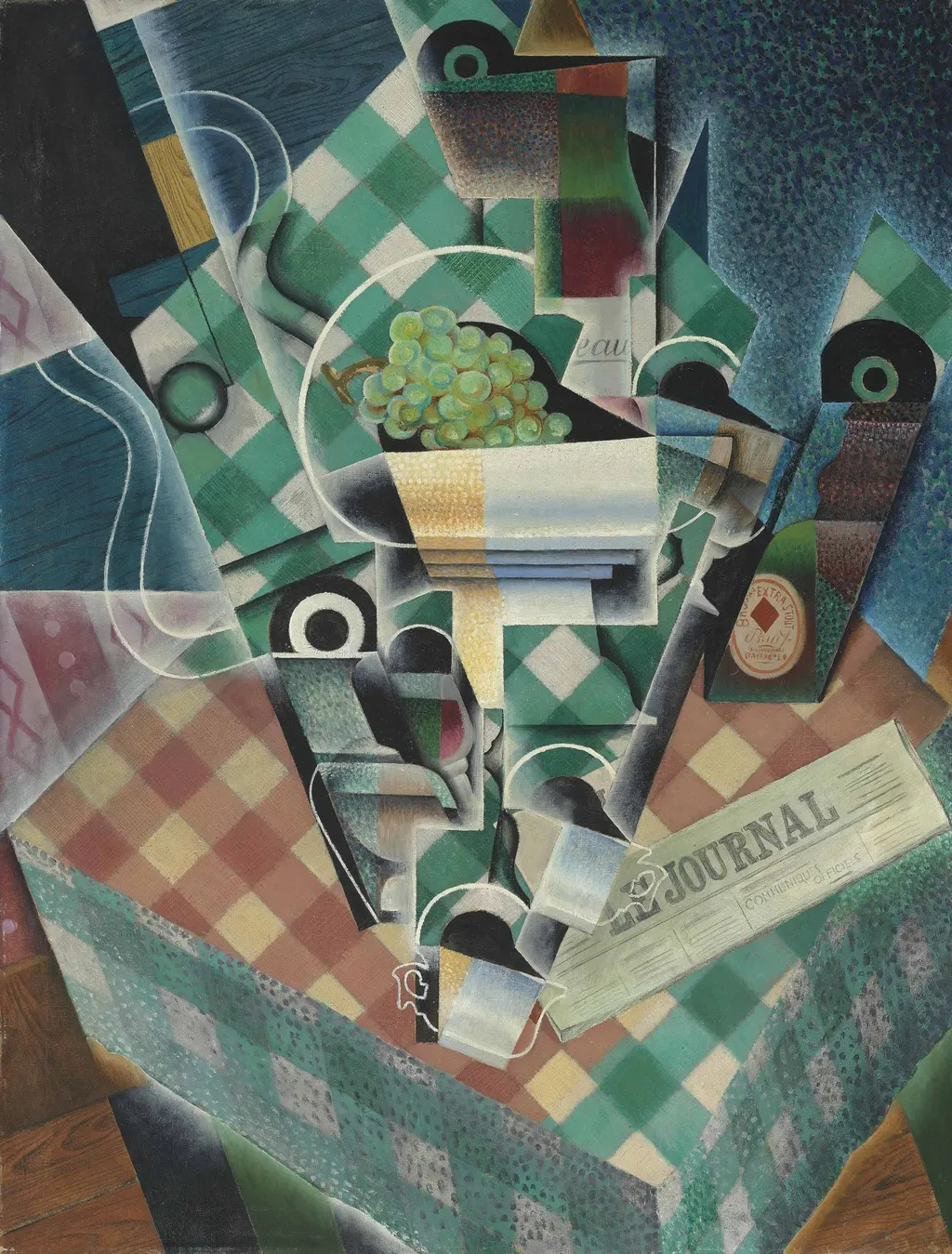
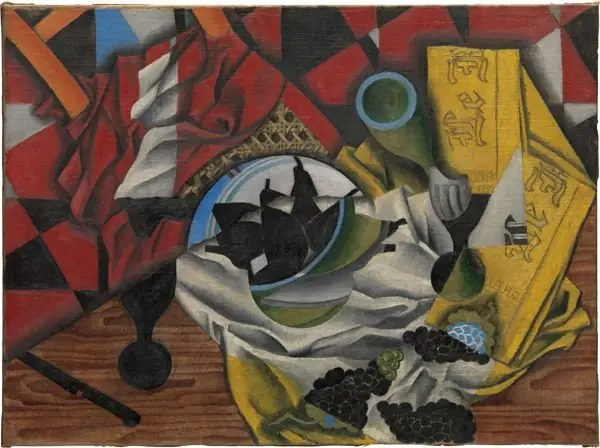
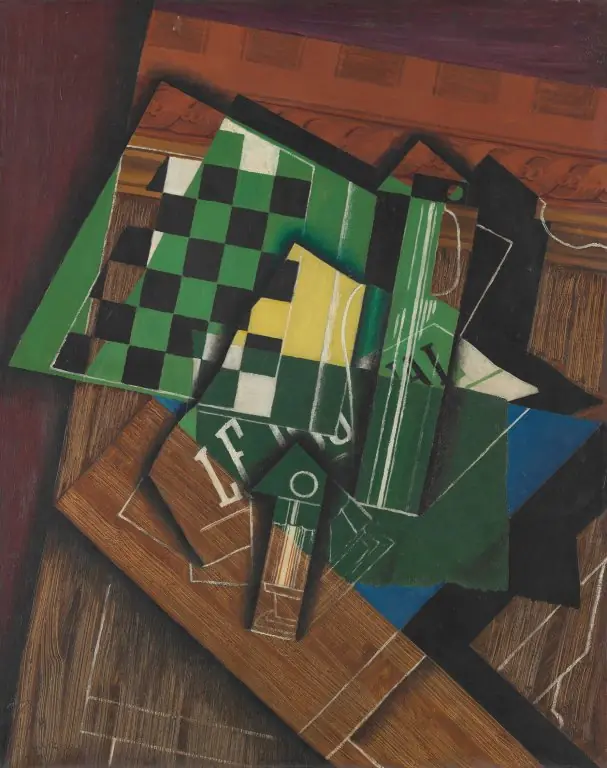
Still Life with Checked Tablecloth is an oil painting by the Cubism Synthetic artist Juan Gris. It dates from 1915 and is held in the collection of the Metropolitan Museum of Art.
About this work
Subject & Meaning
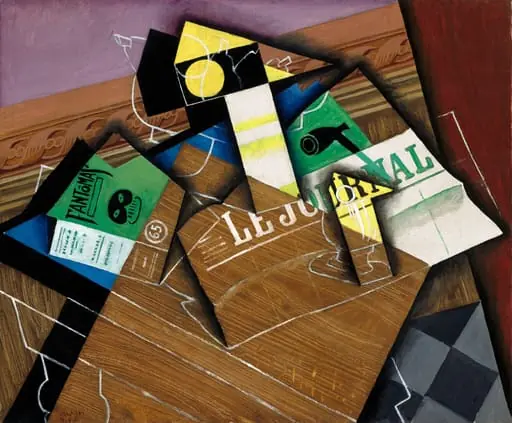
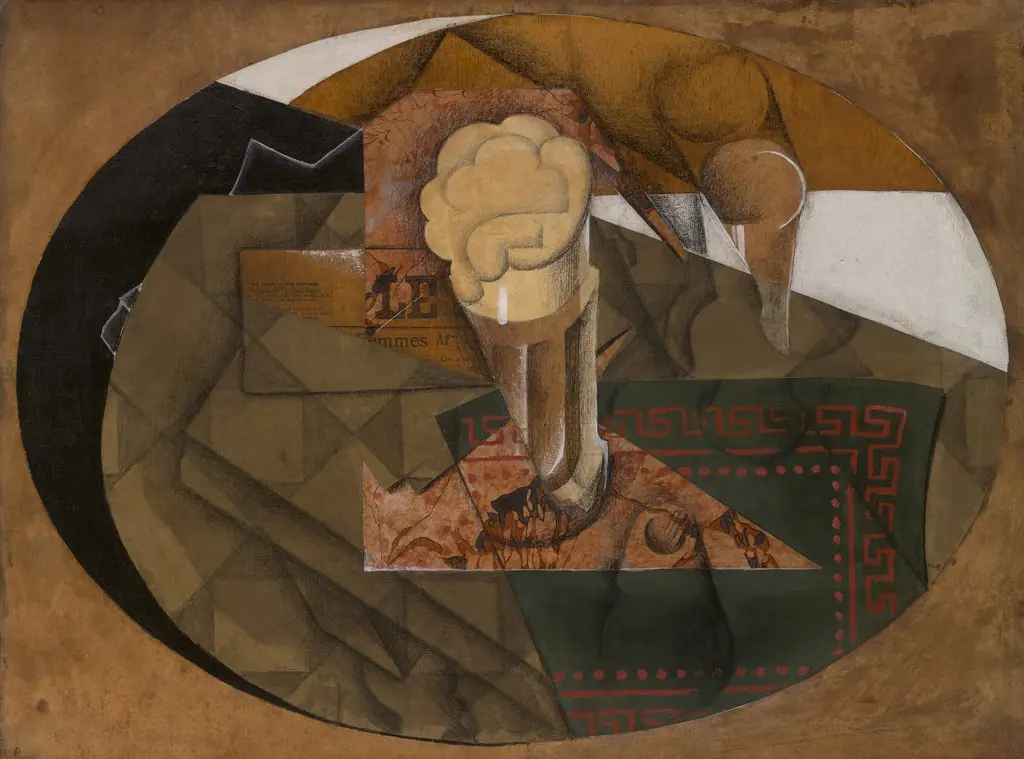
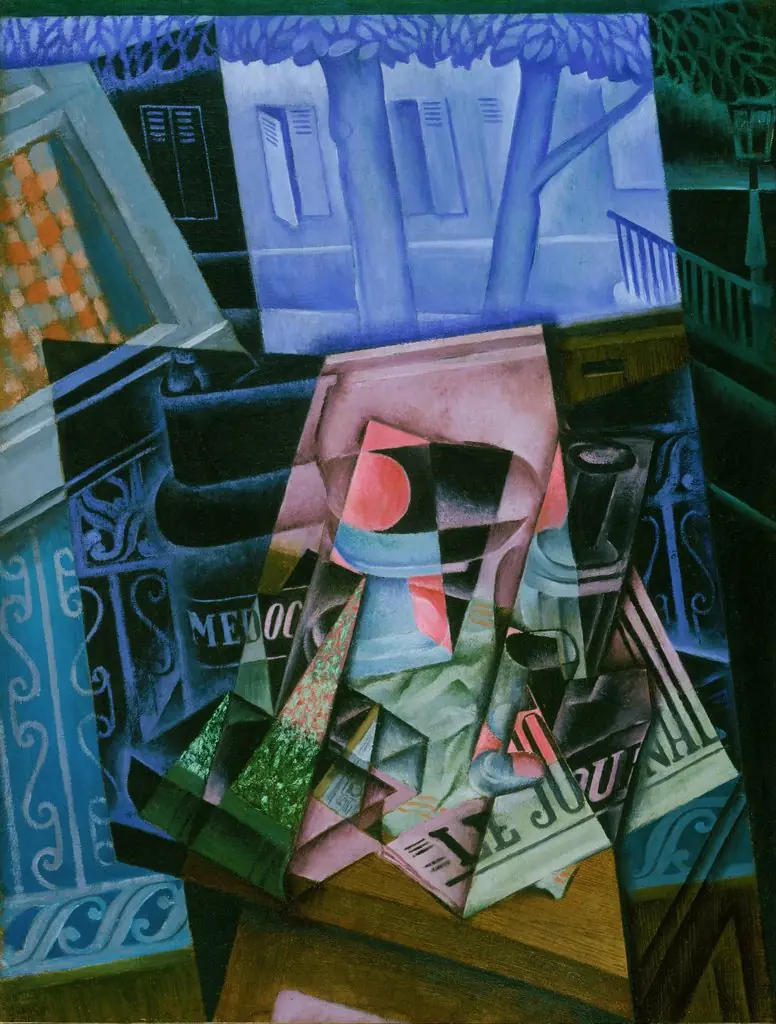
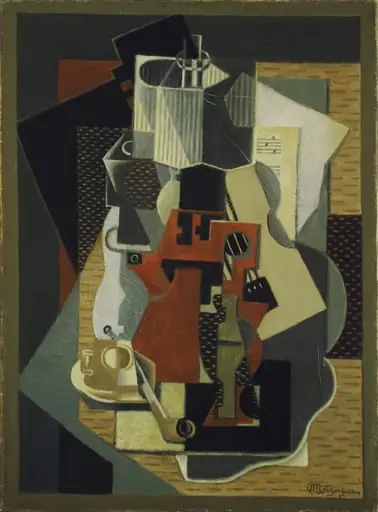
Juan Gris's 1915 painting depicts a table arrangement featuring grapes, a bottle of red wine, beer, a newspaper, and a guitar.
Juan Gris's 1915 painting depicts a table arrangement featuring grapes, a bottle of red wine, beer, a newspaper, and a guitar. While these items constitute a traditional still life, the composition functions as a complex visual pun where the assembled forms simultaneously suggest the profile of a bull's head. This dual imagery exemplifies the artist's Cubist approach to transforming ordinary objects into abstract, composite images.
Originally titled Le compotier, the work reflects Gris's pursuit of architectural unity and movement, moving beyond mere inventory of objects toward a cohesive structural whole. The inclusion of the guitar and the implied bull head connects the scene to broader Spanish cultural motifs often explored in Cubism, blending domestic reality with symbolic abstraction.
History & Provenance
Juan Gris created Still Life with Checked Tablecloth in Paris during March 1915, shortly after returning from the South of France following the onset of World War I. Originally titled Le compotier, the work was painted in oil and graphite on canvas. Its ownership history begins with the Galerie de l'Effort Moderne and Léonce Rosenberg in Paris, where it was reproduced in June 1925. The painting subsequently entered the collection of Gottlieb Friedrich Reber before passing through Galerie H. U. Gasser, Wilhelm Löffler, and Carola Giedion-Welcker.
In 2014, the work was sold at Christie's London for £34.8 million, a record auction price for the artist, and was acquired by the Metropolitan Museum of Art using funds donated by Leonard Lauder.
Still Life with Checked Tablecloth is part of the Metropolitan Museum of Art’s collection in New York, where it entered the museum in 2014 after being acquired from the market. The painting was previously owned by Galerie de l’Effort Moderne, Léonce Rosenberg, Gottlieb Friedrich Reber and other dealers before its purchase. Its first public exhibition occurred at the Staatliche Kunstsammlungen Dresden in the 1926 International Art Exhibition (catalogue no. 374). No accession number is recorded in the available documentation.
Context
Scholars position Still Life with Checked Tablecloth as a pivotal work within Juan Gris's development of Crystal Cubism, marking a shift from static inventories to compositions possessing unified movement. Painted in March 1915, the piece reflects Gris's own assertion that his work had finally achieved a necessary unity. Dealer Daniel-Henry Kahnweiler noted that while Gris typically sought architectural grandeur in static subjects, this period produced images full of dynamism.
Critic James Thrall Soby later highlighted the painting's unique fluorescence and Gris's geometric obsession, specifically his reverence for the triangle as an accurate, endless form. The work's art-historical significance was underscored in 2014 when it achieved a world auction record for the artist, subsequently entering the Metropolitan Museum of Art's collection. Early scholarship includes its reproduction in L'Effort Moderne (1925) and Cahiers d'art (1927), cementing its status in Cubist discourse.
Legacy
Still Life with Checked Tablecloth has maintained a prominent reputation since the mid‑1920s, when it was reproduced in Léonce Rosenberg’s Bulletin de L’Effort Moderne (June 1925) and the French journal Cahiers d’art (1927). It appeared in Daniel‑Henry Kahnweiler’s 1947 monograph on Juan Gris and was catalogued in Douglas Cooper’s 1977 raisonné, cementing its place in scholarly literature. The work was first shown publicly at the 1926 Internationale Kunst Ausstellung in Dresden and later discussed by critic James Thrall Soby in the 1958 MoMA exhibition catalogue, where he praised its fluorescent colour and triangular composition.
Its legacy was reinforced in 2014 when the painting fetched £34.8 million ($57.1 million) at Christie’s London, establishing a world auction record for Gris; the Metropolitan Museum of Art acquired it with funds from Leonard Lauder, where it remains a highlight of the collection.
Overview
Still Life with Checked Tablecloth, originally titled Le compotier, is an early 20th-century painting by Spanish Cubist Juan Gris. Executed in oil and graphite on canvas, it presents a complex arrangement of objects on a table. The work exemplifies Gris's distinctive approach to Cubism and is held in the collection of the Metropolitan Museum of Art.
Technique & Style
Gris employs sharp angles and geometric blocks of color, including greens, blues, and browns, to fragment and reassemble the depicted objects. Bold lines and overlapping planes create a sense of depth and structure, giving the scene an almost three-dimensional quality. The repeating pattern of the tablecloth unifies the disparate elements across the canvas.
Own this work as a print
Artist & collection

Artist
José Victoriano González-Pérez, better known as Juan Gris, was a Spanish painter born in Madrid who lived and worked in France for most of his active period.