The stillness in a Hans Memling panel is built, not born. Stand in front of one of his Virgins and the first thing you feel is composure: the unhurried oval of the face, the cool even light, the absence of strain anywhere in the picture. It reads as temperament, as though the man simply saw the world more gently than his contemporaries. The argument of this essay is that the calm is a manufacturing achievement before it is a spiritual one. Memling learned the hard grammar of Netherlandish painting from Rogier van der Weyden, then engineered the tremor out of it. What remains is a surface so controlled that it looks effortless, and the only way to understand how he got there is to follow the material and the method, layer by layer, rather than the mood.
So the claim is narrow and physical. The Memling style is a sequence of decisions about ground, drawing, glaze, and repetition, made inside a workshop that supplied a luxury export market. Smarthistory describes him as the leading Bruges painter of his generation, a maker of exquisitely detailed portraits and devotional panels whose manner was shaped directly by Rogier van der Weyden (see Smarthistory). That inheritance matters, because it tells us what Memling started with and therefore what he chose to change. Rogier painted grief that buckles the body. Memling kept Rogier's precision and his types, cooled the emotion to room temperature, and standardized the result so that it could be produced again and again at a consistent grade. The serenity, in other words, is partly a production specification.
A German who became the Bruges manner
Memling was not Flemish by birth. He came from Seligenstadt, near Frankfurt, in the Middle Rhine country, which makes the most Bruges of painters a German import (Wikipedia). He was made a citizen of Bruges in 1465 and died there on 11 August 1494, by then one of the richest taxpayers in the city. The biography reads like a method statement. A man arrives in the Burgundian Netherlands already trained, almost certainly seasoned in Rogier's Brussels shop, and grafts that schooling onto the commercial machinery of Bruges, then the banking and trading hub of northern Europe. He did not invent the oil technique he used. He received it, the way a watchmaker receives an escapement, and he tuned it.
This is the frame to keep in mind throughout. When K. B. McFarlane wrote his careful monograph on the painter, published by the Clarendon Press in 1971 and now freely readable on the Internet Archive, he was studying an artist whose surviving output is large, consistent, and unusually well documented for the period. Consistency is the tell. A temperamental genius leaves a jagged record of breakthroughs and failures. Memling leaves a smooth one, because his strength was process. The same blue, the same flesh, the same lawn-soft landscape recurs across decades and across patrons. That repeatability is the thing a market wants, and Bruges was a market.
The line you are not meant to see
Every finished Memling sits on top of a drawing. Infrared reflectography, which lets conservators look beneath the paint to the carbon underdrawing on the white ground, has shown that his panels begin with a precise, economical line. Contours are set first, often with the fluency of a man working from a model drawing kept in the shop. There is little of the searching, restless correction you find in painters who compose at the brush. The hands are placed, the drapery folds are mapped, the architecture is ruled. Then the paint goes on as if filling a plan already approved.
This matters for the way the finished pictures feel. Because the structure is settled before colour, the colour never has to fight the drawing. The result is the characteristic Memling poise, where nothing seems improvised. It also explains the workshop's productivity. A reliable underdrawing is a transferable thing. Cartoons and pattern drawings let a head, a pose, or a whole composition be repeated by assistants and then unified under the master's glazing. The seamlessness we read as personal sensibility is in part the discipline of never letting the planning stage leak into the finish.
Reading the Annunciation
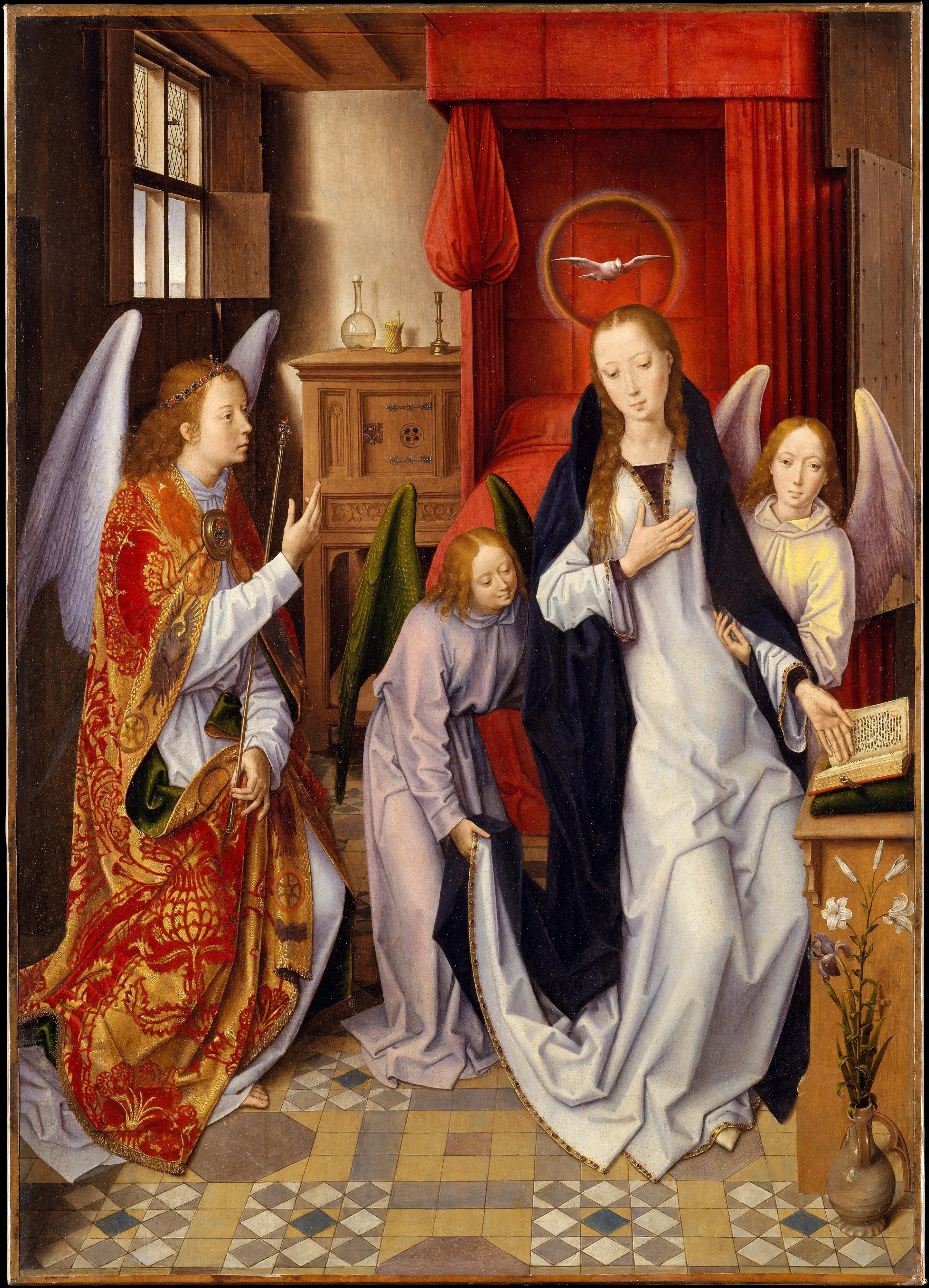
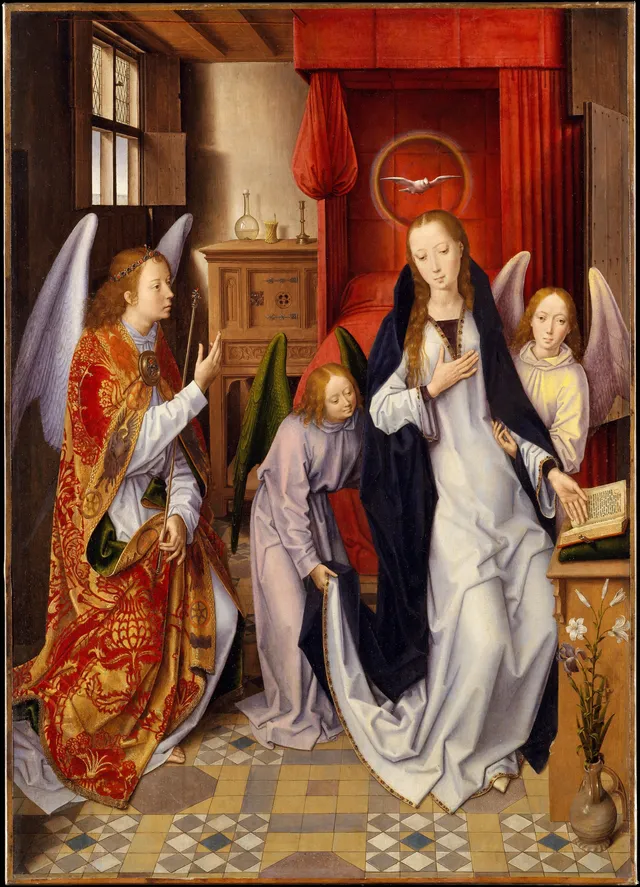
Look closely at the Annunciation. Memling sets the angel and the Virgin not in a gold void but in a Flemish bedchamber, the kind of room his Bruges clients lived in. White lilies stand in a vessel on the floor, the stems splaying just slightly so the flowers catch the light from the left. On the back wall hangs a brass laver with a clean white towel beside it, the everyday object that doubles as a sign of Mary's purity. A canopied bed waits along one side, its hangings a deep warm red that anchors the whole cool scheme. Daylight comes through a window glazed with round bottle-glass panes, and Memling paints the glass as glass, with the slight distortion and the bloom of light where the sun strikes the lead.
Now notice what the handling does. Gabriel's cope is a heavy brocade, and Memling renders the gold thread not with a single yellow but with a base colour modelled in shadow and then licked with fine highlights so the fabric reads as woven metal catching a north light. The floor tiles recede in a measured, ruled perspective, and the objects sit on them with quiet weight. There is no wind in this room. The folds of the Virgin's blue robe fall in long, settled verticals rather than the crumpled cascades Rogier loved. That is the choice. Rogier would have given the cloth a nervous energy; Memling lets it hang. The interpretation follows from the description. He has taken the most charged moment in the Christian story, the instant a young woman is told her life is no longer her own, and he has staged it as a scene of perfect equilibrium. The drama is held entirely in the stillness, which only the technique makes possible.
Oil as a slow machine
The glow in these panels is an optical effect with a recipe. Memling worked on oak prepared with a smooth white chalk ground, and that white is doing work the whole time. Oil paint, unlike tempera, can be laid in translucent films, and Memling built his colours as stacks of thin glazes over the bright ground. Light passes through the upper layers, strikes the white, and comes back to the eye coloured. The flesh of a face is not one mixed pink. It is a pale modelled underlayer with successive transparent passes of warm and cool laid over it, so the skin seems lit from within rather than coated on the outside.
The palette is built around a few costly, well-behaved pigments. Lead white for the body and the highlights, because it is opaque and dries hard. Azurite and the expensive ultramarine for the blues. Red and yellow lakes, transparent by nature, for the glazing reds and the gold. Vermilion for a hot accent. The lakes are the secret of the depth, since a glaze of lake over an opaque underpaint gives a saturation no single mixed tone can reach. Drying is slow, and slowness is the point. Each layer has to set before the next goes down, which is why a Memling surface looks unhurried: it was made that way over weeks, not improvised in a session. The method rewards patience and punishes bravura, and Memling had no interest in bravura.
This is also where the famous detail comes from. With a fine brush and a slow medium you can paint a single hair, the rim of an eyelid, the grain on a wooden sill, the far hills dissolving into a blue distance behind a window. Memling's landscapes, glimpsed through openings behind his sitters, are tiny and exact, and they recede through atmospheric blueing that the glazing technique makes natural rather than laborious. The eye is invited to travel from a jewel an inch wide to a river a hundred miles deep, all on one panel.
Works discussed in this article
The portrait as a product
Memling effectively standardized the independent portrait for a clientele of foreign merchants resident in Bruges. The format he settled on is a small panel, the sitter turned three-quarters, hands sometimes resting on a painted parapet at the bottom edge, and behind the head an open sky or a sliver of landscape rather than a flat dark ground. The National Gallery of Art dates his Portrait of a Man with an Arrow to about 1470 to 1475, and it shows the type already fully formed. Placing a real outdoor distance behind a sitter was Memling's contribution to the genre, and it gives even a sober merchant's likeness a breath of air the earlier dark-ground portrait lacked.
His clients were international, and the portraits travelled. The Metropolitan Museum's essay on private life in the Burgundian Netherlands attributes the paired likenesses of the Florentine banker Tommaso Portinari and his wife Maria to Memling, with Maria's portrait probably commissioned around the time of the couple's wedding (The Met). A Florentine in Bruges, sitting to a German painter, sending his face home to Italy: that is the trade Memling served, and it explains the cool legibility of his portrait style. A face built to read clearly across a continent cannot afford eccentricity.
The Young Woman with a Pink shows the method at portrait scale. The woman holds a single carnation, the pink of the title, between two fingers, an emblem of betrothal handled with the lightest possible touch. Her headdress is a translucent veil, and Memling paints the gauze as a film you can see the hair through, the cloth dissolving at its edges into the skin beneath. The modelling of the face is built up in the slow glazes already described, so the cheek turns from light to shadow without a visible seam. There is no flourish anywhere. The hands are placed exactly, the eyes are level, the whole likeness is finished to the same even pitch from the brow to the lace, which is precisely the consistency a paying sitter wanted to see.
Saint Veronica and the economy of the face
The Saint Veronica is a small, frontal devotional panel, and it concentrates everything the method does. Veronica holds out the cloth that took the imprint of Christ's face, and Memling paints two kinds of likeness on one surface: the living saint, modelled in his slow warm glazes, and the imprinted face, paler and flatter, deliberately rendered as an image of an image. The contrast is a quiet piece of theological wit done entirely through paint. Behind her a Memling landscape opens out, the river winding back to soft blue hills, painted at miniature scale with the same control he brought to a yard-high altarpiece.
Set this beside the two panels in our archive that both carry the plain title Virgin and Child, and the workshop logic comes into view. The same maternal type recurs, the same downcast composure, varied in setting and accessory but built from a shared template. That is not a failure of invention. It is the business model. A second Virgin and Child variant, and the more elaborate Virgin and Child with Saints Catherine of Alexandria and Barbara, show the master pattern scaled up and down for different purses, from a private devotional panel to a saints' sacra conversazione with a mystic marriage at its centre.
The scale of that recurrence is something a single museum visit hides. Artifact World Gallery's archive gathers 77 works under Memling's name, spread across 29 separate institutions, with catalogue dates clustering across roughly 1400 to 1494. Smarthistory gives his own lifespan as about 1430 to 1494, so the wider span in our records is the gravitational pull of a famous workshop hand, drawing in earlier panels by his teachers and later versions by his shop and followers. Twenty-nine venues for one painter is the real measure of the export trade he served. The pictures did not stay in Bruges; they dispersed across Europe and then across the modern museum world, which is exactly what a standardized, reliably excellent product does over five centuries.
The shrine, the copy, and the long afterlife
Memling's most ambitious surviving object is not a panel at all but a painted reliquary, the Shrine of Saint Ursula made for the Hospital of Saint John in Bruges, where it still stands. The Getty holds a nineteenth-century reproduction of his scene of the arrival of Saint Ursula from that shrine, captioned as painted by Memling on the châsse kept at the Hôpital Saint-Jean (Getty). The shrine is a gabled wooden casket whose sides Memling treated as a row of small panels, each a complete town-and-river composition, so the method scales sideways from the single picture to a narrative cycle wrapped around a box. The discipline that lets a face be repeated also lets a city skyline be repeated, varied just enough that no two faces of the casket look alike.
Reproduction kept following him. A style designed for clean repetition turns out to reproduce well in other media and in other hands, and that is the deep continuity of his career. McFarlane's monograph, freely readable on the Internet Archive, is in large part a study of exactly this consistency, the sign of a manner stable enough to be transmitted from the master's brush to an assistant's and onward (Internet Archive). The optical clarity that let a merchant's face read across a continent in 1480 also let it carry, centuries later, into engraved copies made for a wider public, because the information in a Memling is laid down so legibly. The same logic runs through the devotional work. The maternal type of the Virgin and Child travels from one commission to the next without losing its grade, and even the cloth in the Saint Veronica, in its quiet way, is a picture about faithful copying.
Critics in the modern period have sometimes held the very thing this essay has been tracing against him. Where Rogier wrenches and Jan van Eyck dazzles, Memling can be charged with sweetness, with a calm so reliable it tips toward the bland. The charge mistakes the achievement. He chose the calm, engineered it through underdrawing, ground, and glaze, and delivered it at a grade that almost no one could match. To want him to be more turbulent is to want a different painter. The right way to look at a Memling is to watch the technique hold an emotion perfectly still, and then to notice that the stillness is the emotion. Stand close to the bottle-glass window in the Annunciation and you are looking at the moment a method becomes a feeling: the light that took weeks of patient layering to build now falls, in an instant, across a room where everything has agreed to be quiet.
Sources & further reading
- Hans Memling — Wikipedia
- Hans Memling — Smarthistory
- Portrait of a Man with an Arrow, about 1470/1475 — National Gallery of Art
- The Burgundian Netherlands: Private Life — The Metropolitan Museum of Art
- Arrival of Saint Ursula, after the Shrine at the Hôpital Saint-Jean, Bruges — The J. Paul Getty Museum
- Hans Memling (K. B. McFarlane, Clarendon Press, 1971) — Internet Archive