Artwork
Annunciation
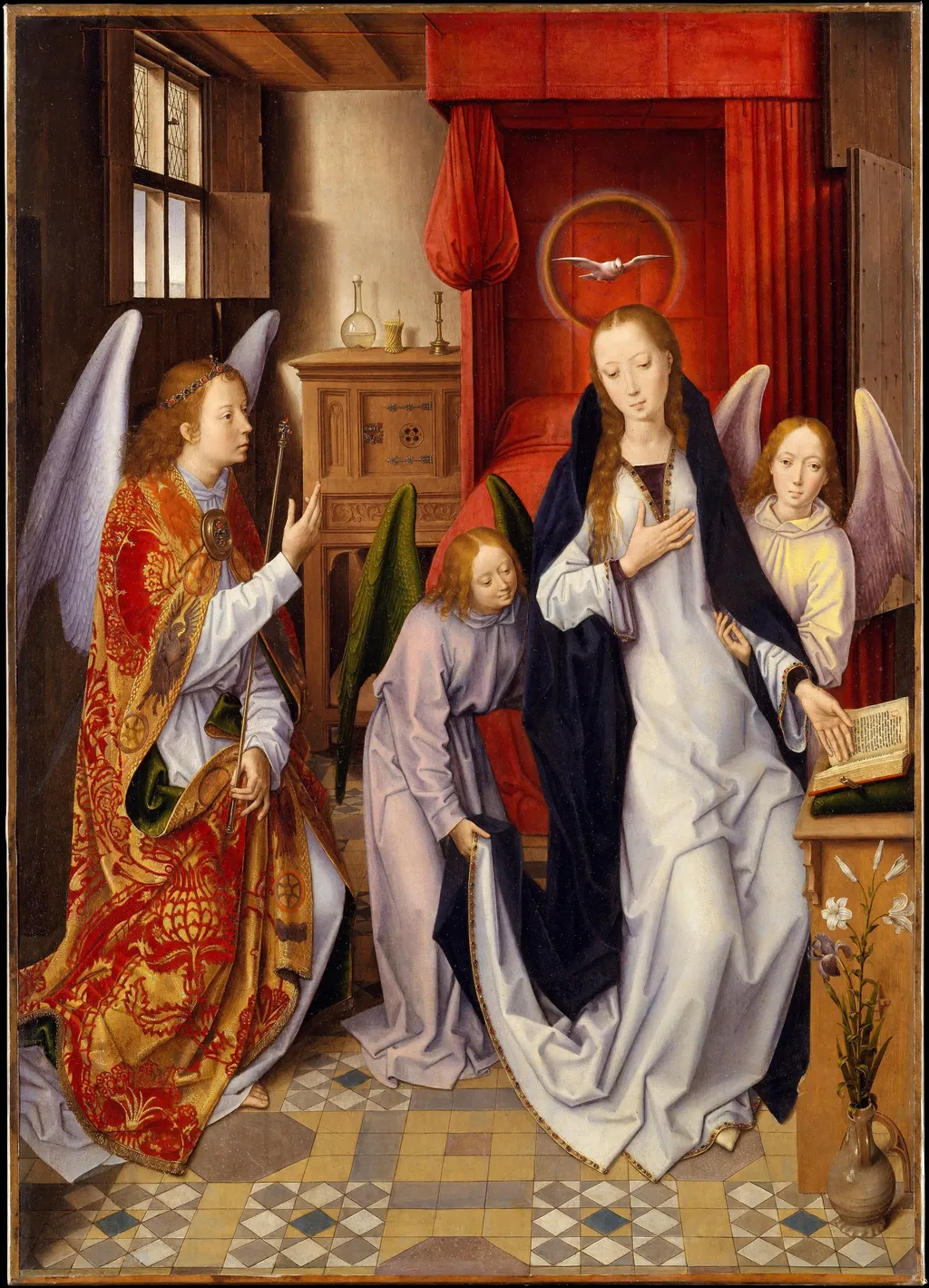
Annunciation is an oil painting by the Northern Renaissance artist Hans Memling. It dates from 1490 and is held in the collection of the Metropolitan Museum of Art.
About this work
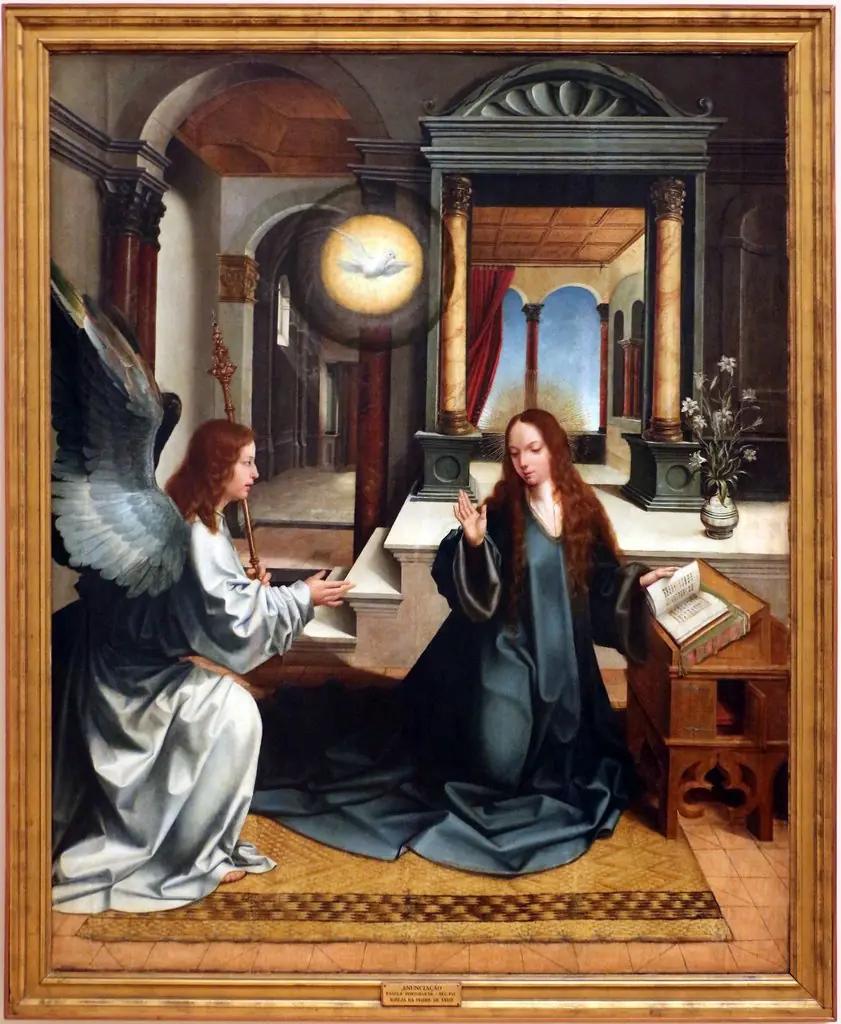
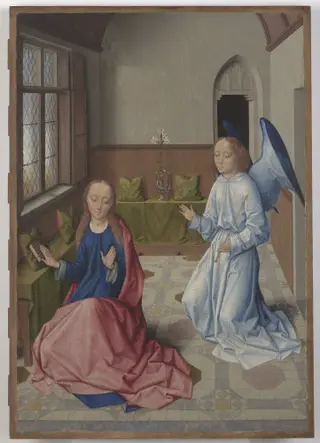
In a richly furnished bedchamber the Virgin Mary swoons as the archangel Gabriel announces she will bear the Son of God, two angels catching her from behind. Hans Memling painted this Annunciation in Bruges around 1480 to 1489, recasting Rogier van der Weyden's kneeling Virgin as a woman overcome by the Incarnation. A dove enters through a closed window, a sign the Word is already made flesh.
Subject & Meaning
The bedchamber setting and red curtain evoke the Incarnation and divine marriage, while the dove of the Holy Spirit hovers above in a rainbow-hued circle.
The painting depicts the Annunciation, the biblical moment when the archangel Gabriel informs the Virgin Mary that she will conceive Jesus, as described in the Gospel of Luke. Its iconography centers on Mary's purity, symbolized by the lily and carafe of clear water, while the empty candlestick alludes to her becoming the bearer of Christ, the light of the world. Mary's swooning posture, interpreted as a birthing position, foreshadows the Crucifixion and emphasizes her role as Theotokos, the God-bearer.
The bedchamber setting and red curtain evoke the Incarnation and divine marriage, while the dove of the Holy Spirit hovers above in a rainbow-hued circle. Attendant angels, one lifting Mary's robe and one engaging the viewer, reinforce the sacred mystery. The composition expands van der Weyden's Saint Columba Altarpiece.
Technique & Style
The Annunciation is executed in oil on an oak panel (76.5 × 54.6 cm), later transferred to canvas in the early 20th century. The work belongs to the Early Netherlandish tradition and displays a highly naturalistic treatment, with meticulous handling of textures, fabrics, and symbolic objects such as the lily and water carafe. Memling employs a glowing, soft light that imbues the scene with a sacred atmosphere while grounding it in a contemporary domestic interior.
The composition is notably innovative: the Virgin is shown swooning, supported by two attendant angels, diverging from conventional kneeling or seated poses. The panel suffered damage from an arrow before the 19th century and underwent restoration after its 1902 exhibition and again following its 1920 acquisition by Philip Lehman.
History & Provenance
Hans Memling's Annunciation was executed in the 1480s, with the original frame, recorded until the 19th century, inscribed with a date typically read as 1482 but possibly 1489. Originally painted on an oak panel, it was transferred to canvas after 1928. The first documented owners were the Radziwiłł family, who may have possessed it since the 16th century; Antoni Radziwiłł rediscovered it on a family estate in the early 19th century, damaged by an arrow.
The painting descended through Prince Michael, Prince Anton, Prince Wilhelm, and Prince Georg Radziwiłł, and then to Marie Branicka Radziwiłł. Philip Lehman acquired it from her via Duveen Brothers in October 1920. It was exhibited at the 1902 Exposition des primitifs flamands à Bruges, after which it was cleaned and restored.
Since 1975 it has been in the Robert Lehman Collection at the Metropolitan Museum of Art, New York.
The painting is held in the Robert Lehman Collection at the Metropolitan Museum of Art, New York, where it entered in 1975 as part of the Lehman bequest. Its exhibition history includes the 1902 Exposition des primitifs flamands à Bruges, after which it was cleaned and restored. Philip Lehman acquired the work in 1920 from the Radziwiłł family, in whose collection it had been since the early 19th century.
Context
Art historian Gustav Friedrich Waagen described the panel in 1847 as one of Memling's 'finest and most original works,' and Maryan Ainsworth later called it a 'startlingly original image, rich in connotations.' Dating to the 1480s (possibly 1482 or 1489), the painting expands upon Rogier van der Weyden's Saint Columba Altarpiece, yet Memling innovated by showing the Virgin swooning, supported by two attendant angels. Its importance was recognized when it was exhibited at the Exposition des primitifs flamands à Bruges in 1902, after which it underwent restoration.
Acquired by Philip Lehman in 1920 from the Radziwiłł family, it entered the Metropolitan Museum of Art's Robert Lehman collection. The work is considered a masterful example of Early Netherlandish painting, blending domestic naturalism with complex Marian iconography, and it has been the subject of extensive theological and formal analysis by scholars including Blum, Jolly, and Ainsworth.
Legacy
Since the 19th century, Memling's Annunciation has been celebrated as a masterwork. In 1847, art historian Gustav Friedrich Waagen called it one of the artist's "finest and most original works." Its inclusion in the landmark 1902 Exposition des primitifs flamands à Bruges brought wider scholarly attention.
Acquired by Philip Lehman in 1920 and now housed in the Metropolitan Museum of Art's Robert Lehman collection, the painting remains a highlight of the museum. Modern scholars such as Maryan Ainsworth have praised it as a "startlingly original image, rich in connotations." The work's innovative depiction of the swooning Virgin continues to generate art-historical analysis, solidifying its legacy as a seminal piece of Early Netherlandish painting.
Overview
Hans Memling's Annunciation is an oil painting from the late 15th century, depicting the biblical moment when the archangel Gabriel informs the Virgin Mary of her divine conception. Originally an oak panel, the work was later transferred to canvas. This Early Netherlandish painting is now housed in the Robert Lehman Collection at the Metropolitan Museum of Art in New York, offering a detailed portrayal of a pivotal Christian narrative within a domestic setting.
Own this work as a print
Artist & collection
Artist
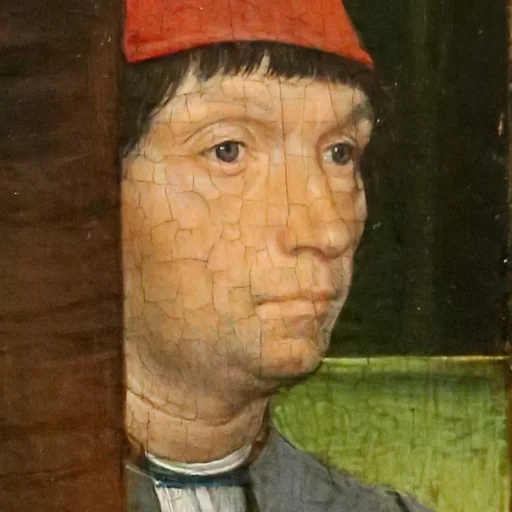
Hans Memling was a German-Flemish painter who worked in the tradition of Early Netherlandish painting.

![Saint Veronica [obverse], by Hans Memling](https://artifactworldgallery.com/img/hans-memling--saint-veronica-obverse--5a649fd8b09c96b9-w320.webp)