Artwork
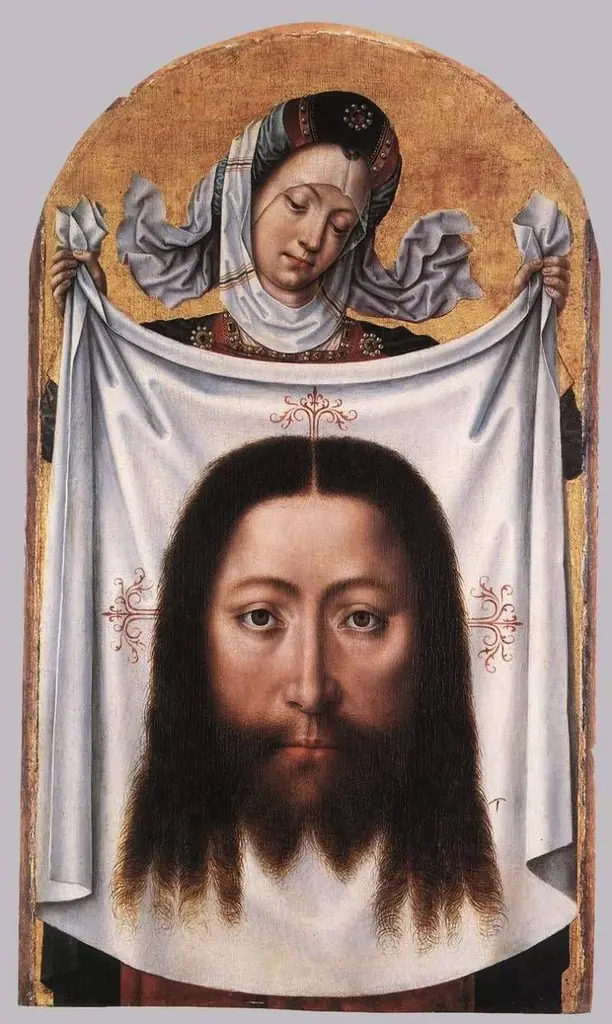
Saint Veronica [obverse]
![Saint Veronica [obverse], by Hans Memling, oil, 1472](https://artifactworldgallery.com/img/hans-memling--saint-veronica-obverse--5a649fd8b09c96b9-w1024.webp)
Saint Veronica [obverse] is an oil painting by the Northern Renaissance artist Hans Memling. It dates from 1472 and is held in the collection of the National Gallery of Art.
About this work
Subject & Meaning
As a central icon of Christian devotion, the veil represents the true likeness of Jesus, supposedly imprinted when Veronica wiped his brow during the Passion.
Created by Hans Memling around 1470, this religious panel depicts Saint Veronica presenting the Veil of Veronica. The composition focuses entirely on the saint holding up the cloth, which bears the miraculous image of Christ's face. As a central icon of Christian devotion, the veil represents the true likeness of Jesus, supposedly imprinted when Veronica wiped his brow during the Passion.
The work functions as a devotional object, inviting contemplation of the suffering of Christ through the tangible relic held by the saint. By isolating the figure and the sacred textile, the painting emphasizes the spiritual significance of the Vera Icon, or 'true image,' serving as a focal point for prayer and meditation on the divine presence captured within the fabric.
Technique & Style
The work is executed in oil on a wooden panel, a medium and support typical of Hans Memling’s oeuvre. Classified as an Early Netherlandish painting, it displays the meticulous technique and luminous coloration associated with that movement. Measuring 31.2 cm in height and 24.4 cm in width, the small devotional panel presents Saint Veronica holding the Veil of Veronica in a finely detailed, religious genre scene. The painting depicts Saint Veronica presenting the Veil of Veronica, a subject drawn from Christian tradition.
History & Provenance
The Saint Veronica [obverse] was painted by Hans Memling around 1470. Its earliest documented ownership traces to Bernardo Bembo, a Venetian humanist and diplomat, likely acquired during his tenure in Venice or Verona (d. 1519). Upon his death, the panel probably passed to his son, Cardinal Pietro Bembo (1470–1547), as suggested by Marcantonio Michiel’s 16th-century notes and a 1502 letter linking the Bembo family to similar works.
By the early 19th century, it entered the collection of Prince Nicolai Nikitich Demidov (1773–1828) near Florence, then descended to his son, Anatoly Demidov, whose 1870 Paris sale listed it as no. 204. The work resurfaced in a private Italian collection until c. 1928, after which it passed through Berlin dealers Matthiesen Gallery and Paul Cassirer. Baron Heinrich Thyssen-Bornemisza acquired it by 1930, consigning it to Knoedler & Co. in 1950.
The Samuel H. Kress Foundation purchased the panel in 1951, gifting it to the National Gallery of Art the following year.
Currently held by the National Gallery of Art in Washington, D.C., this panel entered the institution in 1952 as a gift by exchange from the Samuel H. Kress Foundation. The Foundation had acquired the work in 1951 following its consignment with M. Knoedler & Co. in New York. Prior to American ownership, the painting belonged to Baron Heinrich Thyssen-Bornemisza, residing at Schloss Rohoncz and later Villa Favorita by 1930.
Its earlier provenance includes the Demidov family collection near Florence; it was sold at auction in Paris on March 3, 1870, as lot 204. While specific exhibition records are not detailed in the available texts, the work's movement from private Italian hands through German dealers to the Thyssen collection and finally the Kress Foundation establishes its modern trajectory.
Legacy
After remaining in aristocratic hands, first with the Venetian Bembo family and later the Demidov princes, the panel entered the international art market in the late nineteenth century and was acquired by Baron Heinrich Thyssen‑Bornemisza before passing to the Samuel H. Kress Foundation in 1951. The Kress gift to the National Gallery of Art in 1952 secured its place in a major public collection, where it is displayed as a key example of Hans Memling’s Early Netherlandish religious painting and continues to contribute to the gallery’s representation of fifteenth‑century Netherlandish art.
Overview
This oil on panel painting, titled Saint Veronica, depicts the revered figure holding the sudarium, a veil bearing the miraculous image of Christ's face. Executed in a traditional manner, the artwork features a restrained background, allowing the viewer's focus to remain on the central narrative. Its creation during a period of evolving artistic practices highlights a deliberate adherence to established pictorial conventions.
Own this work as a print
Artist & collection

Artist
Hans Memling was a German-Flemish painter who worked in the tradition of Early Netherlandish painting.