The pictures their first viewers already knew how to read
The standard complaint about Auguste Renoir's paintings is that they are too easy: pretty women, dappled light, a Sunday mood with nothing underneath it. That complaint mistakes legibility for emptiness. To the Parisians who first stood in front of these canvases in the 1870s and early 1880s, Renoir's subjects were not generic prettiness. They were a precise social inventory. A girl in a tutu, a crew of oarsmen on the Seine, a publisher's wife with her children arranged on a sofa, a waitress holding a tray in a cheap fixed-price restaurant: each of these was a recognizable type, fixed to a recognizable place in a city that was rebuilding its class lines in public. The argument of this essay is simple. Renoir's iconography is a map of modern Parisian leisure and labor, and his first audience read that map fluently, decoding rank, money, and respectability in pictures we now wave away as charming.
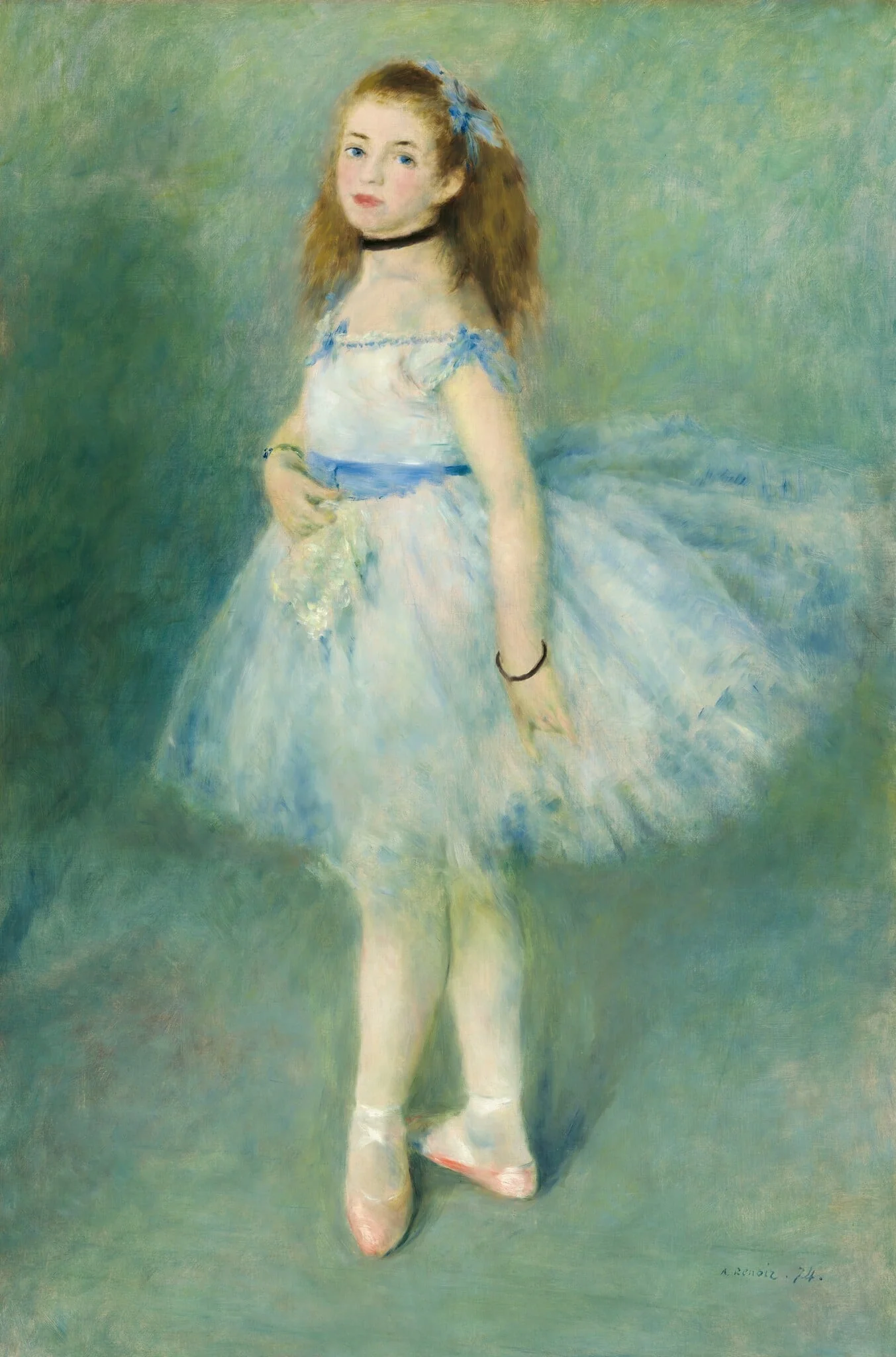
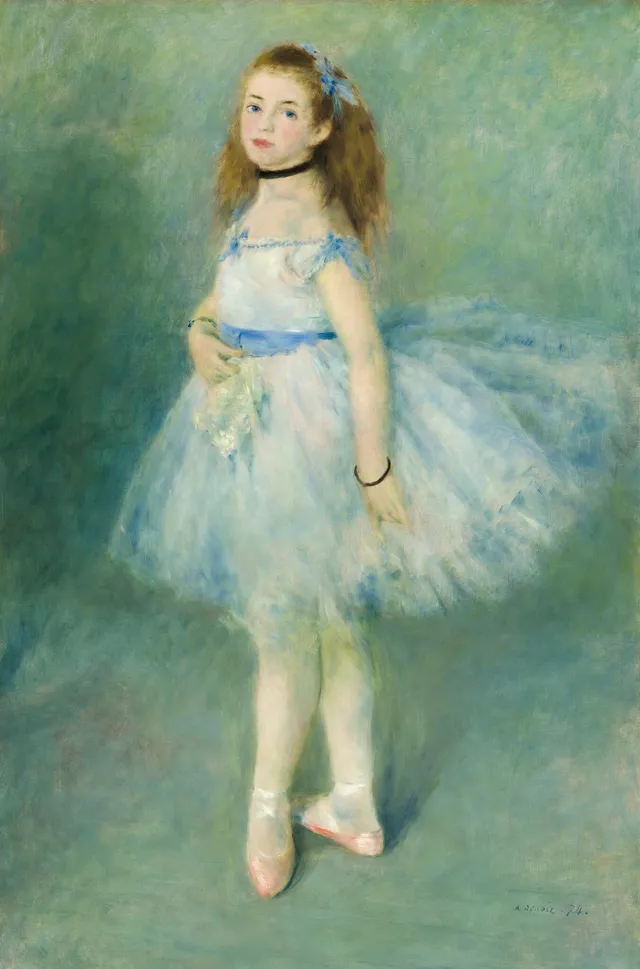
Hold that thesis against the painting the archive calls The Dancer. A ballet girl in late nineteenth-century Paris was not an emblem of grace alone. She was a working adolescent, usually from a poor family, performing for an audience of subscribers who came partly to look at the corps the way one looks at merchandise. Renoir paints her without the cynicism Degas brought to the same subject, but the social fact is still in the picture for anyone who wanted to see it. That is the method I want to follow here, work by work: ask what the figure would have meant to the people who first owned, exhibited, and reviewed it, then watch how Renoir's handling either confirms or quietly softens that meaning. Renoir was born in Limoges on 25 February 1841 (Wikipedia), trained as a porcelain painter, and carried that decorator's instinct for surface charm into pictures that were, underneath, about who belonged where.
1874, and the audience Renoir was painting for
The frame around all of this is the breakaway exhibition of April 1874, when Renoir joined Monet, Sisley, Pissarro, and others to show outside the official Salon. Renoir hung six paintings in that first show (Wikipedia). The word that stuck to the group, Impressionism, started as an insult lobbed at Monet's Impression, Sunrise and was then worn as a badge (Tate). What matters for iconography is who was in the room. These were not aristocratic history paintings made for a state jury. They were scenes of the new bourgeois and lower-bourgeois city, shown to dealers, critics, and collectors who lived in that same city and recognized its codes. Renoir stopped exhibiting with the Impressionist group after 1877 and later moved toward a more monumental, classically grounded manner that would matter to Picasso (The Metropolitan Museum of Art). The works at the heart of this essay come from the years before and around that break, when his subject was Parisian leisure observed at close social range.
It helps to know how much of this output survives and circulates. Artifact World Gallery holds 356 works attributed to Renoir, spread across 40 separate venues, with catalogued dates clustering through the decades of his long career. That spread is itself a piece of evidence. A painter whose pictures sit in forty institutions was, even in his lifetime, the Impressionist whose imagery traveled best into bourgeois drawing rooms and then into public collections. The very thing that makes him suspect to modernist purists, the easy pleasure, is what carried his iconography of leisure out into the world at scale.
The dancer: pleasure with the labor left visible
Stand close to The Dancer and notice how little theatrical drama Renoir allows. A young woman in a pale blue-white tutu stands almost frontally, weight settled onto both feet, arms hanging loose, slippers pointed but unmoving. There is no leap, no arabesque, no glimpse of stage flat or footlight. Her skirt is built from dry, feathered strokes that catch the light and break apart at the hem, so the tulle seems to fizz against the warm neutral ground behind her. Renoir finishes the face and the hair ribbon more tightly than anything else, and that contrast does the work: our eye is pulled away from the shimmer of the costume toward an expression that is young, a little unsure, caught between poses rather than performing one.
A viewer in 1874 supplied the rest. The ballet of the Opéra was a recruiting ground watched by wealthy male subscribers, and the dancers were overwhelmingly girls of slender means whose families counted on the wage. Degas made that transaction explicit, putting top-hatted men in the wings. Renoir does the opposite. He isolates the girl, gives her a moment of rest rather than display, and lets the brushwork flatter her. The result reads as tenderness, and it is, but the tenderness is a choice made against a subject everyone understood to be exploitative. The picture means more, not less, once you see what Renoir declined to paint.
Oarsmen and waitresses: the geography of who plays and who serves
Move to the river and the social map sharpens. Oarsmen at Chatou belongs to the world of the Seine resorts west of Paris, the same world that produced Renoir's larger boating pictures of 1880 and 1881. Chatou and nearby Bougival were where clerks, shopgirls, and young professionals went on Sundays to row, drink, and flirt away from the supervision of the city. Rowing itself was a marker. It meant leisure time, a fit body, and enough money for the train fare and the boat hire, but it was emphatically not aristocratic recreation. It was the play of a rising salaried class inventing its own forms of pleasure. Renoir's bright, broken touch suits that subject because it refuses solemnity. The water is laid in with quick diagonal strokes, the figures lean into their work, and the whole scene tips slightly toward the viewer as if we were sharing the bank.
This is the milieu of his most ambitious statement of the type, the Luncheon of the Boating Party of 1880 to 1881, painted about seven years after the first Impressionist show (Smarthistory). In that canvas the cast is a deliberate cross-section: a seamstress, a journalist, an actress, a wealthy patron, all mingling on the same terrace. The Chatou oarsmen are a study in the same sociology, compressed to the rowers themselves. To read the picture as Renoir's first audience did, you have to feel the mild transgression in it, classes loosening on a riverbank that the city's respectable households would have eyed with suspicion.
Then turn the type inside out. A Waitress at Duval's Restaurant shows the labor that the leisure scenes depend on. The Duval chain sold cheap fixed-price meals to ordinary Parisians, and its waitresses, in their plain dark dresses and white aprons, were a familiar sight to anyone who ate out without money to spare. Renoir paints her standing, attentive, caught in the posture of service rather than rest. Set this beside the dancer and the oarsmen and the argument of the whole body of work comes into focus. The same brush that flatters the girl at the Opéra and the rowers at Chatou here records a working woman on her feet. Renoir's iconography covers both sides of the leisure economy, the people who are served and the people who serve, and his first viewers slotted each figure into the city they walked through every day.
The portrait as social contract
Renoir's portraits of the bourgeoisie are where his iconography does its most consequential work, because there the meaning was transactional. Madame Georges Charpentier and her Children was a commission from the wife of the powerful publisher Georges Charpentier, whose salon gathered the writers and politicians of the Third Republic. The picture is a statement of arrival. Madame Charpentier sits in a fashionable Japonisme interior, her two small children beside her, one of them perched on the family dog. Every object in the room carries class information: the imported screen, the patterned upholstery, the children dressed alike in a way that announces a household with the means and the taste to do so. Renoir's first viewers did not need a caption to understand that this was new money presenting itself as cultivated. The painting's warm, enveloping touch is part of the message, softening a display of status into something that looks like intimate family life.
The portrait earned its keep. Madame Charpentier's connections helped it hang well at the official Salon, and the success it brought Renoir is exactly the point. Commissioned portraiture was how an Impressionist paid rent, and the iconography of comfortable domesticity was the product the market wanted. A related case is The Daughters of Catulle Mendès, three girls of a literary family shown together, music and gentility implied in their poise and dress. To the Mendès circle the picture functioned as a declaration of the family's cultured standing. To us it can look like another lovely Renoir group of children. It was both at once, and the first meaning was the one that paid.
This is the right place to weigh Renoir against his contemporaries, because the portrait of modern life was contested ground. Édouard Manet painted the same Parisian types with a cooler, more confrontational edge, leaving the social tension exposed where Renoir smoothed it. Across the Atlantic, Winslow Homer built an American iconography of work and weather that owes nothing to the Paris salon at all. The sculptor Auguste Rodin pushed the modern body toward raw psychological force, the opposite of Renoir's ease. Set against them, Renoir's distinctive contribution is clear. He took the most legible, marketable face of modern leisure and made its social codes go down sweetly. That was a deliberate position, not a failure of nerve.
Works discussed in this article
Pont Neuf: the city as the real subject
Behind every one of these figures sits the rebuilt city itself, and Renoir painted that too. Pont Neuf, Paris is an early view of one of the oldest bridges in Paris seen on an ordinary, sunlit day, with carriages and pedestrians scattered across the span and the embankments. The interest of the picture is not the monument but the traffic, the way the bridge is a stage for the small movements of citizens going about their business. Renoir worked the figures as quick notations, dabs of dark and light that read as a top hat here, a parasol there, the everyday crowd of a working capital. The Paris of Haussmann's wide new streets was a spectacle its inhabitants performed for one another, and a bridge full of strollers was that spectacle in miniature. The first viewers of this canvas were looking at their own daily theater, the public stage on which all the other Renoir types appeared.
The same instinct shapes his most famous crowd scene, the Bal du moulin de la Galette of 1876, now in the Musée d'Orsay (Smarthistory). That open-air dance hall in Montmartre drew young workers and artists on Sunday afternoons, and Renoir filled the canvas with dappled light falling on faces his audience could place by dress and manner. Pont Neuf and the Moulin de la Galette frame the whole project. One is the public street, the other the public dance floor, and between them stand the dancers, oarsmen, waitresses, and bourgeois families who give the city its cast of characters.
What we lose when we call it pretty
Renoir's later career complicates the picture, and honesty requires saying so. After 1881 he grew dissatisfied with Impressionist looseness and reached back toward the firm contours of Raphael and Ingres, producing the large bathers and nudes that lifted his women out of any datable Paris and into a timeless register. That turn is the opposite of the work examined here. The bathers shed iconography on purpose, trading the dancer's tutu and the waitress's apron for an idealized body with no social address. Some of his finest single figures sit between the two modes, such as the well-loved A Girl with a Watering Can of 1876, later given to the National Gallery of Art (National Gallery of Art), where a child in a garden is still rooted in a real bourgeois world even as Renoir starts to generalize her into pure charm.
What we lose by treating all of Renoir as decoration is the historical intelligence of the earlier work. The dancer is a wage earner, the oarsmen are a new class at play, the waitress is the labor under the leisure, the Charpentier portrait is money buying cultivation, and Pont Neuf is the stage they all walk across. None of this required explanation in 1876. It required eyes that lived in the same city. Recovering those eyes is the whole task, and it changes what the pictures are worth looking at for. The pleasure is real. The pleasure is also a record.
Renoir sits at one end of a wide nineteenth-century argument about what a picture of modern people should reveal and what it should withhold. Paula Modersohn-Becker would soon paint peasant women and mothers with a gravity that refuses all flattery, and a printmaker like Félicien Rops pushed the iconography of modern desire into open provocation. Renoir chose charm, and chose it knowingly, as the surface under which a whole social order could be observed without alarming the people who bought the canvas. The next time his work looks merely easy, count the codes in it. His first viewers did.
Sources & further reading
- Pierre-Auguste Renoir — Wikipedia
- Auguste Renoir (1841-1919) — The Metropolitan Museum of Art
- Renoir, Bal du moulin de la Galette — Smarthistory
- Renoir, Luncheon of the Boating Party — Smarthistory
- Impressionism (art term) — Tate
- A Girl with a Watering Can (1876) — National Gallery of Art
- Renoir, an Intimate Record (1925) — Internet Archive (Ambroise Vollard, A. A. Knopf)
- The Promenade (1870) — The J. Paul Getty Museum