Artwork
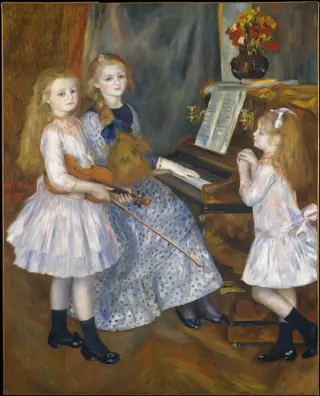
Madame Georges Charpentier and her Children
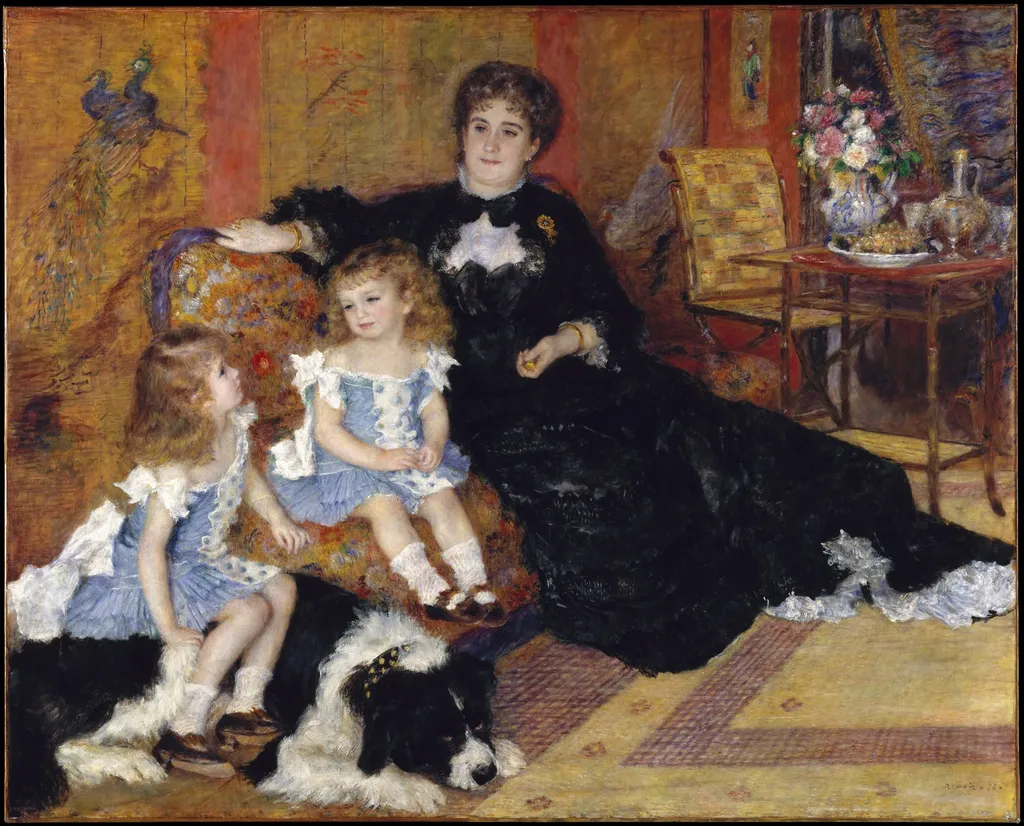
Madame Georges Charpentier and her Children is an oil painting by the Impressionist artist Pierre-Auguste Renoir. It dates from 1890 and is held in the collection of the Metropolitan Museum of Art.
About this work
Subject & Meaning
The painting served to re-establish Renoir’s reputation at the Salon of 1879, symbolizing his shift toward a more refined, fashionable audience.
The painting depicts Marguerite Charpentier, a prominent salonnière and patron of the Impressionists, with her children Georgette and Paul in the private boudoir of their home. The luxurious setting, with Japanese decor and the children’s matching blue dresses, signals their wealth and status. The composition is notably arranged to evoke religious painting, with the Newfoundland dog replacing the lamb, adding quasi-sacred overtones to the family scene.
The black-and-white contrast of Madame Charpentier’s Worth gown is echoed in the dog’s fur, visually unifying the group. Renoir’s portrayal balances intimacy and social formality, emphasizing the sitter’s role as both mother and hostess. The painting served to re-establish Renoir’s reputation at the Salon of 1879, symbolizing his shift toward a more refined, fashionable audience.
Technique & Style
Renoir executed the work in oil on canvas, using a refined, polished handling that emphasizes the luxurious textures of fabrics and the soft diffusion of light throughout the interior. The composition is notably formal and symmetrical, with a structure reminiscent of religious painting (often compared to Rubens), the dog substituting for a lamb. Background details, including the fashionable Japanese decorative elements, are painted slightly out of focus, directing attention to the figures.
Renoir’s characteristic rounded, idealized forms and pretty faces define mother and children. The black silk dress and the white fur of the Newfoundland create a striking tonal contrast, while the matching blue attire of the two children unifies the group. The painting is signed and dated 'Renoir 78' in the lower right.
History & Provenance
Commissioned by publisher Georges Charpentier, the painting was created by Pierre-Auguste Renoir between September and October 1878, as indicated by its signature and date, 'Renoir 78'. The commission followed earlier, successful portraits of Charpentier's daughter Georgette and a bust of Madame Charpentier. Renoir was paid 1,000 francs (some sources state 1,500 francs) for the work.
After the deaths of Marguerite Charpentier in 1904 and Georges in 1905, their heirs put the painting up for sale in April 1907. It was acquired by art dealer Paul Durand-Ruel on behalf of the Metropolitan Museum of Art for 84,000 francs, entering the museum's collection that same year.
The painting is held by the Metropolitan Museum of Art in New York–6). No accession or inventory number is provided in the available sources. Its exhibition history includes the Salon of 1879 (no. 2527), the Salon des XX in Brussels in 1886, an exhibition at the Galerie Georges Petit in Paris in 1886 (no. 124), Renoir retrospectives in 1892 and 1900 (no. 17), and again in Brussels in 1904 (no. 129).
Context
The painting marked a pivotal moment in Renoir's career, as he abandoned the Impressionist exhibitions for the official Salon of 1879, where it achieved notable success. Camille Pissarro observed that Renoir had finally “broken through” with this work. Critic Léonce Bénédite later hailed it as one of Renoir's finest works and lamented its departure from France.
Art historians have noted that the composition echoes religious painting (with the dog substituting for a lamb) and places Renoir in the tradition of Rubens and Fragonard. The portrait also presaged Renoir's break with Impressionism, signaling a shift toward a more polished, traditional style. Kathleen Adler has highlighted how Renoir's female portraits often situate subjects within markers of wealth and status, a strategy evident in the luxurious interior and fashionable attire. The work has been studied as a turning point in Renoir's artistic trajectory.
Legacy
Exhibited at the Salon of 1879, the painting was a critical and popular success; Camille Pissarro wrote that Renoir “has a great success at the Salon” and predicted the work would launch his career. Its favorable reception at the Salon led to new portrait commissions for Renoir. Art historian Léonce Bénédite later described it as one of Renoir’s best works, regretting that it ever left France.
The painting is also seen as presaging Renoir’s shift away from pure Impressionism. After the deaths of its subjects, the work was purchased by the Metropolitan Museum of Art in 1907 for 84,000 francs through dealer Paul Durand-Ruel, and has remained a key piece in the museum’s collection, influencing the reception of Renoir’s portraiture in America.
Overview
Pierre-Auguste Renoir's 1878 oil on canvas, "Madame Georges Charpentier and her Children," captures an intimate domestic scene. The painting features Marguerite Charpentier, a prominent Parisian salon hostess and art collector, alongside her young daughter Georgette and son Paul. This significant work is now part of the collection at the Metropolitan Museum of Art, offering a glimpse into the life of a leading figure in French society and culture during the late 19th century.
Own this work as a print
Artist & collection
Artist
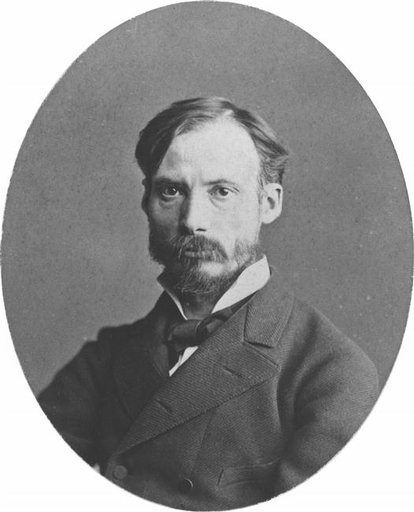
Pierre-Auguste Renoir was a French artist who was a leading painter in the development of the Impressionist style.