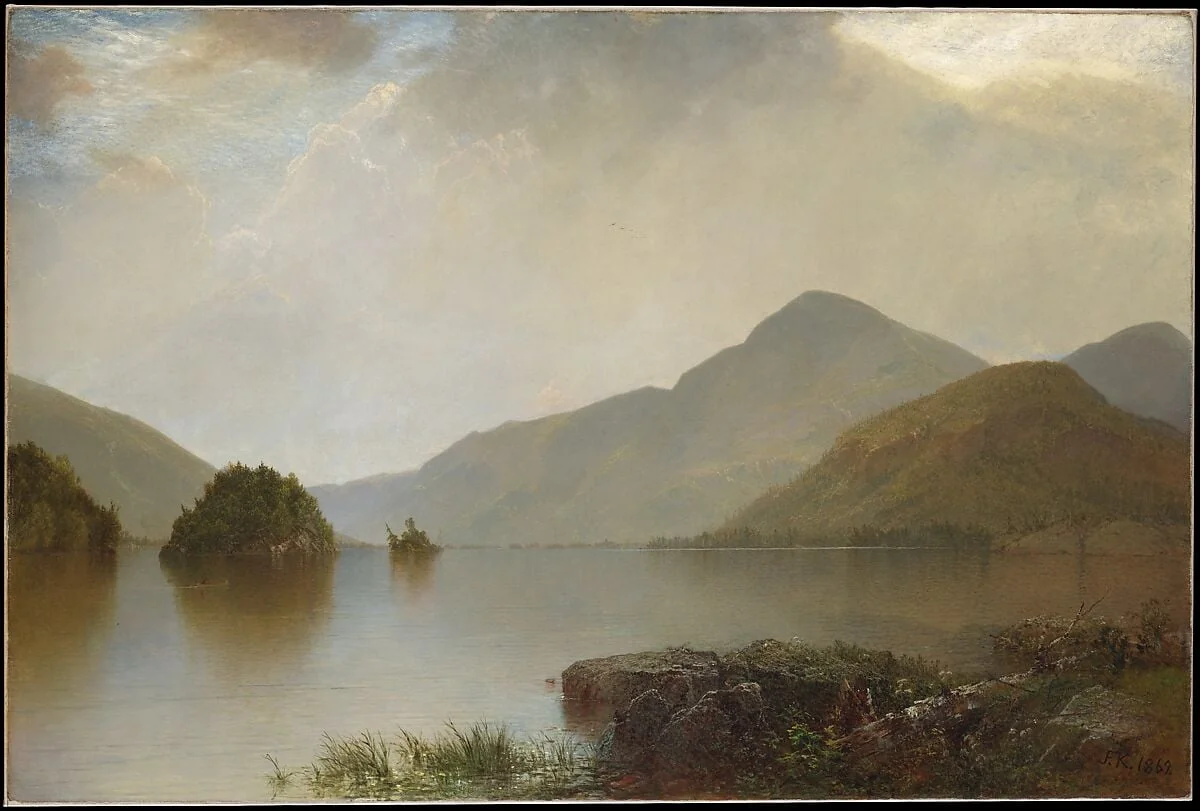
The painter John Frederick Kensett and the art of subtraction spent the last fifteen years of his working life worrying at a single problem, and he never quite settled it. The problem was how much a landscape can lose and still stay a landscape. How much weather, how much incident, how much of the picturesque furniture that the Hudson River School loved can a view shed before it stops being a place and becomes only a panel of arranged tones? Kensett asked that question over and over, often on the same few stretches of water, and he answered it differently almost every time he set up his easel.
Take him, then, as a serial questioner rather than a man who arrived at a settled manner. The school he belonged to is usually narrated as a swelling of ambition, toward Niagara, the Andes, the great theatrical mountain. Kensett ran the other way. He thinned the recipe until a single headland and its reflection could carry a whole canvas, and then he kept thinning. The several answers he reached, some serene, a few nearly empty, one or two faintly uneasy about their own emptiness, are the real subject here. Lake George is where he tested most of them, and where the argument of this essay can be watched changing its mind.
The question, stated plainly
Kensett was born on March 22, 1816, in Cheshire, Connecticut, and he came to landscape by way of the burin rather than the brush. His father, Thomas Kensett, was an English-born engraver, and the son trained in that trade before he trusted himself with paint. He exhibited a work simply called Landscape at the National Academy of Design in 1838, and by 1840 he had resolved to make painting his full occupation, a decision recorded in the National Gallery's account of his life. The engraver's discipline never left him. He thought in line and graded tone before he thought in color, and that habit is the hidden engine of everything quiet he later made.
The engraving background is worth dwelling on because it explains the look of the late work better than any talk of mood. An engraver builds an image out of marks that must each earn their place, since every line is cut and cannot be smudged away. Kensett carried that economy into oil. When he flattens a far hill into a single graded passage, he is doing in paint what he once did with the burin, deciding the fewest marks that will still read as distance. The serenity people praise is, at bottom, a printmaker's thrift.
He is placed in the second generation of the Hudson River School, the cohort that inherited Thomas Cole's wilderness and then had to decide what to do with it. The Metropolitan Museum of Art, which Kensett helped found and served as a trustee after its 1869 charter, calls him outright the master of luminism among the school's painters. Luminism is a useful label as long as it is held loosely. Tate defines it, roughly, as the painting of light, applied to American landscapists of about 1830 to 1870, who built their pictures from aerial perspective and concealed their brushwork so that the surface would not interrupt the glow. That last clause matters for Kensett more than for anyone. The concealment is the answer he kept refining.
Our own holdings let me put a number against the legend. Artifact World Gallery keeps 51 works by Kensett, drawn from eleven different venues and stretching from roughly 1843 to 1872, the year he died. That is a wide spread for a painter remembered as a specialist of stillness, and the dates are the giveaway. The earliest pictures still carry Cole's drama. The latest, made in the final summer of his life, have almost stopped describing and started simply holding light. Fifty-one works, eleven collections: enough of a sample to watch one man change his answer to his own question, decade by decade, in the luminist mode that the textbooks file him under.
First answer: the lake as architecture
Stand in front of Lake George and notice first what your eye is allowed to do. The foreground gives you a low shelf of rock and shore, painted with the engraver's precision, every near stone holding its edge. From there the water opens as a single unbroken sheet, and Kensett does almost nothing to it. There is no churn, no picturesque boat dragged in to give scale. A headland reaches in from the side and lays its dark mass and its softer reflection across the surface, and that reflection is the whole drama of the picture, because it is the one place where solid and liquid trade identities.
Then look at how the distance is handled against that crisp foreground. The far mountains do not so much recede as dissolve, their contours thinning into a pale haze where the hills meet the sky, and the join is nearly impossible to locate. This is the aerial perspective the definitions talk about, but described coldly it sounds like a trick, and it is not a trick here. It is an argument. Kensett is saying that the near world is hard and knowable and the far world is only light, and that a landscape is the negotiation between the two. The composition is architectural. The headland is a buttress, the shoreline a foundation course, the band of luminous water the long horizontal that ties the building together. Nothing is incidental, which is exactly why the picture feels so calm. He has removed everything he could not justify.
That is the first answer to the question: keep the structure, strip the event. A view can survive losing its anecdote as long as it keeps its bones. Kensett returns to this same lake so often partly because its geometry is so generous, a long basin walled by hills, made for the horizontal sheet he favored. He could rearrange a headland the way another painter rearranges a vase of flowers, and the lake forgave him.
Second answer: the coast, and almost nothing
By the mid-1850s the answer began to shift. The National Gallery, writing about this turn in his career, notes that Kensett moved away from the dramatic mountain-and-lake set pieces toward quieter coastal views built on closely observed effects of light and atmosphere, stepping deliberately out of the tradition Thomas Cole had founded. You can feel the pressure of that decision in a work like October in the Marshes. The mountain is gone. So is the framing tree, the repoussoir that earlier landscapists used to usher the eye inward. What is left is flat ground, low water, and an enormous quantity of sky doing the work that geology used to do.
Set that beside an earlier, busier picture such as An October Day in the White Mountains, and the trajectory is plain. The White Mountains canvas still believes in the grand view, in elevation and incident and the autumn color as spectacle. The marsh believes in almost none of that. The second answer to Kensett's question is harder than the first, and braver. It proposes that a landscape can lose not only its anecdote but its structure too, and survive on light alone, provided the painter watches the light closely enough to make it specific rather than generic. The marsh is not anywhere; it is a particular flat October afternoon, the sun already low, the reeds going to rust. Generic light would have killed the picture. Observed light keeps it alive.
Look closely at how little paint actually carries the marsh. Kensett lays the water in thin, almost transparent films, letting the ground tone glow up through them, and he saves his loaded brush for the few reeds that break the horizontal. The economy is total. Every stroke he withholds is a decision, and the picture's calm is the sum of those decisions rather than any single dramatic gesture. An ambitious mountain view hides its labor behind incident. A marsh has nowhere to hide, which is why a weak one looks merely empty and a strong one looks inevitable.
This is the register Smarthistory describes when it writes about American luminism more broadly, a clarity of light that lets each element of the landscape stand apart while the whole settles into a contemplative, almost devotional calm. Kensett's coastal and marsh pictures are the purest American case of that mood. There is a real judgment to make here, and I will make it: the coastal works are his most original contribution, more so than the celebrated Lake George views, because they risk the most. A serene lake is a gift to a painter. A featureless marsh is a dare.
Third answer: the reminiscence and the free study
The late Lake George pictures offer a third answer, and it is the strangest of the three. By now Kensett is not always painting the lake in front of him. He is painting his memory of it. The title Lake George, A Reminiscence says so plainly. A reminiscence is a view filtered through time, softened, edited by what the mind chose to keep. The picture behaves accordingly. Detail that the engraver in him would once have insisted on is allowed to fall away, and the result is less a record of a place than a record of having loved a place. The question has mutated. It is no longer only how little a painter can show, but how much the showing can lean on memory rather than observation.
Against the reminiscence, look at Lake George, Free Study. The word study tells you the ambition is lower and the honesty higher. This is paint thinking aloud, the headland blocked in, the water laid down in a few confident passes, the whole thing made at speed in front of the motive. The finished reminiscence and the rapid study are the two poles Kensett worked between, the remembered and the seen, and the great late pictures are the ones that somehow hold both at once.
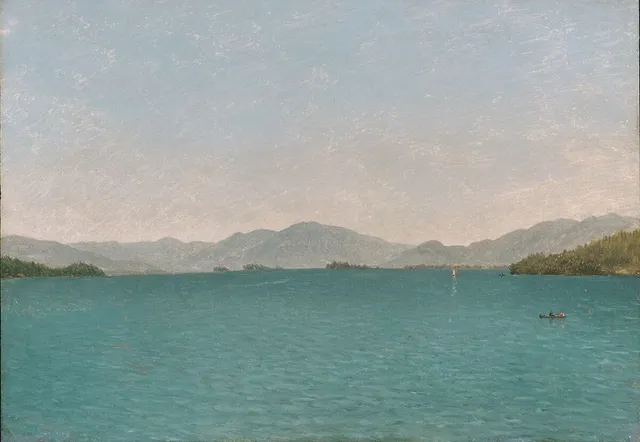
And then there is Lake George, 1872, made in the last year of his life. There is a temptation, always, to read a final picture as a summing up, and the temptation should usually be resisted. Here it is hard to resist. The picture is as quiet as anything he ever did, the lake reduced almost to a tonal exercise, light and its near-double in the water, the hills barely present. If you have followed the three answers, this one reads as a man who has stopped needing the question. The subtraction is total, and the calm is no longer an argument; it has become a temperament.
Works discussed in this article
What the 1873 sale revealed
Kensett died in New York on December 14, 1872, after going into cold water to help recover the body of a friend's wife who had drowned. What happened to his studio afterward tells you something the finished pictures cannot. In March 1873 his estate was sold at auction at Association Hall in New York, over five days, and the period catalogue of that sale advertised more than five hundred paintings and studies left behind. Five hundred. For a painter whose public reputation rested on a relatively small number of grave, finished canvases, that is a staggering shadow body of work.
The number reframes the whole question. The serenity of the famous pictures was not effortless arrival; it was the visible tip of an enormous amount of looking and trying and discarding. The free studies and the lake variations were not occasional exercises. They were the daily practice that made the subtraction possible. You cannot strip a landscape down to light and structure unless you have drawn it a hundred times and learned which hundred things can go. The 1873 sale is the proof of labor behind the proof of calm.
There is a second thing the catalogue tells us, quieter than the headline number. Across more than five hundred lots, the same handful of motives recur again and again, the lake, the coast, the marsh, the autumn wood, painted at every degree of finish from a few smudged notes to a fully resolved canvas. The studio was not a gallery of finished masterpieces awaiting buyers. It was a record of return, the same places revisited until the painter knew them well enough to leave most of them out. Seen that way, the auction reads less like an inventory than a diary.
Several answers, one temperament
So the question never resolved, and that is the point. Across the works we hold, from the architectural lake of the 1850s to the dissolving marsh to the remembered water of 1872, Kensett kept asking how little he could do, and the answers diverged because his needs diverged. Early on he needed structure. In the middle he needed only light. At the end he seems to have needed neither, painting almost from habit and affection, the lake having become less a subject than a place he went to be quiet. The painter who belongs to the second generation of the Hudson River School is often filed under serenity, as though serenity were a single thing he found once and repeated. The fifty-one works in this archive say otherwise. They show a man revising his definition of enough.
The neat developmental story tempts here, the one where a painter marches from crowded early work to pure late abstraction as if obeying a law. Kensett did not obey a law. He painted a busy White Mountain view and a near-empty marsh within a few years of each other, and he went back to the structured lake long after he had proved he could do without it. The answers coexisted. What changed was not his skill but what he wanted on any given morning, and the archive preserves that unevenness honestly.
If you want to test the claim, do not start with the most finished picture. Start with the Free Study and then walk to the great Lake George. Watch the same headland firm up, the same water settle into its mirror, the same haze find the exact altitude where the hills should vanish. Somewhere in the distance between those two pictures is the only definition of luminism that ever really mattered: a man deciding, stroke by withheld stroke, how much of the visible world he was willing to leave out so that the light could come in.
Sources & further reading
- John Frederick Kensett (1816-1872) — The Metropolitan Museum of Art, Heilbrunn Timeline of Art History
- John Frederick Kensett — National Gallery of Art
- View on the Genesee near Mount Morris — National Gallery of Art
- Catalogue of the collection of over five hundred paintings and studies by the late John F. Kensett (1873) — Internet Archive
- Luminism — Tate
- John Frederick Kensett — Wikipedia
- Luminism (American art style) — Wikipedia
- Fitz Henry Lane, Owl's Head, Penobscot Bay, Maine — Smarthistory