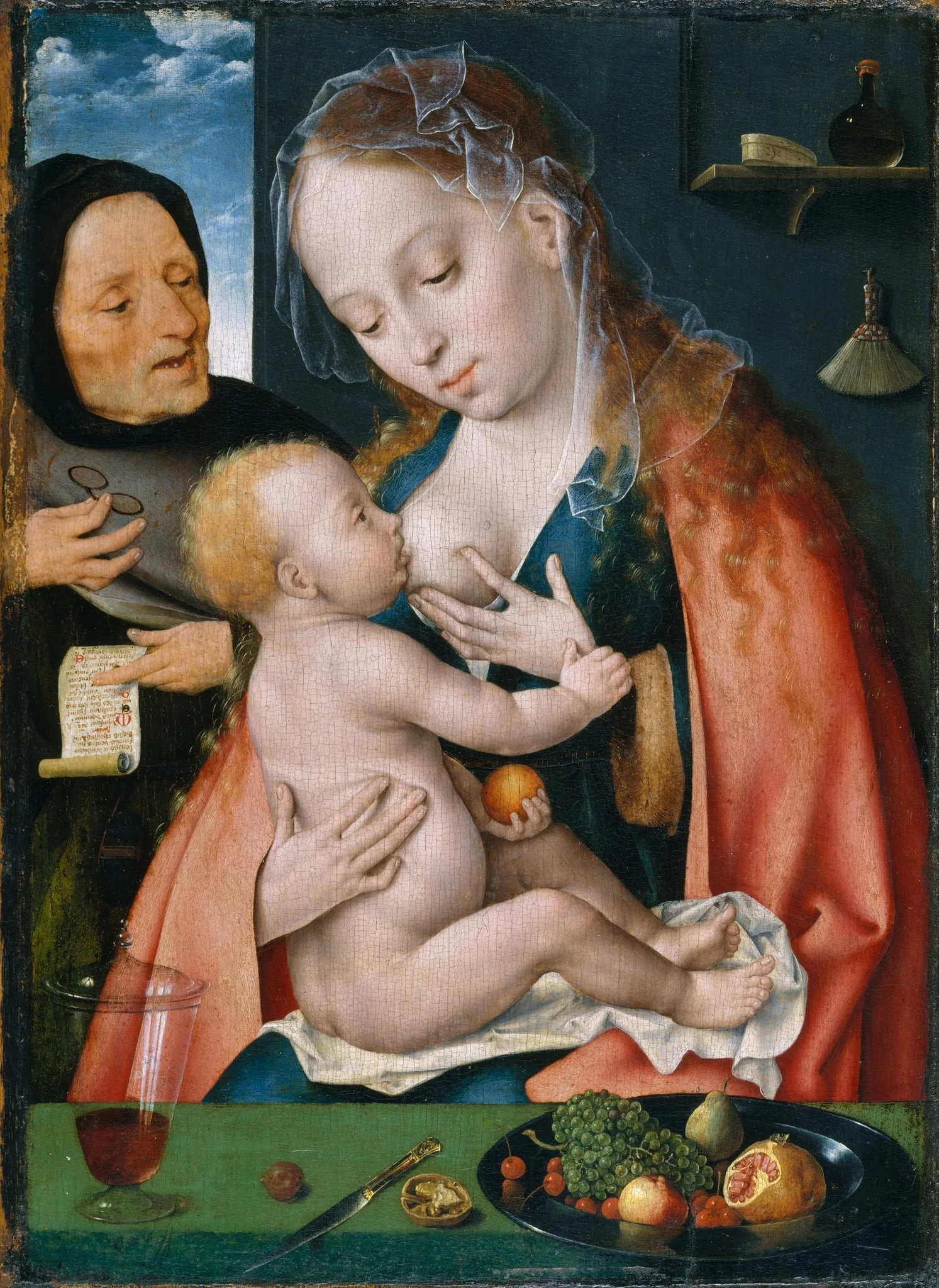
Stand close to a small devotional panel by Joos van Cleve, the Antwerp master who signed himself Joos van der Beke, and you are not looking at decoration. You are looking at equipment. His first owners used these pictures. They knelt before them, prayed into them, wept over them, and propped them up in front of guests to say something about who they were. A half lemon left on a ledge, a fly settled on a sill, a glove pulled halfway onto a goldsmith's hand: none of it is filler. Every object carries a meaning the buyer could read without a caption, because the code was held in common. That is the claim this essay defends. To meet van Cleve you have to stop admiring the finish and start reading the cargo.
The thesis is plain and worth holding against the usual survey hedge. Van Cleve's pictures were instruments before they were treasures, devotional instruments and social instruments at once, and their iconography functioned as a working language rather than a private cipher. A Holy Family taught a household how to die well. A Virgin and Child rehearsed the sacrifice of the Mass. A portrait sealed a marriage or broadcast a trade. The meanings were not buried for scholars to excavate. They were operational, legible at a glance to the merchant, the widow, the guild brother who first owned the panel. Read his work that way, object by object, and the man who has long been treated as a smooth and slightly conservative craftsman turns into something more exact: a supplier of meaning to people who knew precisely what they were buying.
The painter recovered from a nickname
For most of the nineteenth century these panels had no author at all. They hung under a placeholder, the Master of the Death of the Virgin, named after a triptych in Cologne. The works were admired and the hand was anonymous. Then a reader looked at the back of that Cologne triptych and read the monogram as Joos van der Beke, the real name behind the label Joos van Cleve, and a scattered body of work suddenly had a person attached to it. A label became a biography, and the panels stopped being orphans.
The documentary spine is thin but firm. He was born around 1485 in the duchy of Cleves, far enough up the Rhine to give him his toponym. He registered as a free master in the Antwerp Guild of Saint Luke in 1511 and served as co-deacon of that guild around 1520, which places him among the men who set the standards of the most commercial art market in northern Europe. The end is dated almost to the week: surviving Antwerp records show him alive on 10 November 1540 and dead by 4 February 1541, according to the documents collected on his biography. Between those poles sits a career run as a workshop, with assistants, repetitions, and export-ready formats.
That workshop reality is exactly what makes the iconography legible, and our own holdings put numbers on it. Artifact World Gallery carries 68 works under van Cleve's name across 32 separate institutions, the datable examples clustering between roughly 1502 and 1538. A spread like that, one hand reaching three dozen museums, is the footprint of a shop producing variations on a small set of proven subjects. The same Holy Family, the same nursing Virgin, the same half-length Christ recur because they sold, and they sold because their meaning was understood. Repetition here is not poverty of invention. It is a catalogue of demand, a record of what devout and ambitious buyers asked for over and over. Set that against the standard account of him as a careful synthesist, and the spread tells a blunter story. A working life measured in nearly four decades, from the first datable panels near 1502 to the late ones around 1538, produced not a slow stylistic evolution but a steady supply of fixed devotional formats, refreshed in detail and held constant in meaning.
What a Holy Family was for
Begin with the panel a first viewer would most likely have owned. In The Holy Family, the Virgin fills the foreground with the Child against her, while Joseph withdraws into the shadow behind, older, bearded, half attending to a book. The figures press up to a ledge that runs across the bottom of the picture like a shelf pushed toward the viewer, and on that ledge van Cleve lays out a still life that does the theological work. A lemon or orange sits cut open beside a knife. There is bread. There is a glass of wine catching the light. Cherries rest near the fruit, and somewhere on the stone or the sill a single fly has landed. The handling is patient, the modelling soft, the colour cool and exact. Nothing on that ledge is there to be pretty.
Read the ledge and the panel opens. The cut fruit and the bare knife announce the Passion this infant is born to suffer; the blade is already out, the flesh already opened. The bread and the wine are the Eucharist, the body and blood the Child will become, set within reach of the mother who provided that body. The cherries were known as the fruit of paradise and read as a sign of the blood to come. The fly is decay and death and the corruption of the world, placed deliberately at the threshold so the eye trips over mortality on its way into the sacred scene. A merchant who kept this panel in a bedchamber did not see a tender genre piece. He saw a compressed sermon on incarnation and death, the kind of object you looked at last thing at night while rehearsing your own good end. The picture worked on him the way a prayer book worked, page by object. Set the cut lemon beside the bread and the logic tightens: sourness and nourishment, mortality and sacrifice, are laid out together on one stone shelf to be taken in at a single look. The order of the objects is the order of the argument.
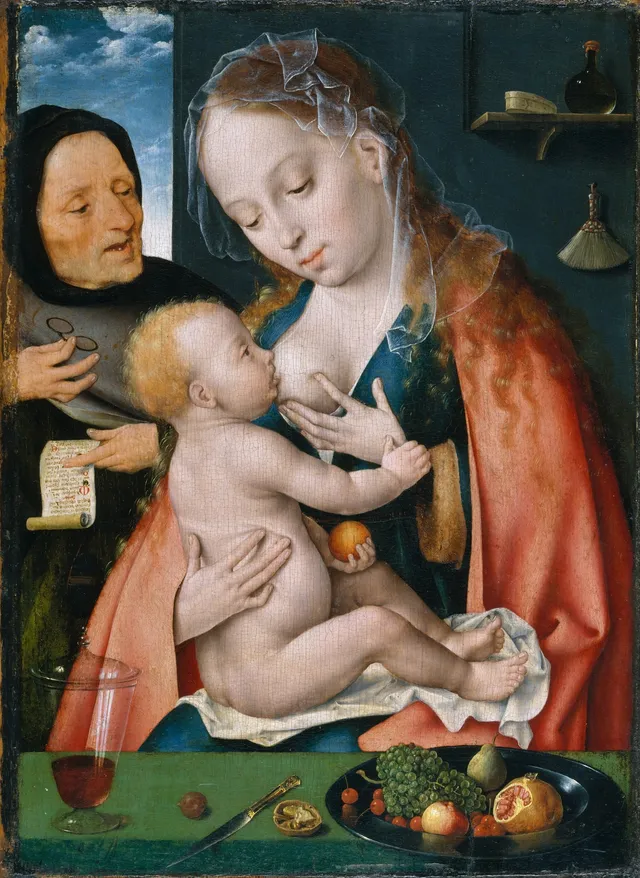
Van Cleve made this subject again and again, and the variants are not careless. A second Holy Family in the corpus shifts the cast and the props while keeping the grammar intact, because the buyer wanted the same lesson delivered with a slightly different inflection. Look from one Holy Family to the next and you watch a shop tuning a fixed argument for a fixed demand. Once you grasp that the still life is the argument, the repetitions stop reading as a shop cutting corners and start reading as a publisher reprinting a reliable text in new bindings.
The Virgin as argument, the donor as petitioner
The half-length Virgin and Child carries the same logic into a tighter frame. Here the mother and infant are the whole picture, brought near, the Child reaching or nursing, the intimacy meant to collapse the distance between the worshipper's prayer and its object. This is not a portrait of a happy family. It is a proof of the Incarnation staged for private use, the moment God became flesh and milk and weight in a woman's arms. A first owner praying before it was meant to feel the doctrine as fact, not metaphor. The softness of van Cleve's modelling, often criticised as mere sweetness, is doing persuasive work: it makes the dogma tactile, something you could almost reach out and hold. Set beside a colder Crucifixion, the warmth of the half-length Virgin reveals its purpose: it is the near, holdable end of the same doctrine the donor panels argue at a distance.
Where the Virgins fold the viewer into devotion, the donor pictures fold the viewer into sacred history outright. In The Crucifixion with Saints and a Donor, a living patron kneels inside the scene of Christ's death, flanked by the saints who plead his case. This is the most aggressively functional iconography van Cleve produced. The donor has paid to be portrayed praying at Calvary forever, with intercessors stationed beside him, so that the panel keeps working after his death as a standing petition for his soul. The saints are not ornaments; they are a legal team. The first viewers, the donor's family and the clergy who said Mass near it, understood the panel as an engine of intercession, a way of buying continuous prayer in paint. Memory, status, and salvation were transacted in a single commission.
Faces that did business
Van Cleve's portraits run on a second code, secular but no less precise, and the pair of the goldsmith Joris Vezeleer and his wife shows it working. In Joris Vezeleer, the sitter is caught in the act of pulling on a glove. The gesture looks casual and is anything but. A drawn-on glove signified gentility and ease, the body language of a man who does not labour with his hands, asserted here by a man whose hands worked gold for a living. Vezeleer was a leading Antwerp goldsmith who went on to deal in art and amass real wealth, and the portrait was made to mark his marriage. It is an advertisement of arrival, a claim to rank dressed as a passing moment with a glove.
Its meaning, though, is only complete beside its partner. Margaretha Boghe is the pendant, the bride the commission celebrates. Marriage portraits in this market were made and hung as a pair, husband and wife turned slightly toward each other so that the two panels finish a single sentence about a household founded and a fortune joined. To a first viewer the pendants read instantly as a union, the way a coat of arms reads. Vezeleer's later career as a dealer is the relevant context: this is a man who sold art understanding exactly what a portrait was for, and who used van Cleve to record his marriage, his money, and his claim to be a gentleman. The glove is the thesis statement of his whole self-presentation.
Works discussed in this article
Italy at second hand
Van Cleve did not stay sealed inside Netherlandish convention, and this is where his reputation as a conservative breaks down. He absorbed Italian art, but largely through prints, and he kept the literal, object-by-object iconography of the north while borrowing southern bodies. The clearest case sits in New York. The Metropolitan Museum dates his Last Judgment to about 1525 to 1530 and notes that the foreground nudes reflect his study of prints after Raphael, while the figure of Christ appears inspired by the ancient Laocoön. An Antwerp painter is quoting Roman antiquity and the Vatican workshops without having to be standing in Rome, because the engravings did the travelling for him. The doctrine of the panel stays orthodox and northern; the anatomy is imported. He took the southern muscle and kept the northern meaning, and felt no contradiction in the join.
He was just as inventive with the space behind his figures. Van Cleve was among the first to set sweeping panoramic landscapes deep behind his sacred and secular subjects, at times collaborating with the landscape specialist Joachim Patinir, whose blue distances became a defining device of sixteenth-century northern painting. The technique matters to meaning, not just to mood. A vast world opening behind a Holy Family stages the cosmic reach of what the little ledge still life predicts, the salvation of the whole created world implied behind the private prayer in the front. The eye travels from a cut lemon to a horizon, from one household's mortality to a redeemed earth, in a single glance.
His portraiture carried him furthest of all. The National Gallery of Art records that van Cleve's skill with faces led to a summons to the court of Francis I of France, and that he is not documented in Antwerp between 1529 and 1534, a five-year silence that fits a stint abroad in royal service. The same hand that pulled a glove onto an Antwerp goldsmith was trusted to fix the likeness of a king. For a guild master from the Rhineland, that is a long arc, and it was the portraits, the most coldly functional of his pictures, that opened the door.
What the first viewers actually saw
Put the categories back together and a single working method emerges. Whether the subject was the Virgin, the Crucifixion, or a married couple, van Cleve loaded the picture with signs his buyers could decode on sight, then finished the surface so well that the meaning slid in without friction. The smoothness people mistake for blandness is the delivery system. A panel that announces its own cleverness gets in the way of use, and these pictures were made to be used, by people praying for a good death, securing a soul, or fixing a family's standing in paint. The polish is not the absence of ambition. It is ambition pointed at function instead of display.
The reason he vanished for so long under a nickname is the same reason he repays attention now. A painter this fluent in a shared visual language leaves no eccentric signature of personality on the surface, so a later age that prized individual genius could not find him and shelved his work under a made-up master. Recovered, he gives back something the geniuses cannot: a clear window onto what ordinary devout and ambitious Europeans wanted their pictures to do. He is the rare master whose value rises the less we hunt for personality in him and the more we read the work as the people who paid for it once read it. Browse the full run of his work in our archive and the pattern holds panel by panel. The next time one of his soft, sweet Virgins reads as merely pretty, look again at the ledge, find the fly, and watch the panel start working the way it worked the day it was bought.
Sources & further reading
- Joos van Cleve — Wikipedia
- Joos van Cleve, The Last Judgment — The Metropolitan Museum of Art
- Joos van Cleve — National Gallery of Art
- Cleve, Joos van (Union List of Artist Names) — Getty Research Institute (ULAN)
- Max J. Friedländer, Early Netherlandish Painting — Internet Archive