Artwork
Margaretha Boghe
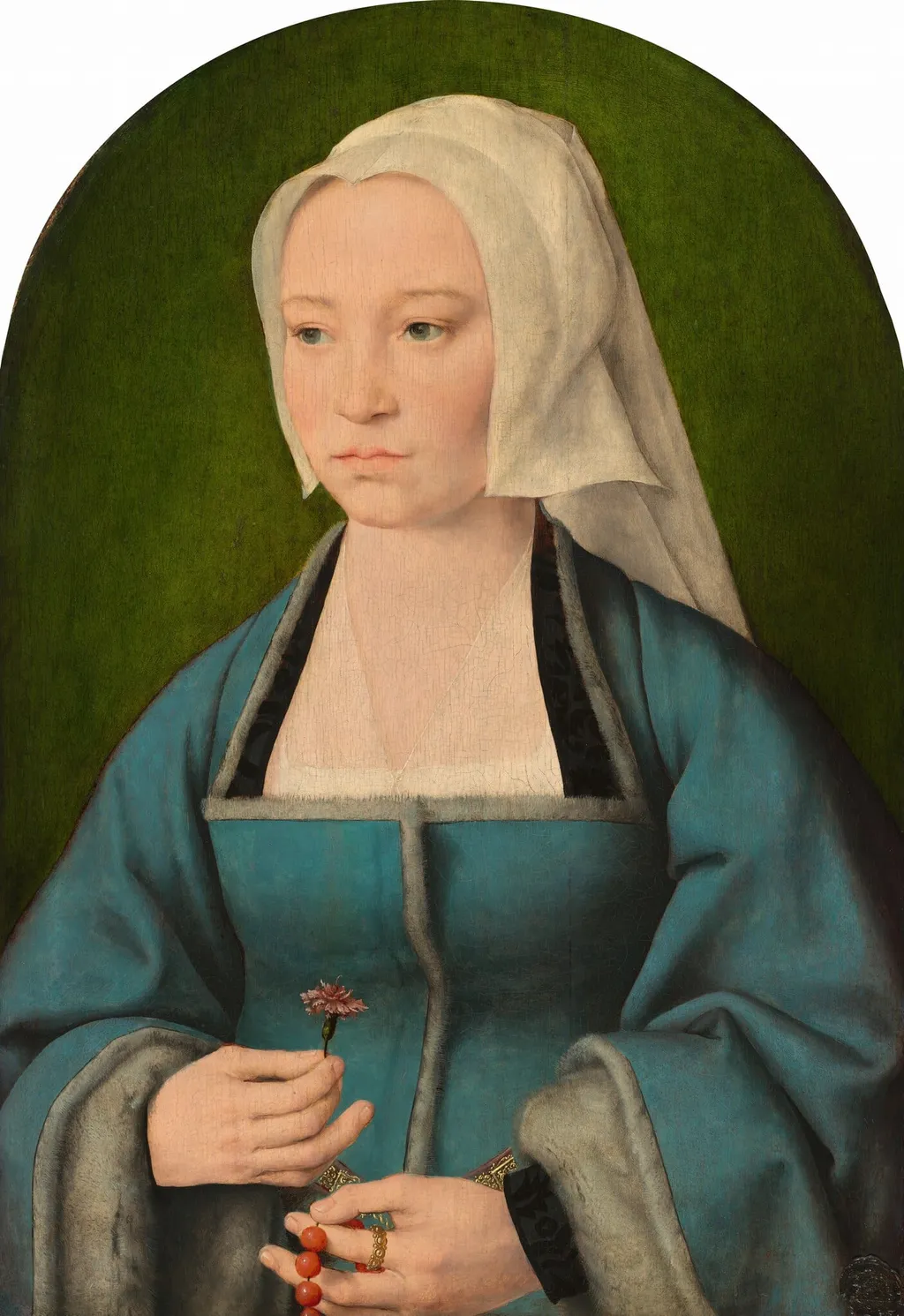
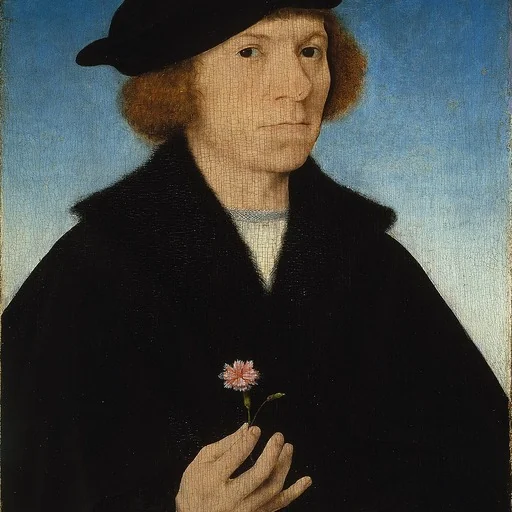
Margaretha Boghe is an oil painting by the Northern Renaissance artist Joos van Cleve. It dates from 1518 and is held in the collection of the National Gallery of Art.
About this work
Subject & Meaning
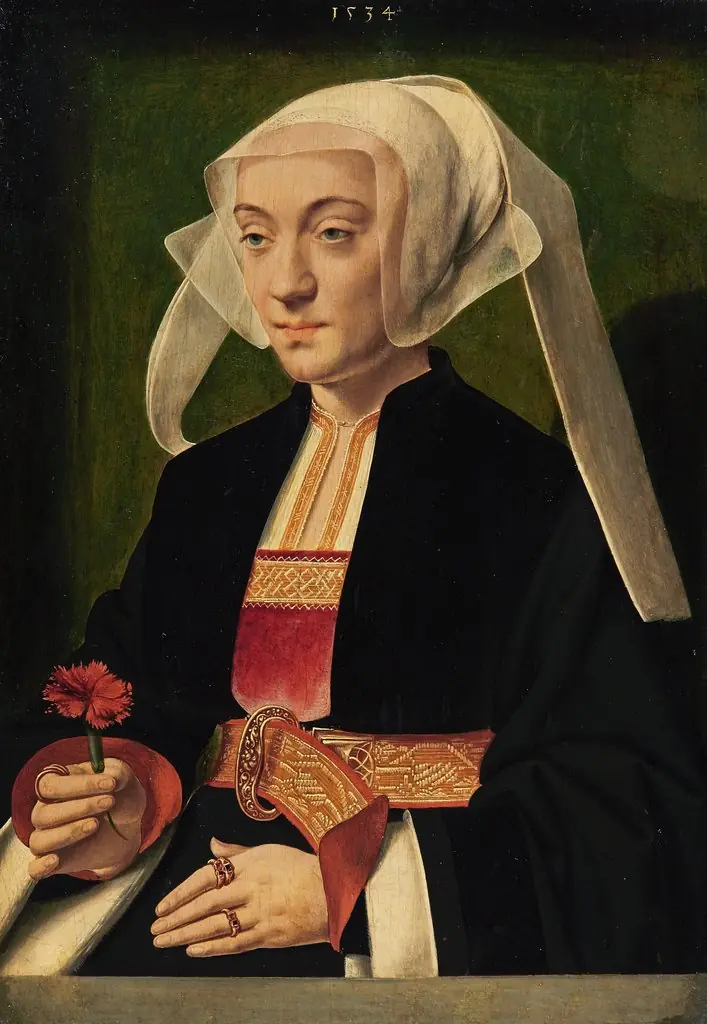
The work's primary iconographic element is the pink flower held by the sitter, which serves as a traditional symbol of engagement and conjugal fidelity.
The painting depicts Margaretha Boghe, likely commissioned to commemorate her betrothal or marriage to Joris Vezeleer around 1518. The work's primary iconographic element is the pink flower held by the sitter, which serves as a traditional symbol of engagement and conjugal fidelity. This symbolism is reinforced by historical inscriptions noting the couple's fifty-two-year union.
The portrait functions not merely as a likeness but as a representation of marital commitment, aligning the sitter's youthful appearance with the estimated date of her wedding. Together with its pendant portrait of Vezeleer, the image stands as a visual testament to their long-lasting partnership, grounded in the specific cultural conventions of early sixteenth-century Netherlandish portraiture regarding marriage.
Technique & Style
The painting is an oil work executed on a wooden panel, as recorded in the documentary records for the piece. It belongs to the portrait genre and is classified as a painting, reflecting the formal category of early sixteenth‑century Netherlandish art. The support is a panel, a material commonly used for portable devotional and portrait panels of the period.
The composition follows the half‑length format typical of betrothal portraits, with the sitter holding a pink blossom that symbolizes engagement, a symbolic attribute noted in the source. The work’s formal qualities thus combine a realistic rendering of the sitter with conventional iconographic elements of marital promise.
History & Provenance
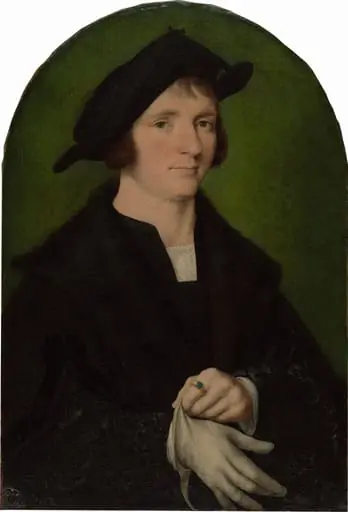
Margaretha Boghe was painted by Joos van Cleve in 1518 as one half of a pendant pair, the other depicting her husband Joris Vezeleer. The portraits were probably commissioned to mark the couple's betrothal or marriage, since an inscription records that Vezeleer and Boghe were married for fifty-two years and Vezeleer died in 1570, placing the wedding around 1518. Both portraits likely appear in the 1574–1575 inventory drawn up at Boghe's death.
The work subsequently passed to Prince Karl Eusebius of Liechtenstein and then to Prince Johann Adam Andreas of Liechtenstein, who held it in his "Fideikomissgalerie" in Vienna. It descended through the Princes of Liechtenstein, reaching Prince Franz Josef II of Liechtenstein, who kept it in Vienna until 1939 and later in Vaduz. In 1962 it was sold through Marianne Feilchenfeldt of Zurich to the National Gallery of Art.
The portrait of Margaretha Boghe, painted by Joos van Cleve circa 1518, is presently in the collection of the National Gallery of Art in Washington, D.C., where it is listed under the museum's accession records for works acquired from Marianne Feilchenfeldt in 1962. Its earlier ownership passed through the Liechtenstein princely family, beginning with Prince Karl Eusebius, then his nephew Prince Emanuel, and subsequently various Liechtenstein princes until Prince Franz Joseph II, who held it until 1939. The work was then sold in 1962 and entered the NGA. No exhibition history is documented in the available sources.
Overview
Joos van Cleve, a significant painter active in Antwerp, created this oil on panel portrait titled Margaretha Boghe around 1518. As a leading figure in the Dutch and Flemish Renaissance, van Cleve was known for his ability to synthesize traditional Early Netherlandish painting techniques with contemporary stylistic developments. This work exemplifies his approach to portraiture, capturing the sitter with a blend of detailed observation and refined execution.
Context
Joos van Cleve was a prominent artist in Antwerp, a major artistic and commercial hub, from approximately 1511 until his death in the early 1540s. His work, including this portrait, is characteristic of the Dutch and Flemish Renaissance, a period marked by a flourishing of artistic innovation. Artists like van Cleve skillfully navigated the evolving art landscape, incorporating new ideas while maintaining a strong connection to regional traditions.
Own this work as a print
Artist & collection
Artist
Joos van Cleve (; also Joos van der Beke; c. 1485–1490 – 1540/1541) was a leading painter active in Antwerp from his arrival there around 1511 until his death in 1540 or 1541. Within Dutch and Flemish Renaissance…