Light as a message, not a mood
The landscapes of Sanford Robinson Gifford, the Hudson River School's great painter of saturated air, were bought, hung, and reviewed by people who took it for granted that light could carry meaning. A glowing afternoon was not, for them, a decorative condition of the weather. It was a sign, and they knew how to read it. The argument of this essay is narrow and, I think, defensible: Gifford's famous haze was content. The veil of warm atmosphere that fills a clove or pools over a lake was understood by his first audiences as a carrier of association, sentiment, and even national feeling, and it was praised in those terms long before twentieth-century critics renamed the style and reduced it to optics.
Gifford lived from 1823 to 1880 and belonged to the second generation of the school, the luminist wing that pushed the painting of light past the picturesque and toward something quieter and more abstract, as the standard biography records. Modern museum labels tend to describe his pictures as studies of atmosphere, and they are. But the people who first stood in front of them were not looking at a meteorological report. They were looking at a wilderness gorge that meant national promise, an Italian island that meant cultivated memory, a frontier clearing that meant labor and consequence, and an evening sky that meant, plainly, the end of things. Read iconographically, his work is far less placid than the soft surfaces suggest. The haze is doing rhetorical work, and his patrons paid for the rhetoric.
"Air painting" and the audience that named it
Gifford trained first as a portraitist and turned to landscape only after the example of Thomas Cole pulled him outdoors, a conversion the National Gallery of Art describes. The first work he showed at the National Academy of Design was a landscape, exhibited in 1847; he was made an Associate in 1851 and a full Academician in 1854. That institutional fact matters for the question of meaning, because it tells us his pictures entered the most public and most reviewed venue American art then possessed. They were seen by critics whose vocabulary survives. And the word those critics reached for was atmosphere.
His contemporaries went further and called the result air painting, a phrase the Metropolitan Museum of Art still uses to describe his handling of saturated ambient light. The same museum counts Gifford among its own founders in 1870, which places him at the center of the institutional machinery that taught Americans how to look at pictures at all. So we have a painter who helped build the audience, then trained that audience to treat his light as the subject. When the British term luminism was later attached to this group, as the Tate defines it, the label covered American landscapists from roughly 1830 to 1870 and their painting of light. The danger of the label is that it makes the light sound neutral. For Gifford's first viewers it was anything but.
The clove as a national subject
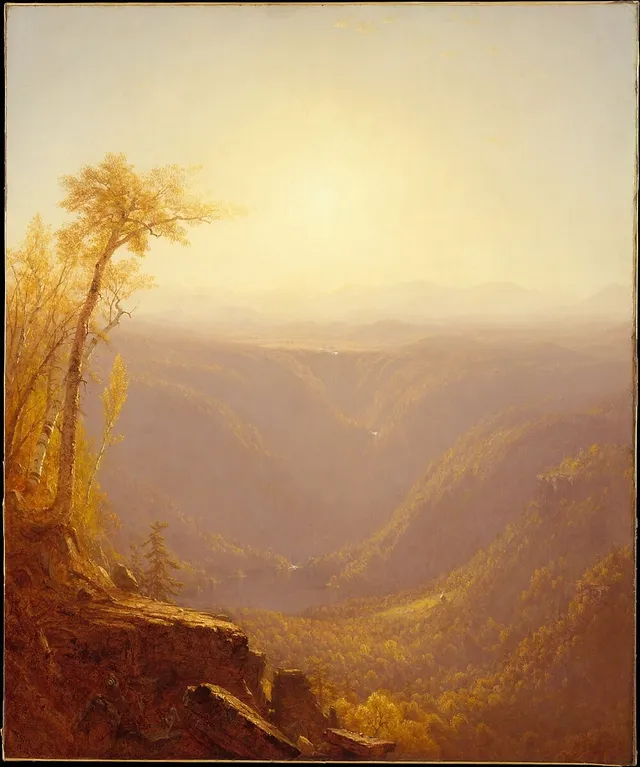
Begin where his reputation was made. Look at A Gorge in the Mountains, his view of Kauterskill Clove. The clove opens as a deep wedge cut into the Catskills, and Gifford fills it from rim to rim with a hanging curtain of amber light. The far end of the valley dissolves into gold, so the eye cannot measure how far back the mountains go. At the lower left, on a rocky shelf, a single small figure stands almost lost against the foreground dark, and a blasted, leaning tree marks the near edge like a stage flat. A bird rides the warm air over the gulf. The painter does not so much draw the mountains as drown them in afternoon. Detail surrenders to glow the deeper you look into the picture, until distance becomes pure colored light.
Now read it the way 1862 read it. Kauterskill Clove was already a celebrated spot, the landscape that Cole's generation had consecrated as the cradle of American scenery. To paint it flooded with this particular honeyed light was to make a claim about the country, not merely the county. The blasted tree is the old emblem of wilderness and mortality, carried over from Cole; the tiny figure is the human measure dwarfed by a continent; the unmeasurable golden distance is, frankly, the future. For a viewership living through the first year of civil war, a glowing American wilderness that opens toward a luminous, unbounded horizon was a consoling proposition. The haze does the consoling. It softens the wound of detail and turns a real ravine into a promise. None of this iconography is hidden. It was the common reading of the picture, and Gifford counted on it.
Stand close to the surface and the method shows itself. Gifford builds the gorge in broad, thin washes, letting the warm ground glow up through the paint so the air itself seems lit from within rather than from a sun you can locate. The near rocks are scumbled with dry, broken strokes that catch the canvas grain, while the far slopes are wiped almost smooth, all edges softened into one another. He is not hiding the labor of the wilderness behind prettiness. He is showing you that the deeper you look, the less you can hold, which is the exact emotional shape of a country that could not yet see the end of its own war.
Borrowed light: Italy and the Nile
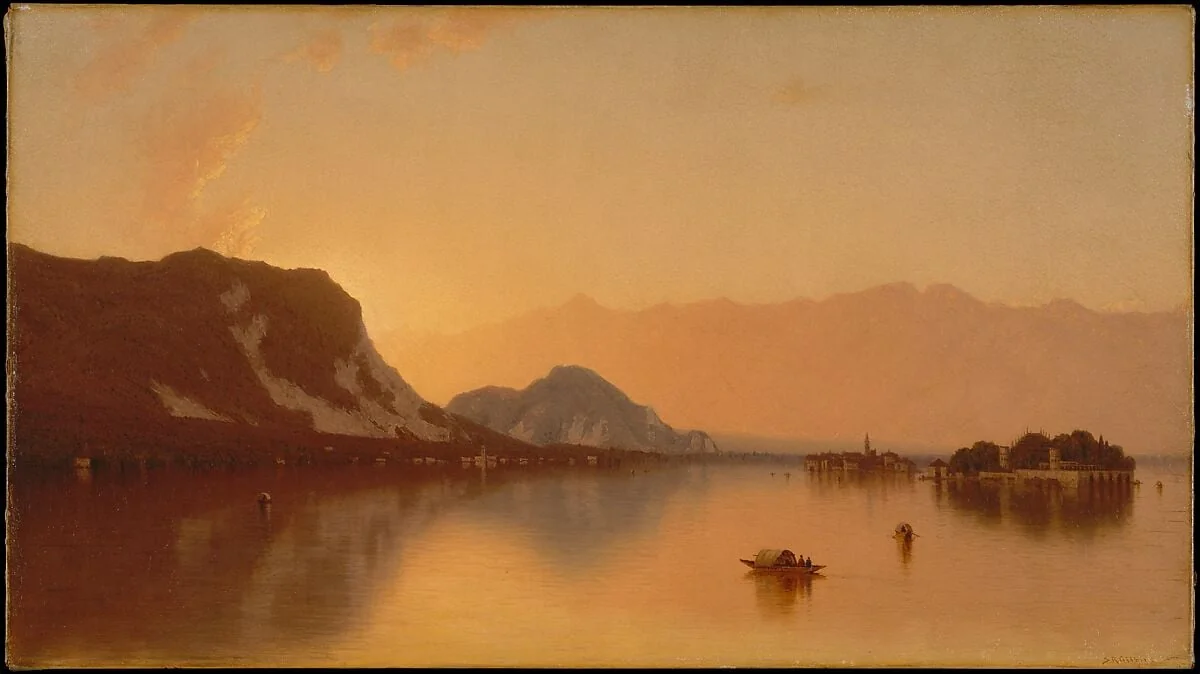
Gifford did not invent his glow from American weather alone. He spent long stretches abroad, and the south taught him how charged a single quality of light could be. Consider Isola Bella in Lago Maggiore. The Borromean island sits low on the water, its terraced palace and garden stacked against a pale ground of lake and far Alpine haze. Gifford keeps the foreground water broad and almost empty, a sheet of dimmed silver, so that the island floats in the middle distance like a memory rather than a destination. The mountains behind are not described; they are suggested by graded bands of cooling light. What you feel first is the hush of the whole surface, the way the painter has lowered the contrast everywhere so the eye drifts toward that one cultivated shape on the water.
An Isola Bella meant something specific to a wealthy New Yorker around 1870. It was a stop on the Grand Tour, a token of cultivation, a place one had seen or wished to have seen. Gifford's softening light does not just render the island; it antiques it, wrapping a famous pleasure-garden in the amber of remembered travel. The same logic governs his Roman subjects. Tivoli, with its hill town above the Campagna, trades on centuries of association between that site and the idea of the classical sublime. The patron who hung a Tivoli announced an education. Gifford supplies the light that flatters the announcement, a warm dusk that makes antiquity feel both present and safely past.
It helps to notice what Gifford leaves out. In the Italian pictures he suppresses incident, the figures and boats and bustle a topographical painter would have crowded in, until almost nothing competes with the light. The eye has no anecdote to rest on, so it rests on tone. That refusal of narrative is itself a choice about meaning. A scene emptied of event becomes a scene about feeling, and the feeling on offer is the warm, retrospective glow of a culture a buyer wanted to claim as his own.
The most exotic of these borrowed lights came from Egypt. Gifford was one of the very few American landscapists of his century to travel the Nile, which he did in 1869, and the haze of the desert river gave him a register of glare and dust that fed his later work. For his audience, a Nile picture was a frontier of a different kind, the biblical and antique East made visitable by steamship. The point worth holding onto is consistent across the Alps, the Campagna, and the Nile: Gifford was selling a quality of light that his buyers had been taught to associate with cultivation, antiquity, and prestige. The atmosphere is the iconography.
The wilderness home, and the cost behind it
Not every Gifford is consolation. A Home in the Wilderness puts a settler's clearing into the middle of the forest, and the iconography here is harder than the title sounds. A wilderness home in mid-century American painting is a story about the axe. The clearing exists because trees were felled, and the felling reads as both achievement and loss. Gifford's contemporaries were entirely fluent in this double meaning. The pioneer cabin, the stumps, the thin smoke of a settler's fire, the ring of standing timber holding the edge of cultivation: these were the standard signs of a nation eating its own frontier, and viewers admired and mourned the process at once.
What Gifford adds is, again, the light. By laying his warm, equalizing atmosphere over the clearing, he tips the scene away from raw conquest and toward elegy. The smoke does not assert industry; it dissolves into the same haze that holds the trees. A more aggressive painter would have sharpened the contrast between cut and uncut land. Gifford blurs it, and in blurring it he tells his audience that the loss is bearable, that the wilderness gives way to home under a forgiving sky. That is a position, and a comforting one, offered to people who were in fact clearing a continent. The pleasure of the picture and its politics are the same brushwork.
Look hard at the clearing and the optimism turns provisional. The standing timber crowds close, darker and taller than the cabin it surrounds, and the cleared ground is a small bright island in a great deal of shadow. Gifford does not let the settler win the picture. He lets the light arbitrate, and the verdict it returns is gentle but undecided. That ambivalence, held inside a surface most viewers called merely beautiful, is the reason his contemporaries trusted him with the country's hardest subject.
Evening, and what evening meant
Gifford returned, again and again, to the low sun. Twilight was his signature hour, and Smarthistory takes a work like his Twilight in the Adirondacks as the representative case of his luminist control of atmosphere. To a Victorian viewer, evening was the most legible of all natural symbols. It meant rest, memory, mortality, the close of a life as much as the close of a day. A painter who specialized in dusk was offering his audience a reliable emotional key, and they turned it without instruction.
His river and coastal views carry the same charge in a minor register. Haverstraw Bay widens the Hudson into a calm expanse under a high, dissolving sky, and the stillness is the meaning. A pacified American river, traffic reduced to a few small sails, the water holding the light like a held breath: this is the iconography of a nation at peace with its own geography. Near the Coast works the same vein at the shoreline, where the boundary of land and sea becomes an excuse for a long, low band of luminous air. In each case the literal subject is modest. The felt subject is time, and the consolation of a quiet hour.
There is a discipline in this that is easy to miss. Painting at the low sun forces a narrow range of values, and a lesser hand turns that limit into mud. Gifford turns it into a held chord. He keeps a few clean accents, a sail and a streak of open water, and lets everything else settle toward a single warm key. The restraint is the expression. A picture that says less, said this carefully, leaves more room for the viewer to bring his own evening to it.
Works discussed in this article
What the archive shows
Set the individual readings against the shape of the surviving body of work. Across Artifact World Gallery's holdings, twenty-six works carry Gifford's name, spread over eight institutions and spanning roughly 1848 to 1876. That is a compact, well-distributed sample, and its spread is itself a kind of evidence. The Met, which counts him among its founders, holds him because he was a founder's painter, a man whose pictures defined respectable American taste at the moment public museums were being invented. A subject census across those twenty-six works runs exactly where the iconographic reading predicts: Catskill and Adirondack wilderness, the Hudson and its bays, the Italian lakes and Rome, the eastern Mediterranean. The collection is, in miniature, a map of what his buyers wanted light to mean.
Concentrate on the date spread for a moment. Roughly 1848 to 1876 brackets almost his entire mature career, from the years just after Cole's death to the decade before his own, so the sample is not a slice but a life in summary. The subjects do not drift over those years toward pure abstraction, the way a strictly optical account of luminism would predict. They keep returning to the same charged places, the Catskill clove and the island on Maggiore, as though the meanings, not the effects, were the point he could not leave alone.
There is a second, more personal record worth weighing against the work. When Gifford died in 1880, Eastman Johnson painted his portrait, an oil on academy board now in the Met and digitized through the Internet Archive, and a period photograph in the J. Paul Getty Museum shows him at his easel. A profession that bothered to portray and photograph him at work understood that it was losing a maker of meanings, not a recorder of weather. The same generosity is visible in the surrounding holdings of early American art in this gallery, among them the draughtsman John Rubens Smith, whose presence marks the drawing culture out of which Gifford's tonal control grew.
Reading him now
The risk in admiring Gifford today is that his surfaces are so seductive we stop at the glow and call it taste. His first viewers did not stop there, and we should not. When you next stand in front of A Gorge in the Mountains or Isola Bella, ask the question a viewer of 1865 would have asked without thinking: what is this light telling me to feel about my country, my education, my own mortality? The answers are built into the haze. Gifford grew out of the Hudson River School and into the tonal precision that would later be named luminism, and at every stage he treated light as a language his audience already spoke. To recover what his pictures meant to their first viewers is to stop reading the weather and start reading the sentence the weather was written to deliver.
Sources & further reading
- Sanford Robinson Gifford (1823-1880) — The Metropolitan Museum of Art
- Luminism (art term) — Tate
- Sanford Robinson Gifford — National Gallery of Art
- Sanford Robinson Gifford — Wikipedia
- Sanford Robinson Gifford, Twilight in the Adirondacks — Smarthistory
- Portrait of Sanford Robinson Gifford by Eastman Johnson — Internet Archive / The Metropolitan Museum of Art
- The artist Sanford Robinson Gifford painting at his easel — The J. Paul Getty Museum
- The Artist Sketching at Mount Desert, Maine — National Gallery of Art