Artwork
Isola Bella in Lago Maggiore
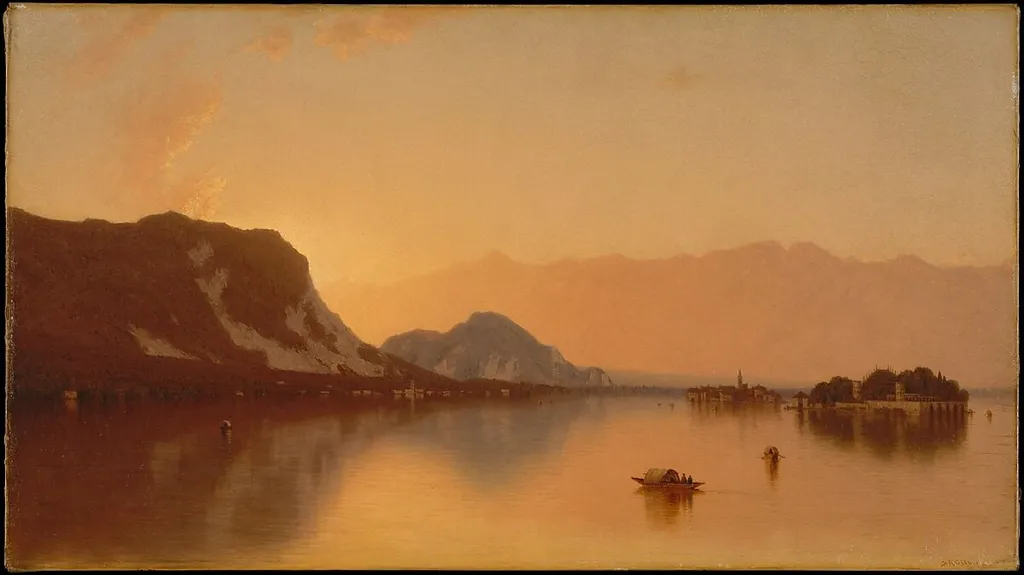
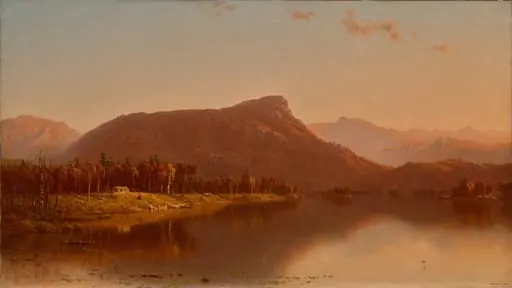
Isola Bella in Lago Maggiore is an oil painting by the Hudson River School artist Sanford Robinson Gifford. It dates from 1871 and is held in the collection of the Metropolitan Museum of Art.
About this work
In 1868, Sanford Robinson Gifford spent several days on Italy's Lago Maggiore and called this stretch 'the finest of all the Italian Lakes.' Working from a sunset oil sketch made there, he produced the 1871 canvas, widening the view to trace the light slipping between the mountains that plunge into the water near Isola Bella.
Overview
Sanford Robinson Gifford's 1871 oil painting, Isola Bella in Lago Maggiore, captures a serene sunset over the Italian lake.
Sanford Robinson Gifford's 1871 oil painting, Isola Bella in Lago Maggiore, captures a serene sunset over the Italian lake. Created following his extensive European travels in 1868, the work exemplifies his approach to landscape. Rather than a literal depiction, Gifford focused on the atmospheric qualities of light and air, rendering the reflective surface of the water and the subtle interplay of illumination. This canvas is a significant example of his luminist style, reflecting his engagement with European scenery.
Subject & Meaning
The painting depicts Isola Bella on Italy's Lago Maggiore, a location Gifford deemed "the finest of all the Italian Lakes" during his 1868 visit. While inspired by a specific site, the artist's intent was not to create a precise topographical record. Instead, the composition emphasizes the lake's reflective surface and the ephemeral qualities of light and atmosphere at sunset. The work transforms a travel experience into a contemplative study of natural illumination and its emotional resonance.
Technique & Style
Gifford's Isola Bella in Lago Maggiore is a prime illustration of his luminist technique, characterized by a meticulous rendering of light and atmospheric effects. The artist expanded an initial oil sketch, broadening the view to encompass a mountain silhouette against the horizon. He prioritized the shimmering surface of the lake and the subtle gradations of light over strict topographical accuracy.
This approach allowed him to convey the emotional depth and tranquility of the scene through the interplay of light and air.
History & Provenance
This canvas originated from Gifford's second and final European tour in 1868, a journey that spanned over a year and included Italy, Greece, Egypt, and the Near East. During a summer stop at Lago Maggiore, he created an oil sketch of a sunset, which he subsequently developed into this larger painting in 1871. Measuring 20 1/4 by 36 inches, the artwork later entered the collection of the Metropolitan Museum of Art in 1921, a donation from Colonel Charles A. Fowler.
Legacy
After Gifford's death in 1880, the Metropolitan Museum of Art honored him with its inaugural monographic retrospective, underscoring his significance. Today, Isola Bella in Lago Maggiore remains a key work for understanding how American landscape artists of the 19th century integrated their European travel experiences into their practice. It serves as a testament to their ability to translate specific sites into broader meditations on light, mood, and the sublime qualities of nature.
Artist & collection

Artist
Sanford Robinson Gifford (July 10, 1823 – August 29, 1880) was an American landscape painter and a leading member of the second generation of Hudson River School artists.


 Compared in the Color & Light course