The painter we file under Jean-Baptiste-Camille Corot, the great hinge of nineteenth-century landscape, spent his career inside an argument he never tried to win. On one side stood the historical landscape, the paysage historique, in which nature existed mainly to give a noble story somewhere to happen. On the other stood a newer, quieter conviction: that light, air, and the particular weight of one afternoon were subject enough. Most accounts make Corot the bridge between these positions, the figure who carried the academy toward the open-air future. The bridge image is too tidy. Corot did not reconcile the two camps. He kept both, worked them in parallel for half a century, and the friction between them is the most interesting thing he left us.
My claim is that the refusal to choose was a method, not a muddle. The Salon machines, the composed biblical and mythological scenes, lived on one set of canvases. The small studies made in front of the motif lived on another. Each kept the other honest. The studio pictures borrowed the freshness of the sketches, and the sketches stayed disciplined by a lifetime of building landscapes that had to hold together as architecture. So when the Impressionists looked back and found a single old master worth keeping, they were not endorsing the half of Corot that won medals. They were answering a tension he had kept alive on purpose, the unresolved quarrel between a landscape that serves a subject and a landscape that is the subject. Read his fifty working years that way and the supposed contradictions stop looking like a man who couldn't make up his mind. They look like the deliberate output of a man who had made it up twice and decided to keep both answers.
The doctrine Corot inherited
Corot was born in Paris on 16 July 1796, in a house on the Rue du Bac that has since been demolished, the son of a wig maker and a milliner who ran a fashionable hat shop near the Pont Royal (per his biography). The comfortable, commercial childhood matters less than the studio convention waiting for him. By the 1820s the prestigious form of landscape was the historical landscape, codified in academic teaching and rewarded with its own Prix de Rome. The rules were explicit. A landscape earned seriousness by hosting a worthy episode from scripture or antiquity, and its forms were composed in the studio toward grandeur and balance rather than copied from a given day. The trees were generalized, the light was idealized, and the whole was arranged so that the eye moved through it the way it moved through a stage set, from a dark framing mass in the foreground back to a luminous, governed distance.
Corot trained inside that system. He studied under Achille-Etna Michallon, whose own canvases in our holdings carry the same inheritance, and through that schooling he absorbed the governing lesson: a landscape was built, not found. The predecessor in this essay is therefore not a single person but a doctrine, nature as a well-mannered backdrop. Corot accepted the doctrine far longer than the textbook version of art history likes to admit. He went to Italy in 1825 and stayed roughly three years, and the Roman campagna gave him exactly the raw material an academic landscapist was supposed to convert into noble composition: broad valleys, ruined towers, the long architecture of distance. What he did with that material in private, though, already cut against the teaching. He sat in front of it at fixed hours and tried to get the light right before the light changed, which is not how a studio composition is supposed to begin.
His first real Salon success arrived in 1833, when a View of the Forest of Fontainebleau took a silver medal, and he kept feeding the Salon the kind of composed, story-bearing landscape it wanted for another two decades (National Gallery of Art). This is the part of Corot a naturalist polemic would rather skip. He did not break with the academy. He kept renewing his membership, year after year, sending the jury exactly the register of work it knew how to reward, even as the studies stacking up in his studio pointed somewhere else entirely.
Hagar, and the landscape that swallows its story
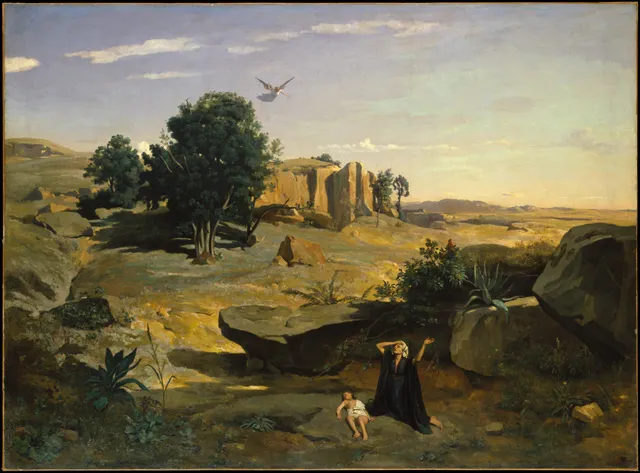
Look hard at Hagar in the Wilderness, the large historical landscape Corot sent to the Salon of 1835. The biblical pretext is the moment Abraham's cast-out servant and her son lie dying of thirst until an angel intervenes. You can find the figures, but you have to hunt for them. Hagar is flung down near the lower edge, one arm thrown back, a small dark accent in a field of pale stone. The boy is a smaller accent still. The angel hangs as a faint speck high in the sky. Everything above and around them is terrain: a wide arid basin, cool grey rock, a horizon that keeps receding. The Met, which holds the picture, notes that this desert was built partly from French nature studies rather than from any observed Sinai (Metropolitan Museum of Art).
Stand back and the proportions tell the whole story before you read a word of the catalogue. The figures occupy perhaps a tenth of the canvas. The rest is given to the slow work of the rock, where Corot has graded the greys so carefully that the cliff face seems to absorb heat as you watch it. The light comes from the left and rakes low, catching the upper edges of the stone and leaving the basin below in a dry, exhausted shadow. There is no relief anywhere in the terrain, no green, no water, only the implied promise of the spring the angel has come to reveal. He has painted thirst as a property of the ground itself.
Here is the argument, visible in a single canvas. The academic rule said the story justifies the land. Corot obeyed the rule and then quietly inverted its weight. The land overwhelms the story. The grief belongs less to Hagar's gesture than to the dry, indifferent expanse that dwarfs her, and the most carefully felt passages are not the figures at all but the rock and the light raking across it. He kept the noble subject on the wall, where the Salon needed it, while spending his real attention on the ground beneath it. That is not a painter waiting to become modern. That is a painter holding two convictions in one frame and letting them press against each other, the kind of doubled allegiance that a jury could read as piety and a younger painter could read as license.
The other canvas: the study made in front of the thing
While the machines went to the Salon, Corot was also doing something the academy treated as preparatory and disposable. He painted small oil studies outdoors, before the motif, fast, looking for the truth of a light rather than the design of a composition. The Getty's Italian Landscape (Site d'Italie, Soleil Levant), an oil of about 1835, belongs to this Italian habit of catching a hillside at a real hour (J. Paul Getty Museum). The point of such a study was never to be sold or framed. It was to fix, while the morning was still doing it, the exact value of the sun coming up over a particular slope, the way the warmest light sits at the horizon and cools as it climbs. No scripture. No antiquity. A place and a weather, recorded before either could be tidied into a composition.
This practice ran straight into the painters gathering at Barbizon, the village on the edge of the Forest of Fontainebleau that gave its name to the loose group Corot worked alongside, Théodore Rousseau among them, on their sketching trips into the woods (Tate). The open-air discipline that the Barbizon men made into a creed had been Corot's private working habit for years, and you can watch it tighten his composed work over time. River with a Distant Tower is the late Corot formula distilled: a band of still water, a screen of feathery trees, a single vertical accent set deep in silvery atmosphere. Note how little of it is local color. The greens have been pushed almost to grey, the sky and the water share nearly the same value, and the tower exists mostly as a darker breath at the point where the eye most wants something to rest on. It is composed, certainly, the way the academy taught him to compose. But the composing now serves the air, not a story. The motif has become its own justification, and the angel has been quietly dismissed from the sky.
The trees in that late manner are worth dwelling on, because they are the clearest sign of what the open-air years did to his hand. Early Corot drew a tree. Late Corot brushed one, dragging a loaded brush sideways so the foliage reads as a soft, broken mass rather than a contour, letting the ground tone show through in flecks the way light actually filters through leaves. The discipline is still there underneath, holding the silhouette in place, but the surface has gone to vibration. That is the technical inheritance the next generation pounced on, and it came directly out of the habit of painting the thing in front of him at the hour he was standing there.
The women, and the late silver
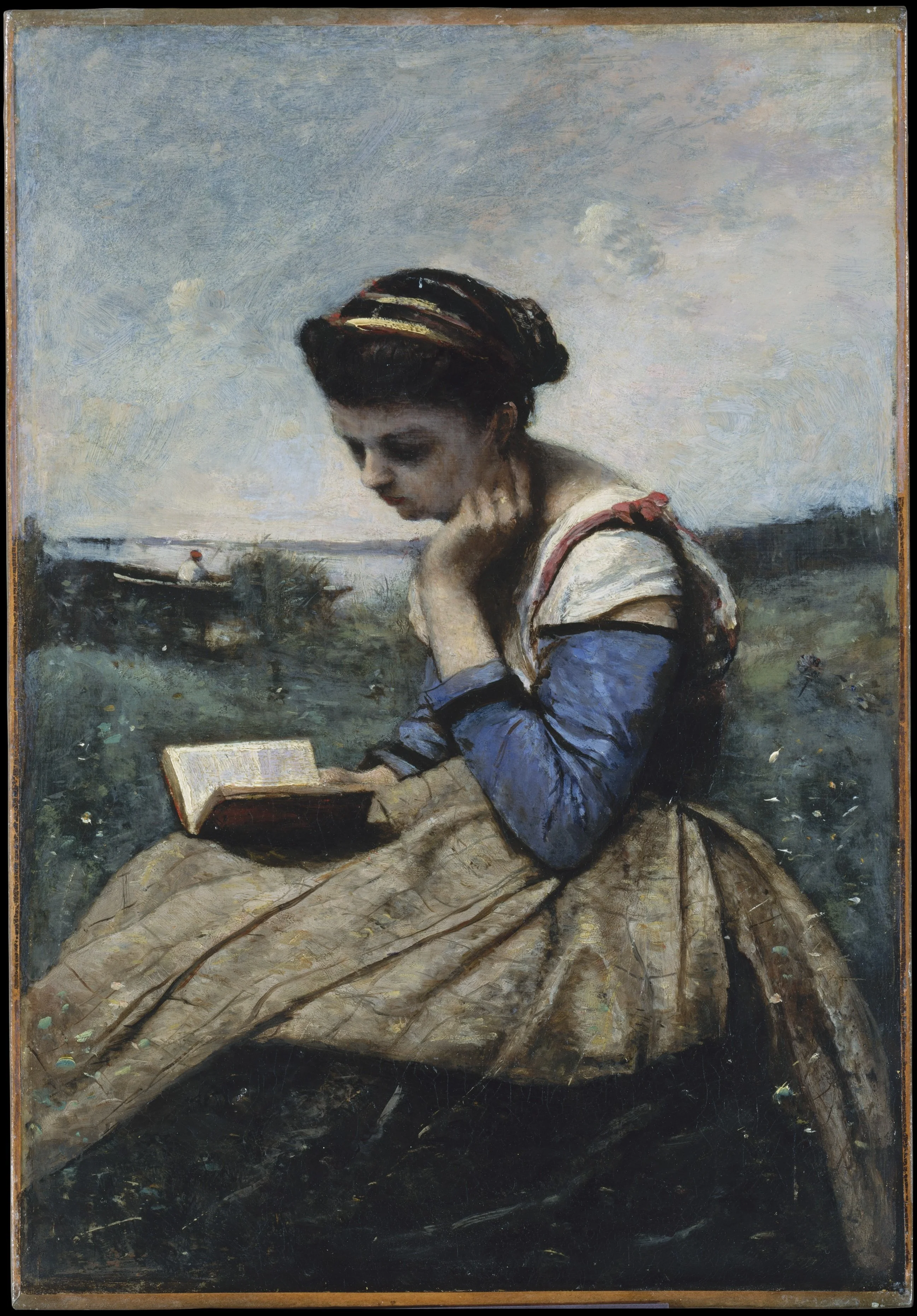
The same quarrel surfaces in the figures Corot kept largely to himself. Femme Lisant shows a seated woman absorbed in a book, her head bent, the light pooling on her shoulder and the pages while the background dissolves into a soft, unspecified landscape. The drawing of the head is firm, sculptural, the legacy of his academic training in the figure. The transition from the lit cheek to the shadowed side is handled with a control that has nothing impressionist about it. Everything behind her, by contrast, is treated like one of his outdoor studies, brushed loosely, kept atmospheric, refusing to compete. The picture sets a built figure against a found world and lets the contrast hum. The woman is composed; her surroundings are observed, and Corot makes no effort to disguise the seam between the two methods.
Put it beside Italian Woman (La Morieri) and the late religious painting Saint Sebastian Succored by the Holy Women, and the range of the man comes into focus. The Italian woman is built like the Salon figures of his youth, weighty and frontal, the costume given real material presence. The Sebastian is a late, ambitious religious machine, the kind of work that would have satisfied any Salon jury of his youth, with its figures grouped around the wounded saint in a frankly traditional arrangement. Yet by then his touch had been permanently loosened by the open air, so even the most conservative commission carries that misted, granular handling. He never abandoned the grand subject. He kept painting it with a hand that no longer entirely believed in finish. The argument with the predecessor had stopped being a choice and become a temperament.
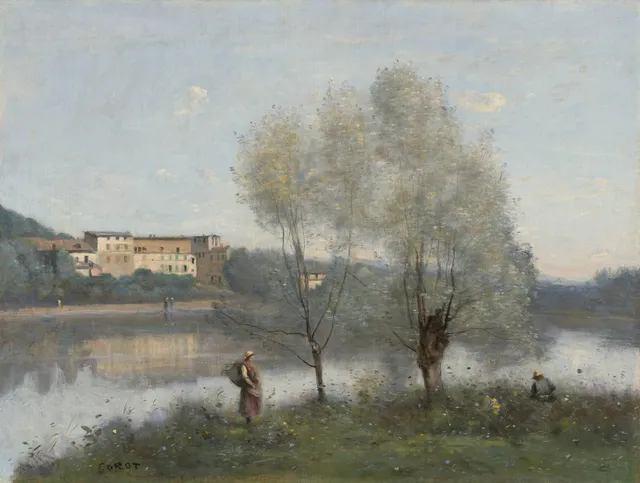
Then there is Ville-d'Avray, the pond near his family's house outside Paris that he painted again and again across his life. Here the two halves finally fuse so smoothly that the seam disappears. The composition is textbook Corot: a screen of tall trees on one side, their reflections laid down the still water, a low horizon, a few small figures placed where the design needs a human note. But the handling is all study. The foliage is broken into soft daubs, the water is a flat sheet of silvered grey, and the whole picture sits inside a single, even light that feels like late afternoon turning toward dusk. The structure is academic. The mood is observed. Neither one is winning, and that is exactly the point. Ville-d'Avray is the place where the lifelong argument stops being audible and becomes, simply, the way he sees.
The scale of his output is part of the story. Alfred Robaut's catalogue raisonné, L'oeuvre de Corot, published in Paris by H. Floury in 1905 in four hundred numbered copies, remains the foundational period record of just how much he made (Robaut, 1905, via Internet Archive). Against that benchmark, Artifact World Gallery holds 371 works attributed to Corot spread across 48 venues, ranging in date from roughly 1800 to 1874. The interesting figure is the venue count. A single painter scattered through four dozen collections is the statistical shadow of a popularity that began in his own lifetime and never collapsed, the kind of even, durable demand that historical-landscape rivals who bet everything on the Salon never achieved. The forty-eight-venue spread is what a doubled career looks like a century and a half later. He made work the museums of his day wanted and work the dealers of the next era would chase, and both halves are still hanging.
Works discussed in this article
What the next generation kept, and what it threw away
The painters who came after Corot resolved the quarrel he had refused to settle, and they resolved it by amputation. They kept the half he had smuggled in, the study before the motif, the conviction that light was the content, and they discarded the half he had defended at the Salon. The recurring motif of Ville-d'Avray, the pond he painted until it became a reflex, was the lesson the younger painters memorised: take an ordinary place, return to it, and let the weather do the rest. You do not need scripture to justify looking. The looking is the work. Claude Monet, asked in 1897 to name the painters who mattered, gave only one answer.
That homage is precise about which Corot the Impressionists loved. Not the Hagar machine. The pond at dawn, the willows, the silver. Berthe Morisot, whose early development passed through the Corot orbit, carried his soft, observed register straight into the heart of Impressionism. The transmission ran across the Atlantic too. William Morris Hunt brought the Barbizon mood to Boston and made it fashionable among American collectors, which is one reason a French landscapist ended up so widely dispersed through American holdings. Around the same conversation you find Sanford Robinson Gifford and Daniel Huntington, American painters working out their own balance between composed grandeur and observed light. The argument Corot kept open had become an international inheritance, dispersed across two continents and a generation of painters who each took the part of him they needed.
There is a cost to the amputation worth naming. The Impressionists gained the immediacy of the study and lost the structural ambition of the machine, the capacity to organise a large canvas into something that holds like architecture. Corot could do both, and the reason his late landscapes feel so settled, so unforced, is that the open-air looseness sits on a frame built by the old discipline. Strip away the academic scaffolding and the silvery touch can drift toward mere prettiness, which is exactly what happened to the weaker corners of the Barbizon market. The touch needs the bones. He is the last painter for whom the two halves of the argument were still load-bearing at once. After him you mostly choose a side, and the choosing, for all that it produced, was also a narrowing.
Sources & further reading
- Jean-Baptiste-Camille Corot — Wikipedia
- Jean-Baptiste-Camille Corot, Artist biography — National Gallery of Art
- Hagar in the Wilderness — The Metropolitan Museum of Art
- Plein air (art term) — Tate
- L'oeuvre de Corot (catalogue raisonné, 1905) — Alfred Robaut / Internet Archive
- Italian Landscape (Site d'Italie, Soleil Levant), about 1835 — The J. Paul Getty Museum