Artwork
Hagar in the Wilderness
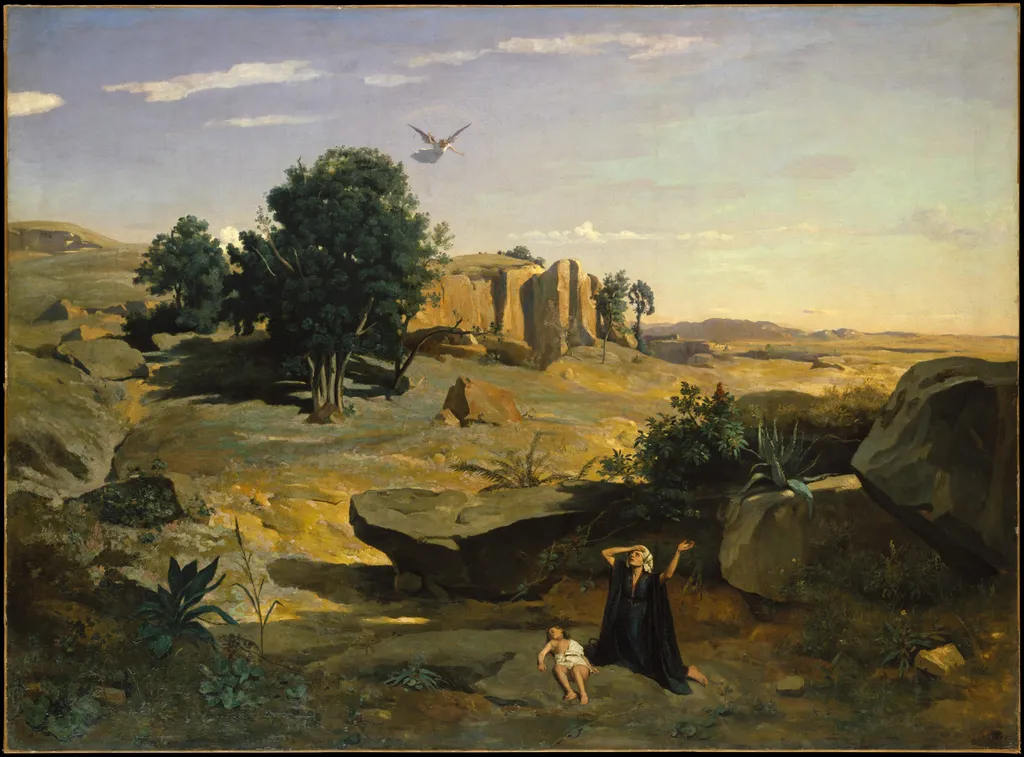
Hagar in the Wilderness is an oil painting by the Academic Art artist Jean Baptiste Camille Corot. It dates from 1835 and is held in the collection of the Metropolitan Museum of Art.
About this work
Subject & Meaning
The painting thus dramatizes the narrative of Hagar’s exile and subsequent salvation, embodying themes of maternal suffering, faith, and divine intervention.
The work shows the biblical figure Hagar together with her son Ishmael in the desert of Beersheba, a moment of divine rescue signaled by an angel positioned in the upper background; this iconography conveys God’s providential care for the abandoned mother and child. Painted by Jean‑Baptiste Camille Corot in 1835, the oil‑on‑canvas composition was exhibited at the Salon of that year and is now housed in the Metropolitan Museum of Art. Corot based the surrounding landscape on his earlier nature studies, reinforcing the realism of the wilderness setting.
The painting thus dramatizes the narrative of Hagar’s exile and subsequent salvation, embodying themes of maternal suffering, faith, and divine intervention.
Technique & Style
Hagar in the Wilderness is executed in oil paint on canvas, a standard support for Corot's ambitious Salon-scale works of the 1830s. The painting measures 180.3 cm in height by 270.5 cm in width, giving it a wide horizontal format suited to its panoramic wilderness setting. Much of the landscape is derived from Corot's earlier nature studies, indicating a working method that combined on-site sketching with studio assembly.
The composition places the biblical figures, including Hagar, her child, and a salvation angel in the back center, against a landscape derived from preparatory plein-air studies. Stylistically, the work is associated with the academic art movement and represents Corot's earliest of four ambitious biblical paintings exhibited during the 1830s and 1840s, beginning with its presentation at the Salon of 1835.
History & Provenance
Jean-Baptiste Camille Corot painted Hagar in the Wilderness in 1835 as an oil‑on‑canvas work measuring 180.3 cm × 270.5 cm. The composition was conceived for exhibition at the Salon of 1835 and is part of a series of four ambitious biblical canvases Corot showed in the 1830s‑1840s. Executed in the academic style, the painting depicts the biblical figure Hagar and her son Ishmael in the desert, a theme drawn from the Book of Genesis. Since its creation, the work has remained in the collection of the Metropolitan Museum of Art in New York, where it is catalogued as part of the museum’s holdings.
Hagar in the Wilderness has been in the collection of the Metropolitan Museum of Art in New York since at least the time its modern documentation was compiled. The painting was first publicly shown at the Salon of 1835, where Corot debuted it as the earliest of four ambitious biblical compositions he exhibited during the 1830s and 1840s. It was later included in the retrospective exhibition "Corot 1796-1875," a presentation dedicated to surveying the artist's career. The work remains associated with the Metropolitan Museum of Art as its holding institution.
Context
Jean-Baptiste-Camille Corot's 1835 oil‑on‑canvas Hagar in the Wilderness entered the Metropolitan Museum of Art collection and was shown at the 1835 Salon, marking the first of four ambitious biblical canvases he produced in the 1830s and 1840s. Art historians view the work as a pivotal example of academic painting that merges landscape study with narrative religious content, reflecting Corot’s broader engagement with the academic art movement and his debt to nature observation. The painting’s depiction of the biblical episode of Hagar and Ishmael, underscored by an angelic apparition, illustrates Corot’s synthesis of classical composition and Romantic sensibility, establishing a precedent for later artists who integrated biblical themes within naturalistic settings.
Overview
Jean-Baptiste-Camille Corot's Hagar in the Wilderness, painted in 1835, depicts the biblical narrative of Hagar and her son Ishmael during their exile in the desert. The composition centers on Hagar, dressed in dark robes, kneeling on arid, rocky terrain with her head tilted back in a gesture of supplication or despair. Beside her, the infant Ishmael lies on the grass, mirroring her upward gaze toward the heavens.
The setting is a sun-drenched landscape characterized by scattered trees, classical ruins, and distant hills under a pale, expansive sky. Executed in oil paint, the work reflects Corot's early adherence to the Neoclassical tradition, where religious subjects were rendered with a focus on idealized forms and structured composition rather than the loose, atmospheric brushwork that would later define his mature style. Created during a period when Corot was still heavily influenced by his training under Jean-Victor Bertin and his study of Italian landscapes, this painting demonstrates his ability to integrate a moralizing narrative within a carefully constructed natural environment.
The work stands as a significant example of Corot's academic phase, bridging the gap between historical painting and the emerging interest in direct observation of nature that would eventually lead to the Barbizon School.
Own this work as a print
Artist & collection
Artist
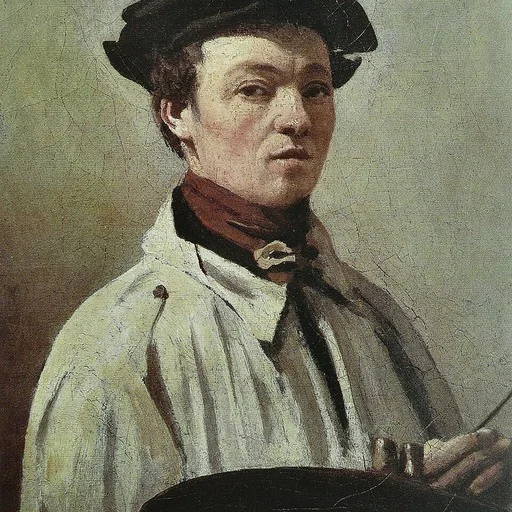
Jean-Baptiste-Camille Corot (UK: KORR-oh, US: kə-ROH, kor-OH; French:; 16 July 1796 – 22 February 1875), or simply Camille Corot, was a French landscape and portrait painter as well as a printmaker in etching.

 Mercury and Battus
 Bandits in Romagna
 Study for "The Destruction of Sodom"
 Klassische Landschaft
 An antique rural scene
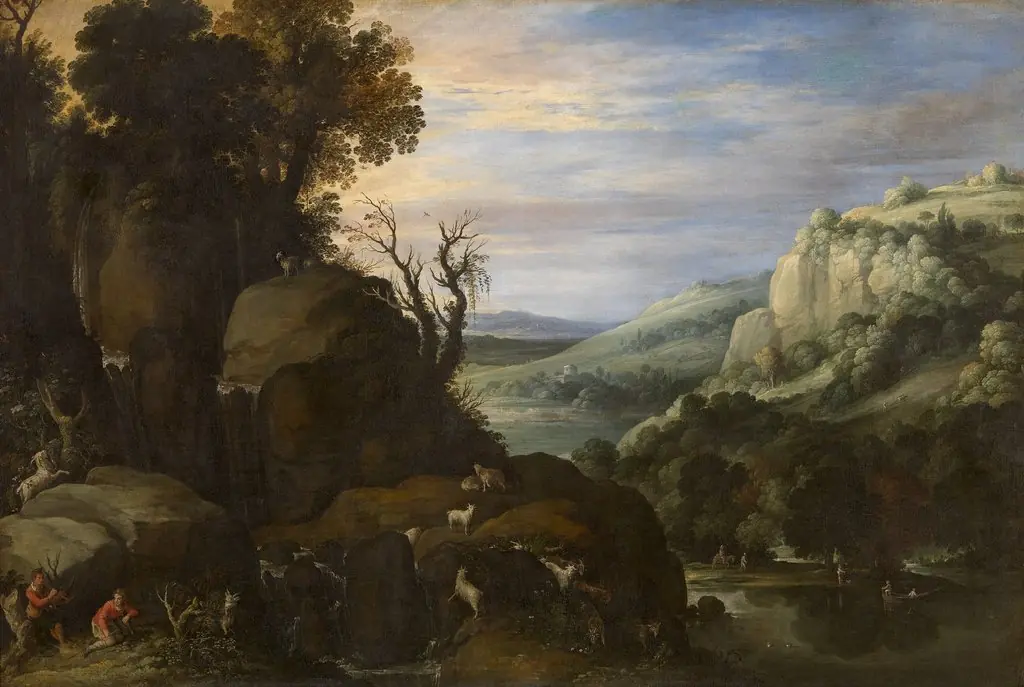 Landscape
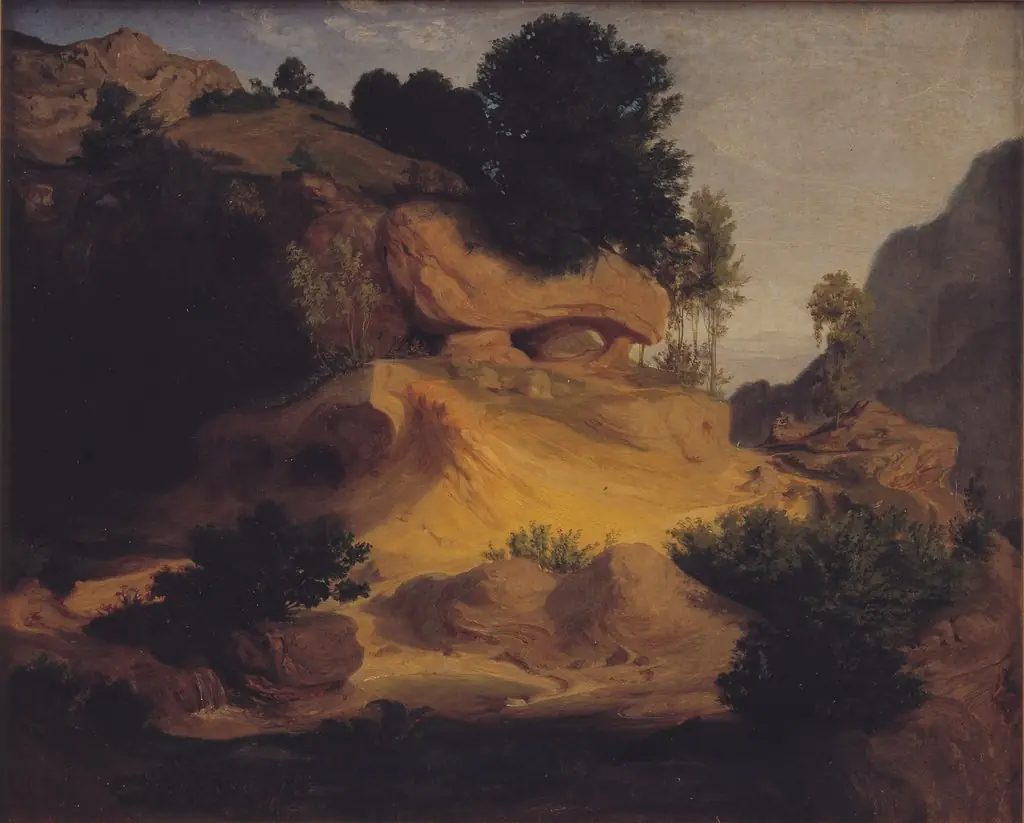 Landscape near Subiaco, Italy
 Italian Landscape with Bathers
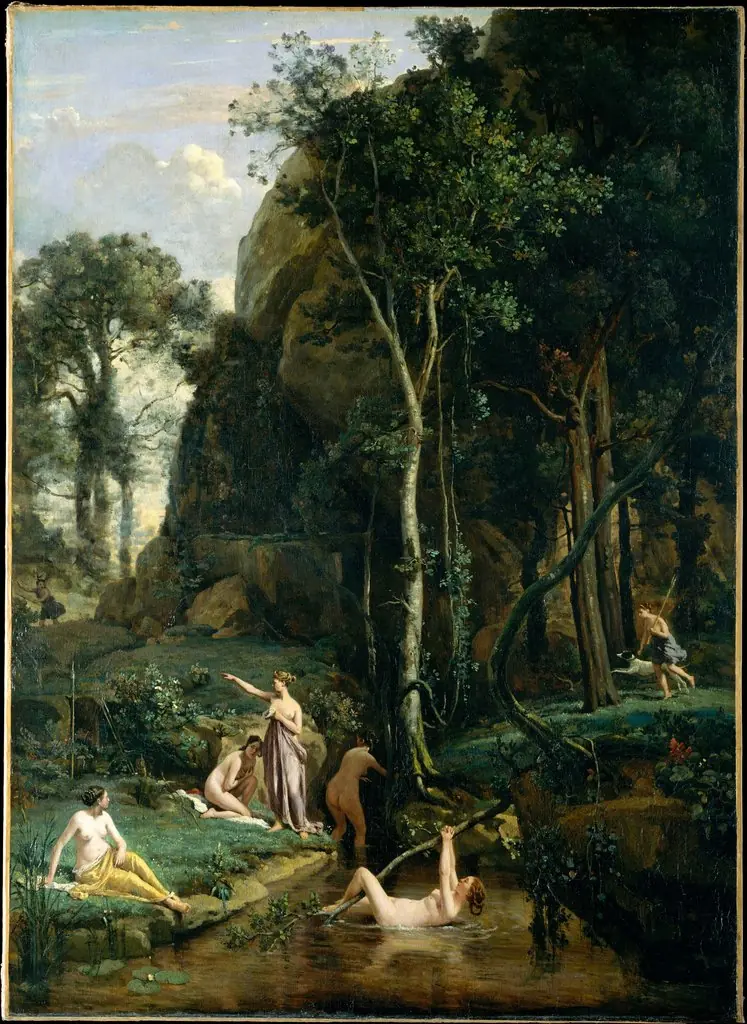 Diana and Actaeon (Diana Surprised in Her Bath)
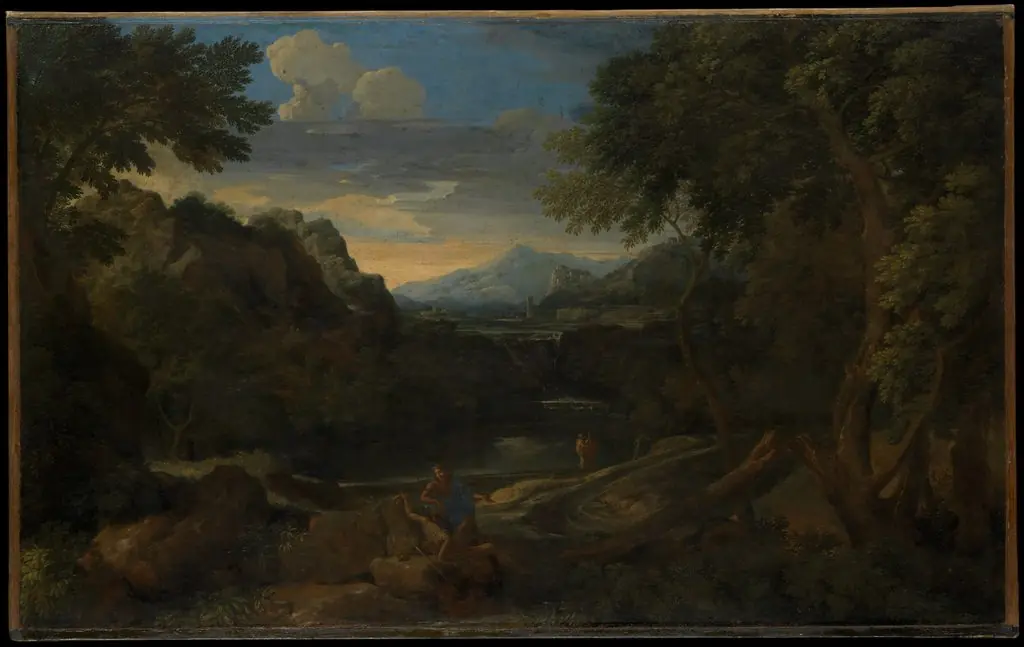 Imaginary Landscape
 Landscape near Subiaco, Italy
- Hagar and Ishmael in the Desert