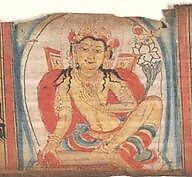
To look at an Indian miniature painting is to read a ledger as much as an image. The artists who made these small, jewel-dense pictures rarely chose their own subjects, and they almost never signed them in a way we would recognize today. Someone else did the choosing: a Mughal emperor with a library to fill, a Rajput raja, a Jain merchant guild buying spiritual merit, later a colonial officer with a taste for the picturesque. This essay defends a single claim. The history of Indian miniature painting is the history of its paymasters, and you cannot explain one stylistic shift in it without first asking whose money was on the table.
That cuts against the way the genre is usually sold, as the timeless flowering of an Eastern sensibility. The truth is blunter and more interesting. When the imperial treasury was full and the emperor curious, the workshops swelled and the style turned ambitious and experimental. When a later emperor shut his purse on religious grounds, the painters packed their brushes and walked to the hill courts, carrying the imperial manner into the Himalayan foothills, where new patrons paid for Krishna instead of conquest. Follow the money and the map of Indian painting redraws itself. The hand that held the brush is, more often than not, the least documented part of the transaction. The patron, the text, the donation, the dealer: those are the things the record keeps.
The patron held the brush
A miniature was a manufactured object, made inside an atelier the patron paid for and staffed. The Mughal version, the karkhana, was organized like a department of state, with a head painter, colour grinders, gilders, and apprentices on the rolls. The Met, in its survey of Mughal court art, identifies Akbar as the first great patron of the arts of the book, and notes that his painters included Persians alongside Indian Muslims and Hindus, a deliberate mixing that produced a specifically Mughal style.
Read that staffing list closely, because it is an argument about money and power, not aesthetics. An emperor who could afford to import Safavid masters and pair them with local Hindu colourists was buying a fusion no single tradition could have generated on its own. The patron set the brief, supplied the costly lapis and gold, and owned the result. The painter executed. The relationship was contractual before it was anything else, and the contract is what shaped the look of the page. When we ask the romantic question, who was the artist, the workshop answers with a shrug and a payroll. (The Met's Heilbrunn essay on Mughal painting lays out that collaborative model in detail.)
A scriptorium before an empire
The tradition did not start with the Mughals, and neither did its economics. Centuries before Akbar, the workshops of western India were turning out illustrated Jain manuscripts, first on narrow palm leaves and later on paper, financed by exactly the kind of patron we keep meeting: a wealthy lay community buying merit. A merchant would commission a copy of a sacred text, have it illuminated, and donate it to a temple library, the bhandara, as an act of piety. The painters stayed anonymous. The names that survive belong to the authors and compilers of the texts, not the hands that painted them.
Our own catalogue preserves that asymmetry. The most-represented name attached to this material is the monk Bhadrabahu, to whom the Kalpasutra, the most lavishly illustrated of all Jain texts, is traditionally ascribed. He was a teacher and a textual authority, not a painter, yet the corpus files dozens of folios under his name because the manuscript, not the illuminator, was the unit that mattered. The same logic puts the great twelfth-century polymath Hemachandra and lesser-known compilers like Pradyumnasuri and Devachandra at the head of pictures they never touched. It is the cleanest evidence we have for the thesis: in this tradition, authorship was assigned to the source of the commission and the doctrine, not to the brush.
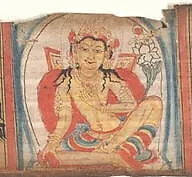
Look hard at the sheet catalogued as Untitled, and the conventions of that scriptorium are right on the surface. The figures are built from sharp, wiry contour rather than modelled volume, set in three-quarter view against a flat, saturated ground that admits no depth at all. The diagnostic feature is the eyes. The farther eye is pushed clear past the line of the cheek, floating out into the empty field beside the face, a stylization the western workshops kept for generations because devotion, not optical truth, was the point. Colour arrives in unbroken blocks, hot red and deep blue, with gold reserved for haloes and ornament. Nothing recedes. The whole page reads like heraldry, a scheme of signs a worshipper was meant to recognize, not a window to look through. That refusal of depth is not a limitation the painter failed to overcome. It is the house style a paying community expected, and other folios from the same milieu, this one and this one, repeat it almost note for note. A painter who strayed from the agreed scheme would have produced something the donor never ordered, and a manuscript bound for a temple library could not carry a private flourish.
The repetition is the point, and it is worth dwelling on, because a modern eye trained on signed European panels wants to read it as monotony. It is the opposite. The sheets catalogued as Untitled and Untitled carry the same protruding eye, the same red ground, the same flattened ranks of figures, and they were meant to. A donor paying for merit wanted the orthodox image, not the inventive one, and a workshop that delivered the agreed scheme was delivering exactly the product on order. Even the densely worked border on this folio, a lattice of small repeated motifs framing the scene, is a unit of value the patron was buying by the square inch, gold and labour made visible. Consistency was the brand. Deviation would have been a defect in the goods.
Akbar's laboratory
Then a patron arrived who wanted something the old workshops could not deliver, and he had the revenue of an empire to fund the experiment. Akbar's first great project was the Hamzanama, the adventures of Hamza, begun around 1562 and produced over roughly fourteen years. The numbers are the argument. It originally ran to about 1,400 large folios, each painted not on paper but on cotton cloth at roughly 69 by 54 centimetres, of which only a little over a hundred survive today.
Smarthistory describes the Hamzanama as the laboratory in which the synthetic Mughal style was negotiated, fusing Persian elegance, indigenous Indian colour and observation, and European Renaissance modelling and perspective. Its introduction to the Mughal tradition makes the scale concrete: these were storytelling aids, held up while the tale was recited aloud. A project that size is not a hobby. It is industrial commissioning, and it tells you precisely how much an emperor was willing to spend to invent a court manner out of three borrowed ones. The fourteen-year run, recorded in the history of the Hamzanama itself, was less a single book than a training programme that produced the next generation of imperial painters. The Persian masters set the design, the Indian colourists learned the new vocabulary on the job, and the emperor footed the bill for the apprenticeship of an entire school. By the time the last folio dried, Akbar had not merely bought a book. He had financed the training of every painter who would carry the court manner forward.
The signature problem
Here is where the question who painted it gets genuinely hard, and where patronage explains the difficulty. Imperial folios often carry tiny library notes attributing the design, the tarh, to one master, the colouring, the amal, to a second, and sometimes the faces of the chief portraits to a third specialist. A single picture could be the work of three hands by design, because the patron ran a production line and wanted the best face-painter in the building on the emperor's own likeness. Attribution in this system is not a name on a canvas. It is a quality-control memo, written by the library to track who did what well enough to be asked again.
The very word we use carries a similar foreign fingerprint. Tate's glossary defines a miniature as a small painting, usually a portrait, and reaches for the European court tradition to do it, naming Nicholas Hilliard, painter to Elizabeth I, as one of the greatest of all miniature painters. The term itself descends from minium, the red lead used to mark initials in medieval manuscripts, and has nothing to do with smallness in its origin. We file the Indian material under a borrowed European label, which is a small reminder that the people who named, collected, and classified these works were frequently not the people who made them either. The vocabulary, like the gold, was imported.
When the money moved
The cleanest proof that patronage drives the whole story is what happened when patronage stopped. Imperial support for painting contracted sharply under Aurangzeb, who reigned from 1658 to 1707 and was never an enthusiastic patron, largely for religious reasons, commissioning essentially no paintings after 1668. The record of that withdrawal marks a hinge in the art's geography. Trained painters with no imperial salary did what skilled workers always do. They went where the work was.
The work was in the courts. Rajput rulers in Rajasthan and the Rajas of the Pahari hill states, Basohli, Guler, Kangra, took on the dispersed talent, and the style bent to fit the new buyers. Out went imperial durbars and battle scenes. In came Krishna and Radha, the Gita Govinda, the Bhagavata Purana, a softer and more lyrical line tuned to Hindu devotional taste. The master most associated with the Kangra refinement, Purkhu of Kangra, ran a busy atelier under Raja Sansar Chand, whose appetite for picture-making rivalled a small Mughal court. Same trained hands, different gods, because a different patron was paying. The brushwork stayed imperial while the iconography turned domestic and devotional. The imperial manner did not die when Delhi lost interest. It relocated, and it changed its subject because the buyer changed his.
Our own archive maps that dispersal in miniature. Artifact World Gallery holds 211 Indian Miniature works spread across nine venues, attributed to thirteen named hands, and dated across an extraordinary span from roughly 1149 to 1949. That eight-century reach, from Jain palm-leaf devotion to the threshold of independent India, is itself the patronage story in a single line. No one workshop, no one dynasty, and no one religion held the tradition. It passed from buyer to buyer, and each one left a fingerprint on what got painted. Nine venues holding a single named movement is itself a measure of how widely those commissions scattered once the central paymaster fell away. Thirteen names across eight centuries is a thin roster for a tradition this large, and the thinness is the evidence: most of the hands went unrecorded because the buyer, not the painter, was the figure the ledger cared to name.
Europe pays attention
The patronage circuit eventually ran in both directions. As Mughal portraits travelled west through Dutch and Portuguese trade, they reached the most unlikely of admirers. Rembrandt made roughly twenty-three drawings copying Mughal imperial portraits, among them a delicate sheet now in the Rijksmuseum, the Portrait of Jahangir, dated about 1656 to 1658, executed in pen and brown ink with wash on imported Japanese paper. That drawing is a strange and telling object: a Dutch master, working for the open Amsterdam market rather than a prince, studying the conventions an Indian workshop had built for an emperor. The Getty has framed exactly this exchange, placing Rembrandt's copies inside a broader circuit of cross-cultural contact across Europe and South Asia. The market had become the patron, and the market wanted the exotic East. A portrait built to flatter an emperor now answered a private collector's curiosity about a place he would never see, the same image bought twice over for opposite reasons.
Under British rule the patron changed again, and the change was decisive. East India Company officials commissioned Indian painters to record monuments, costumes, and natural history in a hybrid manner now called Company painting, half miniature technique, half European watercolour. The buyer's eye, foreign and documentary, reshaped the output once more. By the end of the line stands Raja Ravi Varma, who took Indian subjects into European oil and, crucially, into the lithographic press. His mass-produced prints answered to a new patron entirely, the broad buying public, and a god that had lived on a single donated manuscript page now hung in thousands of ordinary homes. The corpus end-date of 1949 sits right at that threshold, where courtly commission gives way to the printed market.
Works discussed in this article
What the ledger teaches
It is tempting to mourn the anonymity, to wish we could pin every brilliant page to a named genius the way we do a Renaissance panel. That wish misreads the form. These pictures were never meant to be signatures. They were commissions, and the commission is exactly what survives most clearly: the merchant buying merit, the emperor inventing a style by decree, the hill raja importing a refugee atelier, the Company officer ordering up his curiosities, the publisher pressing a goddess into ten thousand sheets. The names we can recover are mostly the names of the people who paid and the texts they revered, and that is not a gap in the record. It is the record.
So the next time a small, dense, gold-flecked Indian painting stops you, run the older question first. Not who was the artist, but who wanted this made, and what were they buying. The answer will tell you the date, the region, the gods on the page, and the foreign elements smuggled into the line, long before any connoisseur gets around to guessing the hand. The patron is still in the room. You only have to look for the receipt.
Sources & further reading
- Mughal Painting | Heilbrunn Timeline of Art History — The Met
- The Mughal painting tradition, an introduction — Smarthistory
- Hamzanama (Akbar) — Wikipedia
- Mughal painting — Wikipedia
- Miniature | Art Terms — Tate
- Jahangir (Rembrandt, after a Mughal portrait), c. 1656-1658 — Rijksmuseum
- Rembrandt and the Inspiration of India — The J. Paul Getty Museum
- Indian Painting Under the Mughals, A.D. 1550 to A.D. 1750 (Percy Brown) — Internet Archive