A landscape painting always answers a question, even when it pretends to be nothing more than a faithful record of a place. The question is this: is the visible world a stage set for human business, or is it the subject itself, worth our full attention with no saint, no battle, no patron's profile to justify the attention we give it? For most of European art history the answer was assumed rather than argued. Land was where the story happened. The story was what you painted. Then, slowly, the land began to talk back, and painters discovered that a field of light and a band of weather could carry as much meaning as a face.
Here is the claim this essay defends, work by work: the history of landscape is not a tidy march toward realism, and it is not one tradition handing a torch to the next. It is a single question asked over and over, answered in incompatible accents, and each strong school wins by refusing the answer it inherited. The Dutch refused idealization. The French academicians refused the ordinary. The English refused the studio. The Americans refused modesty. Read the genre this way and the famous canvases stop being scenery and start being arguments. What is a view for? Every painter below gives a different reply, and the disagreements are the point.
A word that began as a painting
Start with the word, because it carries the argument inside it. English borrowed "landscape" from the Dutch landschap, and it entered the language first as a term for a picture, not a place. Its earliest recorded use to mean a painting dates to 1598, according to the standard account of the genre's history (Wikipedia, Landscape painting). That order matters. Before there was an English noun for a stretch of countryside seen all at once, there was an English noun for the thing a Dutch artist did with it on a panel. The category arrived as art and only later loaned itself back to the land. So the genre was self-conscious from birth. It knew it was a way of looking before it was a thing looked at.
That self-consciousness had to fight for status. When the French Royal Academy organized painting into a ranked order of seriousness, landscape came out near the bottom. André Félibien's hierarchy of 1667 put history painting first, then portraiture, then scenes of everyday life, and only then landscape, with still life last of all (Wikipedia, Hierarchy of genres). The Tate puts the same verdict plainly: the Academy placed landscape fourth in importance out of five (Tate, landscape). The reasoning was that painting the unpeopled world asked nothing of the intellect. A man who could compose a moral drama out of bodies and gestures stood above a man who could only render fruit or a hillside. The whole later history of the genre is, in one sense, an attempt to prove that verdict wrong. The painters who matter did not accept that a hillside asks nothing of the mind.
The Dutch answer: the everyday horizon
The first sustained rebuttal came not from theory but from a market. During the 1600s landscape grew into an independent, sellable genre in the Dutch Republic and the Spanish Netherlands, where a Protestant merchant class wanted pictures of the country it actually lived in rather than altarpieces it no longer commissioned (Walter Liedtke, Metropolitan Museum of Art). The Dutch answer to the question was blunt: a view is for recognition. You should know this place. The dunes, the flat polder under a high sky, the frozen canal in January.
Look at how far that went. Hendrick Avercamp built a career on winter scenes, the kind the seventeenth century called wintertjes, and his Winter Landscape with Ice Skaters packs roughly two hundred figures onto a single frozen surface (Rijksmuseum). Two hundred. Skaters, sledders, a couple who have fallen, fishermen, dogs, a distant town. No single one is the subject. The crowd is the subject, and so is the cold white light that lets you see all of them at once. Avercamp answered the Academy in advance: a view asks plenty of the eye. It asks you to hold a hundred small human stories in suspension and call the holding itself the picture's content.
The classical answer: an Italy that never existed
Against the Dutch insistence on the actual stood the opposite answer, and it came, fittingly, from two Frenchmen working in Rome. The classical or ideal landscape was perfected by Nicolas Poussin and Claude Lorrain (J. Paul Getty Museum). Their answer to the question was the reverse of Avercamp's: a view is for the mind, not the eye, and so it should not record any real place at all. Claude composed harbors at golden hour, framed by feathery trees and screened by ruined temples, with a shepherd or a fleeing Holy Family tucked into the corner to license the grandeur. The light is gorgeous and the geography is invented. He was building an argument about order, calm, and the dignity of nature arranged by reason.
This is the cleverest move in the whole dispute, and it is worth naming. By idealizing, Poussin and Claude smuggled landscape up the hierarchy. If a painted valley could embody a philosophical mood, then it was doing the intellectual work the Academy reserved for history painting. The strategy worked so well that two centuries of European painters learned to see real countryside through Claude's golden filter. The English even carried a tinted glass, the "Claude glass," to make actual hills look more like his canvases. The ideal had colonized the real. The next answer would have to take the real back.
The English answer: weather, not theatre
That recovery is the achievement of John Constable, and you can watch him perform it in Wivenhoe Park, Essex. The painting is a commission, a record of a friend's estate, and it could have been a flattering inventory of property. Constable turns it into something stranger and more honest. The cattle stand in real water in the foreground, the cows mirrored with a precision that is about reflection and not about ownership. A wide, low band of trees runs across the middle distance, and above it sits the true subject: a sky of moving cloud, blue breaking through grey, the light uneven because in Essex the light is always uneven. He has painted the air. Look at the small touches of white he flicks onto the leaves and the water, the famous "snow" his critics mocked, which are not snow but the way wet English foliage throws back the sun for an instant before a cloud crosses. Constable has more than two hundred works in our archive, and across them you find the same conviction repeated: that a particular hour of particular weather over a particular field is a worthy subject for serious paint.
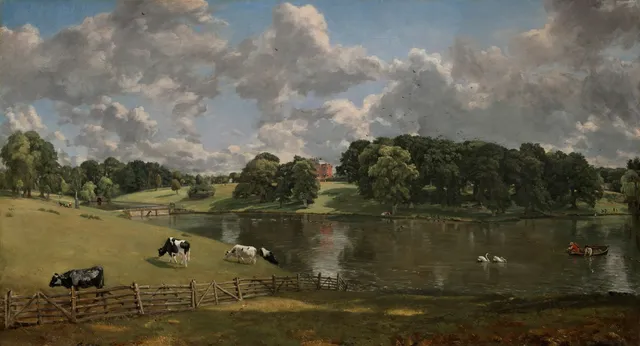
Constable's answer is the Dutch answer made personal. Not just recognition of a place, but fidelity to a moment that will never recur. He sketched clouds in oil outdoors and noted the date, the wind, the time of day on the back, like a man keeping a weather diary. The view is for truth, and truth means the transient. That is a quiet revolution against Claude. Where the Frenchman gave you an eternal golden afternoon, Constable gives you four-fifteen on a windy Tuesday, and insists that the Tuesday is enough.
Ruskin's wager: the moderns beat the masters
By the 1840s the argument had a champion willing to make it a war. The young John Ruskin published the first volume of Modern Painters in 1843 with a title that reads like a battle order: a defense of the modern landscapists' superiority to all the ancient masters, proved from the work of J. M. W. Turner (Modern Painters, Internet Archive). Ruskin's wager was that truth to nature, close and reverent observation of cloud, stone, and water, was the highest aim painting could have, and that Turner observed more truly than Claude ever had. The genre the Academy ranked fourth was now, in Ruskin's hands, the proving ground for the whole question of what art is for. Turner answered by dissolving the view into pure light and storm, pushing the Constable principle until the weather nearly swallowed the land. The transient had become the sublime.
The American answer: the view as a verdict on a nation
When the question crossed the Atlantic, it picked up a political charge no European answer carried. American painters faced a continent that was being settled in real time, and the landscape became a place to argue about what that settlement meant. The figure who frames the debate is Thomas Cole, and his clearest statement is View from Mount Holyoke after a Thunderstorm, the Oxbow. Cole splits the canvas down a diagonal. On the left, dark wilderness, a blasted tree, the trailing edge of the storm, everything wild and shadowed and bent by wind. On the right, the valley opens into sunlight: tidy fields, the river curling into its famous oxbow, smoke rising from cleared farmland. Down in the foreground, almost hidden, Cole paints himself at his easel under an umbrella, turning to look back at us. He is asking the viewer to choose, and refusing to choose for them. Wilderness or cultivation? Sublimity or use? The painting holds the two halves in deliberate tension and lets the question hang.
This is the American innovation. The view becomes a verdict on a nation's future, and the painter declines to pronounce it cleanly. That ambivalence is the source of the Hudson River School's power, and it runs straight into the work of Cole's most ambitious heir.
Bierstadt: the sublime as spectacle
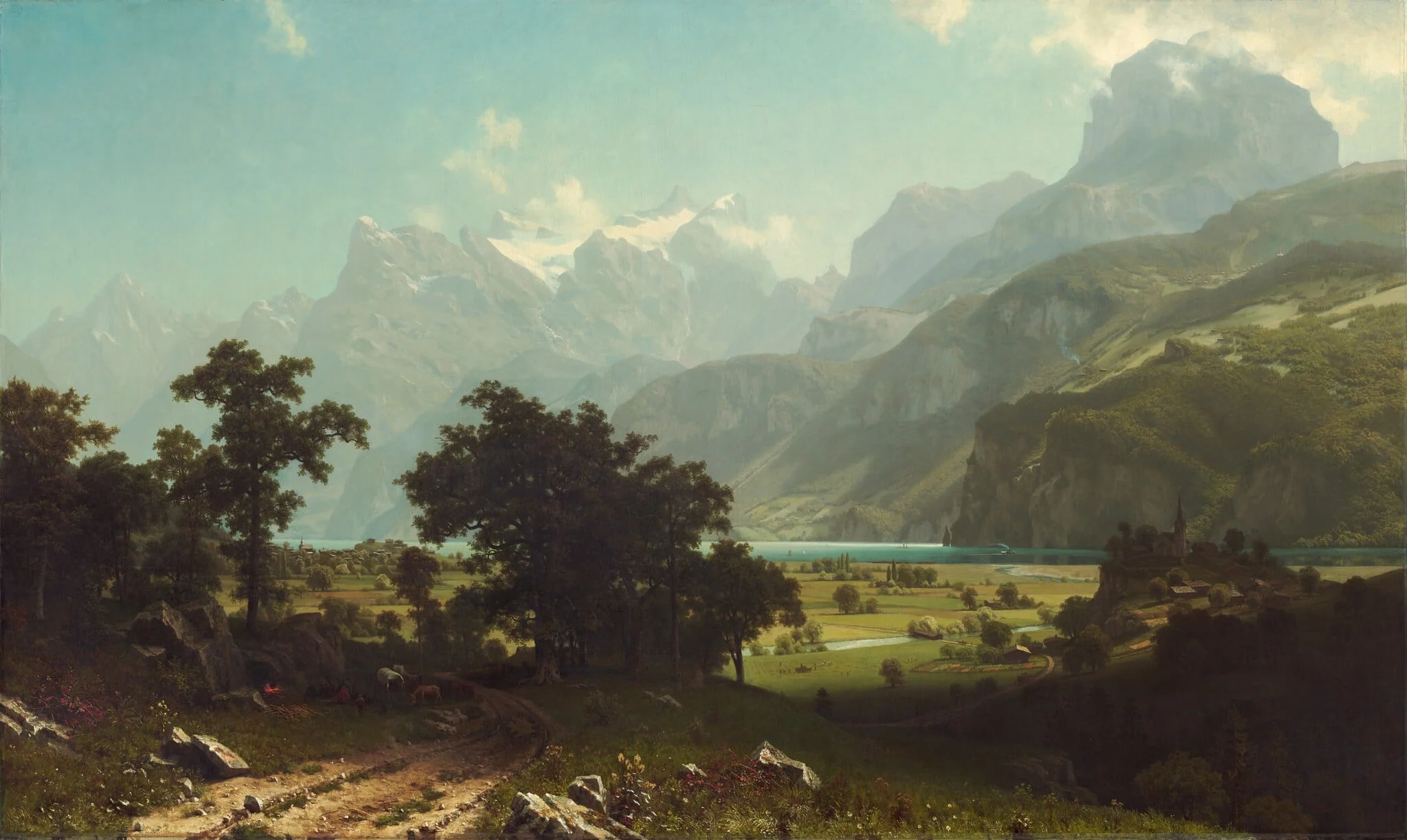
Albert Bierstadt resolved Cole's tension by overwhelming it. Before he ever went west, he painted Lake Lucerne, a Swiss subject built on a scale meant to stop a crowd in a gallery. Stand in front of it and the structure announces itself. The near shore comes right up to your feet, broken and rocky, with small figures and animals scattered along it so that you measure yourself against them and find yourself tiny. Then the lake pulls back, a sheet of still water reflecting the last of the storm, and the eye runs across it to the far peaks, where the clouds are tearing open and a cold high light is breaking through onto snow. Bierstadt stacks the depth in clear bands: foreground rubble, mid-distance water, the wall of mountains, the dramatic sky. The light does the persuading. He makes the air at the top of the picture luminous, almost theatrical, so that the mountains seem lit from within by something close to revelation.
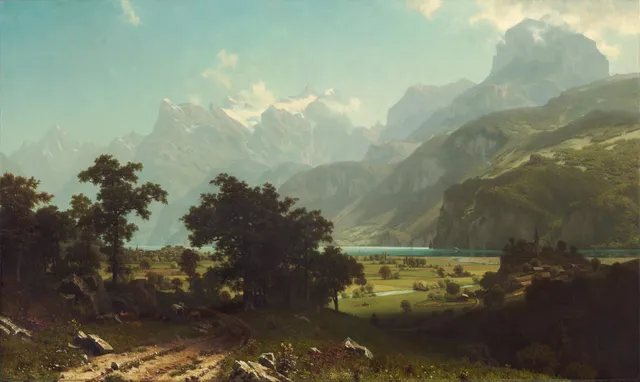
Notice what the foreground figures are doing in that scheme. They are not the subject. They are the unit of measurement that proves the mountains are enormous. Cole would have made them choose; Bierstadt makes them gape. When he carried this technique to the American West in The Rocky Mountains, Lander's Peak, he set a Native encampment along the base of a colossal range and lit the peaks like an altar. The painting toured as a paid attraction, hung alone behind a curtain, sold by ticket. Bierstadt gave the genre its loudest answer yet: a view is for awe, manufactured at scale and delivered to a paying public. It is magnificent, and it is also a performance, and the best of his canvases know it.
Cropsey and the local answer
Not every American painter wanted the Alpine register. Jasper Francis Cropsey turned the sublime down to the scale of a single season and a single river, and in doing so recovered something Constable would have recognized. Autumn, On the Hudson River is, famously, a painting Cropsey made from memory while living in London, partly to convince skeptical English viewers that American foliage really did burn that red in October. He pinned actual autumn leaves to his studio wall as evidence. The picture answers the question in a domestic key: a view is for belonging. The light is warm and low, the river hazy, the hills layered back into atmosphere, and the whole thing glows with a color that is local pride as much as observation. In The Valley of Wyoming, he does something similar with a Pennsylvania valley freighted with a massacre's memory, painting a peaceable, harvested countryside that quietly carries its own history. Cropsey is the answer that the land is not a continent to be conquered but a home to be loved, and a season to be kept before it falls.
What the archive shows
Spread these answers across a collection and the scale of the conversation becomes legible. Artifact World Gallery holds 21,541 landscape works by 5,173 artists across 201 venues, ranging in date from roughly the year 1000 to 2019. That span is the whole argument in one line. The earliest works sit close to the Chinese tradition, where, by the late Tang dynasty, landscape had already become an independent genre with its own philosophy of looking (Metropolitan Museum of Art, Asian Art). Chinese painters answered the question centuries before the Dutch even coined the word: a view is for contemplation, a path the mind walks rather than a window the eye looks through. A thousand years of disagreement, and the disagreement has not resolved. It has only accumulated more accents.
That accumulation is why the genre never sat still. The American examples here lean on the European ones and overturn them in the same gesture. Cole owes Claude his framing trees and owes Turner his storm, then bends both toward a question about a republic. Even the printmakers in the orbit of this school carried the answers into ordinary homes; Thomas Chambers worked Hudson River motifs into bold, flattened pictures meant for people who would never own a Bierstadt. The conversation moved from the salon to the parlor wall without losing the question at its center.
Works discussed in this article
The question stays open
So the genre the Academy ranked fourth turned out to be the one that never stopped revising itself. Each answer was a rejection. The Dutch rejected the ideal and painted the canal they skated on. Poussin and Claude rejected the ordinary and built an Italy out of reason. Constable rejected the studio and painted the exact Tuesday. Ruskin and Turner rejected the masters and bet everything on close looking. Cole rejected the easy verdict and made the wilderness argue with the plow. Bierstadt rejected restraint and sold awe by the ticket. Cropsey rejected the spectacle and pinned real October leaves to a London wall.
Notice that none of these answers cancels the others. We still look at all of them, in the same archive, on the same afternoon, and we feel the pull of each. That is the unusual fate of landscape among the genres. A portrait settles who someone was. A history painting settles what happened. A landscape never settles what a view is for, because the next painter will stand on the same hill, see the same lake, and answer differently. Go back to Bierstadt's torn clouds over Lake Lucerne and you can watch the next answer forming inside the last one, the light already escaping the frame he built to hold it.
Sources & further reading
- Landscape — Tate
- Landscape painting — Wikipedia
- Modern Painters (vol. 1, 1843) — Internet Archive / Getty Research Institute
- Winter Landscape with Ice Skaters — Rijksmuseum
- Landscape Painting in Chinese Art — The Metropolitan Museum of Art
- Landscape Painting in the Netherlands — The Metropolitan Museum of Art
- Hierarchy of genres — Wikipedia
- Landscapes: Background information — The J. Paul Getty Museum