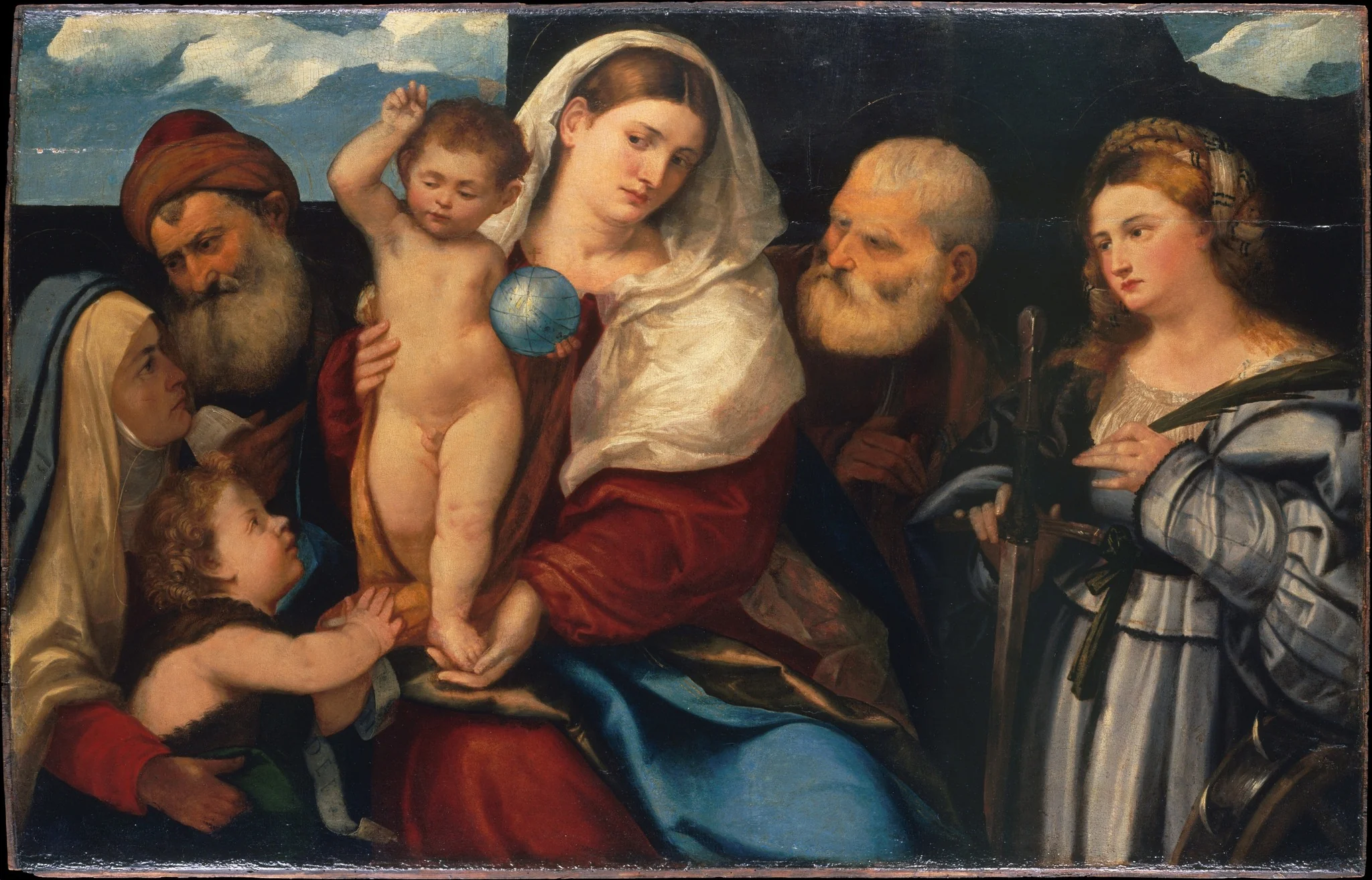
Stand in front of an early Italian saint panel painting and the first instinct is to ask who the holy figure is. That is the wrong first question. The more useful one, the question that actually explains why the picture looks the way it does, is who paid for it. A saint in Western painting is seldom a free invention. He or she enters the frame because a guild, a confraternity, a widow, or a wool merchant put money on the table and set the terms. The subject we file under saint is, more than almost any other in the canon, the painted residue of a transaction. The halo is the part everyone notices. The contract is the part that decided the picture.
Here is the claim this essay will carry from panel to panel: the patron is not hidden behind the saint, the patron is legible in the decisions the saint forces. Which holy figures stand beside the Virgin, who kneels in the lower corner at a shrunken scale, which protector against plague gets the place of honor, which city the altar faces. All of it reads back to the commission. Artifact World Gallery holds 433 works under the saint subject, gathered from 29 venues, by 95 named hands, spanning roughly 1150 to 1933. Across that long arc the saint holds steady while the payer keeps changing, and the painting changes with the payer. Treat the figure as fixed and the variation as the message, and a wall of pious panels turns into a record of who was anxious, about what, and how much they could spend to feel safer.
How to read a saint
Before the money, the grammar. A saint is legible in paint because of attributes, the objects and animals that fasten an identity to an anonymous face. The Metropolitan Museum's Heilbrunn essay on saints in medieval Christian art records that James the Great is known by the satchel and staff of a pilgrim and by the scallop shells of his shrine at Santiago de Compostela. The device was practical. An unlettered congregation could read a crowded scene at a glance, and each saint kept a recognizable character from one picture to the next. Strip the arrows from Sebastian or the wheel from Catherine and the figures collapse into interchangeable robes. The attribute is a caption that needs no reading, which is exactly why it survived for centuries with so little drift.
The vocabulary is tight enough that scholars treat it almost as a writing system. The Tate's glossary defines an attribute as the symbolic object conventionally assigned to a figure so a viewer can name him on sight, and standard reference work on saint symbolism catalogues the keys for Peter, the wheel for Catherine, the gridiron for Lawrence. Once you carry that key ring, a saint panel stops being a wall of robed strangers and becomes a list of named advocates, each one summoned for a reason.
This grammar served an enormous appetite. The J. Paul Getty Museum sets the cult of saints at the heart of religious life in Western Europe from the fall of Rome around 476 to the Lutheran Reformation of 1517. For something like a thousand years a saint was an intercessor, the advocate you petitioned for a safe delivery or a broken fever. To commission a saint was to purchase proximity to that intercession. You paid for a painted lawyer in the heavenly court, and you expected to be shown kneeling at his feet. The transaction was not a metaphor the patrons would have recognized. It was the literal point of the object.
That expectation shaped the iconography from the ground up. A patron rarely ordered a saint at random. He ordered his name-saint, the figure he was baptized under, or the patron of his trade, or the protector his confraternity had sworn itself to. A bakers' guild wanted its patron present in the frame. A family chapel wanted the saint the founder was named for. So a great many altarpieces are, beneath the devotion, a kind of household crest rendered in haloes. Read the saints and you can often reconstruct the family that paid. The choice of who stands where was rarely left to the painter. It was specified, sometimes line by line, in the document that set the price.
Four saints, two donors, one plague
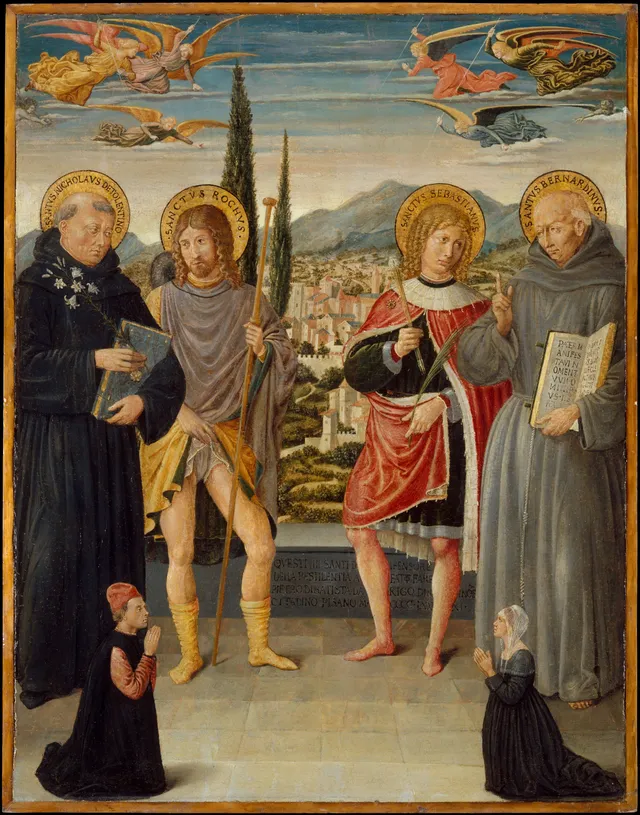
No work in the collection makes the bargain plainer than Benozzo Gozzoli's Saints Nicholas of Tolentino, Roch, Sebastian, and Bernardino of Siena, with Kneeling Donors. The title itself is the contract, spelled out. Four standing saints, and two donors on their knees, named in the picture by their posture if not by an inscription.
Look at how the panel is built. The four saints stand in a tight rank, shoulder to shoulder, gold haloes crowding the upper edge, each one fixed by his attribute. Nicholas of Tolentino wears the black Augustinian habit with a star at his breast. Roch hitches up his pilgrim's robe to bare the plague sore on his thigh and turns it toward us without embarrassment. Sebastian stands bound and arrow-struck. Bernardino of Siena holds the radiant tablet of the IHS monogram he preached. Then, at the saints' feet, two small kneeling figures, scaled to perhaps a third of the holy bodies above them, hands pressed together. That size difference is the whole argument of the picture. The saints are large because they are powerful. The donors are small because they are supplicants, and they paid to be placed exactly there, inside the circle of protection.
Notice what the scale is not. It is not bad drawing, and it is not modesty for its own sake. The hierarchy of size is a deliberate ranking, a chain of command in pigment, with the donor positioned at the bottom of it precisely so the saints loom as guarantors above. The kneeling pair are turned slightly inward, their gaze lifted, so the composition itself stages the act of petition. You are watching two people ask, and you are watching four figures who are, by the logic of the cult, obliged to answer.
- Nicholas of Tolentino: the black Augustinian habit, a star at the breast, sometimes a lily.
- Roch: pilgrim's dress, lifting his hem to show the plague bubo on his thigh.
- Sebastian: bound and pierced by arrows, the classic protector invoked against pestilence.
- Bernardino of Siena: the gaunt friar holding the radiant IHS monogram tablet he made famous.
Now read the commission off the saints. Roch and Sebastian are the two great protectors against plague, the figures you invoked when the pestilence came up the road. Their pairing is the reason the panel exists. Someone, very likely a confraternity or a family that had survived an outbreak and feared the next one, paid Gozzoli to manufacture insurance. Bernardino, canonized not long before, dates the impulse to the generation that had watched him preach. The donors bought a standing appointment with four advocates, and had themselves painted into the waiting room. The picture is, in the most literal sense, a hedge against the next bad summer.
The cheaper end of devotion
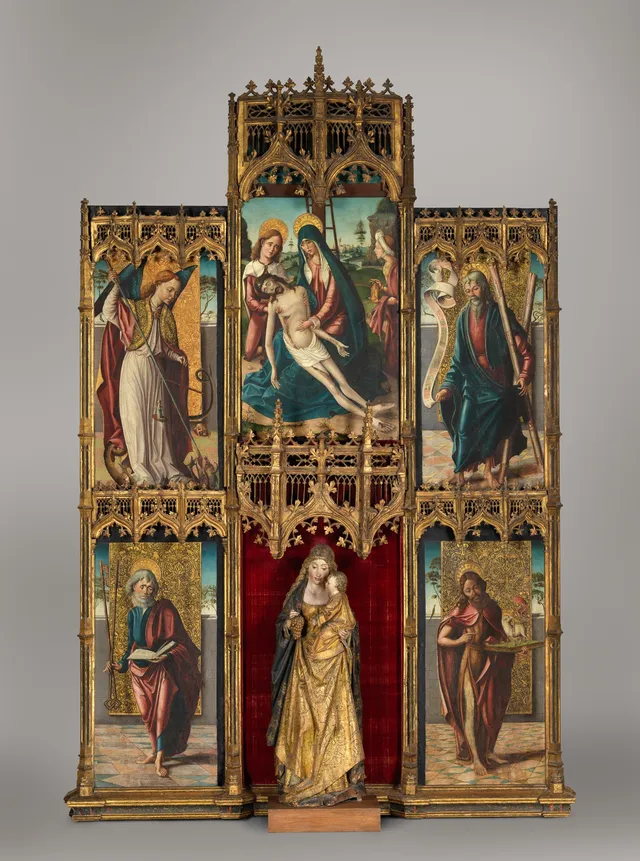
Not every saint cost an altarpiece. The market ran from grand polyptychs, paid for by a guild or a wealthy family and built to crown an altar, down to small single-panel votives a modest household could afford. The economics show in the picture. A lean purse bought a lean panel: one saint, perhaps two, no donor portrait, no flanking court, the attribute doing all the identifying work because there was no budget for anything else. The logic of the commission stayed identical at every price. A plague protector bought as a private guard, a name-saint bought for the bedroom wall, the same petition scaled to whatever the buyer had.
The collection's anonymous Virgin and Child with the Pietà and Saints is the compressed kind. It folds grief and intercession into a single panel, the dead Christ and the interceding saints sharing one shallow stage, the sort of dense, all-in-one program a private chapel favored when it could not commission a wall of separate scenes. The hand is lost, but the brief is plain in the picture. Whoever ordered it wanted the whole arc of mercy in one frame they could afford to hang.
The Virgin's company, and the donor's
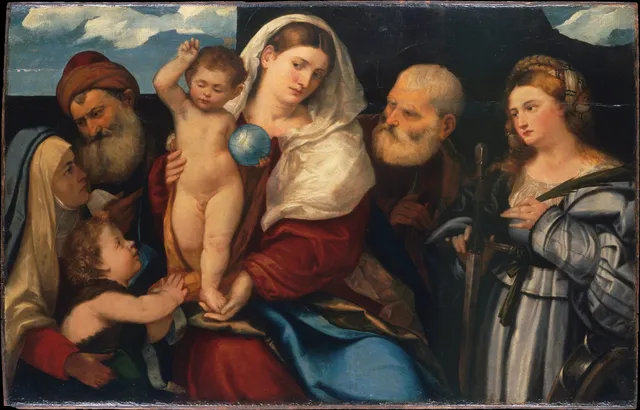
The format that dominates the collection is the sacra conversazione, the Virgin and Child enthroned amid a standing company of saints. The arrangement looks serene and theological. It is also a seating chart, and the patron usually has a say in the guest list. At the National Gallery of Art, the Visitation with Saint Nicholas and Saint Anthony Abbot flanks its central event with two saints identified by their attributes, set at the edges of the sacred meeting. The chosen pair is rarely accidental. They are the patron's saints, summoned into holy company to speak on his behalf.
Our hero panel, Bonifazio Veronese's Madonna and Child with Saints, is a Venetian instance of the type. The Virgin holds the Child at the center, the saints gather close in the warm, saturated color the Venetian shops were known for, and the composition keeps everyone within a single shallow stage. There is no deep landscape to wander into and no architecture to get lost in. The figures press toward the picture plane, close enough to address, which is the point of a devotional object meant to be knelt before rather than admired across a room. Bonifazio ran a busy Venice workshop that supplied exactly this product to private patrons and institutions across the lagoon. The painting works less as a singular vision than as a well-made instrument for devotion, tuned to whoever ordered it.
Where Bonifazio implies the patron, Sebastiano del Piombo names him outright. His Madonna and Child with Saints and Donors puts the payers in the title and in the frame, kneeling among the holy figures as full participants. The donor portrait is the most honest object in art history. It admits that the sacred scene was financed, and it preserves the financier's face beside the saints he hoped would vouch for him. Sebastiano, a Venetian who built his career in Rome, gave such patrons the gravity of his Roman manner, weighting their portraits with the same monumental seriousness as the saints themselves. The donors do not shrink to a corner here. They hold their ground in the holy assembly, which tells you something about both their confidence and their purse.
Works discussed in this article
The collection's saints are not all by famous hands working for famous patrons. Giovanni Battista Cima da Conegliano supplied altarpieces to churches across the Venetian terraferma, the provincial towns where a parish or a guild could still afford a serious painter. Ridolfo del Ghirlandaio carried the Florentine workshop tradition into the sixteenth century on the same commercial footing, a name and a shop trusted to deliver a competent saint on schedule. Spread across 29 venues, the saint holdings map a whole economy of devotion, from cathedral to country chapel, each commission scaled to a different purse. The same subject that crowned a city's high altar also hung, smaller and plainer, in a side chapel a village could just barely pay for.
Where the painter's name is lost, the patron's logic often survives in the subject. The collection's Twelve Apostles, an anonymous assembly of Bartholomew, Andrew, Matthew, James and the rest, was the sort of comprehensive program a church ordered to furnish a nave or a screen, a complete set rather than a single advocate. You do not commission all twelve for private comfort. You commission them to clothe an institution. The choice of the full college, rather than one or two chosen protectors, is itself the fingerprint of a corporate patron with a building to fill.
After the church: who paid when faith stopped buying
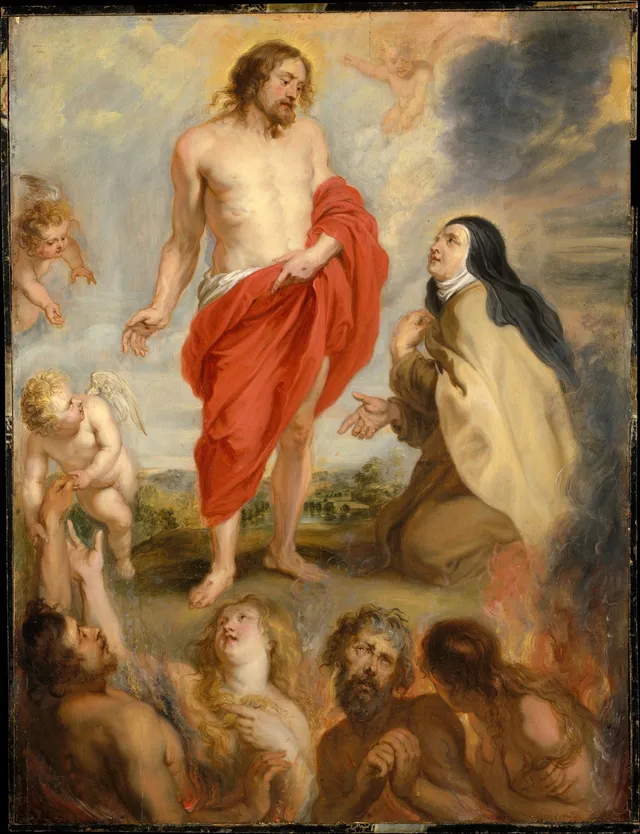
The thousand-year market did not end cleanly. In the north, the Reformation throttled church demand for saints almost overnight, stripping altars and breaking the commission chain that had sustained the subject for centuries. In the Catholic south, the Counter-Reformation answered with a fresh wave of saint imagery, and a figure like Saint Teresa of Ávila, the newly canonized reformer, became a standard subject, painted interceding for souls as in the anonymous canvas the collection holds. The picture keeps the old transaction intact under a new saint. Teresa is shown at her work as advocate, pleading for the dead, exactly the intercession a patron would have paid to be remembered by.
The forms also mutated. Hans Memling's Saint Ursula Shrine in Bruges fused reliquary and painting, its painted panels narrating Ursula's pilgrimage on the very box that held the relics, so the image and the holy bones it advertised travelled as one object. By the nineteenth century the patron had changed again. When Jean Auguste Dominique Ingres painted a saint, the buyer was as likely a collector or a state as a confraternity, and the saint had become a subject of art before an object of petition. The figure outlived the contract that made it. The collection's saints run to about 1933, by which point the saint survives mostly as art history, a motif a painter could quote without believing a word of the intercession it once promised.
The scholarship registered the same turn. Anna Jameson's Sacred and Legendary Art treated the saints of the fine arts as a catalogue of legend to be decoded by a museum-goer, rather than a living court of advocates to be petitioned. Once a book like that exists, the keys to the iconography have passed from the worshipper to the connoisseur. The attribute that once let an illiterate congregation name a protector now lets a tourist name a picture.
So the next time a saint looks out from a gold ground, hold off on naming him. Find the small kneeling figure, count the protectors against plague, notice which trade's patron got the best light. The holiness is the surface. Underneath it sits a ledger, and the ledger is often the more human document. A saint panel is one of the few places in art where you can still see, fixed in pigment, the exact moment a frightened person decided that proximity to a painted advocate was worth a year's wages.
Sources & further reading
- Saints in Medieval Christian Art — The Metropolitan Museum of Art (Heilbrunn Timeline of Art History)
- The Cult of Saints — The J. Paul Getty Museum
- Hans Memling, Saint Ursula Shrine — Smarthistory
- The Visitation with Saint Nicholas and Saint Anthony Abbot — National Gallery of Art
- Attribute (art term) — Tate
- Saint Symbolism — Wikipedia
- Sacred and Legendary Art — Internet Archive (Anna Jameson)