Spanish Baroque Tenebrism is usually taught as a regional accent on an Italian invention. Take Caravaggio's raking light, carry it across the Mediterranean, darken the palette one further notch for Counter-Reformation Spain, and you have the formula. That account is tidy and mostly wrong about the part that matters. The Spanish painters were not importing a lighting trick they admired. They were answering a question, and the question was theological before it was ever visual: what is the darkness for, and what does it cost the figure who steps out of it?
Here is the claim this essay will defend. Spanish tenebrism is best read as a single sustained question asked by one national school across roughly three generations, and the visible differences between its painters are not competing styles so much as competing answers. The dark is never a neutral ground in these pictures. It is the figure's antagonist, the thing pressing in, and each painter decides separately what that pressure means. For Jusepe de Ribera it means mortality you can touch. For Zurbarán it means a silence the worshipper is meant to enter. For the older Bartolomé Esteban Murillo it softens into something almost domestic, the dark turned warm. Read this way, the movement stops being a footnote to Rome and becomes an argument the Spanish carried on among themselves.
Where the dark came from
Start with the vocabulary, because the words carry an assumption worth dragging into the light. Chiaroscuro is the older, broader idea: an Italian compound meaning light-dark, describing the whole balance and pattern of bright and shadow across a picture, as the Tate's art glossary sets it out. Every modeled form since antiquity uses some of it. Tenebrism is the violent special case. It collapses the middle of that range, so a painting lurches from lit to black with almost no intermediate value, the way a face looks under a single candle. The figure is not so much lit as rescued, momentarily, from a void.
The man generally credited with inventing that manner is Caravaggio, whose hard, theatrical contrast became a model that a whole circle of followers carried across Europe, as the standard account of tenebrism records. What gets lost in that lineage is how differently the device behaves once it crosses into Spain. In Rome and its imitators, the spotlight is often a piece of stagecraft, a way to make a card game or a martyrdom theatrical. Spain inherited the apparatus and changed its purpose. There the light became a sacramental event, the visitation of grace onto a body that the surrounding black is actively trying to reclaim. Same tool, different question.
The seam where the Italian device entered the Spanish school runs through Valencia. Francisco Ribalta was among the first painters working in Spain to take up Caravaggio's austere contrast and apply it to devotional subjects, and once it took hold in that workshop culture it never really let go. By the 1620s a young generation had a fully formed grammar of darkness available to them, ready to be bent toward whatever they each believed paint was for. The interesting history begins with how they disagreed.
Ribera: the answer as flesh
Ribera gives the bluntest answer of the three, and arguably the most influential. A Spaniard by birth, he settled permanently in Spanish-ruled Naples in 1616, where he absorbed Caravaggio's naturalism directly and grew into the leading tenebrist of the Neapolitan school, as the Metropolitan Museum's survey of seventeenth-century Naples describes. Naples was Spanish territory, so calling Ribera an expatriate slightly misses the point. He stayed inside the empire and exported its severity. His darkness is not atmospheric. It is material, the colour of old leather and dried blood, and it makes the lit flesh look more perishable, not less.
Look closely at his Holy Family with Saints Anne and Catherine of Alexandria. The subject is tender, a family group with two attendant saints, the kind of scene a lesser painter would flood with sweetness. Ribera withholds the sweetness. The light enters from the upper left and lands, hard, on the foreheads and the backs of hands, on the infant's torso, on the white linen, then drops off a cliff into shadow that swallows the lower bodies whole. Saint Anne's face is built from real creases, the skin slack under the eyes, lit so frankly you can read the age in it. Catherine inclines toward the child with a calm that the surrounding black makes feel provisional, as if the moment is being held against something. There is no architecture, no landscape, nothing to stand on. The figures are a small warm island, and you understand without being told that the dark is what they are surrounded by always, and that the painter thinks this is the human condition rather than a stage effect.
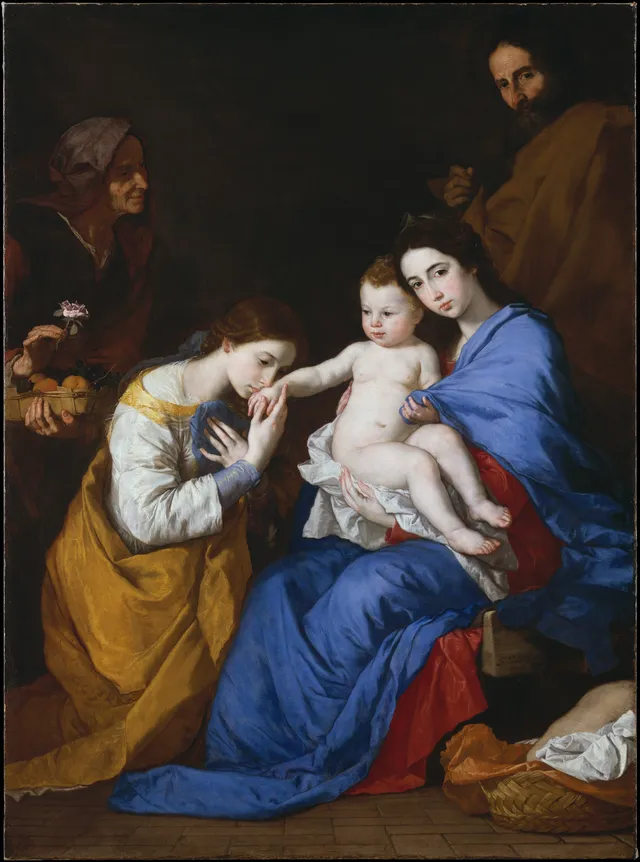
Ribera's answer, then, is that the dark stands for death and the body's frailty, and the light is grace arriving on skin that will not last. He paints saints the way he paints beggars, with the same dirt under the same fingernails. That refusal to flatter was itself a theological position, aligned with a Counter-Reformation taste for the literal and the felt over the idealized. His holding in the corpus is substantial: the archive carries a dozen Ribera works, enough to watch the same conviction recur from canvas to canvas. The Getty's collection record for him fixes the dates simply, 1591 to 1652, a working life that spans the high tide of the whole movement.
Zurbarán: the answer as silence
Zurbarán took the identical apparatus and gave it the opposite tone. Where Ribera crowds the lit zone with incident, Zurbarán empties it. His Martyrdom of Saint Serapion, painted in 1628 for the Mercedarian order and now in the Wadsworth Atheneum, works squarely in the Spanish tenebrist tradition of strong chiaroscuro against a dark ground, as Smarthistory's reading of the Serapion lays out. The martyr hangs from ropes, his white Mercedarian habit catching almost all the available light, his face fallen sideways into death. There is no torturer in frame, no crowd, no blood to speak of. The violence has already happened. What you are given is the aftermath and a great quantity of black around it.
That emptiness is the answer. For Zurbarán the dark is not death pressing in. It is a contemplative space, a held breath the worshipper is meant to step into and occupy. The white habit functions almost as a screen for projection, large and quiet and close to the picture plane, so that kneeling in front of it the believer finishes the scene with their own grief. Ribera wants you to flinch at the flesh. Zurbarán wants you to fall silent. Same grammar of light and shadow, a completely different sentence.
Murillo: the answer softened
Then comes Murillo, and the question gets a third answer that almost looks like a rebuttal. The younger Sevillian generation inherited the dark ground and the focused light, but Murillo warmed both. His shadow is brown rather than black, lit at its edges, breathable. He is the painter usually credited with carrying Spanish art out of severity and into charm, and the corpus reflects his reach: one of the Murillo holdings runs to more than fifty works on its own, with a second attribution cluster beside it. The temptation is to file him as the man who diluted tenebrism into sentiment. His best secular picture argues otherwise.
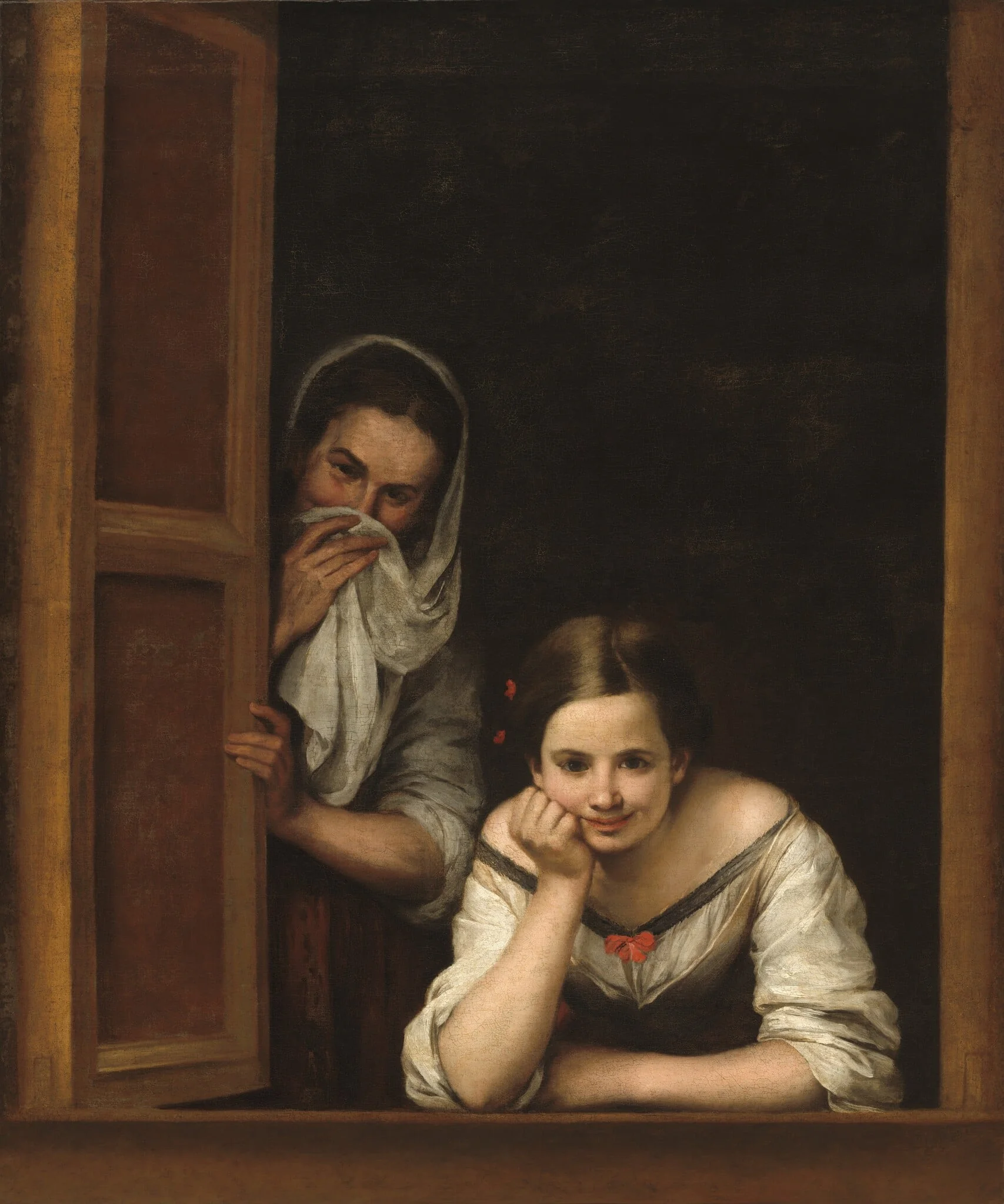
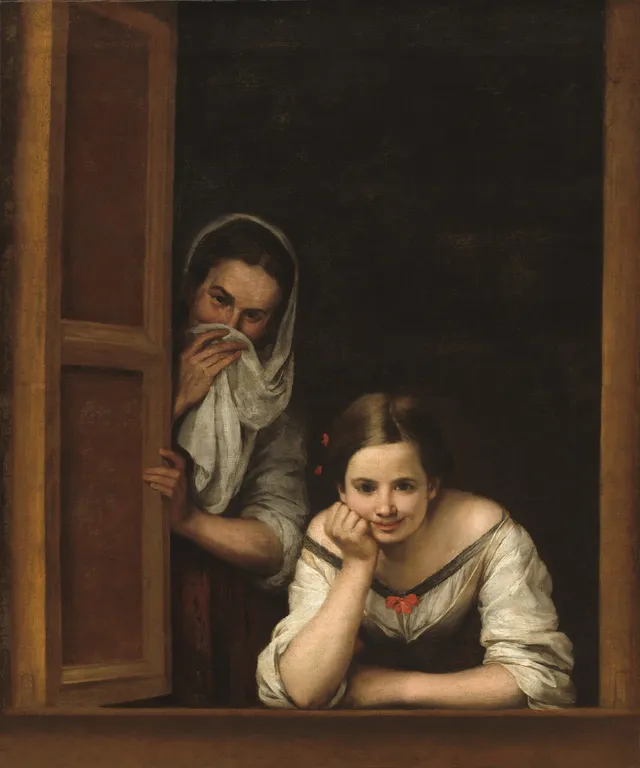
Stand in front of Two Women at a Window and watch what the darkness is doing, because it is doing tenebrist work in disguise. Two young women occupy a window opening. The nearer one leans her bare forearms on the sill and looks straight out at us, half-smiling, completely at ease. Behind her, a second woman stands further back in the room, drawing a fold of cloth up across the lower half of her face to hide a laugh, her eyes bright above it. The whole interior behind them is a flat, deep brown, almost empty. Murillo gives you no furniture, no floor, no detail to anchor the room. That void is the same black Ribera used for a martyrdom, repurposed. Here it throws the lit faces and the white sleeve forward with exactly the tenebrist punch, except the emotional charge has flipped from terror to flirtation. The wooden shutter cuts a hard diagonal. The forward woman's skin is the brightest thing in the frame. The dark is no longer death. It is the cool inside of a house on a hot Seville afternoon, and the light is simply the street, the world, the men presumably standing where we stand.
This is why Murillo belongs inside the movement rather than after it. He keeps the engine and changes the freight. When he does turn to sacred subjects, the apparatus snaps back to its first purpose: his Crucifixion sets the pale body against a darkened sky with the lit torso doing the same isolating work as the lit habit in Zurbarán. Murillo proved the question could be asked of ordinary happiness and not only of death. That is an enlargement of tenebrism, not an abandonment of it.
Works discussed in this article
Valdés Leal: the answer as decay
There is a fourth answer, the darkest, and it belongs to Murillo's Sevillian contemporary Juan de Valdés Leal. Where Murillo warmed the shadow, Valdés Leal pushed it toward the morbid. His most famous works for the Hospital de la Caridad turn the lit-against-dark formula into a meditation on putrefaction, bishops and knights shown as decomposing corpses under a beam of unsparing light. The archive carries fourteen works under his name, and they make plain that the same tool that gave Murillo his charm could be aimed at the opposite extreme. For Valdés Leal the light does not rescue the figure from the dark. It exposes exactly what the dark was hiding, and what it was hiding is rot. The question, what is the darkness for, gets its most unsettling reply here: the darkness is mercy, because it spares you the sight of the body's end.
What the archive shows
Pull back from the four marquee names and the corpus tells you something the single-painter monographs tend to flatten. Artifact World Gallery holds 316 Spanish Baroque Tenebrist works, spread across 46 venues and made by 93 distinct artists, spanning roughly 1570 to 1937. Two numbers in that line are worth sitting with. Ninety-three artists is far more than the half-dozen the textbooks rehearse, which means the manner was a workshop dialect, a shared default among scores of working painters and not the property of a few geniuses. And the venue spread, 46 institutions, shows how thoroughly these dark altarpieces were dispersed by collecting and suppression of religious houses, scattered out of the chapels they were painted for and into museums on several continents.
The minor figures carry the same argument as the majors. Take Pedro Orrente, represented by six works including a stark Crucifixion. Orrente was a transmitter, a painter who moved the Venetian-inflected dark manner into the Spanish provinces, and his presence in the count is a reminder that tenebrism in Spain was a network before it was a canon. The same is true of an anonymous panel like the Saint Teresa of Ávila Interceding for Souls in Purgatory, an unattributed work whose subject, souls lit inside a surrounding fire and dark, is tenebrism's logic made literal as doctrine. The painter is lost. The argument survives.
And then there is that strange far edge of the date range, the 1937 that closes the span. The high tide of Spanish tenebrism ended in the seventeenth century, so a span reaching into the twentieth is the archive recording afterlife rather than activity, the long shadow the manner cast over later Spanish painting. The hinge figure is Goya. The corpus carries sixteen works under his name, and his late art is unthinkable without the dark inheritance traced here. Even a formal commission like the Portrait of Tiburcio Pérez y Cuervo, the Architect, a sitter in shirtsleeves against a plain dark ground, lets the void do its old isolating job. Push that ground a little further, drain the warmth out of it, and you arrive at the Black Paintings, where the dark stops being grace's foil and becomes the whole subject. Goya is the painter in whom the Spanish question, asked for two centuries, finally gets the answer nobody wanted: the darkness is for nothing, and the light is not coming.
The question, restated
So the textbook framing has the causation backward. Spain did not receive a finished style from Rome and apply it. Spain received an instrument, a way of pinning a body in light against a void, and then spent four generations disagreeing about what that confrontation meant. The disagreement is the achievement. Ribera's frailty, Zurbarán's silence, Murillo's warmth, Valdés Leal's decay, and at the end Goya's despair, are five answers to one durable question, and you can only see them as answers if you hold the question steady while the replies change. The movement is not a single dark room. It is a long argument conducted in the dark, and the lit faces are the points being made.
If you want to test the thesis against the works rather than the prose, line the painters up and let the dark do the talking. Put Ribera's swallowed lower bodies beside Zurbarán's empty white habit, then beside Murillo's brown afternoon interior and Valdés Leal's lit corpse, and the single shared device declares itself across the four. The Spanish answer to the question of darkness reads as the most theologically loaded version Europe produced, because only here is the void handed a job to do rather than a mood to set. Stand close enough to one of these canvases and the black is not behind the figure. It is reaching for him.
Sources & further reading
- Chiaroscuro — Tate
- Tenebrism — Wikipedia
- The Art of the Seventeenth and Eighteenth Centuries in Naples — The Metropolitan Museum of Art
- Zurbarán, The Martyrdom of Saint Serapion — Smarthistory
- Francesc Ribalta — Wikipedia
- Caravaggio (Michelangelo Merisi) (1571-1610) and His Followers — The Metropolitan Museum of Art
- An Account of the Lives and Works of the Most Eminent Spanish Painters, Sculptors and Architects (London, 1739) — Internet Archive
- Jusepe de Ribera (1591-1652), collection person record — The J. Paul Getty Museum