Artwork
The Crucifixion
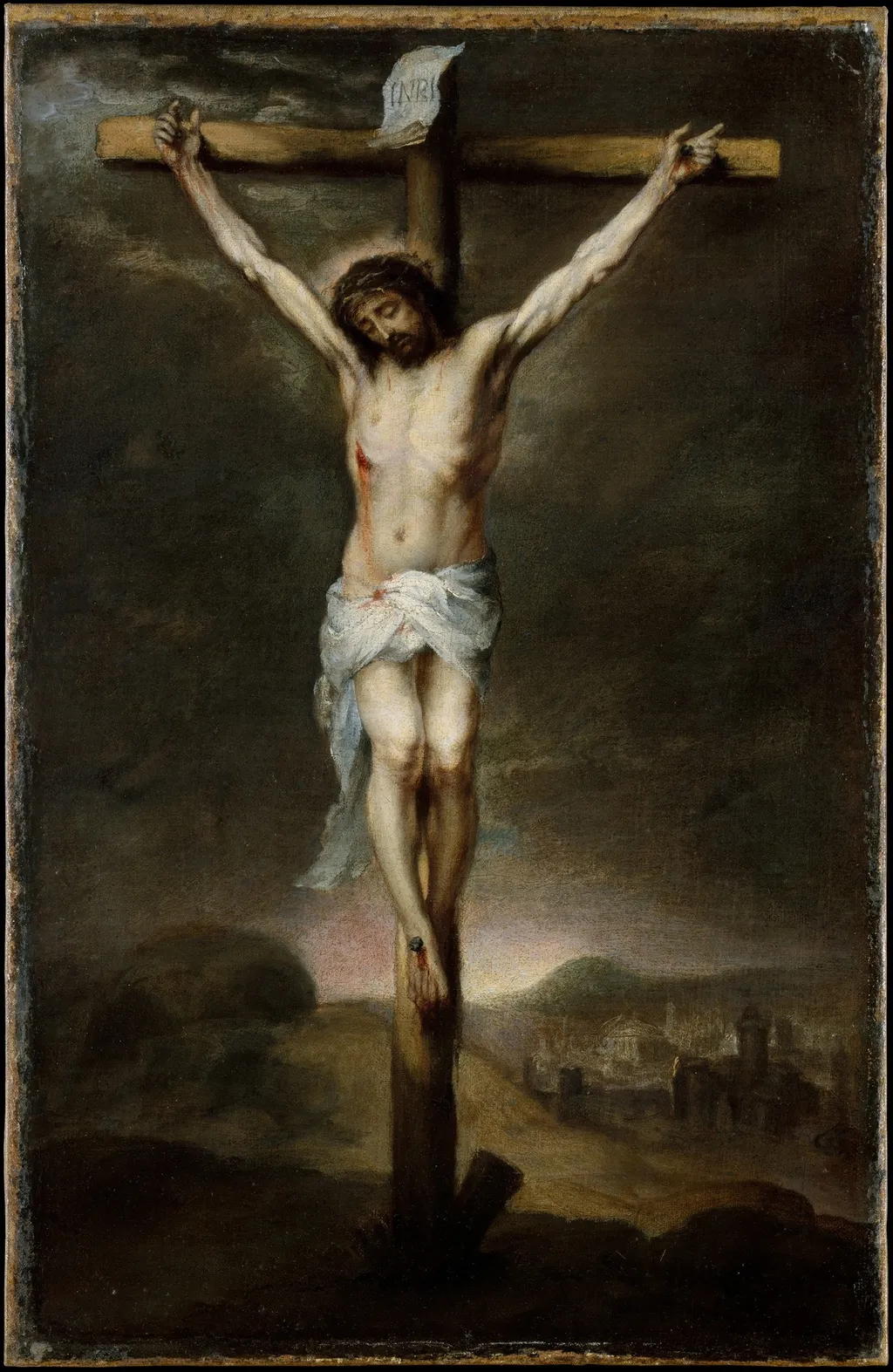
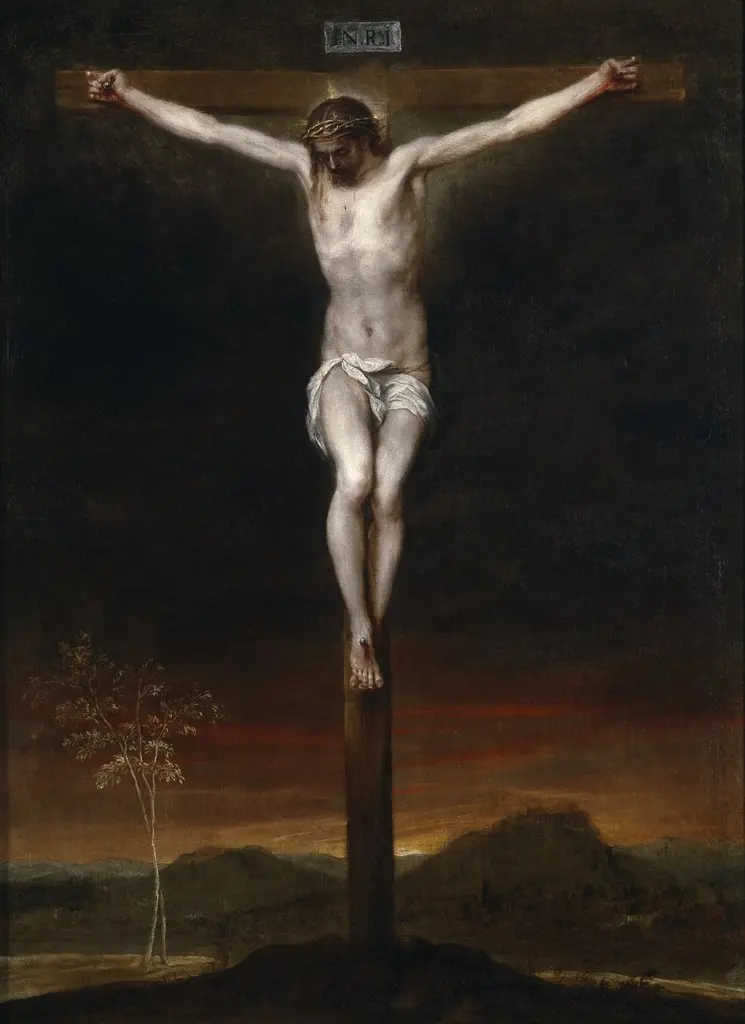
The Crucifixion is an oil painting by the Spanish Baroque Tenebrist artist Bartolomé Esteban Murillo. It dates from 1675 and is held in the collection of the Metropolitan Museum of Art.
About this work
Subject & Meaning
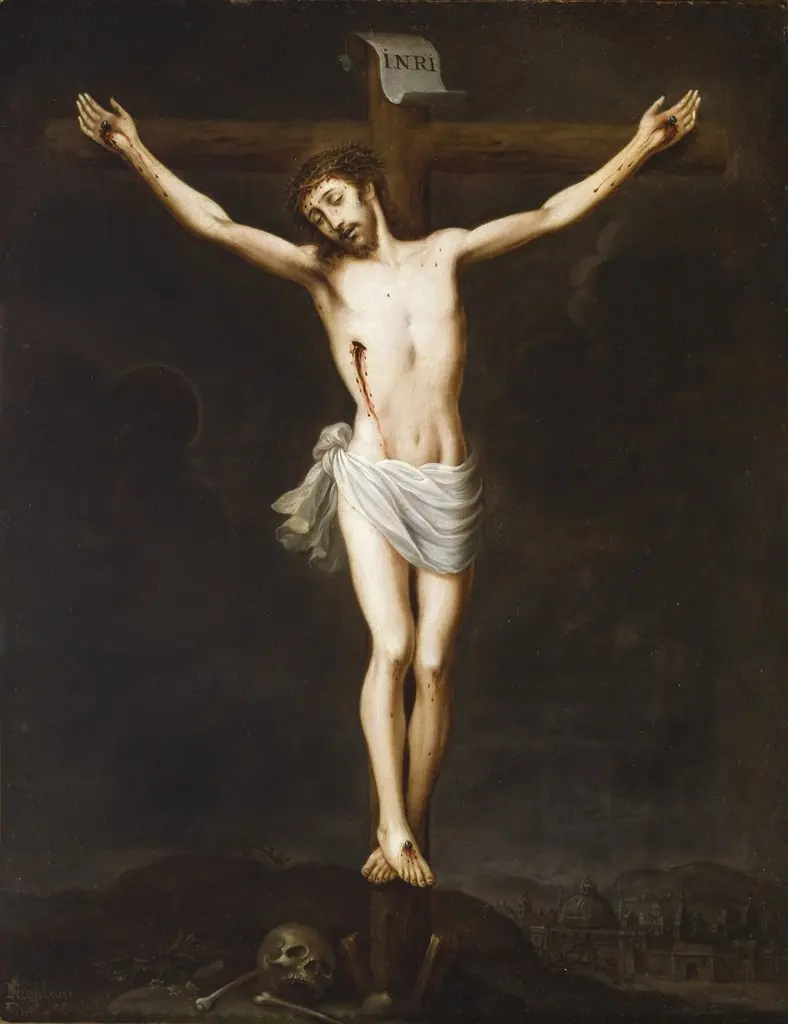
Symbolically, the scene is set after sunset, illuminated by a moonlit glow that highlights the figure while leaving the surrounding atmosphere dark and cloudy.
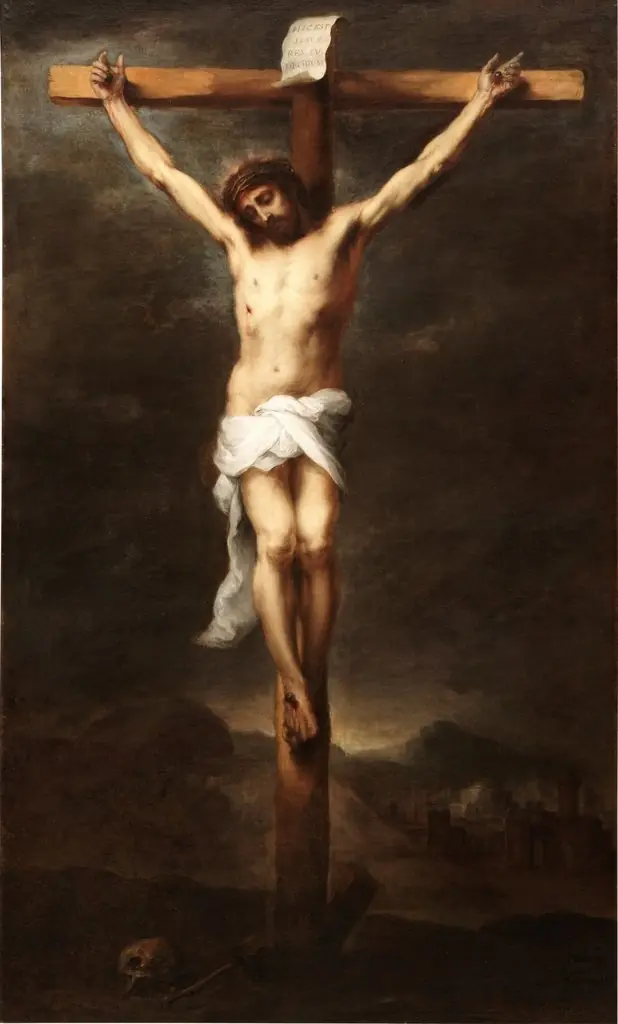
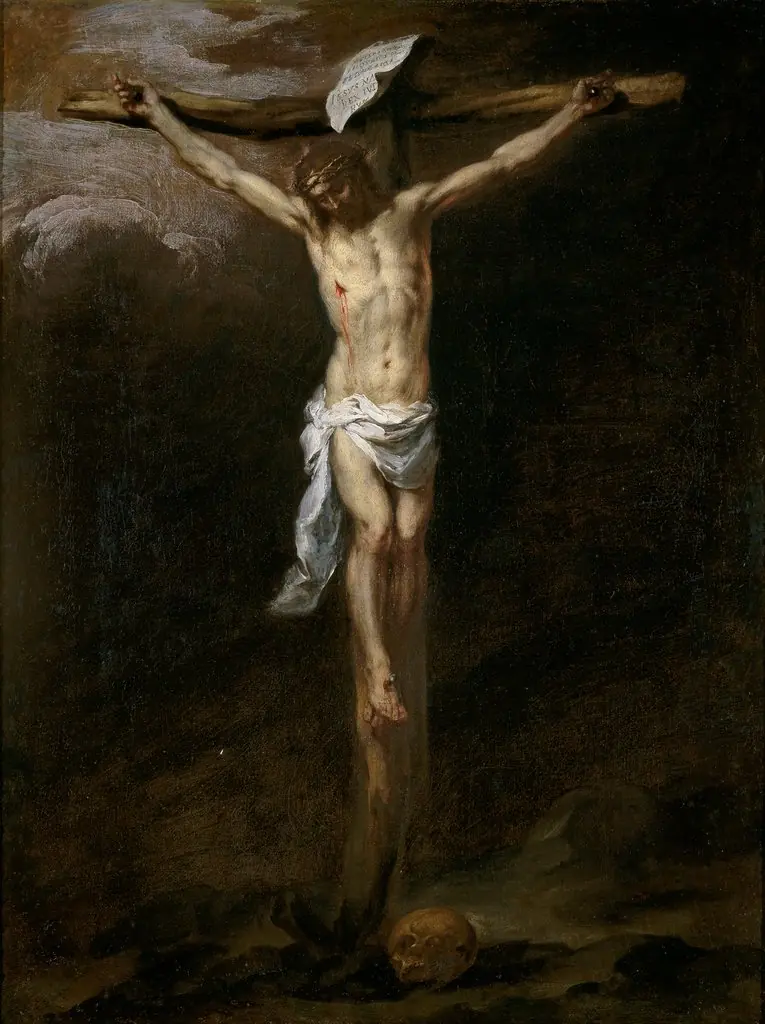
Bartolomé Esteban Murillo's 1675 oil painting depicts the crucifixion of Jesus Christ, presenting the deceased figure on the cross against a somber, gray sky. The composition centers on the lifeless body of Christ, with his head bowed and a visible wound in the chest from which blood emerges. Symbolically, the scene is set after sunset, illuminated by a moonlit glow that highlights the figure while leaving the surrounding atmosphere dark and cloudy.
In the lower right background, the faint outlines of Jerusalem's buildings are visible, partially obscured by clouds, grounding the spiritual event in a specific geographical context. This vertical canvas serves as a religious representation of the Passion, emphasizing the physical reality of the sacrifice and the solemnity of the moment.
Technique & Style
The Crucifixion is an oil‑on‑canvas painting created circa 1675 by Bartolomé Esteban Murillo. It is executed in oil paint on a canvas support, measuring approximately 50.8 × 33 cm and presented in a vertical format. The composition depicts Christ with his head lowered, a visible wound in his torso from which blood emerges, and a faint outline of Jerusalem’s architecture at the lower right, set against a gray sky and moonlight‑lit background.
Murillo’s soft lighting illuminates the figure while the surrounding space remains dark and cloudy, creating a solemn, devotional atmosphere. The work has been part of the Metropolitan Museum of Art’s collection since its 1971 bequest by Harry G. Sperling and is conserved within the museum.
History & Provenance
The Crucifixion was painted by Bartolomé Esteban Murillo, with the work dated to 1675. According to one source, the canvas is considered a smaller preview or study related to a larger Crucifixion composition held at the Museo del Prado in Madrid. The painting entered the Metropolitan Museum of Art in New York through a bequest from Harry G. Sperling in 1971, where it has remained in the collection since.
The sources do not document an earlier ownership chain prior to Sperling, nor do they specify the circumstances of the original commission.
The painting is held by the Metropolitan Museum of Art in New York, where it entered the collection as a bequest from Harry G. Sperling in 1971. The work's relatively small dimensions, 50.8 cm in height by 33 cm in width, place it as a reduced-scale study or preview for a larger Crucifixion composition by Murillo preserved at the Museo del Prado in Madrid. Beyond its permanent placement at the Metropolitan Museum, no further exhibition history is documented in the available sources.
Context
The Crucifixion is a religious oil on canvas painted by Bartolomé Esteban Murillo around 1675. It belongs to the Spanish Baroque tradition of devotional imagery and is classified as a painting of the crucifixion of Jesus. The work is relatively small, measuring 50.8 × 33 cm, and was created as a devotional piece intended for private contemplation.
It served as a compositional study for a larger Crucifixion later housed in the Museo del Prado, Madrid. In 1971 the painting entered the collection of the Metropolitan Museum of Art through the bequest of Harry G. Sperling, joining other Murillo works in the museum’s holdings. Its iconography includes a lowered head, a visible wound, and a faint outline of Jerusalem’s architecture beneath a twilight sky, reflecting Murillo’s characteristic blend of naturalistic detail and spiritual intensity.
Legacy
The Crucifixion (c. 1675) by Bartolomé Esteban Murillo entered the Metropolitan Museum of Art through the 1971 bequest of Harry G. Sperling, securing its place in a public collection and ensuring continued scholarly visibility. As a Baroque devotional work, it exemplifies the Spanish master’s focus on intimate, emotionally charged crucifixion scenes and has been cited in studies of Murillo’s influence on later religious imagery. Its presence in the Met’s European paintings wing has made it a reference point for exhibitions and publications on 17th‑century Spanish art, contributing to the artist’s sustained reputation beyond his contemporary fame.
Overview
This oil painting, titled The Crucifixion, depicts a central figure affixed to a wooden cross. The composition focuses on the solitary figure, rendered with a somber palette. The artwork is a traditional representation of a pivotal religious event, executed in the medium of oil paint, allowing for rich tonal variations and detailed rendering of the human form.
Own this work as a print
Artist & collection
Artist
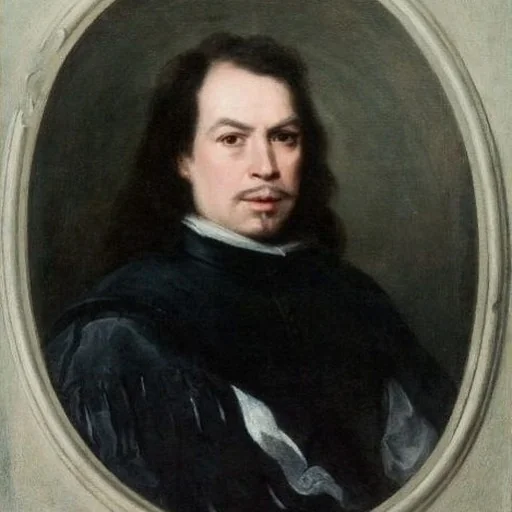
Bartolomé Esteban Murillo ( mure-IL-oh, m(y)uu-REE-oh, Spanish:; late December 1617, baptised 1 January 1618 – 3 April 1682) was a Spanish Baroque painter.