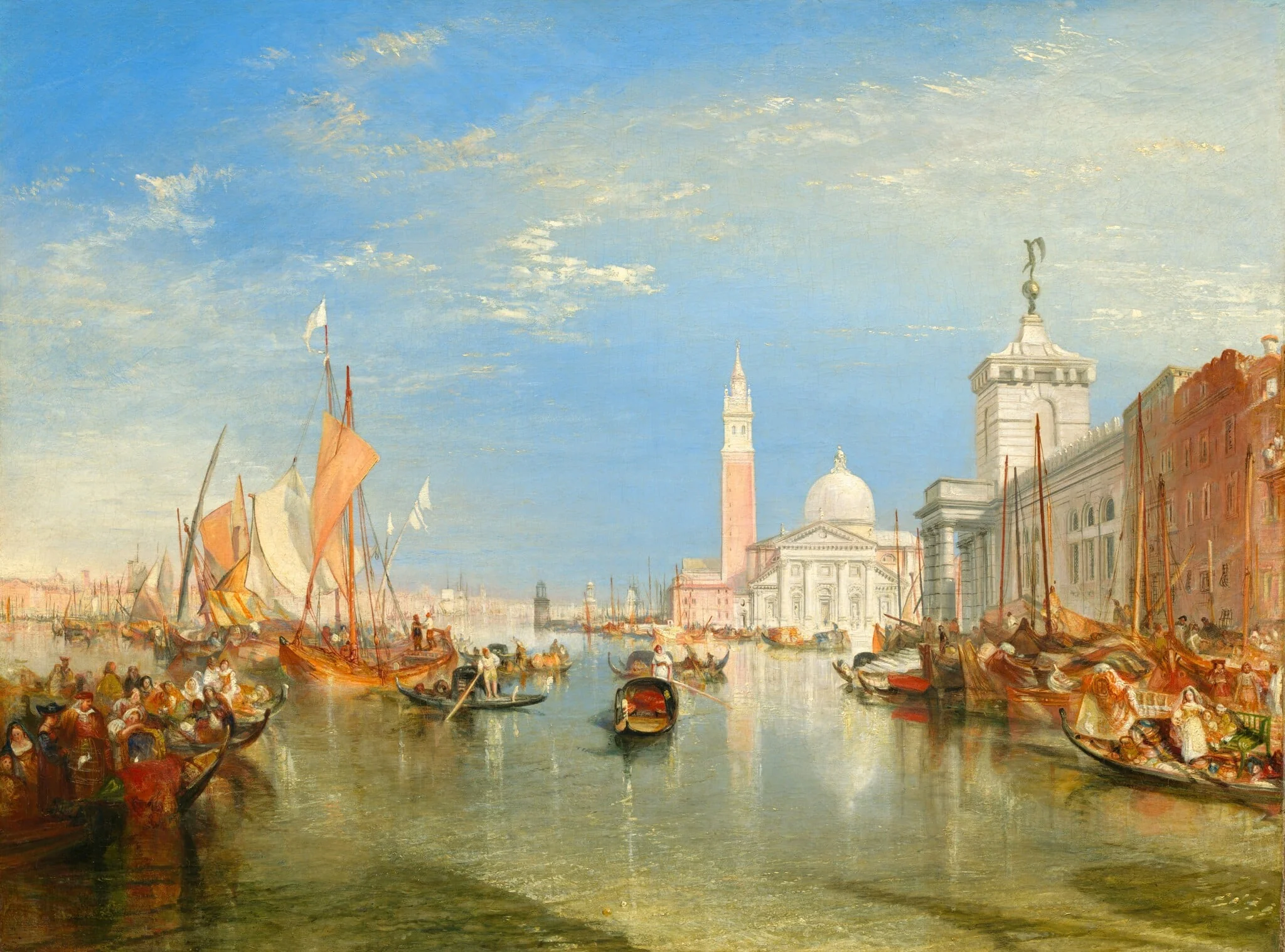
Joseph Mallord William Turner spent a long career taking landscape painting somewhere it had never been. He began within the topographical tradition, painting recognisable places with the accuracy a patron expected. He ended by painting light and air so directly that the place almost disappears. The arc of his work traces a single ambition: to make the weather itself the subject of a picture.
The sublime as a programme
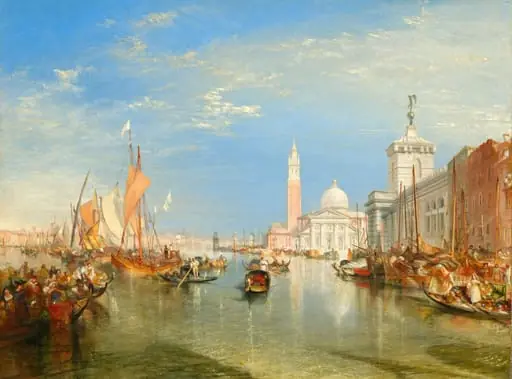
Turner worked in the age of the sublime — the idea, central to Romantic thought, that the deepest aesthetic experience came not from beauty but from awe in the face of something vast and overpowering: a storm at sea, a mountain pass, a fire. Where an earlier landscape painter arranged a view to please, Turner arranged one to overwhelm. His Venice: The Dogana and San Giorgio Maggiore dissolves the famous skyline into a haze of light off the lagoon, the architecture barely holding its edges against the glare. The city is present, but the real subject is the way light behaves on water at a particular hour.
That interest in atmosphere over fact set him apart from his contemporaries and unsettled the critics. A finished Turner could look, to an eye trained on careful topography, like an unfinished sketch. The looseness was deliberate. He had decided that the truth of a scene lived in its light and motion, not in the crispness of its outlines.
Painting the event
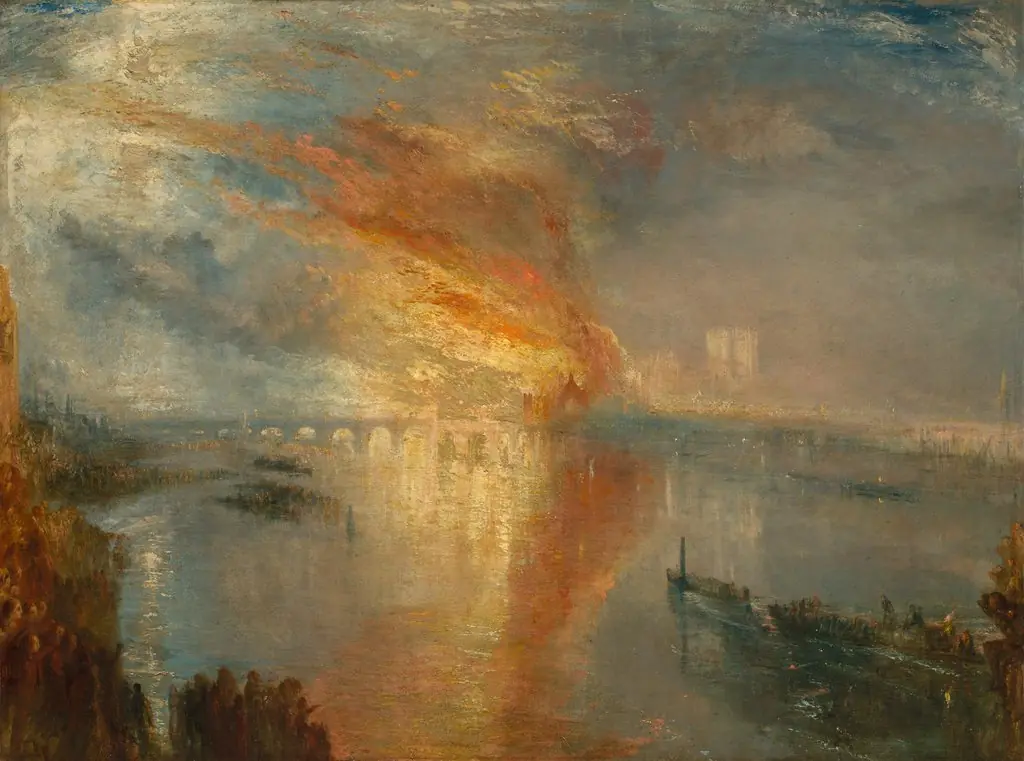
Turner was drawn to subjects that were themselves events — things in violent motion. The Burning of the Houses of Lords and Commons records the 1834 fire that destroyed the Palace of Westminster, and Turner, who watched it from the river, painted the blaze as a wall of incandescent colour reflected in the Thames. The building is a structure being consumed; the painting is about the consuming, not the structure.
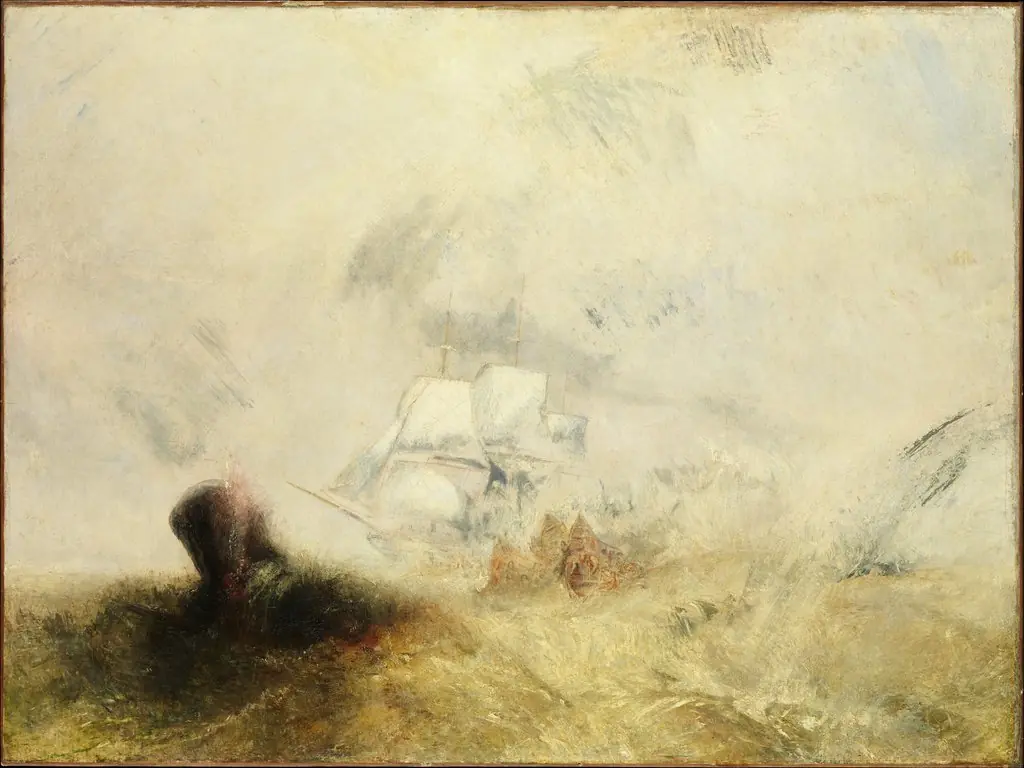
Whalers turns the same attention to the sea. The ships and the hunt are nearly swallowed by the cold light and the swell, the human drama reduced to dark notes inside an immense, indifferent atmosphere. This is the sublime in its purest form: nature at a scale that dwarfs the people inside it.
Ahead of his time
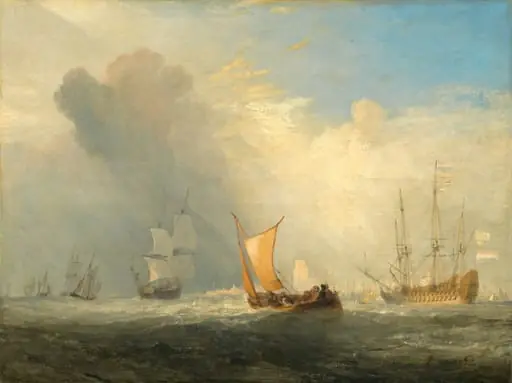
Even Turner’s quieter works carry the same logic. Rotterdam Ferry-Boat sets a working harbour scene under a wide, luminous sky, the boats and figures secondary to the light that fills the picture. The ordinary subject becomes a pretext for a study of atmosphere.
By the end of his life Turner was painting canvases so close to pure colour and light that later viewers would see them as anticipations of Impressionism and even abstraction. He did not think of himself that way; he was a Romantic pursuing the sublime with the tools of oil paint. But in chasing the weather to its limit, he loosened painting’s hold on outline and fact, and opened a door that the next century would walk through.
For more, see the British Romanticism movement page and the Landscape genre.