Artist
Jefferson David Chalfant
United States
Jefferson David Chalfant is an United States American Impressionism artist. 2 works are cataloged here, principally at National Gallery of Art.
Jefferson David Chalfant (November 6, 1856 – February 3, 1931) was an American painter who is remembered mostly for his trompe-l'œil still life paintings.
Overview
Jefferson David Chalfant (November 6, 1856, February 3, 1931) was an American painter celebrated as one of the most technically accomplished practitioners of trompe-l'œil still life in the United States. Working primarily in Wilmington, Delaware, he produced meticulously illusionistic paintings that rivaled and sometimes surpassed those of his better-known contemporaries William Michael Harnett and John F. Peto. Though he began his career without formal training and continued to work as a commercial decorator, Chalfant achieved recognition through exhibitions at major institutions and left a body amid-19th-century American still life tradition that has attracted renewed scholarly attention, including a 2022 Metropolitan Museum exhibition that connected his work to early modernist developments.
Biography & dates
Chalfant was born on November 6, 1856, in Sadsbury Township, Chester County, Pennsylvania. After studying at Lancaster, he relocated in young adulthood to Wilmington, Delaware, where he would reside for the remainder of his life. Initially employed by a commercial firm painting parlor car interiors, he also worked as a cabinetmaker and decorative painter for a railway design company. He opened his own studio in 1883 and began exhibiting as a fine artist in the early 1880s, showing at the Pennsylvania Academy of the Fine Arts and the National Academy of Design. In 1890, with financial support from the philanthropist Alfred Corning Clark, Chalfant traveled to Paris for a two-year period of study. At theoverride the Académie Julian, he studied figure painting under Adolphe-William Bouguereau and Jules Joseph Lefebvre, adding nude drawing and genre painting to his skills. He returned to Wilmington and continued working until 1927, when a stroke ended his painting career. He died in Wilmington on February 3, 1931.
Style & movement
Chalfant worked in the trompe-l'œil tradition that flourished in late nineteenth-century American painting, creating still lifes that deceive the eye through precise illusionistic technique. His paintings frequently follow compositional prototypes established by William Michael Harnett, though Chalfant typically simplified these models by eliminating secondary objects and extraneous details to achieve greater clarity and focus. His technical finesse in rendering textures, surfaces, and spatial depth distinguished him even among accomplished followers of the movement. Beyond still life, his Paris training enabled him to paint genre scenes, portraits, and nudes, though his trompe-l'œil works remain his most significant achievement. A notable work, Which is Which, demonstrates his engagement with complex illusionistic strategies: the painting depicts a postage stamp with collage elements including an actual postage stamp and a fictitious printed newspaper clipping, creating a "faux collage" effect that anticipates later modernist concerns with the boundary between reality and representation.
Major works
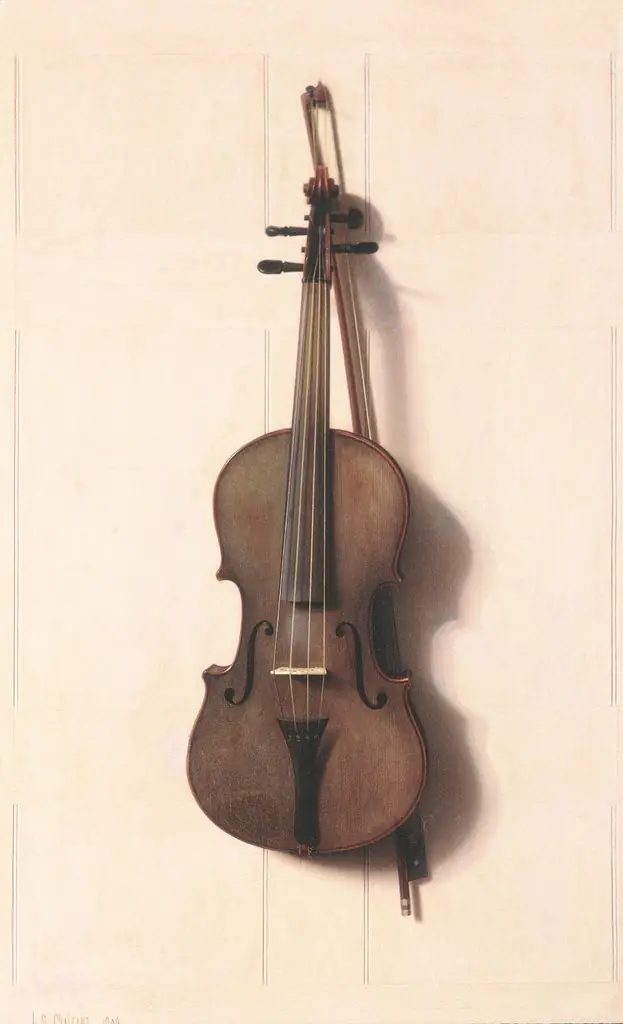
Chalfant's most celebrated works are his trompe-l'œil still lifes. Violin and Bow (1889), held at the Metropolitan Museum of Art, exemplifies his technical mastery and his close engagement with Harnett's compositional precedents. The painting Which is Which, with its incorporation of actual collage elements and printed fictions, has drawn particular scholarly interest for its self-conscious meditation on illusion and reality. His works are held in numerous public collections including the Delaware Art Museum, the Delaware Historical Society in Wilmington, the Metropolitan Museum of Art in New York, the Smithsonian American Art Museum in Washington, the San Francisco De Young Museum, the Brandywine River Museum in Chadd's Ford, the Newark Museum, Barratt's Chapel in Frederica, the Colby College Museum of Art in Waterville, and the Hood Museum of Art in Hanover.
Influences & students
Chalfant's artistic development was shaped by multiple influences. In his formative years, he had no formal training but quickly developed technical proficiency through self-directed study. The dominant influence on his still life work was William Michael Harnett, whose trompe-l'œil compositions provided direct prototypes that Chalfant adapted and refined. John F. Peto, another significant figure in the American trompe-l'œil movement, represented a parallel rather than direct influence. During his Paris sojourn from 1890 to 1892, academic painters Adolphe-William Bouguereau and Jules Joseph Lefebvre provided instruction in figure painting and draftsmanship that expanded his repertoire beyond still life. Chalfant also engaged with European trompe-l'œil traditions, including works by Samuel van Hoogstraten, Cornelius Norbertus Gijsbrechts, Jean-Étienne Liotard, and Luis Meléndez, as later scholarship has emphasized. No pupils or followers of Chalfant are documented in the available sources.
Legacy
Chalfant's posthumous reputation has evolved significantly. For decades overshadowed by Harnett and Peto, he has increasingly been recognized for surpassing both in technical refinement. A 2022 exhibition at the Metropolitan Museum of Art, which drew comparisons between Chalfant's work and that of European trompe-l'œil masters as well as early Cubist painters Georges Braque, Juan Gris, and Pablo Picasso, signaled his elevated critical standing. This exhibition highlighted how Chalfant's Which is Which, with its faux collage and incorporation of a fictitious newspaper clipping, not only hints at Cubist strategies but also foreshadows contemporary concerns with fake news and constructed media. His continued presence in major institutional collections and the scholarly literature, including foundational studies by Alfred Frankenstein and John Wilmerding, confirms his position as a central figure in American trompe-l'œil painting.
Works by Jefferson David Chalfant
Collections represented


Artists in a similar vein