Artist
Symons
United States
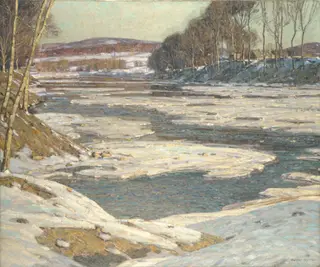
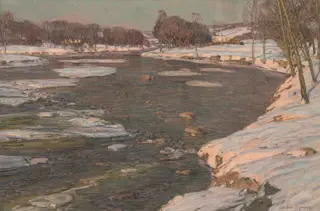
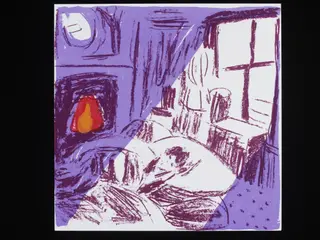
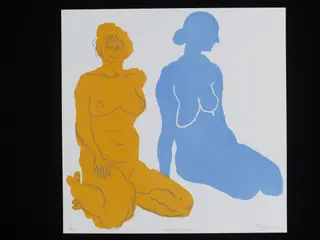
Symons is an United States American Impressionism artist. 4 works are cataloged here, principally at Victoria and Albert Museum.
Symons’ prints feel like secrets pressed onto paper—every line a whisper, every shadow a half-told story. What sticks is how her work turns everyday moments into something quietly unforgettable, like the way a stranger’s coat sleeve brushes against yours on a crowded bus and lingers in your mind. She belongs in Gallery Tiles because her piece *Viv Expecting* is the kind of work that makes you pause and ask, “What’s happening here?”—a perfect entry point into her world of soft, searching images.
Overview
George Gardner Symons (1861-1930) was an American Impressionist painter celebrated for his plein-air landscapes, particularly his New England snow scenes and winter landscapes. Born in Chicago to German immigrant parents, he became one of the most noted American practitioners of outdoor painting, combining Impressionist color and light effects with a strong realist foundation. His career spanned both coasts of the United States and extended years of study and work in Europe, where he absorbed influences from British and Continental plein-air traditions. Today he is recognized as a significant figure in American Impressionism, with works held in major institutions including the Metropolitan Museum of Art and the Art Institute of Chicago.
Biography & dates
George Gardner Symons was born George Gardner Simon in Chicago, Illinois, in 1861, though some sources cite 1863. His parents were German immigrants, and the family surname was originally Simon. Concerned about anti-Semitism, he later changed his name to Symons after returning from studies in England. He reported receiving his first artistic training at the Art Institute of Chicago, where he formed a lifelong friendship with fellow painter William Wendt, though institutional records of his attendance are lacking. He worked for a time as a commercial artist in Chicago.
Symons spent nearly a decade in Europe, studying in Paris, Munich, and London. Around 1899 he exhibited at London's Royal Academy and began painting at the artist colony in St. Ives, Cornwall, where he adopted plein-air techniques. In 1896 he toured California with Wendt, and by 1906 he had acquired a studio in Laguna Beach, California, which he maintained at least part-time until 1915. Despite frequent travel to the West and abroad, his primary studio was in Brooklyn, New York, and he spent considerable time painting in Colerain, Massachusetts, where the snow scenes that became his specialty were created.
Symons was elected an Associate of the National Academy of Design in 1910 and a full Academician in 1911. He served on the Academy Council from 1923 to 1926. He died on January 14, 1930, in Hillside, New Jersey, after a long illness, from complications of pneumonia. His widow, Zara, later married the painter Louis Betts.
Style & movement
Symons was a central figure in American Impressionism, distinguished by his commitment to plein-air painting and his synthesis of Impressionist and realist approaches. Working almost entirely outdoors, he captured transient effects of light and weather with a vibrant palette and energetic, dynamic brushwork. His technique reflected the influence of British plein-air painters at St. Ives, particularly Julius Olsson, Adrian Stokes, and Rudolf Hellwag, whose methods he absorbed during his years in Cornwall.
His paintings are characterized by panoramic compositions, bold color, and vigorous paint handling that often approached impasto. Yet unlike some Impressionists who dissolved form entirely, Symons maintained strong structural underpinnings and careful natural observation. Critics noted the decorative patterning in his expansive landscapes, where bright colors were vigorously brushed across wide scenic sweeps. His subjects ranged from California coastal views and Arizona desert landscapes to the snow-covered Berkshire Mountains of New England, the latter becoming his most celebrated specialty. The immediacy of his outdoor practice lent his work a freshness and spontaneity that distinguished him among his American contemporaries.
Major works
Symons's first major success came with An Opalescent River, which won the Carnegie Prize at the National Academy of Design's winter exhibition of 1909 and was promptly acquired by the Metropolitan Museum of Art in New York. This marked the beginning of a distinguished record of institutional recognition. He received the Saltus Medal from the National Academy in 1913 and the Altman Prize in 1922.
While specific titles of many works remain less documented, his oeuvre centered on several iconic subjects: New England snow scenes, particularly of the Berkshire Mountains; California coastal and canyon views from his Laguna Beach period; Arizona desert landscapes; and Grand Canyon panoramas. The snow scenes became his most sought-after and celebrated body of work. His paintings are held in collections including the Art Institute of Chicago, the Brooklyn Institute of Arts and Sciences, the Fleischer Museum in Scottsdale, Arizona, and the Metropolitan Museum of Art.
Influences & students
Symons's artistic development was shaped by multiple influences across continents. In Chicago, his close friendship with William Wendt proved formative; the two artists painted together in California and later in Cornwall, England in 1898, sharing artistic dialogue throughout their careers. In Europe, his exposure to French Impressionism in Paris and the plein-air traditions of Munich and London broadened his technical repertoire.
The decisive influence came during his residence at St. Ives, Cornwall, where he joined an international artists colony and adopted the plein-air techniques of Julius Olsson, Adrian Stokes, and Rudolf Hellwag. There he also formed an association with Walter Elmer Schofield, who arrived in 1902; the two artists' work bore marked affinities thereafter. Through his connections with the Pennsylvania School, Symons likely met Edward Redfield and possibly Daniel Garber, and his expansive landscape compositions shared much in common with those of Schofield and Redfield. The Newlyn School painters, including Stanhope Forbes and Walter Langley, may also have influenced his work given the proximity of Newlyn to St. Ives, though direct contact is not documented. No pupils or followers of Symons are recorded in the available sources.
Legacy
Symons's legacy rests on his achievement as one of America's most dedicated plein-air painters and his particular mastery of the winter landscape. The National Academy of Design, upon his death, remembered him as 'first and foremost a student of nature,' noting that even his largest canvases were produced entirely outdoors. His work bridges the regional schools of California Impressionism and East Coast landscape painting, reflecting the increasingly national scope of American art in the early twentieth century.
His paintings remain in prominent museum collections, and his market has been sustained by the enduring appeal of his snow scenes among collectors of American Impressionism. However, comprehensive scholarly attention has been limited by the relative scarcity of biographical documentation and the difficulty of accessing his paintings, many of which remain in private hands. The misattribution and confusion of titles that occasionally surface, such as a Gloucester Harbor scene incorrectly labeled as St. Ives, point to ongoing challenges in cataloguing his work. Symons is now recognized as a significant, if understudied, contributor to American Impressionist landscape painting, whose best works combine technical vitality with a profound responsiveness to the natural world.
Works by Symons
Collections represented


Artists in a similar vein